
If you're an active adult who understands the importance of proper form, root-cause diagnosis, and building a resilient body, you know that telling an aging parent to "just be careful" is a terrible strategy for preventing falls. It’s the equivalent of telling someone with a bad deadlift to "just lift lighter." It misses the entire point.
Telling them to "be careful" creates a fear of movement that actually increases their risk. The real answer isn’t restriction; it’s empowerment. It's about diagnosing the underlying weakness and building a body that's more resilient, capable, and confident—the same principles you apply to your own training.
Falls Aren't Random—They're a Warning Sign

Watching a parent become unsteady is unnerving. You see them grab the wall or hesitate before standing up. Your instinct might be to tell them to stop doing things, but you know from your own experience with injury that restriction is rarely the answer.
Falls are not "accidents." They are predictable outcomes when the body's systems can no longer handle the demands of daily life.
A fall isn't an inevitable part of getting older. It’s a signal. It’s the body's "check engine" light, telling you that strength, balance, or mobility is failing. The good news? These systems can be retrained and rebuilt.
This isn’t about handing out generic leg lift exercises. It's about digging into the "why" behind the instability. Think of it like this: in your training, a weak glute or poor core activation causes your squat to fail. In an older adult, that same mechanical failure can cause a stumble when stepping off a curb. It’s the same principle, just a different arena.
A 'Be Capable,' Not 'Be Careful' Philosophy
At Valhalla Performance, we apply a movement-first philosophy to everyone, from CrossFit athletes to their parents. We treat the body as one interconnected system to find and fix the root cause of weakness. It’s about building real-world strength and confidence.
This means a total shift in thinking:
- From "Be Careful" to "Be Capable": Instead of avoiding stairs, we build the leg and hip strength to climb them safely.
- From Restriction to Resilience: Instead of staying home, we improve dynamic balance to walk confidently on uneven ground, like a grassy park or a cracked sidewalk.
- From Generic to Functional: Forget random chair exercises. We focus on movements that directly mimic getting out of a car, carrying groceries, or squatting to pick something up.
Research consistently shows that targeted balance and strength programs work. You can find more of our thoughts on building a more resilient body in our articles on proactive injury prevention.
If you’re in Marlton, Mount Laurel, Cherry Hill, Moorestown, Haddonfield, Medford, or anywhere in South Jersey and want to apply a smart, root-cause approach to your parent's health, let's build a plan that empowers them, not restricts them.
Building a Body That Refuses to Fall
Telling an older adult to just “do some balance exercises” is like telling an athlete with a bad knee to "just do some leg extensions." It’s a nice thought, but it completely misses the point and fails to address the underlying cause.
Standing on one leg in a quiet living room doesn’t prepare the body for the real world. It won’t help them catch their balance when they trip over a curb, stay upright on an icy patch, or get off a low couch without a struggle.
True fall prevention isn't about gentle, isolated movements. It’s built with functional strength that shows up when it's needed most—just like in your own training.
From Gym Lifts to Real-World Wins
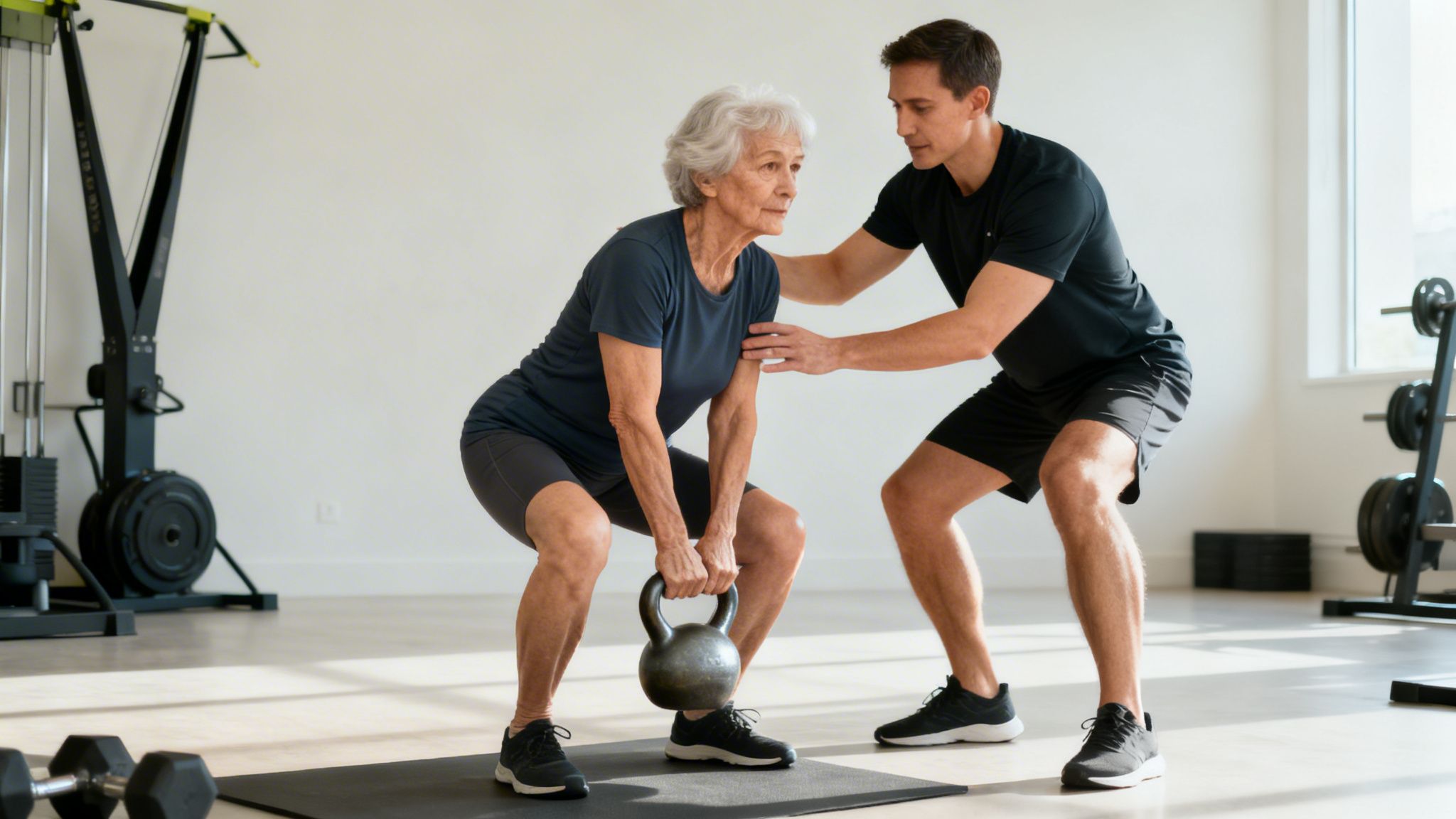
You know that a goblet squat isn't just for building quads; it’s a fundamental movement pattern. And what is a squat if not the exact motion of getting up from a chair? Or out of a car? By building strength in this pattern, we directly attack one of the biggest daily struggles for older adults.
We're not just strengthening muscles; we're training the brain and body to work together to stay stable and generate power. This is how you build a body that’s genuinely resistant to falls.
The Problem: Needing to use their hands to push out of a chair. This is a red flag for weak legs and glutes—the same muscles you need for a strong squat.
The Fix: Goblet Squats. Start with bodyweight, maybe to a box or chair, then progress to holding a light weight. You’re building the exact strength needed to stand up with power and control.
The Problem: Losing balance while bending over. This points to a weak core and poor single-leg stability.
The Fix: Single-Leg Romanian Deadlifts (RDLs). You know this one. It trains the hinge pattern while balancing on one foot, directly mimicking how to reach for the floor without toppling over.
These aren't just "exercises." They're tools for independence.
Building Strength From the Ground Up
Real stability starts at the core—it’s the anchor that links your upper and lower body. When it’s weak, the body compensates, leading to wobbly, inefficient movement and a much higher risk of losing balance. From there, we focus on the hips. Strong hips are the secret weapon against a fall.
It’s not your feet that save you when you trip—it’s your hips. The ability to instantly shift your weight, stabilize your pelvis, and shoot a leg out to the side is what turns a potential disaster into a minor stumble.
Exercises like glute bridges and banded side steps aren't just for "toning" or warm-ups. They are non-negotiable drills for building the reactive strength that keeps you on your feet. It's a core part of our philosophy for strength, conditioning, and rehab.
Foundational Fall Prevention Exercise Progressions
Static balance is just the beginning. To prepare for the real world, you need to challenge stability in a smart, progressive way. Here’s a sample of how we build balance and strength from the ground up.
| Movement Focus | Level 1 (Foundation) | Level 2 (Progression) | Level 3 (Challenge) |
|---|---|---|---|
| Squatting | Bodyweight Box Squat | Bodyweight Squat | Goblet Squat (light weight) |
| Hinging | Glute Bridge | Single-Leg Glute Bridge | Bodyweight Single-Leg RDL |
| Static Balance | Single-Leg Stand (with support) | Single-Leg Stand (no support) | Single-Leg Stand (eyes closed) |
| Dynamic Balance | Tandem Walk (heel-to-toe) | Tandem Walk + Head Turns | Tandem Walk on Foam Pad |
This approach builds confidence right alongside physical skill, preparing them for the complex and unpredictable world of daily life.
Fortifying the Home: Your Defensive Strategy Against Falls
Building a stronger body is the offense against falls. But a great offense is useless if your defense is full of holes. That's where the home environment comes in.
Most "home safety" advice is just a generic checklist. That’s not how we operate. We look at the home like a movement specialist. It's not just about adding a grab bar; it's about understanding why that grab bar works from a biomechanical standpoint.
The Biomechanics of a Safer Space
Think about setting up for a heavy squat. You set the safety pins on the rack to the perfect height. Why? They’re a fail-safe. A stable anchor in case your strength wobbles.
Home safety modifications are the exact same concept.
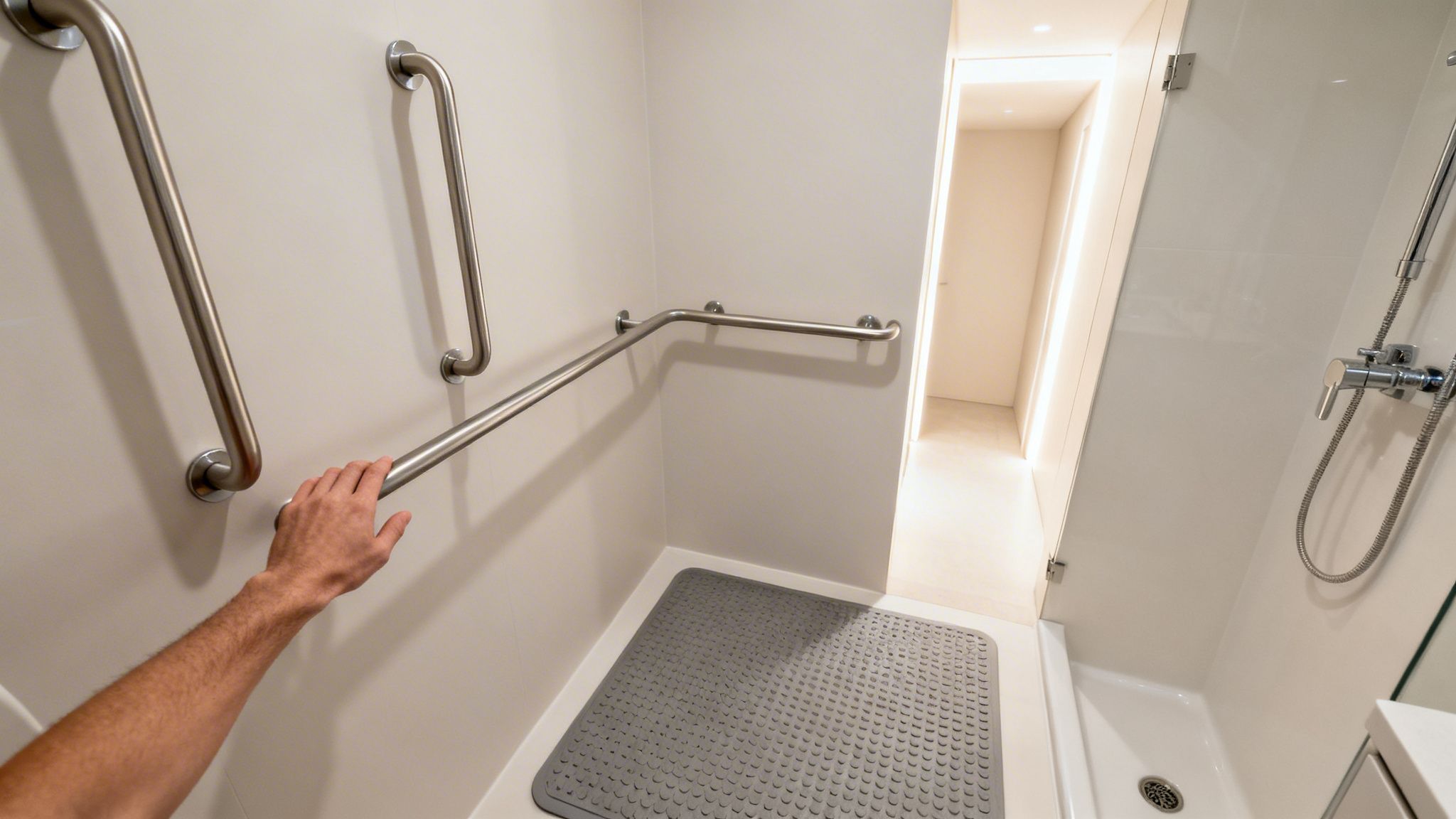
That grab bar in the shower? It’s not just a handle. It's an anchor point that lets a person widen their base of support and lock in their center of gravity on a slick, unpredictable surface. It’s the safety rack for the bathroom.
The goal isn’t to turn the house into a padded cell. It’s to strategically eliminate the random variables that can wreck stable movement. A strong body is useless if the environment constantly sets it up to fail.
This can be a touchy subject. Frame it as a team project: "How can we make this space work better for you?" This shifts the focus from limitation to empowerment. You can see more on how small environmental tweaks impact the body in our guide on ergonomics and preventing back pain.
The Non-Negotiable Upgrades
Some home hazards are just too risky to ignore. These are critical fixes that will immediately lower the odds of a fall.
The data confirms that home modifications are a core part of any legitimate fall prevention plan. If you want to dig into the research, you can see how multifactorial interventions reduce fall risks from PMC.
Here's where to start:
Kill the Throw Rugs: A throw rug is an athlete's nightmare—an unstable, shifting surface. For an older adult, it’s a landmine waiting to catch a foot and torpedo their balance. If a rug is a must, it needs to be low-pile and securely taped down.
Light Up the Pathways: Many falls happen during nighttime trips to the bathroom. Low light destroys depth perception. The fix is simple: motion-activated nightlights in hallways, bathrooms, and the bedroom.
Obliterate the Clutter: Walkways need to be wide and clear. That means ditching extra side tables, wrangling loose cords, and clearing stacks of magazines off the floor. Every object is a potential obstacle that forces a change in gait and invites instability.
If you’re in Marlton, Mount Laurel, Cherry Hill, Moorestown, Haddonfield, Medford, or anywhere in South Jersey and want a professional eye on how movement and environment play together, let's talk. Schedule a Free Discovery Visit today and let’s build a real plan to keep your loved one safe, strong, and in control.
3 Sneaky Culprits Wrecking Your Parents' Balance
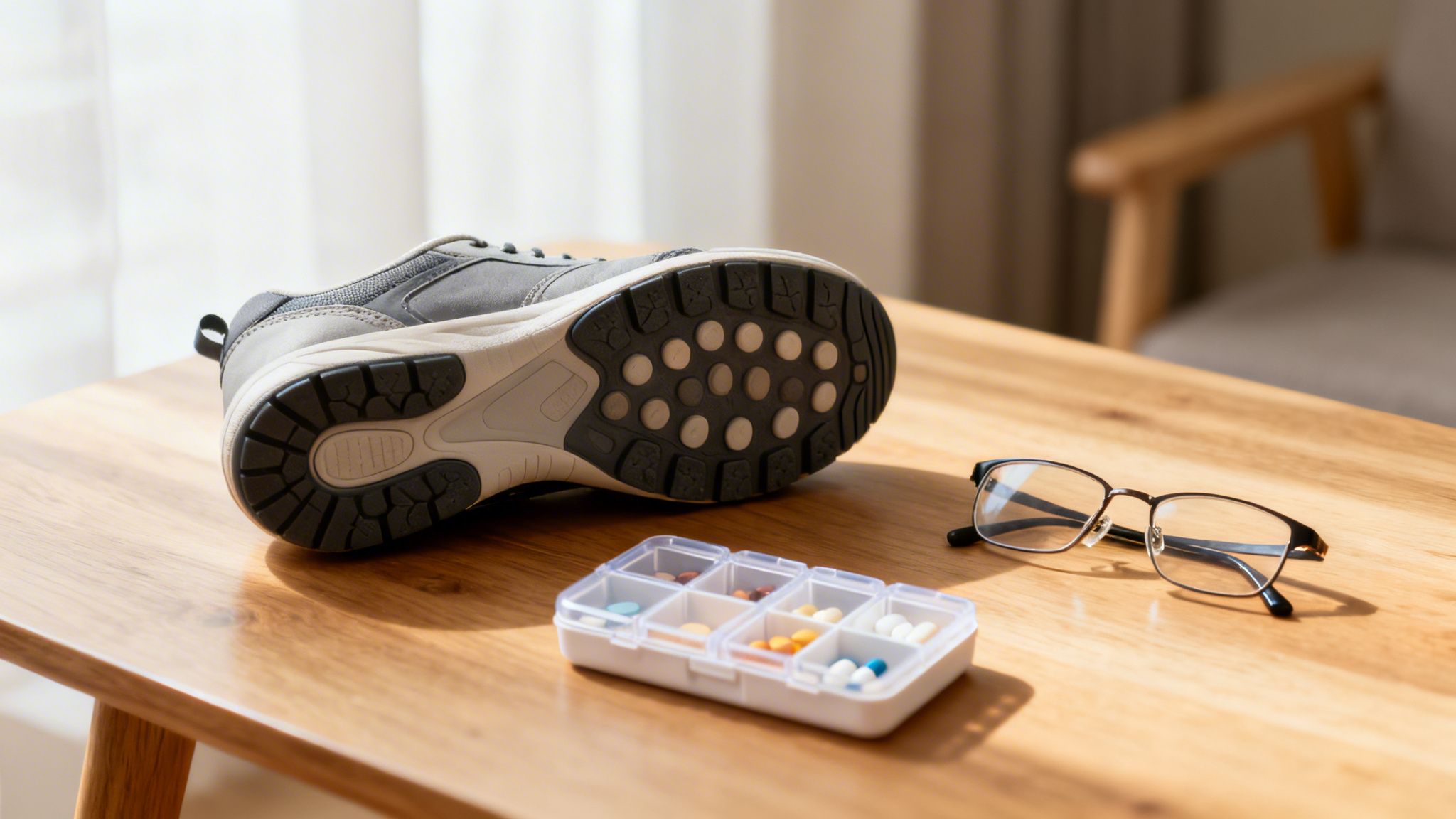
So you’ve got your parents doing functional exercises and you’ve trip-proofed the house. Awesome. But if you’re ignoring their medications, vision, and shoes, you’re missing the plot entirely.
These are the hidden saboteurs—the invisible threats silently pulling the rug out from under them. Building a stronger body is crucial, but it's only half the battle. It's like a lifter who trains like a beast but eats junk food and gets four hours of sleep. They're undermining all their hard work. It's time to apply that same root-cause mindset here.
That Medicine Cabinet is a Minefield
As we get older, prescriptions tend to pile up. The real danger isn’t just one pill; it’s the cocktail of drugs interacting with each other. It’s a huge problem called polypharmacy.
Common meds for blood pressure, sleep, or anxiety can cause dizziness, brain fog, or a sudden blood pressure drop when standing. Combine a few, and the side effects multiply. You’ve just created the perfect storm for a fall.
A prescription that was totally fine five years ago might be a massive liability now, especially when new ones are added to the mix.
This is why a “brown bag review” is non-negotiable. Have your parent put every single prescription, over-the-counter pill, and supplement they take into a bag and take it to their doctor or pharmacist. A professional can spot the red flags and find safer alternatives.
Blurry Vision is a Balance Killer
You wouldn't try to deadlift heavy with your eyes closed, right? Your ability to see your feet and the floor is critical for staying stable. The same exact principle applies to your parents navigating their home.
Age-related vision changes slowly chip away at depth perception, making it nearly impossible to tell the difference between a shadow and the last step on a staircase.
This is why you can’t skip the annual eye exam:
- Poor Depth Perception: A flat-looking rug and a step can look identical, leading to a disastrous misstep.
- Bifocal & Progressive Lenses: Great for reading, but terrible for walking down stairs. Looking down through the bottom of the lens distorts the ground and can instantly throw off balance.
- Cataracts & Glaucoma: These conditions are like trying to navigate a room with the lights dimmed, making it easy to trip over something you never saw.
An up-to-date prescription isn't a "nice-to-have." It's essential safety gear.
Their Shoes Are Their Foundation
You know that lifting in squishy running shoes is a recipe for instability. For an older adult, their everyday footwear is even more critical.
Those backless slippers, worn-out sneakers, or socks on a hardwood floor? They’re a disaster waiting to happen. They offer zero support and no grip.
A good shoe is the literal foundation for every stable step. Here’s what matters:
- A Grippy, Non-Slip Sole: Traction is everything.
- A Low, Supportive Heel: Keeps the foot locked in and stable.
- A Snug Fit with a Closed Back: The foot and shoe should move as one unit.
Fixing their footwear is one of the fastest and cheapest upgrades you can make to their stability.
If you’re in Marlton, Mount Laurel, Cherry Hill, Moorestown, Haddonfield, Medford, or anywhere else in South Jersey and feel like you're missing a piece of the puzzle, give us a call. Schedule a Free Discovery Visit and let’s build a real-world plan that tackles every risk—seen and unseen.
When It’s Time to Call in the Pros for Fall Prevention
You’ve seen it. Your parent hesitates before getting out of a car. They wobble stepping off a curb or grab the wall for a second when they stand up. It’s easy to write it off as “just getting older.”
But it’s not. These aren’t minor quirks. They are your check engine light, blinking furiously to tell you a critical system is failing.
DIY fixes like grab bars are a decent start, but they’re just patching the symptoms. If a fall has already happened—even a "small" one—the time for guessing games is over. It’s time to call in a professional who understands movement.
Your Body Doesn't Lie: Decoding the Warning Signs
Ignoring these signs of instability is a recipe for disaster. The body is giving you early warnings that a professional needs to diagnose.
Here’s what to look for:
- Hesitation During Movement: That pause before standing up isn't just caution. It's the brain admitting it doesn't trust the body's strength or balance to pull off the move. It's a compensation for a real physical deficit.
- A "Minor" Fall or Near-Miss: A fall is a fall. It means the body's balance systems were completely overwhelmed. Research confirms that one fall doubles the risk of it happening again.
- Fear of Movement: If they’re turning down activities they once loved because they’re scared of falling, that's a massive red flag. Fear leads to less activity, which leads to more weakness, creating a vicious cycle.
These aren't just random signs of aging. They’re symptoms of specific, fixable problems—like weak hips, stiff ankles, or a core that’s not activating properly. An expert assessment is designed to find out exactly which one it is.
Why a Movement Specialist Is Your Best Bet
If a powerlifter’s squat keeps failing, they don't just "try harder." They hire a coach who breaks down the movement, finds the weak link—maybe it’s lousy ankle mobility or glutes that aren’t firing—and gives them specific drills to fix it.
Preventing falls requires the exact same root-cause approach.
A professional assessment isn't about getting a generic handout of exercises. It’s a deep-dive investigation to figure out why the instability is happening. It’s the difference between treating a symptom and actually solving the problem.
At Valhalla Performance, our one-on-one, movement-based chiropractic care starts with that deep dive. We don't do cookie-cutter protocols. We watch how your parent moves, test their strength, and pinpoint the exact breakdown in the chain.
Is it a stiff ankle from an old sprain that’s throwing off their entire gait? Are weak hip stabilizers making them unstable? Once we find the root cause, we build a truly personalized plan to fix it for good.
The research is clear: targeted, multi-part interventions are incredibly effective at preventing falls. You can see for yourself how global fall rates highlight the need for targeted prevention from ProBiologists. Our entire approach is built on this evidence.
Take the First Step Toward a Real Solution
You wouldn't let a loved one keep deadlifting with a rounded back, waiting for an injury. So don't let them navigate daily life with movement patterns that are setting them up for a life-altering fall.
If you’re in Marlton, Mount Laurel, Cherry Hill, Moorestown, Haddonfield, Medford, or anywhere else in South Jersey, stop waiting for a crisis. Be proactive.
Schedule a Free Discovery Visit for your loved one today. We’ll do a thorough assessment, give you clarity on what’s really going on, and lay out a clear, actionable plan to rebuild their strength, confidence, and independence. It’s the first step to getting them back to living their life, not just fearing it.
Your Questions About Senior Fall Prevention, Answered
We get it. Talking to your parents about fall prevention can feel like walking on eggshells. You're worried, but you don't want to take away their independence. Here are the straight-up, no-nonsense answers to the questions we hear every single day from active adults like you.
My Parent Is Resistant to Help. How Do I Even Start This Conversation?
The secret is to frame it around empowerment, not limitation.
Nobody wants to be told they're fragile. Instead of leading with fear ("You need to be careful!"), lead with a goal they care about. Try something like, “Hey Dad, I want to make sure you can keep golfing for years to come. I learned about some specific exercises that help with balance and power in the swing. Want to try a few with me?”
When you focus on a shared goal—like independence or staying active in a sport they love—it stops being a lecture and starts being a partnership.
What's the Single Best Exercise if They Only Have 5 Minutes a Day?
If you can only get them to do one thing, make it the unassisted sit-to-stand from a solid chair. This isn't just some basic movement; it's a foundational strength-building exercise.
This one movement builds the quad and glute strength needed to get out of a car, off the toilet, and up from the dinner table. It’s a direct deposit into their independence bank account. Start with 5-10 controlled reps, making sure they don't use their hands to push off.
How Is a Movement-Based Chiropractor Different for Fall Prevention?
A lot of places just don't get it right. A typical PT clinic might have your parent doing generic exercises in a group, while some chiros offer a quick adjustment for temporary relief. That's putting a Band-Aid on a bullet wound.
At Valhalla Performance, we're different. We combine precise adjustments with active rehab in a dedicated one-on-one setting. We get the joint moving right, then immediately teach the body how to control and strengthen that new motion for long-term results.
We play detective to find the real root of the instability—whether it's weak hips from sitting, a stiff ankle from an old injury, or a core that's gone offline—and build a real plan to fix it for good.
Are Falls Just a Normal Part of Getting Older?
Absolutely not. This is a dangerous myth. While the risk of falling increases, falls themselves are not inevitable.
A fall is a symptom that an underlying system—like strength, balance, or even vision—is failing. By proactively attacking those root causes with the right exercises and lifestyle changes, you can dramatically lower the risk. You can absolutely age with strength, confidence, and stability.
Don't let guesswork and fear dictate your family's future. At Valhalla Performance, we provide a clear, battle-tested plan to help your loved ones build strength and reclaim their independence. If you're in Marlton, Mount Laurel, Cherry Hill, Moorestown, Haddonfield, Medford, or anywhere in South Jersey, it's time to take the first step.
Schedule a Free Discovery Visit at thevalhallaperformance.com and get a real plan to keep your parent safe, strong, and living life on their own terms.