
You've rested. You've stretched. You've done the band exercises they printed off in a clinic. You've had your back cracked, felt better for a day or two, then watched the same pain show up the next time you deadlifted, swung a golf club, went out for a run, or rolled in jiu-jitsu.
That cycle gets old fast.
What makes it worse is that you're not trying to become a couch person. You want your body to hold up under real life. You want to train hard, move well, and trust your shoulder, knee, back, or neck again. If you're searching for pulsed electromagnetic field therapy for pain, the right question isn't “Does this machine fix everything?” The right question is “Can this help create a window for real recovery, if it's used the right way?”
That's the conversation worth having.
When Your Body Betrays You and Nothing Else Works
The CrossFitter with the cranky shoulder knows this feeling. Every overhead press clicks. Every snatch feels like a gamble. You warm up longer, modify more, and tell yourself it's “fine,” even though you know your training is shrinking.
The runner feels it too. Shin pain that never fully leaves. Hip tightness that changes your stride. You still run, but you're not running free. You're negotiating with pain every mile.
Then there's the BJJ athlete whose low back locks up after a hard roll. Or the golfer who can still play, but can't rotate without that sharp reminder that something is off. You can function, sure. But you can't perform like yourself.
Why failed treatment hits harder for active people
When you're active, pain isn't just pain. It attacks identity.
You don't only miss exercise. You miss stress relief, confidence, community, momentum, and the version of yourself that felt strong and capable. That's why generic care feels so insulting when it doesn't work. You're handed the same exercises everybody gets, or you get temporary relief with no plan to keep it.
You don't need more random relief. You need a reason your body keeps breaking down under load.
That doesn't mean physical therapy or chiropractic is bad. It means the version you got may have been too passive, too rushed, or too generic for your problem. If the actual issue is poor hip control in a squat, a thoracic rotation restriction in a golf swing, or a stability problem that shows up under speed and fatigue, then chasing symptoms won't solve it.
The future problem most people avoid thinking about
If your shoulder is this unreliable now, what's it going to feel like after another year of pressing around pain?
If your knee already talks back every time you run stairs, what happens when your weekly workouts keep stacking on top of dysfunction?
That's where a lot of active adults get stuck. They're not injured enough to stop, but they're not healthy enough to train the way they want. They live in the gray zone. And the gray zone is where frustration turns into long-term limitation if you don't change the strategy.
That's why tools like PEMF matter. Not because they're magic. Because in the right plan, they can help calm the noise so you can rebuild the system underneath.
How PEMF Recharges Your Body's Healing Power
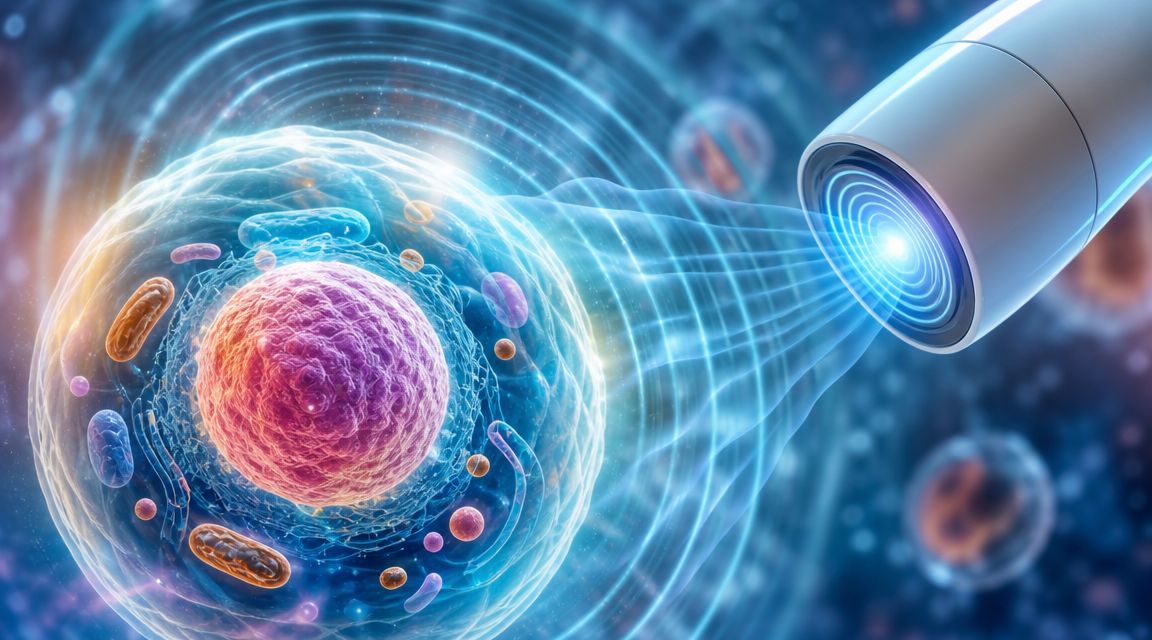
Think of injured tissue like a phone battery that never gets above low power mode. It still works, but poorly. It drains fast. It doesn't perform when you ask a lot from it.
Pulsed electromagnetic field therapy for pain is best understood as a way to nudge the body toward a better healing environment. A simple analogy is this. Your cells are like tiny rechargeable batteries. Stress, inflammation, overload, and injury can leave them running flat. PEMF applies pulsed electromagnetic signals to the area to support how those tissues function and recover.
What PEMF is actually doing
People get sloppy and turn PEMF into a miracle story. Don't do that.
PEMF isn't the same as a TENS unit. A TENS unit is mainly about changing pain signaling. PEMF is used with a different goal. It aims to influence the local healing environment, which is why people use it when they're trying to settle irritated tissue and support recovery rather than primarily blocking discomfort for an hour.
Here's a practical perspective:
- TENS tries to turn down the volume on pain signals.
- PEMF tries to improve the setting where healing has to happen.
- Exercise rebuilds capacity so the problem doesn't keep returning.
That distinction matters. If your patellar tendon, shoulder, or low back keeps getting angry every time training intensity rises, you need more than pain relief. You need the tissue to tolerate stress again.
Why it can be useful for active adults
The people who do best with tools like PEMF usually aren't looking to lie on a table forever. They want enough symptom relief to squat cleanly, hinge without guarding, rotate without fear, or get through a run without compensation.
That's where PEMF can fit.
Practical rule: If a passive treatment doesn't help you move better afterward, it's not doing enough.
A good session should serve a purpose. It should help open a door. Maybe your knee calms down enough to train step-down control. Maybe your neck feels less guarded so you can restore upper back rotation and scapular mechanics. Maybe your back eases enough that you can groove a hinge pattern without bracing like you're about to get hit.
What PEMF should feel like
Something dramatic is often expected. It usually isn't.
You're not getting shocked. You're not supposed to grit your teeth through it. The experience is generally subtle. And that's fine. The goal isn't to entertain you. The goal is to create conditions that make the next part of rehab more productive.
Here's the bottom line. PEMF can be a smart support tool. But if someone sells it like a stand-alone cure, walk away. The body doesn't come back from stubborn pain by stacking passive treatments. It comes back when symptom control and movement retraining work together.
What the Science Says About PEMF for Pain
If you're going to use PEMF, use it with your eyes open.
The research doesn't support the lazy claim that PEMF works for everything. It doesn't. The strongest historical evidence clusters around specific problems, especially degenerative knee conditions and some bone-related pain issues, not every ache from head to toe.
Where the evidence looks most credible
A major review cited by Aetna found that 9 of 14 studies were suitable for pooling, and those trials produced a cumulative odds ratio of 3.5 with a 95% confidence interval of 1.94 to 6.3 in favor of PEMF for knee osteoarthritis outcomes, according to Aetna's medical policy review of PEMF evidence.
That same review noted PEMF was more effective than placebo at 4 and 8 weeks, with function improving at 8 weeks. It also discussed findings in spontaneous osteonecrosis of the knee, where PEMF reduced knee pain and necrosis area in Koshino stage I disease and preserved 86% of knees from prosthetic surgery at 24 months.
Those are meaningful signals. Not because they prove PEMF fixes every painful knee, but because they show this tool has real history in specific musculoskeletal situations.
What that means in plain English
If you've got a degenerative knee issue, or a condition where joint and bone-related pain are part of the picture, PEMF deserves a more serious look.
If you've got some vague, chronic pain issue with no proper diagnosis and no movement plan, PEMF alone is not the answer.
That's the difference between clinical thinking and marketing. A hammer is useful. That doesn't mean it's the right tool for a leaking pipe.
The question isn't whether PEMF “works.” The question is whether it matches your condition, your irritability level, and your rehab plan.
A simple decision lens
Use this lens before you get excited about a machine:
| Situation | Better way to think about PEMF |
|---|---|
| Joint-driven knee pain | More reasonable to consider as part of care |
| Bone-related pain cases | Can make sense in a targeted plan |
| General chronic pain everywhere | Be skeptical of big promises |
| Pain with major movement breakdown | Use only if active rehab is also part of the plan |
My opinion is straightforward. PEMF is worth considering when the diagnosis fits and the plan goes beyond symptom management. It's not a universal fix. It's a specialized tool. And that's exactly why it can still be valuable.
Why Pairing PEMF with Active Rehab Is the Only Way

Here's where most clinics get this wrong. They treat PEMF like the event. It isn't. It's the setup.
If you lie there, get a passive modality, feel a little looser, then go home without addressing why your body keeps failing under load, you're just decorating the problem. That might feel good for a day. It won't build a comeback.
What more rigorous studies tell us
A controlled study in chronic non-specific neck pain used a 3-week program where both groups received 15 sessions of conventional physical therapy, while the active group also received 20-minute PEMF sessions. Pain improved significantly in both groups with p < 0.001 in each, but the PEMF group was not superior to sham on the main outcomes. The authors concluded PEMF was safe, but did not provide additional improvement over standard care in that setting, as reported in this chronic neck pain trial on PubMed Central.
That finding matters.
It tells you that throwing PEMF on top of standard treatment doesn't automatically change the result. If the rest of the program is generic, the machine won't save it. If the exercises don't address your real movement problem, PEMF won't rescue that either.
The low back lesson is the same
A systematic review in low back pain found PEMF could reduce pain and improve function, but when it was added to standard therapy, it did not show additional benefit. That same review also highlighted the mixed picture when PEMF is layered onto routine care pathways, which you can see in this systematic review on PEMF in low back pain.
This key point is often missed. Passive care fails active adults when it's disconnected from performance-based rehab.
If your squat falls apart because your ankle mobility is limited and your trunk can't control load, no amount of lying on a table fixes that. If your neck tightens every time you press because your rib cage, thoracic spine, and scapula don't coordinate well, pain relief without movement retraining is temporary.
What pairing PEMF with active rehab should look like
The right sequence is simple:
Calm the irritated area
Use PEMF strategically when pain or guarding is too high. Not forever. Just enough to lower the threat level.Restore lost movement
Here, you find what's missing. Rotation, loading tolerance, positional control, force transfer, balance, timing.Reload the system
You don't earn long-term results by stretching forever. You earn them by rebuilding strength, speed, and confidence.Return to real activity
That means your lifts, your running mechanics, your rotational power, your mat work. Not just table tests.
Coach's rule: If treatment never progresses to the demands of your sport or training, it was never built for your real life.
A good movement-based plan doesn't ask only, “Where does it hurt?” It asks harder questions.
- What breaks down under speed or fatigue
- What movement do you avoid because your body doesn't trust it
- What load, position, or pattern keeps reproducing the pain
- What capacity do you need to get back to your sport
That's the mindset behind a true active recovery physical therapy approach. The machine helps create an opening. The rehab work changes the outcome.
Why this matters for athletes and hard-charging adults
Think about a golfer with recurring lead-side hip pain. A passive treatment might settle symptoms. But if that golfer can't load the trail hip, rotate through the thoracic spine, and transfer force cleanly, the pain comes back when the volume rises.
Same with a lifter whose low back tightens during heavy pulls. If the body doesn't own the hinge, can't manage pressure well, or dumps stress into the lumbar spine every rep, temporary symptom relief is just halftime. The game problem is still there.
That's why I'm opinionated about this. PEMF is useful when it supports essential work. It's a waste when it replaces essential work.
Your Comeback Journey What to Expect

The first step shouldn't feel like you're being sold. It should feel like someone is finally listening.
A proper start is a conversation. What hurts, yes. But also what matters. Are you trying to get back to barbell training without fear? Finish a long run without your knee swelling up? Roll in BJJ without your neck or back flaring for two days after? That context changes treatment.
The first visit should answer bigger questions
You need more than a label. You need a working explanation.
That means looking at how you move, how you load, what positions trigger pain, what movements you avoid, and what your sport demands. A desk worker who wants to sleep without neck pain needs one kind of plan. A grappler trying to return to hard rounds needs another.
Here's what a smart process usually includes:
A root-cause assessment
Not just the painful spot. Hips, trunk, shoulder blade, foot mechanics, breathing strategy, rotational control, and how those pieces affect one another.A clear symptom strategy
PEMF may be applicable. If the area is hot, guarded, or stubbornly irritated, it can help settle things enough to train productively.A movement plan
Corrective exercise should match your problem. Not a random sheet of clamshells and band pull-aparts for every human with pain.
What a session often feels like
If PEMF is part of your care, it should feel calm, not dramatic. The sensation is often described as subtle. No shocking. No white-knuckle discomfort.
After that, the visit should move quickly into active work. You might go from symptom reduction into mobility drills, then positional control, then loaded movement. For a runner, that may mean gait-related strength and impact tolerance. For a lifter, it may mean squat patterning, trunk stiffness, and single-leg control. For a golfer, it may mean hip internal rotation and thoracic rotation tied directly to the swing.
Recovery should feel like training with a purpose, not sitting through a menu of passive treatments.
What progress usually looks like
Not linear. But measurable.
Some days the win is less pain. Other days it's owning a position that used to trigger symptoms. Then it becomes something bigger. Your front rack stops feeling jammed. Your split squat is stable again. You can bridge, rotate, cut, or hinge without bracing for impact.
That's when the comeback starts to feel real.
A real rehab process also has to prepare you for the end goal. If your target is getting back to lifting, competition, recreational sports, or weekend golf, your program should build toward those exact demands. That's the whole point of a return to sport physical therapy plan. Rehab isn't done when you're merely less miserable. It's done when your body can handle your life again.
Stop Chasing Symptoms and Start Building Your Solution

You can keep doing what most frustrated active adults do. Wait for pain to calm down. Avoid the movements that trigger it. Get temporary relief. Try easing back in. Flare up again. Repeat.
That loop doesn't end because you found a better stretch. It ends when you stop treating pain like the whole problem.
The real standard you should demand
You should expect care to do three things:
Reduce irritation
If you're too inflamed or guarded to move well, that has to be addressed.Find the driver
The painful area isn't always the true source of failure.Build resilience
You need strength, coordination, and load tolerance that hold up outside the clinic.
That's why pulsed electromagnetic field therapy for pain should sit in the support category, not the savior category. Used well, it can help create momentum. Used alone, it often becomes just another stop in the symptom-chasing carousel.
If your body matters, your plan has to match your life
The goal isn't to survive workouts by modifying everything forever.
The goal is to train, run, lift, rotate, grapple, hike, and play without your body constantly bargaining with you. If your back keeps barking after deadlifts, if your shoulder still pinches every press, or if your knee owns your running schedule, you need a plan that respects the demands of your sport and the reality of your life.
A good starting point is understanding why recurring symptoms happen in the first place. This breakdown on how to relieve chronic back pain is a useful example of that bigger root-cause mindset.
Temporary relief feels productive when you're desperate. Long-term capacity is what actually gets your life back.
My recommendation
Be skeptical of anybody selling PEMF as a stand-alone miracle.
Be equally skeptical of any clinic that ignores tools that may help calm pain enough for high-quality rehab. The sweet spot is in the middle. Use the modality when it helps. Then do the work that changes the system.
That's how you stop living in maintenance mode. That's how you keep your training identity instead of slowly losing it.
If you're in Marlton, Mount Laurel, Cherry Hill, Moorestown, Haddonfield, Medford, or anywhere in South Jersey, Valhalla Performance offers a Free Discovery Visit to help you figure out whether your pain is being driven by the wrong thing, and whether a movement-based plan that may include PEMF is the right fit. If you're done guessing and ready for a real comeback, schedule your visit and start building a solution that lasts.