
You've rested. You've stretched. You've done the band work, the clamshells, the generic “3 sets of 10,” and you still don't trust your body under a barbell.
That's where most lifters get stuck.
Not because they're lazy. Not because they're impatient. Because they were told to treat the painful spot and wait for confidence to magically return. It doesn't work that way. If your back lights up every time you hinge, if your shoulder barks on bench, or if your knee gets cranky every time squat day comes around, the problem usually isn't that you need more rest. It's that nobody found the reason your body started borrowing motion from the wrong place in the first place.
If lifting is part of who you are, this stuff hits deeper than pain. It changes how you train, how you move, and how you see yourself. First you skip heavy deadlifts. Then you stop doing Murph-style workouts. Then you pass on BJJ rounds, weekend golf, or playing full speed with your kids because you're “being careful.” That slide happens slowly, then all at once.
A smart return doesn't start with blind optimism. It starts with a better diagnosis, a calmer nervous system, and a plan that makes you trust your body again.
That Nagging Injury Isn't Just Bad Luck
Recurring injuries usually aren't random. They're patterns.
You tweak your back pulling from the floor. It settles down. You feel decent for a few weeks. Then one hard training day, one awkward rep, or one intense round of rolling in BJJ and you're right back where you started. That isn't bad luck. That's your body telling you the same movement problem is still there.
The real problem isn't pain alone
Pain grabs your attention, but pain is rarely the whole story. The knee hurts, but the hip may not be controlling rotation. The shoulder pinches, but the scapula may not be moving well. The low back spasms, but your rib cage and pelvis may be out of sync every time you brace.
That's why symptom-only care feels good for a bit, then fails when training gets real again.
If all someone did was chase inflammation, crack the joint, massage the hot spot, or hand you a printout of generic rehab drills, they probably didn't solve the root cause. They calmed the area down. That's not the same thing.
If you've been stuck in that cycle, this is worth reading on why recurring injuries keep coming back.
Rest isn't a strategy
A lot of active adults get terrible advice after an injury. “Just take some time off.” “Avoid anything that hurts.” “Come back when it settles down.”
That might help in the very short term. It does almost nothing to prepare you for a loaded squat, a kipping pull-up, a hard run, a heavy clean, or a scramble on the mats.
Rest can calm symptoms. It cannot rebuild capacity.
Your body needs a reason to adapt. That means controlled loading, movement quality, and progression. Not recklessness. Not ego lifting. But also not endless avoidance.
If this keeps going, the cost gets bigger
Right now maybe it's “just” your training. But that's rarely where it stops.
If you can't hinge without fear today, what happens when you pick up your kid after a long day? If overhead work feels unstable now, what will your shoulder feel like after years of avoiding strength and moving less? If your knee already makes you second-guess stairs after leg day, you should care about where that trend goes, not just whether you can survive next week's workout.
You don't need another temporary reset. You need a plan that treats you like an athlete whose body needs to be rebuilt, not a patient whose body needs to be protected forever.
The Mindset Shift From Patient to Athlete in Rehab
Many lifters fail their return to lifting before they touch a bar.
They fail in their head first.
You can see it in the warm-up. They move cautiously. They overthink every rep. They brace like the injury is waiting to jump out from behind the next set. That hesitation matters. It changes mechanics, reduces force, and keeps your body stuck in protection mode.
Fear changes how you move
This isn't weakness. It's common. A 2023 study in the Journal of Orthopaedic & Sports Physical Therapy found that 68% of injured weightlifters reported high kinesiophobia, or fear of movement, and that fear correlated with 40% longer return-to-training timelines, as summarized in this discussion of returning to weightlifting after injury.
If you've been hurt lifting, your brain remembers. That's normal. The mistake is acting like the answer is to “be careful forever.”
Careful becomes tentative. Tentative becomes stiff. Stiff becomes altered movement. Altered movement becomes the next flare-up.
Stop acting like a fragile patient
You're not trying to win the award for best-rested injured person. You're trying to become capable again.
That requires a different identity. Not “I'm broken.” Not “I guess my body can't handle that anymore.” The useful mindset is athlete in rehab. That means every session has purpose. Every modification has a reason. Every regression is temporary and strategic.
Here's what changes when you make that shift:
You stop chasing pain alone. You ask why the movement failed.
You stop measuring success by relief. You measure control, tolerance, and confidence.
You stop waiting to feel ready. You build readiness through exposure.
Practical rule: Confidence doesn't appear before movement. It grows because of repeated, controlled movement.
A real movement screen is different
A lot of people say they were “evaluated.” What they usually mean is someone poked the sore spot, checked one range of motion, maybe watched one squat, then gave them exercises.
That's not enough.
A proper movement-based assessment looks at how your whole system organizes force. It asks better questions. Can you own your ribs and pelvis under load? Do you shift off one hip at the bottom of a squat? Can your shoulder blade upwardly rotate, or are you cranking through the front of the joint? Do you lose foot pressure when you lunge? Does your trunk brace before your limbs move, or after?
Those details matter because your pain pattern is often the end result of a compensation pattern.
The goal is trust, not hype
You don't need motivational slogans. You need reps that prove to your body it's safe to work again.
That usually starts with lighter loading, higher quality, and more frequent exposure to the movement that scares you. Not max effort. Not random variety. Repetition with control.
A runner with persistent hip pain needs to trust single-leg loading again. A CrossFitter coming back from a back tweak needs to trust the hinge again. A golfer with rib or shoulder pain needs to trust rotation again. A BJJ athlete needs to trust awkward positions again. You build that trust the same way every time. Calm the threat, clean up the pattern, then layer in load.
That's what most traditional rehab misses. They treat the tissue, then skip the process of teaching the athlete how to own movement again.
The Critical First Step Your Old PT Probably Missed
Before you load anything, you need to know what broke down.
Not the diagnosis on paper. Not just “rotator cuff irritation” or “low back strain.” You need to know what your body was doing before the pain showed up. That's the first step often overlooked.
Root cause beats symptom chasing
If your knee hurts during squats, staring at the knee won't tell the whole story. You need to look at what's feeding the knee. Can your ankle dorsiflex? Can your hip control internal rotation? Are you collapsing through the foot? Are you bracing well enough to keep your pelvis from dumping under you?
Same story with the shoulder. If benching hurts, don't just rub the front of the shoulder and hope. Look at thoracic motion, rib flare, scapular control, grip width, elbow path, and whether you can even create a stable upper back.
That's why “rest and some exercises” leaves so many lifters frustrated. It's too shallow.
The four phases matter
A successful return to lifting has to move through four distinct phases in order: Mobility, Stability, Functional Movement, and Return to Performance. Skipping steps, or adding load before you've restored positional control, is a major driver of re-injury according to this return-to-exercise framework.
That sequence matters because each phase solves a different problem:
| Phase | What you're rebuilding | What it looks like |
|---|---|---|
| Mobility | Access to the positions you need | Pain-free range, cleaner joints, less guarding |
| Stability | Control inside those positions | Bracing, balance, scapular control, foot pressure |
| Functional movement | Patterning for real life and sport | Hinge, squat, carry, rotate, push, pull |
| Return to performance | Tolerance to real training stress | Progressive loading, speed, volume, sport demands |
A lot of athletes jump from “it hurts less” straight to “let me see what I can do.” That's where they get burned.
Positional control comes before load
If you can't hold a clean start position with no weight, adding plates won't fix it. It will just hide the problem until the stress gets high enough.
For deadlifts, that may mean relearning how to lock the ribs down, engage the lats, and maintain pressure through the whole foot before a bar ever leaves the floor. For overhead pressing, that may mean owning upward rotation and trunk position before touching a heavy kettlebell or barbell.
The body doesn't care what you used to lift. It responds to what you can control today.
Non-negotiable rules for your comeback
You need structure, not guesses. These are the rules I'd use with any lifter trying to figure out how to return to lifting after an injury:
Earn the pattern unloaded first. If a bodyweight squat is ugly or painful, loaded squats are too soon.
Use pain as feedback, not a dare. Mild discomfort can be workable. Sharp, escalating, or weird pain is your stop sign.
Track effort with RPE. Don't think in maxes yet. Think in how hard the set feels.
Rebuild movement frequency. One random “test day” each week isn't enough to retrain confidence or skill.
Fix the leak in the chain. Back pain from deadlifting may be a hip and trunk problem. Shoulder pain on pressing may start at the rib cage and scapula.
If you want a movement-based route back to full training, return to sport physical therapy is one option that blends assessment, rehab progressions, and strength work instead of separating them into silos.
Your Pain-Free Return to Lifting Protocol
Generic advice says start light and go slow. That's incomplete.
You need a return plan with rules. Not vibes. Not “see how it feels.” The point is to dose enough stress to create adaptation, while keeping the tissue and nervous system calm enough to keep progressing.

The rules of the road
An evidence-based return-to-lifting approach calls for dropping intensity to an RPE of 5 to 6, then using linear progressions to climb back to an RPE of 8 to 8.5 over 8 to 12 weeks. Training the aggravating lift 2 to 3 times per week at this lower intensity builds neuromuscular adaptation and confidence more effectively than training it once weekly, according to Barbell Rehab's return-to-gym guidance.
That should immediately change how you think about your comeback.
You do not need one heroic heavy day to prove you're back. You need repeated, calm exposures that teach your body the lift is safe again.
Use these rules:
Start around half of your old training load. If that bruises your ego, good. Ego is what got a lot of lifters back into trouble.
Keep pain at or below 2 out of 10. If pain climbs, lingers, or changes your mechanics, back off.
Train the pattern often enough to learn it again. Two or three exposures beats one weekly test.
Leave reps in reserve. Early rehab sets should look crisp, not gritty.
Take at least 48 hours between hard exposures to the same aggravating pattern. Recovery still matters.
A low back example
Let's say deadlifts flare your back.
The wrong move is to avoid hinges for six weeks, then pull from the floor because “it finally feels okay.” The smart move is to regress the pattern and keep training.
You might start with:
hip hinge wall taps
dowel RDLs
RDLs with feet on blocks and slow eccentrics
block pulls if tolerated
carries and anti-rotation core work to reinforce trunk control
You're not trying to baby the back forever. You're trying to rebuild the hinge pattern without feeding the compensation that overloaded the back before.
A shoulder example
Bench press bothers your shoulder. Fine. Bench press isn't the only pressing pattern on earth.
Start with options that let you train without forcing the painful angle. Neutral-grip dumbbell pressing, floor presses, incline variations, push-up progressions, or landmine pressing often let lifters keep strength work in the program while restoring scapular control and upper back tension.
Then earn your way back to barbell work.
You don't get bonus points for returning to the exact lift too early.
Sample 4-Week Squat Return-to-Lifting Template
This isn't a medical prescription. It's a simple model for how to organize your return if squats have been aggravating a knee, hip, or back and you can perform the movement in a pain-limited range.
| Week | Day 1 Volume | Day 2 Intensity | Notes & Goals |
|---|---|---|---|
| 1 | Goblet squat, 3 to 4 controlled sets at RPE 5 to 6 | Box squat or goblet squat, 3 controlled sets at RPE 5 | Stay in a pain-free range. Focus on foot pressure, bracing, and tempo. |
| 2 | Goblet squat or front-loaded squat, 4 controlled sets at RPE 6 | Squat variation of choice, 3 to 4 sets at RPE 6 | Increase range only if positions stay clean and symptoms stay calm. |
| 3 | Barbell squat variation, 4 sets at RPE 6 to 7 | Barbell squat variation, 3 to 4 sets at RPE 6.5 to 7 | Reintroduce the bar only if bodyweight and goblet work looked solid. |
| 4 | Barbell squat, 4 working sets at RPE 7 | Barbell squat, top work sets at RPE 7 to 8 | Keep reps smooth. If pain spikes or form changes, return to the previous week's setup. |
Why I don't love blind percentage rules
Some lifters obsess over weekly load increases. That can work as a guardrail, but it's not enough by itself.
Your tissue doesn't read spreadsheets. It responds to stress tolerance, movement quality, sleep, recovery, and how well you own the position. A small weight jump with bad mechanics can be worse than a bigger jump with crisp execution and no symptom response.
So yes, be conservative. But don't turn progression into math only. Use RPE, symptom response, and positional quality together.
Green lights and red lights
Use this checklist after each session.
Green lights
pain stayed low and stable
no limping, guarding, or major compensation
symptoms settled quickly after training
next-day soreness feels like training, not injury
Red lights
pain sharpened during the set
your movement changed to avoid the painful side
symptoms stayed angry into the next day
you felt less confident, not more, after the session
That's how to return to lifting after an injury without guessing every week.
Smart Regressions for Common Lifting Injuries
A lot of people think “returning” means forcing the old exercise back into the plan as fast as possible. Wrong target.
The goal is to keep training while removing the exact stressor your body can't manage yet. That's how you maintain momentum without feeding the injury.
When your back hates deadlifts
Don't force the bar from the floor just because that's your “main lift.”
Try this sequence instead:
Pattern the hinge first. Wall taps, dowel hinges, and bodyweight RDLs teach you to move from the hips without dumping stress into the lumbar spine.
Shorten the range. Block pulls or RDLs from a raised position let you train the posterior chain without forcing your weakest position.
Slow the lowering phase. Controlled eccentrics help you own the movement instead of rushing through it.
Build trunk stiffness. Carries, dead bugs, and anti-rotation drills make your hinge stronger indirectly.
When your shoulder gets angry on pressing
You don't need to stop pressing. You need a better pressing option.
A useful progression often looks like this:
| Problem lift | Better temporary option | What you're training |
|---|---|---|
| Barbell bench press | Neutral-grip dumbbell floor press | Pressing without excessive shoulder extension |
| Strict overhead press | Landmine press | Upward pressing with a friendlier angle |
| Dips | Push-up variations | Scapular control and trunk stiffness |
| Wide-grip bench | Closer-grip dumbbell press | Better humeral position and less irritation |
If your shoulder pain shows up only in one angle, don't train through that angle to prove toughness. Train the angles you can own, then rebuild from there.
The best regression still looks like training. It just removes the stress your body can't tolerate yet.
When a lower body strain keeps threatening to come back
Hamstrings, adductors, quads, calves. These are the areas that love to fake recovery, then flare when speed or load returns. That's why random stretching and hope isn't enough.
A review of lower extremity muscle strains found that structured rehab can cut rerupture risk substantially. Programs that used a four-step process of stretching, isometrics, dynamic resistance, and functional movements returned athletes to sport when pain was minimal, defined as NRS 1 out of 10 or less, as described in this review of lower extremity strain rehabilitation.
That matters for more than field sport athletes. It applies to:
Runners coming back from a hamstring or calf issue
BJJ athletes returning to explosive bridging, shots, and scrambles
CrossFit athletes reintroducing box jumps, sprint work, or Olympic lift variations
The lesson is simple. Don't jump from “it feels okay” straight to dynamic sport stress. Rebuild the chain in order.
Getting back isn't the finish line
A lot of lifters stop caring the second they can do the movement again. That's exactly why the same issue returns.
If your old deadlift setup cooked your back, your comeback should include permanent hinge prep. If your shoulder lost control every time volume climbed, your program should keep scapular and upper-back work in year-round. If your knees cave when fatigue hits, single-leg strength and foot control aren't optional accessories. They're part of your base.
Prehab isn't a side quest. It's the price of staying in the game.
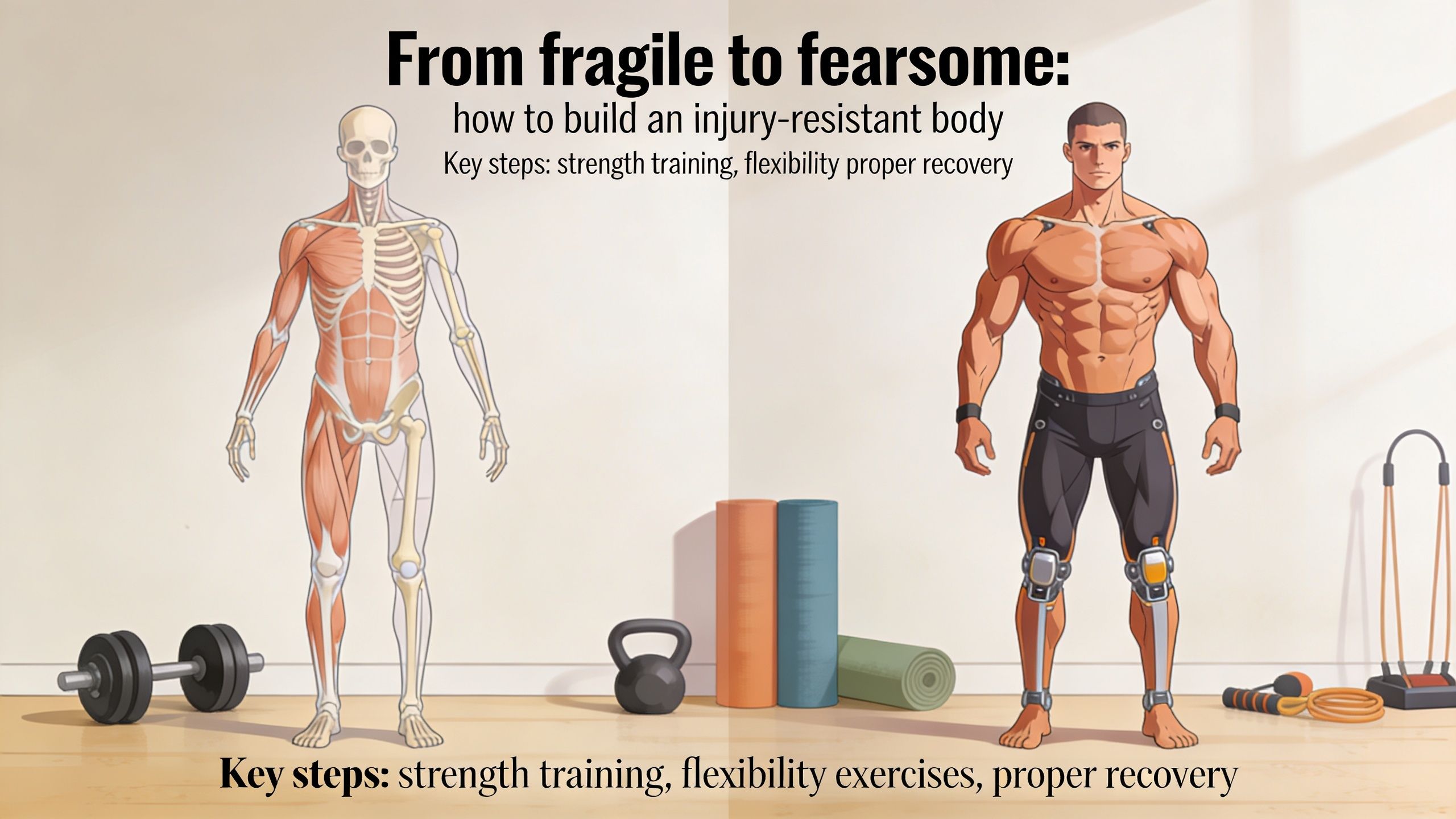
From fragile to fearsome how to build an injury resistant body
You shouldn't want to get back to the old version of your body if that body kept breaking down.
You want a stronger base, cleaner movement, and more margin for error. That's how you stop living from flare-up to flare-up.
Strength is part of the treatment
This is the part too many rehab plans miss. Strength training isn't just what you return to after injury. Done properly, it's one of the things that protects you from the next one.
A thorough review found that strength training reduced overall sports injuries by up to 68% and overuse injuries by nearly 50%, which is a strong case for using structured resistance training as part of long-term prevention, as covered in this review on the risks of returning and the protective effect of strength training.
That should change how you think about accessory work and rebuilding weak links. Those drills aren't punishment. They're insurance.
Build around your actual weak points
Once you know the root cause, your training changes.
Not forever in a restrictive way. Forever in a smarter way.
If you lose pelvic control under fatigue, your plan needs trunk and breathing work that transfers into squats and deadlifts. If your shoulder gets sloppy overhead, your plan needs scapular control and upper-back strength baked into your week. If your foot and ankle collapse on single-leg work, your knee and hip are going to keep paying for it unless you address that base.
Here's what resilient training usually includes:
A permanent movement prep. Short, specific, and tied to your weak links.
Accessory lifts with purpose. Not random burnout work. Targeted pieces that support your main lifts.
Exposure to positions you used to avoid. Gradual, repeatable, and owned.
Clear load management. Hard days stay hard, but they're earned.
A plan for flare-ups. Not panic. Not total shutdown. A quick regression path.
This matters for post-surgical athletes too
If you've had surgery, you already know how easy it is to get cleared medically but still feel nowhere near ready physically.
That gap is where people get into trouble. They've technically healed, but they still can't absorb force, rotate well, stabilize under load, or trust the repaired area during real training. That's why post-op lifters, runners, and field sport athletes need the same root-cause process. Whole-body assessment. Position first. Capacity next. Sport-specific demand after that.
For some people, support from a movement-based clinic can help bridge that gap. For example, strength and conditioning for athletes can be used alongside rehab principles to rebuild force production, movement quality, and confidence after injury or surgery.
What durable training actually feels like
It feels less dramatic.
You don't test yourself every week. You don't live on the edge of another tweak. You don't need a miracle adjustment, random deload, or emergency massage every time training gets hard. You know what your body needs. You know how to modify without spiraling. You know the difference between effort and danger.
Build a body that can handle life, not just one good workout.
That applies whether you lift in a commercial gym, train CrossFit, roll in BJJ, run local races, or just want to move without fear. The point isn't to become cautious forever. The point is to become resilient enough that training adds to your life again instead of shrinking it.
If you're in Marlton, Mount Laurel, Cherry Hill, Moorestown, Haddonfield, Medford, or anywhere in South Jersey, and you're tired of being told to rest, stretch, and hope, then stop recycling the same failed approach. Get the root cause identified. Build the pattern back correctly. Then load it like an athlete.
If you're ready to stop guessing and finally find out why your pain keeps coming back, schedule a Free Discovery Visit with Valhalla Performance. If you're in Marlton, Mount Laurel, Cherry Hill, Moorestown, Haddonfield, Medford, or the surrounding South Jersey area, this is your chance to talk through your injury, your training goals, and what a real movement-based plan could look like before committing to care.