

If you're an active person sidelined by a herniated disc, you've probably been given frustrating advice: rest, take pills, and stop doing what you love. This approach treats the symptom—the disc bulge—but completely ignores why it happened in the first place.
For people who lift, play sports, or lead an active life, a herniated disc isn't just bad luck. It's a "check engine light" flashing on your dashboard, signaling a deeper movement problem that needs to be fixed.
Beyond Temporary Fixes: Finding the Root Cause of Your Herniated Disc
Your disc didn't herniate out of the blue. It was the final straw after months or years of repetitive stress from a faulty movement pattern. Maybe your form got sloppy during hundreds of deadlifts. Perhaps a weak core gave out during a demanding CrossFit WOD. Or it could be that years of sitting at a desk created a slow-burn disaster of muscle imbalances.
Whatever the cause, the disc took the hit. The pain is just the messenger.
Why Standard Treatments Miss the Mark for Active People
This is why generic, passive treatments often fail to deliver long-term results for active adults. A cookie-cutter sheet of exercises from a typical PT clinic or a quick "crack-and-go" chiropractic adjustment might provide temporary relief. But the pain comes roaring back because the poor movement pattern that caused the problem is still there.
This creates a vicious cycle of pain, temporary relief, and reinjury that leaves you feeling stuck and defeated.
The good news is that your body is designed to heal. Research overwhelmingly supports active, conservative care. In fact, one study on professional athletes found that a whopping 90.3% returned to their sport with conservative care, compared to just 82.1% who had surgery. You can review the long-term outcomes of different treatments for yourself.
The most effective approach shifts your mindset from "I have a bad back" to "I have a movement problem that I can fix." This puts you back in the driver's seat of your recovery.
A real solution, the kind we focus on, is built on three pillars:
-
Find the Root Cause: We perform a thorough assessment to pinpoint exactly why the disc was overloaded. Is it weak glutes? A rigid mid-back? Hips that move like they’re stuck in concrete? We find the true culprit.
-
Build a Fortress of Strength: We create a personalized plan to build rock-solid stability around your spine, turning a point of weakness into a source of strength.
-
Restore Confident Movement: We systematically reintroduce the activities you love, ensuring you can return to the gym or your sport stronger and more resilient than before the injury.
If you're in the Marlton, Mount Laurel, Cherry Hill, Moorestown, Haddonfield, Medford, or South Jersey area and tired of temporary fixes, it’s time for an approach that delivers lasting results. We invite you to schedule a Free Discovery Visit to get a clear diagnosis and a plan to get you back to performing at your best—for good.
How a Disc Actually Herniates in Active People
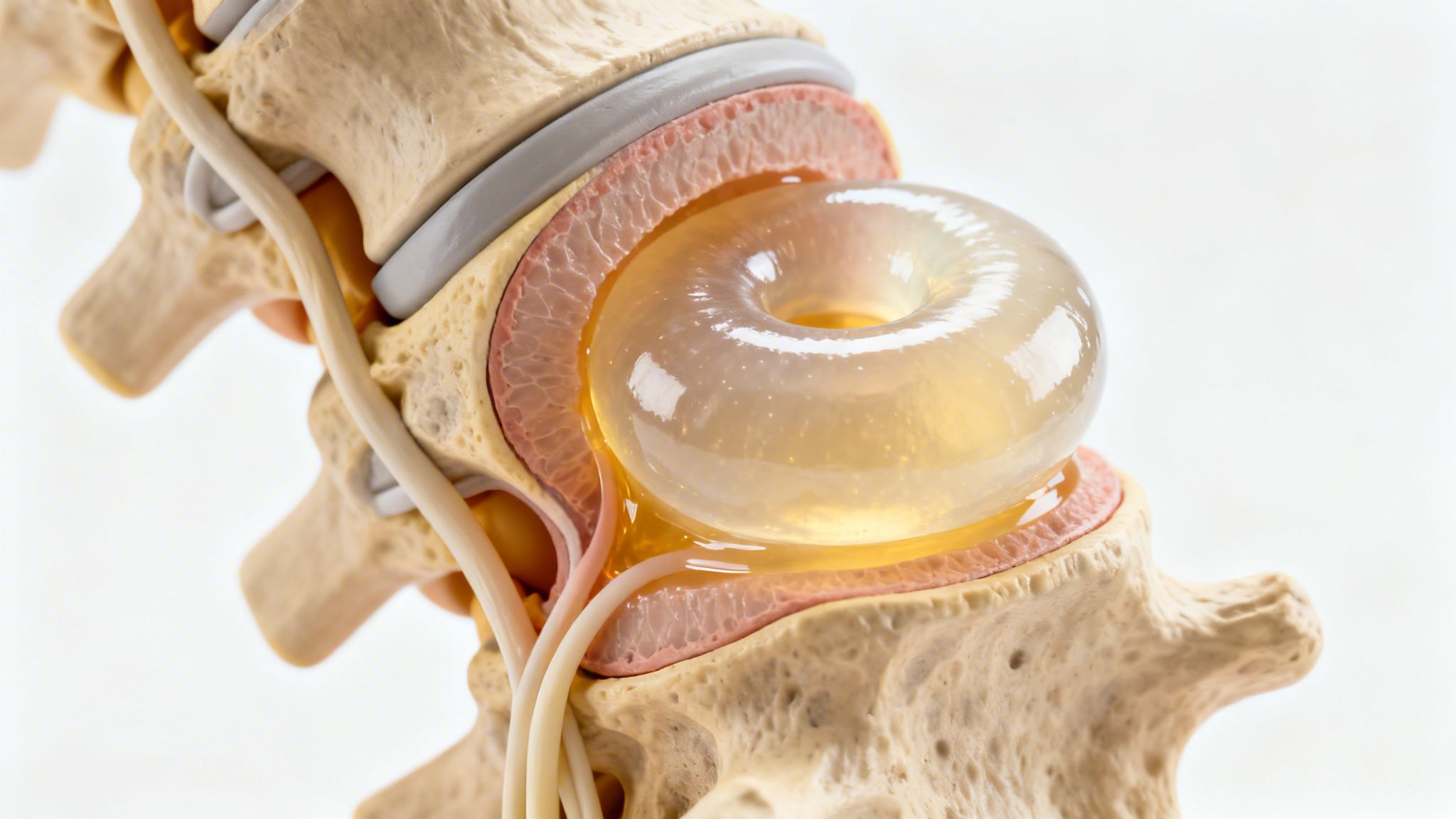
Most people think a herniated disc happens in one catastrophic moment—a loud pop during a heavy lift or a sudden wrong twist. But that final, agonizing moment wasn't the cause. It was just the breaking point after months or even years of slow, steady wear and tear.
Think of your spinal discs as jelly donuts between your vertebrae. They have a tough outer layer (the annulus fibrosus) and a gel-like center (the nucleus pulposus). They absorb shock and allow your spine to move.
A herniation occurs when that tough outer layer tears, allowing the inner "jelly" to push out. If that material presses on a nerve, you get the classic signs: searing pain, sciatica, or numbness and tingling down your leg or arm.
It's Not Random, It's Repetitive Strain
For anyone who trains, lifts, or lives an active life, this is almost never a random event. It’s the direct result of repetitive stress from a flawed movement pattern that made the disc the weakest link in the chain.
This is critical because it means the herniation itself isn't the real problem. It’s the symptom of a movement flaw that’s been silently damaging your disc, one rep at a time.
Does this sound familiar?
-
The Lifter: You've done thousands of squats. But a subtle "butt-wink" at the bottom—that slight rounding of your low back—has added a little forward-bending stress to your L4/L5 disc on every single rep. For years.
-
The CrossFit Athlete: You're deep in a WOD, and fatigue sets in. Your core bracing gets sloppy during kettlebell swings. Now, your spine is taking the load your hips and glutes were supposed to handle.
-
The "Weekend Warrior": You sit at a desk all week, so your hips are tight and your glutes are weak. Come Saturday, you hit the basketball court, and your low back is forced to twist and bend to make up for the mobility you don't have.
In each case, the herniation was predictable. That's good news.
A herniated disc isn't a life sentence for a "bad back." It's a clear signal that a movement pattern is broken—and movement patterns can be fixed.
The Desk Jockey Dilemma
Even if you crush it in the gym for an hour, the other 23 hours matter. Sitting in a chair all day puts constant, low-grade pressure on your lumbar discs.
Slouching forces your spine into flexion, which pushes the gel-like center of the disc backward against its outer wall. It essentially pre-loads the disc for failure.
You spend eight hours priming the bomb at your desk, then go to the gym to lift heavy or do something explosive. Is it any wonder it finally goes off? If this sounds like you, our guide on ergonomics and chronic back pain is a must-read.
Seeing your herniation as a mechanical failure from poor loading strategies is the first and most important step. It means we can stop chasing pain with temporary fixes. Instead, we can identify and fix the faulty movements that got you here, then build you back stronger and more resilient so it never happens again.
The Full Spectrum of Herniated Disc Treatments
Figuring out how to fix a herniated disc can feel like navigating a maze blindfolded. Everyone is selling a different “cure,” making it nearly impossible to know which path leads to actual, lasting relief.
Let’s cut through the noise. Here’s a breakdown of the entire playbook of treatments, so you understand what works, why it works, and what’s just a waste of your time.
The starting line for almost everyone is conservative care. And for good reason—when done right, it works. The first step is to calm the storm. We need to quiet that screaming nerve pain so you can start the real work of fixing the problem.
This begins with smart activity modification. This doesn't mean becoming a couch potato. It means temporarily trading the movements that are aggravating the nerve—like heavy deadlifts or high-impact running—for activities that don't, like targeted core work or walking.
The Role of Manual Therapy and Injections
Once the five-alarm fire in your back is under control, many people turn to hands-on treatments or injections. These can be useful tools, but only as part of a bigger game plan focused on long-term results.
-
Manual & Chiropractic Care: A skilled practitioner can use specific adjustments to restore motion to a “stuck” spinal joint, which can provide quick relief. But that’s just one piece of the puzzle. Getting adjusted without strengthening the muscles that support your spine is like realigning your car’s tires but never fixing the busted suspension that’s causing the problem. You’re just setting yourself up for the same breakdown down the road.
-
Epidural Steroid Injections: These shots deliver a powerful anti-inflammatory medication directly to the irritated nerve. They do not "fix" the herniated disc. Think of them as creating a window of opportunity. The goal is to reduce pain and inflammation just enough so you can tolerate the rehab exercises needed to build a stronger, more resilient back.
An injection should be seen as a tool to enable active recovery, not as a standalone cure. It's the fire extinguisher that puts out the flames so you can start rebuilding the damaged structure.
Without a solid, movement-based rehab plan to follow, an injection is just a temporary truce. The root cause—the weak core, the faulty movement patterns—is still there, waiting to flare up again.
When Is Surgery the Right Answer?
For a small percentage of people, conservative care isn’t enough. If you’re dealing with severe, relentless pain that hasn’t improved after months of dedicated rehab, or you have "red flag" symptoms like progressive muscle weakness or loss of bladder/bowel control, it might be time to discuss surgery.
The most common procedure is a microdiscectomy, where a surgeon removes the piece of the disc compressing the nerve. It’s often presented as the gold standard for relieving leg pain (sciatica) quickly. The data looks good—surgery like a microdiscectomy has success rates between 75% and 95% for relieving symptoms. One study showed that 89.3% of athletes returned to their sport after surgery. You can dig into the surgical success rates for herniated discs to see the data for yourself.
But here’s the critical part: surgery is not a magic bullet. While it’s effective at removing the material pressing on your nerve, it does absolutely nothing to fix the underlying issues that caused the disc to fail—the weak core, poor lifting mechanics, or stiff hips.
This is why post-surgical rehab is non-negotiable. If you skip it, your risk of re-herniating the same disc—or another one—goes through the roof. The best treatment for a herniated disc, even after a successful surgery, always comes back to fixing the root cause with smart, personalized movement.
If you’re located in Marlton, Mount Laurel, Cherry Hill, Moorestown, Haddonfield, Medford, or anywhere in South Jersey, and you’re sick of guessing, you don’t have to do it alone. We specialize in finding the root cause of your pain and building a plan to make you bulletproof. Schedule a Free Discovery Visit with us to get a clear, honest assessment and a roadmap back to 100%.
Why Generic Physical Therapy and Chiropractic Often Fail Active People
If you're an active adult dealing with a herniated disc, you've likely tried standard physical therapy or chiropractic care. And if you're reading this, it probably didn't deliver the long-term results you wanted. It’s not your fault. The typical model of care often fails people with performance goals because it's built on a foundation of generic, passive, and symptom-chasing treatments.
These one-size-fits-all programs are designed for the average person, not for someone who wants to get back to heavy squats, competitive sports, or a demanding active lifestyle. They might get you just good enough to get by, but they rarely make you resilient enough to stay in the game.
The Problem with “Check-the-Box” Rehab
Does this sound familiar? You get an evaluation, then you're handed off to a tech who guides you through a generic sheet of clamshells, bird-dogs, and bridges. These exercises aren't "bad," but they are the bare minimum and fail to address the why behind your injury.
A competitive powerlifter might get the same bird-dog exercise as an 80-year-old with spinal stenosis. But the lifter’s problem isn’t a general lack of "core activation"—it’s a very specific failure to maintain a braced, neutral spine under a 400-pound load.
A generic exercise sheet doesn’t fix a specific performance problem. It’s like trying to fix a faulty engine timing belt by changing the oil—it might not hurt, but it completely misses the point.
This cookie-cutter model is ineffective for active people because it lacks two critical components:
-
Personalization: It doesn’t address your unique movement flaws or specific weaknesses.
-
Progression: It never challenges you enough to build the high-level resilience needed to get back to your sport and stay there.
The Limits of Passive Chiropractic Care
The traditional chiropractic model can be equally frustrating for those seeking a permanent solution. A quick, 5-minute adjustment might feel great, providing temporary relief by getting a stuck joint moving again. Our article on chiropractic manipulation explains how we use this as part of a comprehensive plan.
But when that adjustment is the only treatment, it’s just a temporary fix. It’s like repeatedly jamming a misaligned car part back into place without ever tightening the bolts. The root cause—the weak core, poor motor control, and faulty movement patterns—is never addressed.
This is why you find yourself going back for the same adjustment week after week. The adjustment addresses the "stuck" joint but does nothing to solve the muscular weakness that allowed it to get stuck in the first place. For an active person, this isn't a long-term solution; it’s a subscription to symptom management.
Lasting recovery from a herniated disc demands an integrated approach that combines hands-on therapy with targeted, progressive exercise to build bulletproof strength and control. By fixing the root cause, you can finally break the cycle of pain and get back to performing at your peak.
If this vicious cycle sounds all too familiar and you’re in the Marlton, Mount Laurel, Cherry Hill, Moorestown, Haddonfield, Medford, or South Jersey area, it’s time to break free. Schedule a Free Discovery Visit with us and see what a different approach feels like—one that’s actually built around you, your goals, and getting you permanent results.
A Movement-Based Solution for Lasting Relief
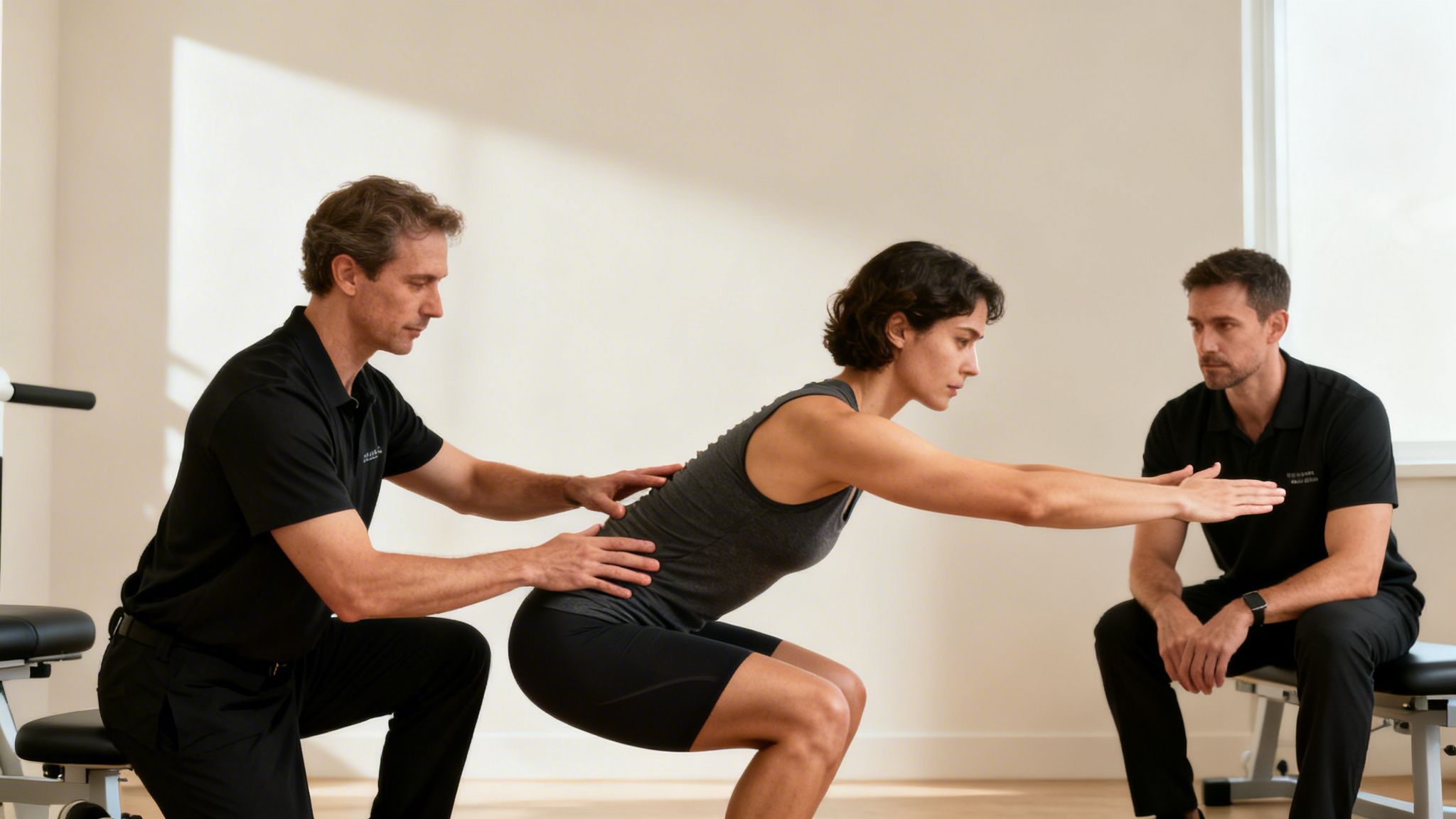
This is where we stop chasing pain and start building a real, long-term solution. The best treatment for a herniated disc isn’t about just surviving—it’s about fixing the actual problem so you can thrive. A modern, integrated approach combines precise, one-on-one care with a full-body assessment that looks far beyond the spot that hurts.
Instead of just focusing on the disc bulge on an MRI, we hunt for the root cause. It might be concrete-block hips forcing your low back to compensate, a core that fails under pressure, or stiffness in your mid-back that turns every lift into a low-back problem. Finding the real culprit is the only way to get off the injury merry-go-round for good.
From Pain to Performance: The Integrated Method
Our approach blends skilled hands-on therapy to restore motion with smart strength training to build unshakable stability. We don't just get you out of pain; we build you a permanent exit ramp off the highway of chronic injury.
This method delivers lasting results through two core principles:
-
Decompress and Restore Motion: First, we use targeted techniques, like chiropractic manipulation, to gently decompress the irritated nerve and get "stuck" spinal segments moving again. This creates immediate space and reduces pain signals.
-
Rebuild and Reinforce: This is where you become bulletproof. We create a personalized strength program that attacks the specific weaknesses that caused the herniation. This isn't about doing random bird-dogs; it’s about forging a back that can handle the demands of your sport and life.
This process transforms your body from a fragile structure one wrong move away from disaster into a powerful, coordinated machine.
Building Bulletproof Resilience for Athletes
So what does this actually look like for a weightlifter or CrossFit athlete?
Let’s say you’re a weightlifter who herniated a disc on a deadlift. The old-school model would tell you to stop deadlifting forever. Our model asks why the deadlift hurt you.
Was your core unable to brace against the load? We’ll teach you high-threshold bracing strategies and build the core endurance to hold it through a tough set.
Did your hips lock up, forcing your low back to round? We’ll unlock your hip mobility and teach you to hinge properly, so your powerful glutes and hamstrings do the work, not your vulnerable discs. You can learn more about this connection in our guide on essential lower back and hip exercises.
A truly effective treatment plan doesn’t just relieve pain. It makes you a better, more efficient, and more durable mover. The goal isn’t just to stop hurting; it’s to build a body that’s more resistant to injury than it was before.
This goal-driven plan creates long-term resilience, helping you get back to the gym, trail, or your favorite sport with total confidence. It’s about giving you the tools and the physical capacity to own your movement and never let a disc injury sideline you again.
Your Next Step to a Permanent Solution
If you’re tired of the pain-relief-reinjury cycle and want a solution that actually fixes the problem, it's time for a different approach. If you are in Marlton, Mount Laurel, Cherry Hill, Moorestown, Haddonfield, Medford, or anywhere in South Jersey, we invite you to take the first step.
Schedule a Free Discovery Visit. Let's figure out exactly what’s going on, map out your comeback story, and build a plan to get you back to the life and activities you love—stronger than ever.
Your Roadmap to Recovery From a Herniated Disc

Navigating a disc injury can feel like being lost without a map. You need a clear action plan based on a root-cause diagnosis, not just a random list of treatments from the internet.
Many people assume surgery is the only real fix, but the data tells a different story. Non-operative care often has the same return-to-play rates for athletes as surgery. That’s why a thorough diagnosis before considering surgery is critical.
While modern surgeries like disc replacement have impressive success rates, sometimes over 90%, and a microdiscectomy for an L4-L5 herniation hits around 90% success, the best treatment is the one that keeps you off the operating table. If surgery is unavoidable, the goal is to ensure you don’t end up back there with a repeat injury. You can learn more about how different surgical options compare to conservative care to see the full picture.
Your Initial Action Plan
Before starting any rehab program, you need to know if you're dealing with a true emergency.
Emergency Red Flags:
-
Progressive and significant weakness in a leg or arm.
-
Loss of bowel or bladder control.
-
Numbness in the "saddle" region (inner thighs and groin area).
If you experience any of these, go to an emergency room immediately. For everyone else, your road to recovery begins with a simple, three-step strategy.
A Step-by-Step Guide to Begin Healing
This isn’t about diving into complex exercises. It’s about creating an environment where your body can calm down and begin to repair itself.
-
Stop Picking the Scab: This is the golden rule. Identify and immediately stop any activity that causes sharp, shooting, or radiating pain. For a lifter, this might mean swapping barbell back squats for goblet squats. For a runner, it could mean switching to incline walking or an elliptical.
-
Focus on Pain-Free Movement: Your body needs movement to heal, but it must be the right kind. Start with gentle core activation that doesn't aggravate the nerve, like controlled breathing drills or basic pelvic tilts. The goal is to re-establish a connection with your core muscles without causing pain.
-
Get a Comprehensive Diagnosis: This is the most crucial step. You need a movement-focused provider who will look beyond your MRI report to figure out why the disc failed. A proper diagnosis is the foundation of any treatment plan that delivers long-term results.
Your next step is clear. Don't guess what will work or follow a generic plan. Get a precise diagnosis that uncovers the root cause of your specific injury.
If you’re in Marlton, Mount Laurel, Cherry Hill, Moorestown, Haddonfield, Medford, or anywhere in South Jersey, your roadmap to recovery starts here. We invite you to schedule a Free Discovery Visit to get a precise diagnosis and understand your specific path back to performance, with no obligation.
Your Herniated Disc Questions, Answered Honestly
When you're an active person sidelined by a disc injury, you want real answers, not the generic "just rest and take pills" advice you've heard before.
Here are the big questions we get from athletes and active adults, answered from a root-cause, performance-focused perspective.
Can a Herniated Disc Heal on Its Own?
Yes, your body is an incredible healing machine. A large number of herniated discs can and do resolve without surgery. But here's the critical distinction: "healing on its own" doesn't mean passively waiting on the couch for a miracle.
Passive rest won't fix the weak core, poor lifting mechanics, or faulty movement habits that caused the disc to fail. True healing is an active process. You have to create the right environment by unloading the injured area and rebuilding a stronger, more bulletproof system around it.
Will I Have to Stop Lifting Weights Forever?
Absolutely not. That’s not only a miserable thought, but it's also incorrect. In fact, smart, progressive strength training is the cornerstone of the best treatment for a herniated disc. The key is to shift your mindset from viewing exercises as "good" or "bad" to understanding the principles of proper movement.
For a lifter, the goal isn't to stop deadlifting forever. It's to finally master the hip hinge and core bracing so you can perform the lift without your spine taking a beating. You might temporarily swap the barbell for kettlebells or use different variations, but the long-term mission is to build you back stronger and more technically sound than you were before the injury.
A disc injury isn't a life sentence to the leg press machine. It's a chance to rebuild your squat, deadlift, and other foundational lifts from the ground up, making them brutally efficient and unbreakable.
How Long Does Recovery Take?
This is the "it depends" answer nobody likes, but it's the truth. The timeline depends on the severity of the injury and the quality of your rehab. While some people feel much better in a few weeks, a full return to high-level activities like CrossFit or competitive sports takes longer.
A realistic path moves from getting out of pain, to rebuilding foundational strength, and then—and only then—slowly reintroducing sport-specific movements with perfect form. Rushing this process is the fastest way to get reinjured. A disciplined, patient approach that focuses on quality movement is always the fastest path to long-term success.
At Valhalla Performance, we guide active adults in South Jersey through this exact process. If you're in Marlton, Mount Laurel, Cherry Hill, Moorestown, Haddonfield, or Medford and you’re tired of guessing, it's time for a real plan.
Schedule your Free Discovery Visit at thevalhallaperformance.com. Let's find the root cause of your pain and build your roadmap back to peak performance.