
You stretch your hip after every BJJ class. Your shoulder gets the doorway stretch before every upper-body day. Your hamstrings get attacked with bands, foam rollers, and whatever mobility drill social media served you that morning.
And you're still in pain.
That’s the part nobody wants to say out loud. A lot of active adults are doing the “right” things and getting nowhere. They’ve done PT. They’ve done chiropractic. They’ve done the home exercises, the lacrosse ball, the stretching routine taped to the fridge. Relief shows up for a minute, then disappears the second they run, lift, roll, swing, or sit too long.
If that sounds familiar, the problem probably isn’t that you need to stretch harder. The problem is that you’ve been treating a warning light like the engine.
You've Stretched Everything and You're Still in Pain
You know this cycle if you’ve lived it.
A runner wakes up with that same “tight” hamstring. They stretch it before the run. It loosens a bit. Mile three hits, and it grabs again. A lifter spends ten minutes opening up the shoulder before pressing. The first set feels decent. Then the pinch comes back overhead. A BJJ athlete keeps smashing a hip flexor with couch stretches because the front of the hip always feels jammed during guard work. Temporary relief. Same problem tomorrow.
That cycle wears people down fast. Not just physically. Mentally.
You stop trusting your body. You start negotiating with pain before every workout. You wonder whether this is just what getting older feels like, even though you know deep down that’s lazy advice and you’re not ready to accept it. You don’t want to become the person who “used to” run, “used to” lift, “used to” train.
When relief keeps expiring
The most frustrating part is that stretching can feel like it’s helping, just enough to keep you hooked.
That’s why people stay stuck for months or years. The stretch gives a brief reduction in tension, so you assume you found the right target. But if the same area keeps tightening back up like a seatbelt yanking on you, your body is telling you something important. It is not fixed. It is compensating.
You don't need another bigger stretch. You need an honest answer about why your body keeps asking for protection in the same spot.
The real cost of chasing the wrong fix
This isn’t just about nagging soreness. It changes how you train and how you see yourself.
- In the gym: You avoid positions that expose the issue. Deep squats become partial reps. Overhead work disappears.
- On the mat: You stop scrambling hard because you don’t trust your hip, neck, or back.
- On the road or trail: You shorten runs, skip speed work, and tell yourself consistency matters more than intensity, when really pain is making the decision.
- At home: You get stiff getting off the floor with your kids, or think twice before carrying something heavy.
If it’s this annoying now, what’s it going to look like a few years from now if all you do is keep pulling on the same irritated tissue and hoping the answer finally shows up?
That’s why stretching advice makes me crazy when it’s handed out like a default prescription. For a lot of active people, it’s not just incomplete. It’s the reason they stay trapped.
The Great Stretching Myth Why We All Got It Wrong
The old story sounds clean and simple. You feel tight. Tight means short. Short means stretch it.
That story is easy to understand and easy to sell. It treats your body like a collection of rubber bands. If one feels restricted, just pull it longer and the problem disappears. Nice theory. Bad model.

Tightness is a message, not a diagnosis
Tightness is often treated like the main issue. It usually isn’t.
Tightness is often a signal. It can mean your body feels unstable, overloaded, poorly coordinated, irritated, or threatened by a movement pattern. Stretching that area over and over without asking why it’s tight is like pumping air into a tire with a slow leak. You’ll keep getting the same result because you never fixed the underlying problem.
The same thing happens with warm-ups. People confuse feeling looser with being better prepared. Those are not the same thing. If you want movement prep that properly fits training, use active work that teaches control, not just passive hanging and yanking. A smart dynamic stretching routine for training makes a lot more sense than parking in static stretches and hoping your body cooperates.
The research isn’t flattering to stretching
The evidence here is blunt. Post-exercise stretching as a standalone intervention produces negligible and statistically non-significant improvements in muscle soreness, performance, or pain, according to an extensive meta-analysis published in Frontiers in Physiology. The same analysis concluded that stretching, by itself, is severely limited as a primary recovery tool because it does not adequately address the complex nature of pain involving inflammation, microtrauma, and central sensitization.
That should be a wake-up call.
People have been told for years that stretching is mandatory for recovery, pain relief, and injury prevention. But if your pain has been hanging around despite all that faithful stretching, you are not broken and you are not failing rehab. You were handed a simplistic answer to a more complicated problem.
Practical rule: If you have to stretch the same area every day just to feel temporarily normal, stop assuming that area is the true problem.
Why this myth survives
Because stretching is easy to prescribe. It feels proactive. It gives you something to do.
But easy doesn’t mean effective. A lot of generic rehab gives people passive homework because it’s simple, not because it solves the issue. Active adults deserve better than a photocopied hamstring stretch and instructions to “take it easy.”
If you train hard, compete, or just refuse to give up the things that make you feel like yourself, you need a better framework. Pain is rarely a pure flexibility problem. It’s usually a control, stability, or sensitivity problem wearing a flexibility costume.
Your Brain Is Holding Your Muscles Hostage
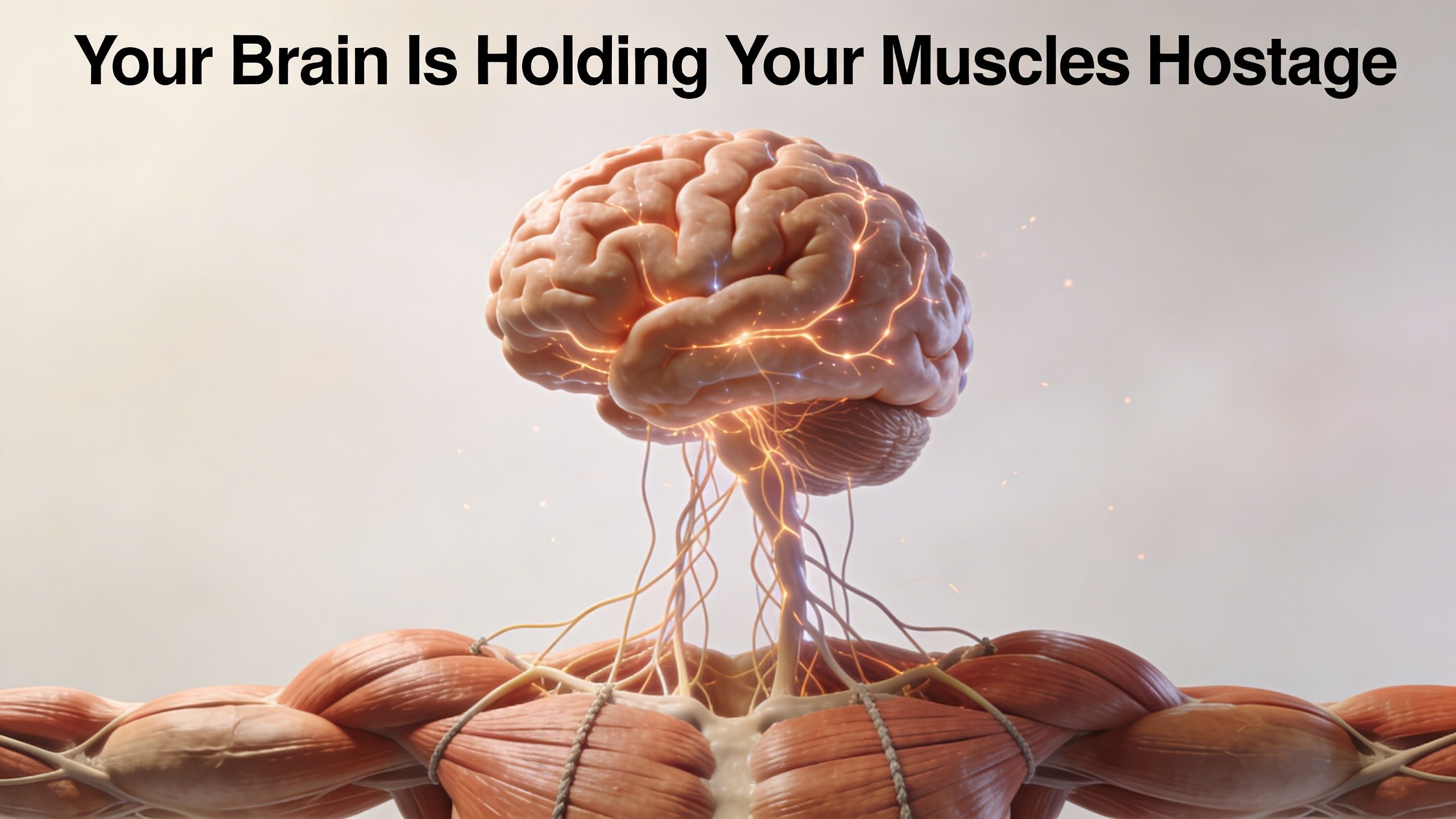
The reason why stretching doesn't fix pain often has nothing to do with your muscles being too short. It has to do with your nervous system deciding that certain muscles should stay turned on.
That’s the part many never hear.
Your brain and nervous system set the resting tension in your body. Not the foam roller. Not the banded distraction drill you saw online. Your body has an internal setting for how much tension it thinks is necessary to keep you safe in a given area. If that setting is too high, the muscle feels tight even when “stretch more” is the exact wrong answer.
Think thermostat, not tissue length
A good way to understand this is to think of a thermostat.
If your house thermostat is set too high, opening a window might cool the room for a bit. But the system will kick back on and bring the temperature right back where it started. That’s what chronic tightness often looks like. Stretching is the open window. Your nervous system is the thermostat.
The problem is that stretching does not reset the gamma feedback loop, the neurological mechanism that helps establish resting muscle tension. The explanation from Somatic Movement Center is direct: prolonged static stretching can temporarily suppress the stretch reflex, creating a false sense of improvement that lasts only a few hours before the original programming returns.
That’s why the same calf, hip, hamstring, or shoulder keeps calling your name day after day. The body never changed the setting. You just muted the alarm for a minute.
Why passive stretching keeps losing the fight
When you stretch a muscle that your nervous system already wants to guard, you can trigger the very reflexes designed to resist that change. Even when the stretch creates short-term relief, it doesn’t teach the brain a new pattern. It doesn’t improve how you own that range. It doesn’t prove to your system that the area is strong, stable, and safe under load.
So what changes the setting?
- Slow, controlled movement: This gives your brain better information than passive pulling.
- Sensory feedback: Position, breathing, pressure, and awareness help the system stop acting like every movement is a threat.
- Loaded control: Your body trusts positions you can control, not positions you can barely survive.
- Repetition with intention: The nervous system learns through consistent input, not random stretching marathons.
What this looks like in real training
If your shoulder feels tight overhead, the answer might be teaching your rib cage, scapula, and shoulder to move together under control. If your hamstring always feels like a piano wire, the answer might be regaining control through hinging, pelvic position, and glute function.
That’s why some people feel looser after a well-structured strength session than after sitting in stretches. Their nervous system got better information. It stopped slamming the brakes.
A body part that only feels good when you yank on it is not fixed. It’s just temporarily distracted.
The short version
If the nervous system is the one holding tension high, passive stretching is a poor negotiation strategy. You don’t solve a software problem by pulling harder on the hardware.
You change the software with movement quality, graded loading, better coordination, and enough strength that your body no longer feels the need to guard every inch of motion.
The Stability Lie Why Tightness Is a Cry for Strength
A lot of “tight” muscles are doing dirty work for somebody else.
That hamstring may be trying to stabilize for a glute that’s asleep at the wheel. That upper trap may be grabbing because your shoulder blade doesn’t have enough support. That hip flexor may be bracing because your trunk can’t control force well enough to make the hip feel safe.
The discussion gets uncomfortable, because people love the idea that they just need more mobility. It sounds easier. It sounds cleaner. But your body doesn’t care what sounds nice. It cares whether the joint feels protected.
Your body is guarding for a reason
According to Spectrum Therapy, pain and muscle tightness typically result from muscular compensation patterns triggered by weakness or instability elsewhere. When certain muscles lack strength, adjacent muscles tighten defensively to stabilize compromised joints. Stretching that compensatory muscle can increase instability and trigger more protective guarding afterward.
That’s the punchline often missed. The tight muscle may be the hero, not the villain.
Take away its tension without fixing the support system, and your body often responds by tightening it right back up. It’s like kicking out a crutch and then acting surprised when the person limps harder.
Why weak muscles can still feel tight
This confuses people all the time.
They assume that if a muscle feels tight, it must be short and powerful. Not necessarily. A muscle can feel tight because it’s overworked, irritated, poorly coordinated, or stuck doing a stabilization job it was never meant to handle all day.
Here’s what that often looks like:
- Hamstrings: They grip because the hips and pelvis aren’t controlled well.
- Hip flexors: They clamp down because the trunk can’t create enough stability.
- Neck muscles: They brace because the upper back and shoulder girdle aren’t doing their part.
- Low back muscles: They lock up because the hips don’t rotate well and the trunk leaks force.
What to do instead of attacking the symptom
If tightness is driven by a stability problem, the answer is usually not more passive length. The answer is better support.
A smart plan often includes:
- Strength work in the right places: Build the weak links that force the overworked area to compensate.
- Movement retraining: Teach the body a cleaner pattern so the same tissues don’t keep taking the hit.
- Controlled range of motion: Earn mobility you can own.
- Progressive loading: Make the body more resilient under the exact demands of your sport or training.
If you’re an athlete or serious recreational lifter, generic stretching isn’t enough preparation for your body to absorb force, create force, and rotate without leaking tension everywhere. You need the kind of work found in real strength and conditioning for athletes, where stability and output get trained together.
When a muscle keeps “getting tight,” ask which weaker area forced it to become the bodyguard.
The trap active adults fall into
Active people are stubborn. That can be a strength. It can also keep you stuck.
You feel resistance in a movement, so you attack the resistance. More stretching. More smashing. More mobility classes. Meanwhile, the actual issue keeps laughing in the background because nobody trained the weak link.
Your body is not asking for endless flexibility homework. A lot of the time, it’s begging for strength, control, and a reason to stop guarding.
Real-World Scenarios From the Mat to the Marathon
Theory matters. Real life matters more.
Most active adults don’t care about rehab jargon. They care about one thing. Why does this keep happening when I’m trying to train?
Here’s what this pattern looks like in the wild.

The CrossFit athlete with the stubborn shoulder
They say their lats and pecs are “so tight” that front rack and overhead positions always feel blocked.
So they stretch the lats. Hang from bars. Smash the pec minor. Spend half the class mobilizing while everybody else warms up and gets to work. Then they still get that pinch pressing overhead or catching a bar.
A lot of the time, the shoulder isn’t begging for more length. It’s begging for better scapular control, rib cage position, and rotator cuff function. The body doesn’t trust the overhead slot, so it locks things down.
The runner with the permanent hamstring issue
They’ve been stretching the hamstring for months. Maybe years.
It always feels like it’s about to pull, especially after speed work or hills. They keep treating the hamstring like the problem because that’s where they feel it. Meanwhile, weak or poorly timed glute function keeps asking the hamstring to do extra work during propulsion and deceleration.
The runner thinks they need more flexibility. What they usually need is stronger hips, cleaner mechanics, and control through the pelvis so the hamstring stops doing overtime.
The BJJ athlete with the “tight” hip flexor
This person can sit in a couch stretch and breathe through misery. They’re proud of it.
But they still feel pinching in the front of the hip when they invert, shoot, or play guard. That’s because front-of-hip discomfort often isn’t a simple tissue length issue. Poor core control, poor hip rotation strategy, and bad positional awareness can all make the front of the hip feel crowded and reactive.
Stretching harder into that doesn’t make the joint feel safer. It often makes the body guard harder later.
The golfer with recurring low back pain
They swear their back is tight. They twist, stretch, hang, and crack it. Relief lasts until the next round, range session, or long drive in the car.
The low back often gets blamed because it’s loud. But many golfers are missing hip rotation, thoracic movement, and the ability to transfer force well. The low back becomes the emergency substitute and pays the bill.
Here’s the blind spot. Continuously stretching an already-weakened muscle can further weaken it by disrupting the strength-tension relationship, creating a loop where the muscle feels tighter and tighter and gets stretched more and more, as explained in this analysis from Flow PT Wellness.
The pattern behind all four
Different sport. Same mistake.
| Athlete | What they feel | What they usually do | What often needs attention |
|---|---|---|---|
| CrossFit lifter | Shoulder tightness overhead | Stretch lats and pecs | Scapular stability and shoulder control |
| Runner | Tight hamstring | Stretch before and after runs | Glute strength and pelvic control |
| BJJ athlete | Hip flexor tightness or pinching | Aggressive hip stretches | Core stability and hip motor control |
| Golfer | Tight low back | Twist and stretch back daily | Hip rotation and thoracic motion |
If you see yourself in one of these, stop trying to win a strength problem with a flexibility tool.
The Valhalla Method Building a Body That Doesn't Need Stretching
If stretching hasn’t fixed it, the answer isn’t to quit on movement. The answer is to get more precise.
The right plan starts by finding out what kind of problem you have. Not all pain is muscular. Not all tightness is a mobility issue. And not every sore area should be stretched just because that’s what generic rehab tends to hand out.
First, figure out what kind of pain you're dealing with
This matters more than people realize.
When pain is driven by nerve compression or inflammation, aggressive stretching can make things worse by irritating already sensitized tissue. That’s especially relevant in problems like sciatica, where the source may not be a “tight” muscle at all. This overview on why stretching can fail in sciatica and similar cases makes the point clearly. You have to differentiate nerve-driven pain from muscle-driven pain before choosing treatment.
That’s why guessing is such a bad strategy.
A useful assessment asks questions like these:
- Does the pain change with position or load? That can point toward a movement and tolerance issue.
- Is there numbness, zinging, burning, or radiating pain? That changes the entire game.
- Is the painful muscle weak? If yes, stretching it harder may be feeding the problem.
- Does the joint move poorly? Sometimes the tissue is innocent and the joint is the limitation.
Then build the right solution
A real rehab plan is active. It teaches your body to stop asking the same tissues to do the same desperate jobs.
One option for that kind of care is Valhalla Performance’s mobility and flexibility approach, which combines joint assessment, movement retraining, and strength work rather than using stretching as a standalone answer.
What works tends to look like this:
Root-cause assessment
Test what’s weak, what’s guarded, what’s painful, and what’s just noisy. Don’t assume the painful spot is the source.Strategic strengthening
Strengthen the area that failed to provide support in the first place. If glutes are underperforming, train them. If the shoulder blade lacks control, build it.Motor control retraining
Teach your body how to use the range it already has, and how to earn more range with control. This is how you change the nervous system’s opinion about a position.Manual care with a purpose
Joint work can help, but only if it supports active change. A quick crack without follow-through is a trailer for a movie you never watch.
The goal isn't to become someone who stretches more. The goal is to become someone whose body no longer has to scream for protection every day.
What durable progress feels like
Durable progress doesn’t usually feel dramatic at first. It feels stable.
Your squat stops feeling sketchy at the bottom. Your shoulder no longer needs a ritual before pressing. Your hamstring stops threatening you every time pace picks up. You stop thinking about the painful area every hour because it stops running the show.
That’s what people actually want. Not temporary relief. Ownership.
Your Path Off the Sidelines Starts Now
You can keep doing what is commonly done. Stretch the loud area. Hope today is different. Get a few minutes of relief. Repeat tomorrow.
That road is crowded for a reason. It doesn’t lead anywhere.
If you’re an active adult dealing with persistent pain, your body is not asking for more random flexibility work. It’s asking for a real diagnosis. It’s asking for someone to figure out whether the problem is coming from poor stability, weak links, bad movement strategy, joint dysfunction, or irritated nerves. Until that happens, you’re just chasing symptoms with a tool that was never built to solve the whole problem.
Stop bargaining with pain
Pain has a way of shrinking your life slowly.
First you modify the workout. Then you skip the class. Then you stop signing up for races, rounds, or tee times because you don’t trust how your body will respond. Eventually the issue isn’t just physical. It starts messing with your confidence.
That’s the bigger threat. Not one cranky shoulder or one stubborn hip. It’s becoming hesitant in a body that used to feel capable.
Make the next move count
If you live in Marlton, Mount Laurel, Cherry Hill, Moorestown, Haddonfield, Medford, or anywhere in South Jersey, stop wasting months on recycled advice that hasn’t worked.
Get the issue looked at properly. Figure out whether your “tightness” is really a strength problem, a control problem, a joint problem, or a nerve problem. Then build a plan that matches reality.
You don’t need another lecture about stretching more consistently. You need a strategy that helps you lift, run, roll, swing, and train without feeling like your body is one bad rep away from a setback.
If you're ready to stop guessing and get a real plan, schedule a Free Discovery Visit with Valhalla Performance. It’s a simple first step for active adults in South Jersey who want to understand the root cause of their pain and what it will take to get back to training with confidence.