
You’ve probably done the whole routine already.
Your knee flares up three miles into a run. Your shoulder clicks every time the bar goes overhead. Your low back tightens up after deadlifts, golf, or a hard round of jiu-jitsu. So you did what responsible adults do. You went to physical therapy. You tried chiropractic. Maybe both. Maybe more than once.
And yet you’re still typing athlete chiropractor near me into Google because the problem never left. It just got quieter for a minute.
That’s the part that drives people nuts. Not just the pain. The feeling that your body is turning into a project. The feeling that the stuff that makes you feel like yourself is getting taken away one lift, one run, one round, one weekend at a time.
Still in Pain After Physical Therapy and Chiropractic
You’re not crazy. You’re not fragile. And you’re probably not “just getting older.”
You likely got stuck in a bad treatment model.

A lot of active adults hit the same wall. The runner gets a sheet of band walks and calf stretches. The CrossFitter gets told to stop snatching for a while. The golfer gets a few quick adjustments and is told to “listen to your body,” which is useless advice when your body has been complaining for six months.
The real problem
Most failed care plans have one thing in common. They chase pain instead of solving the reason the pain keeps coming back.
A stiff ankle can keep feeding a cranky knee. A locked-up mid-back can keep dumping force into your shoulder. A weak hip can keep your back doing work it was never supposed to do. If nobody found that chain, then no, the issue wasn’t fixed. It was babysat.
A sore spot is rarely the whole story. Athletes lose progress when providers treat the symptom and ignore the movement pattern that keeps recreating it.
That’s why people bounce from visit to visit getting temporary relief but no real change.
There’s also a major gap in standard care. Recent 2025 reporting on sports injury chiropractic care says combined chiropractic-strength programs reduce re-injury rates by 40% in recreational athletes compared to chiropractic alone, yet most clinics still lean on isolated adjustments instead of building strength into the plan.
Why this matters emotionally, not just physically
If your shoulder still hurts now, what happens after another year of pressing around it?
If your shin splints keep coming back now, what happens when every run starts feeling like a negotiation?
This stuff steals more than workouts. It chips away at identity. The runner stops signing up for races. The lifter avoids leg day. The parent hesitates before getting on the floor with their kids. That’s not a small loss.
If you want a deeper look at what movement-based rehab should look like, this page on sports performance physical therapy is worth your time.
The Vicious Cycle of Temporary Fixes
Let’s call out the nonsense.
The “pop, crack, see you next week” model is not performance care. It’s symptom management with better branding.
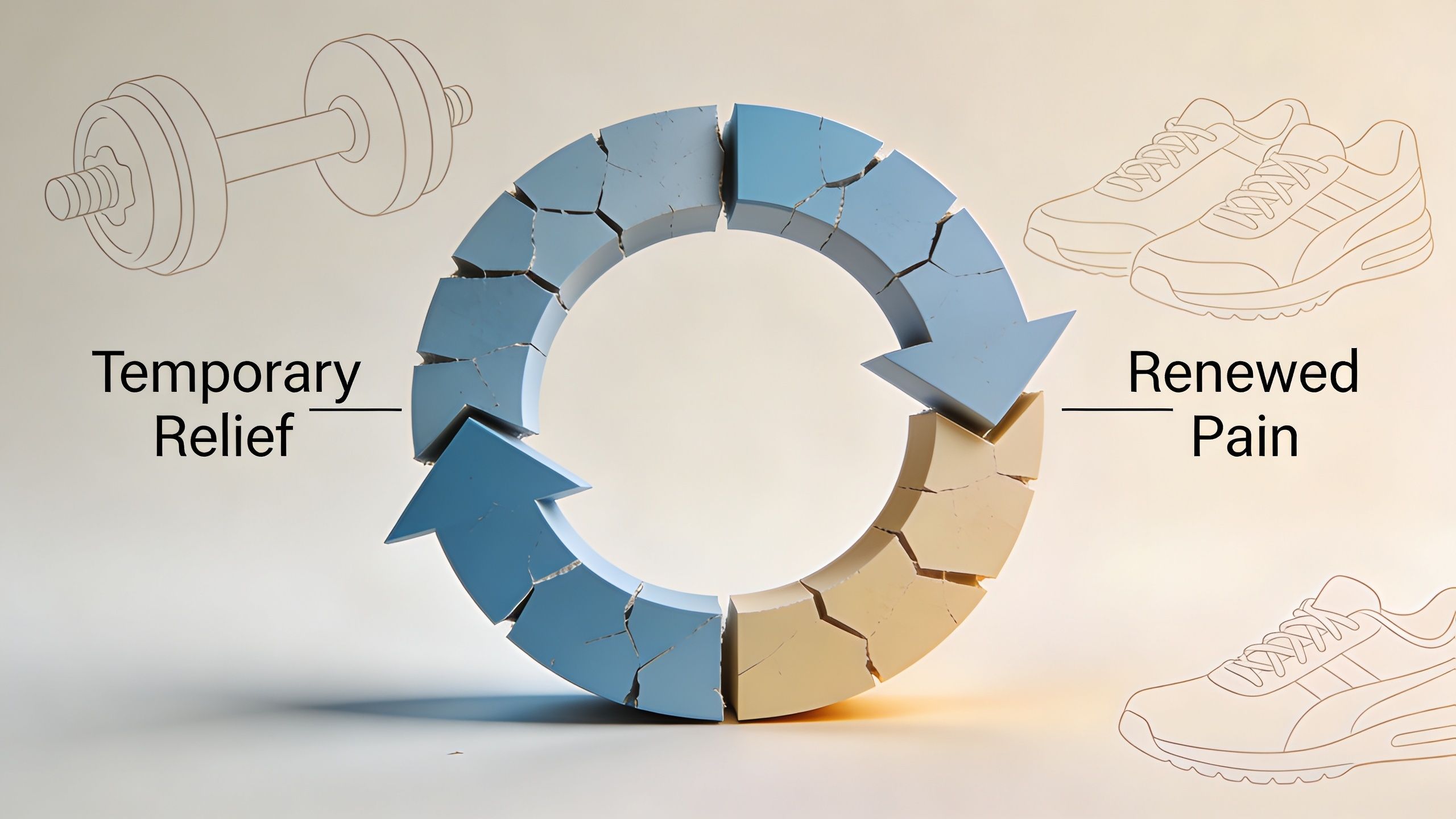
An adjustment can absolutely help. Good hands-on care matters. But if that’s all you get, you’re basically resetting a joint without teaching your body how to keep it there. That’s like inflating a tire with a nail in it and acting surprised when it goes flat again.
Why generic PT misses active people
Traditional PT often fails active adults for a simple reason. The exercises never progress to the demands of real life.
If you want to get back to heavy squats, hill sprints, rotational power, takedowns, or long rounds on the mat, then a few low-level rehab drills aren’t enough. They might calm things down. They won’t build capacity.
Here’s what that looks like in real life:
- Weightlifter: elbow pain settles with rest, then comes roaring back as soon as pulling volume goes up
- Runner: knee pain disappears during reduced mileage, then returns the second speed work starts
- Golfer: back feels “fine” until the course, where rotation exposes the same old restriction
- BJJ athlete: neck or hip improves after treatment, then gets tweaked again the first hard roll back
Why serious athletes use chiropractic differently
The funny part is people love to dismiss chiropractic because they’ve only seen the watered-down version.
According to this overview of chiropractic and sports performance, an estimated 90% of professional athletes use regular chiropractic care, not as a gimmick, but as part of maintaining biomechanics, reducing injury risk, and supporting performance. Pros don’t use it as a magic trick. They use it as one piece of a bigger system.
Practical rule: If a treatment gives you short-term relief but doesn’t improve how you move under load, it’s incomplete.
The cycle that keeps people stuck
It usually goes like this:
- Pain shows up during training or sport.
- You rest or get treatment and feel some relief.
- You return too soon to the same movement pattern.
- The pain returns because the root cause never changed.
That cycle eats months. Then years. Then people start saying ridiculous stuff like “I guess my body just can’t handle that anymore.”
No. Your body can probably handle a lot. It just hasn’t been rebuilt properly.
Our Approach A Real Solution for Athletes
If you want long-term results, stop choosing between treatment and training. You need both.
Manipulation without strength is temporary. Strength work without restoring motion is compensating with better-looking exercises. Neither one is enough by itself if you want to stay active and stop reliving the same injury story.
What effective care actually includes
Real athlete-focused care has to do three jobs at once:
- Restore motion in the joints and tissues that are stiff, guarded, or moving poorly
- Rebuild control so your body can own that motion instead of losing it again
- Reload the pattern so it holds up under real demand, not just on a treatment table
That means your plan should feel less like passive care and more like smart coaching with clinical precision.
The difference in plain English
Here’s the split between standard care and the model that respects how athletes move.
| Feature | Standard Chiro/PT | Valhalla Performance |
|---|---|---|
| Visit style | Quick adjustments or shared rehab space | One-on-one care for the full visit |
| Primary focus | Pain relief | Root-cause diagnosis and long-term function |
| Movement analysis | Basic or skipped | Detailed assessment of squat, hinge, gait, rotation, and sport demands |
| Adjustments | Often isolated | Paired with active rehab and progression |
| Exercise plan | Generic home sheet | Personalized strength and conditioning with clear progression |
| Goal | Feel better this week | Move better, train better, stay better |
| Patient role | Passive recipient | Active participant who understands the plan |
What athletes should demand
You should expect a provider to answer basic questions clearly.
- Why does this keep happening? If they can’t explain the pattern, they’re guessing.
- What are we measuring? If progress is just “how do you feel today,” that’s weak.
- How does this get me back to my sport? If care never connects to running, lifting, golf, or jiu-jitsu, it’s not athlete care.
If your rehab doesn’t look anything like the way you need to move in real life, don’t be shocked when real life keeps hurting.
The right approach isn’t flashy. It’s just more honest. Find what’s not moving. Find what’s weak. Fix both. Then build enough resilience that your body stops folding every time training gets serious.
How We Rebuild You From the Ground Up
This is the part most clinics skip because it takes time, attention, and actual thinking.
A real return-to-sport process starts with watching you move, not just asking where it hurts.
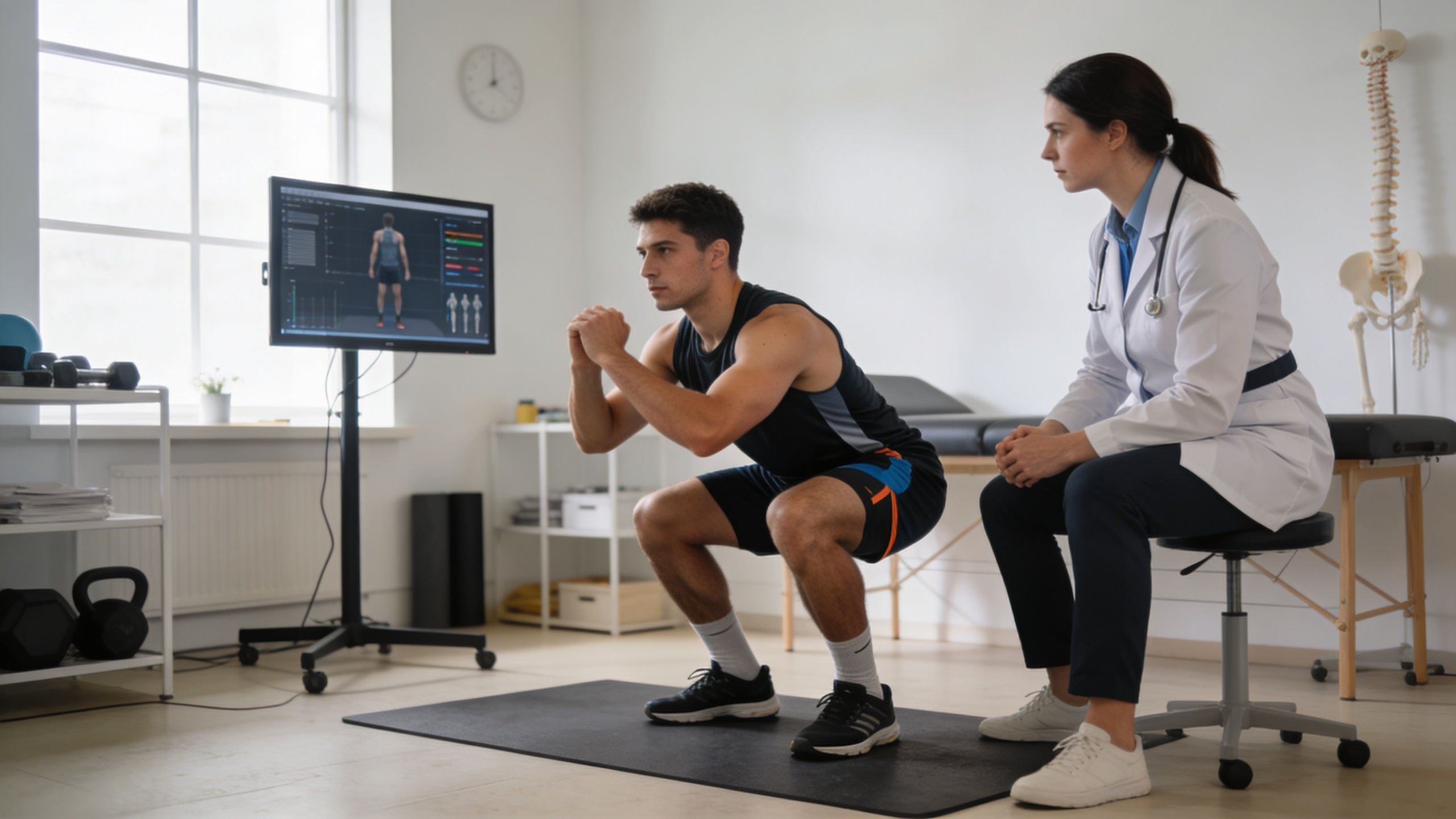
Step one is finding the weak link
If you squat and shift, hinge and compensate, run with poor control, or rotate like a rusty shopping cart, that matters more than the pain scale.
A good assessment looks at:
- Loaded patterns like squats, hinges, lunges, presses, and carries
- Sport-specific stress like overhead mechanics, gait, grappling positions, and rotational power
- Joint contribution so you can spot where one area is forcing another area to clean up the mess
A golfer with back pain might be missing thoracic rotation. A runner with knee pain might have an ankle that doesn’t move well. A BJJ athlete with hip pain might be guarding one side and twisting through the low back instead.
Step two is restoring motion where you need it
Chiropractic earns its keep when it’s used with purpose.
According to this review of sports injury performance care, chiropractic extremity adjustments can lead to 15-25° gains in range of motion in joints like the ankle or shoulder, and they’re important for preventing bigger chain problems like IT band syndrome or rotator cuff trouble in athletes.
That matters because restricted joints don’t just stay local. They force compensation elsewhere.
A few examples:
- CrossFit shoulder pain: restoring motion at the shoulder and upper back so pressing mechanics stop grinding
- Runner ankle restriction: improving ankle function so the knee doesn’t keep paying the bill
- BJJ hip limitation: opening rotation so guard work stops spilling stress into the lumbar spine
If you want to see how athletic rehab should pair with performance work, take a look at strength and conditioning for athletes.
Step three is building strength that sticks
The long-term change happens here.
Not clamshell purgatory. Not endless bird-dogs. Not rehab that feels like punishment for being active.
You need targeted strength that matches your deficits and your sport. If your single-leg control is shaky, train it. If your trunk can’t resist rotation, build it. If your shoulder can’t control the overhead position under fatigue, own that position before loading it hard again.
Treatment opens the door. Strength keeps it from slamming shut again.
That’s how you rebuild from the ground up. Assess. Restore. Reinforce. Then progress until your body can handle your life again.
Your Journey Back to Peak Performance
Individuals delay getting help because they’re expecting another sales pitch, another cookie-cutter exam, or another provider who talks at them instead of listening.
That hesitation makes sense. A lot of you have been burned already.
What the process should feel like
The first step should be a conversation. You talk through what hurts, what you’ve tried, what keeps failing, and what you want to get back to. Not just “less pain.” Real goals. Running without your knee blowing up. Pulling heavy without back spasms. Rolling hard without your neck feeling cooked for three days.
Then comes a proper one-on-one evaluation. History matters. Training history matters even more. Your movement tells the truth.
From there, sessions should revolve around two things:
- Hands-on care with a reason so restricted joints and tissues stop sabotaging movement
- Progressive rehab with intent so your body can tolerate real demand again
What improvement should look like
Progress isn’t just “it feels a bit better after the visit.”
It should look like cleaner movement, better tolerance to training, more confidence in positions that used to feel sketchy, and fewer flare-ups after normal life or hard effort. That’s what active adults care about.
There’s also a performance upside to quality chiropractic care. This report on chiropractic for sports injuries notes that 32% of athletes receiving chiropractic care report significant gains in flexibility, speed, and power, along with a reduction in injury rates during sport. That doesn’t mean everyone gets magic powers. It means better function tends to show up where athletes notice it most.
The end goal
The goal isn’t to keep you dependent on treatment.
The goal is to graduate you back into your sport with a body that’s stronger, more aware, and harder to break down. You should understand your triggers, know your weak points, and have a plan to stay ahead of them.
That’s what real confidence feels like. Not crossing your fingers before every workout.
Is a Movement-Based Chiropractor Right for You
Not everyone needs this approach.
But if you’ve already tried the usual stuff and you’re still stuck, then yes, this is probably what you should’ve done earlier.

You’re a good fit if these sound familiar
- You lift and keep getting told to stop lifting heavy. That advice is lazy. The better question is why your body can’t currently tolerate the load.
- You run and the same issue returns every training cycle. Rest doesn’t fix bad mechanics or poor load capacity.
- You play golf and your back tightens every round. Your swing is asking for motion and control. If your body can’t supply it, something else gets overloaded.
- You train BJJ and keep tweaking your neck, back, or hips. Grappling exposes every weak link you’ve got.
- You’re an active parent or weekend athlete who just wants their body back. You shouldn’t need a recovery plan just to get through a normal Saturday.
You’re probably not a good fit if
You want someone to crack you, reassure you, and send you home with no work to do.
That sounds harsh, but it’s true. A movement-based chiropractor is for people who want answers and are willing to participate in fixing the problem.
If walking, running, and lower-body mechanics are part of your issue, this page on gait training gives a useful starting point.
The best years of your active life don’t have to be behind you. But they won’t magically show up if you keep repeating the same failed plan.
The bigger decision
This isn’t just about pain today.
It’s about whether you want your future to keep shrinking. Fewer miles. Lighter weights. Shorter rounds. More caution. More skipped workouts. More “I used to.”
That slide happens slowly. Then all at once. Fixing it early is easier than pretending it’s normal.
Reclaim Your Active Life in South Jersey
You don’t need more generic advice. You don’t need another round of treatment that feels good for two days and does nothing for the actual problem.
You need care that treats you like an athlete, even if you’re not getting paid to compete.
If you’re in Marlton, Mount Laurel, Cherry Hill, Moorestown, Haddonfield, Medford, or anywhere in South Jersey, stop settling for temporary fixes. Get the issue assessed properly. Find the weak link. Restore what’s missing. Build strength around it. Then get back to your life without wondering when the next flare-up is coming.
A search for athlete chiropractor near me should lead you to someone who understands performance, movement, and long-term resilience. Not someone handing out the same script to every sore shoulder and angry knee that walks in the door.
Your body isn’t asking for less life. It’s asking for a better plan.
Frequently Asked Questions
Do I need to be a serious athlete to work with an athlete-focused chiropractor
No. You just need to be active and care about getting back to what you love. That could mean CrossFit, distance running, golf, lifting, jiu-jitsu, or keeping up with your kids without pain.
What if I already tried chiropractic and it didn’t work
Then you probably got the passive version. Fast adjustments without movement assessment or strength progression often miss the root cause. That’s why many people feel temporary relief and then end up right back where they started.
Is this better than physical therapy
Bad question. Good rehab is good rehab. The main issue is whether your provider is giving you a complete plan. If you’re getting generic exercises, no clear progression, and no link to your sport or training demands, then the label on the door doesn’t matter much.
Will I have to stop training
Not always. A smart plan modifies training when needed, but the goal is to keep you moving whenever possible. Total rest gets overprescribed because it’s easy to say, not because it’s usually the best answer.
What if I’ve had pain for a long time
That doesn’t mean you’re doomed. It usually means the source of the problem never got identified and rebuilt properly. Chronic doesn’t always mean complicated. Sometimes it just means neglected.
What should I look for when searching athlete chiropractor near me
Look for one-on-one care, movement assessment, sport-specific rehab, and a clear strength component. If the whole plan is passive treatment, keep looking.
If you’re ready for a smarter plan, book a Free Discovery Visit with Valhalla Performance. If you’re in Mount Laurel, Marlton, Cherry Hill, Moorestown, Haddonfield, Medford, or nearby in South Jersey, this is your chance to talk through what’s been going on, get clear on why it keeps happening, and find out what it’ll take to get back to training, competing, and living without that constant setback hanging over you.