
That nagging ache in your lower back? It's probably got a partner in crime, and it’s not what you think. For most active adults dealing with persistent pain, the real culprit behind stubborn stiff hips and lower back pain isn't your back at all.
It’s your hips. They’ve stopped doing their job, forcing your spine to pick up the slack and take on stress it was never built to handle.
Why Your Stiff Hips Are Wrecking Your Lower Back
If you lift, run, or play any sport, you know the feeling. That frustrating tightness in your hips, followed by that all-too-familiar ache in your lower back. It's easy to blame your back, but the problem almost always starts one joint lower.
Think of your hips and lower back as a team. Your hips are designed to be mobile, moving in every direction to power your squats, runs, and swings. Your lower back? Its job is to be stable and strong. When your hips get stiff and stop providing that mobility, your body hunts for movement from the next joint up the chain: your poor, unsuspecting lower back.
This compensation is a disaster waiting to happen, and it’s why you’re still in pain.
Your Body's Terrible Compensation Strategy
When your body starts cheating to find movement, pain and injury are right around the corner. Sound familiar?
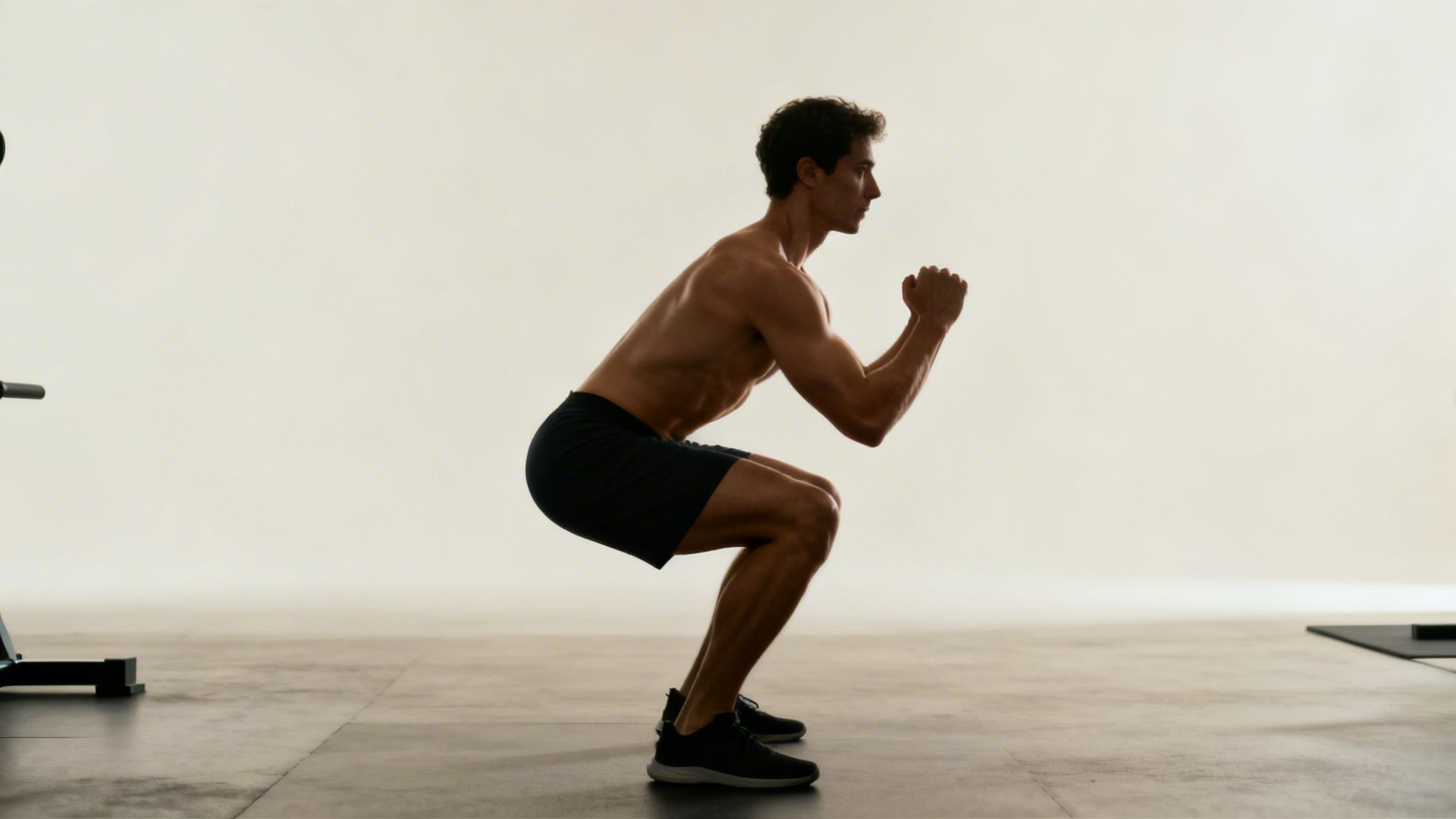
- During Squats or Deadlifts: Can't sink into a deep squat without your lower back rounding? That's "butt wink," and it happens because your hips are too stiff to allow for more depth. All that load gets dumped right onto your lumbar discs.
- While Running: Tight hip flexors pull your pelvis forward, creating a massive arch in your lower back. This compresses the spine and leads to that chronic, dull ache that just won't quit, mile after mile.
- In CrossFit, Golf, or Tennis: Power comes from explosive hip rotation. If your hips are locked up, all that rotational force gets driven straight into your lower back, which is a classic recipe for overuse injuries and herniated discs.
The bottom line is this: Your lower back is being forced to create movement it doesn't have, while your hips are refusing to provide the mobility they should have. This role reversal is ground zero for most non-specific lower back pain that keeps active adults on the sidelines.
And this isn't just some minor annoyance. Low back pain was the world's leading cause of disability in 2020, sidelining a staggering 619 million people. That number is expected to hit 843 million by 2050, largely because people aren't fixing the bad movement patterns that cause the problem in the first place.
For athletes and active adults, stiff hips are a direct line to becoming one of these statistics. They sabotage your mechanics and overload your spine until something gives. It’s why lifting heavy things strategically is about rebuilding your foundation from the ground up, not just chasing temporary relief.
Tired of the endless cycle of pain, stretching, and frustration? If you're in Marlton, Mount Laurel, Cherry Hill, Moorestown, Haddonfield, or Medford, it's time to stop chasing symptoms and fix the root cause. Schedule a Free Discovery Visit with us and find out how a real, movement-based plan can get you back to your sport for good.
Quick Self-Checks to Pinpoint Your Hip Issues
Before you start throwing random stretches at the wall to see what sticks, you need to know what you’re actually dealing with. Guessing is a surefire recipe for frustration and zero progress.
These simple at-home tests are your starting point for a root-cause diagnosis. They’ll give you real data on your specific limitations so you can stop guessing and start attacking the source of your stiff hips and angry lower back.
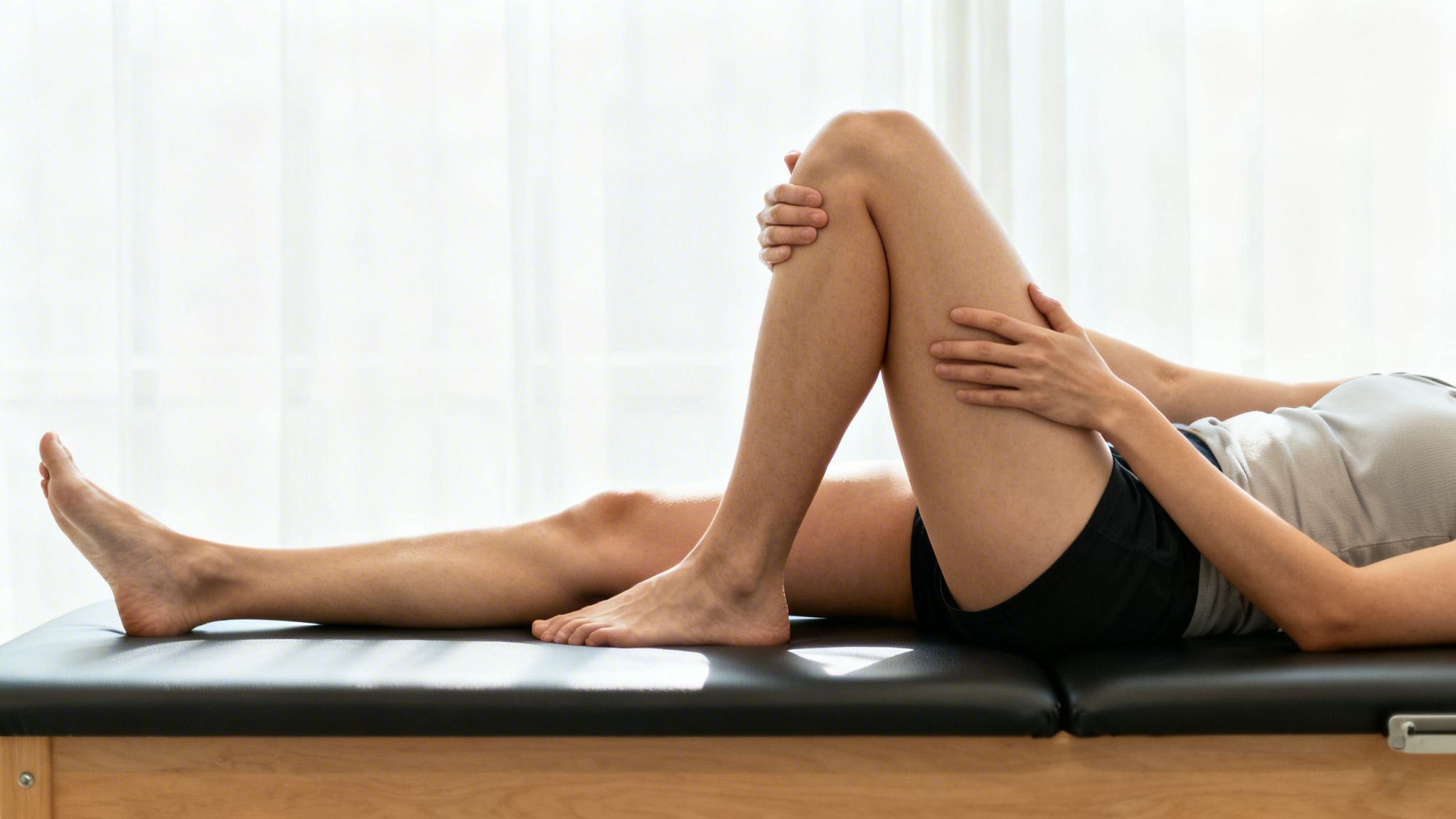
The Thomas Test for Hip Flexor Tightness
Your hip flexors—the muscles at the front of your hip—are notoriously tight, especially if you sit for work or have a high training volume. When they get short and stiff, they yank your pelvis forward, forcing your lower back into a stressed-out arch. This test tells you in seconds if they're the villain in your story.
Here's how to do it:
- Lie on your back on a sturdy table or the edge of your bed, with your legs hanging off from the knees down.
- Pull both knees up toward your chest.
- Now, lock your hands around one knee, holding it tight to your chest. Slowly lower the other leg and let it hang completely relaxed.
What to look for:
- Good to Go: If your hanging thigh rests flat against the surface (or close to it) and your knee is bent around 90 degrees, your hip flexors are likely moving well.
- Red Flag: If your thigh pops up and hovers in the air, you’ve got tight hip flexors. This is a massive clue for anyone whose lower back aches during squats, running, or even just standing for long periods.
If you fail this test, you've found a huge piece of the puzzle. That tightness is very likely forcing your lumbar spine to compensate for a hip that can't extend properly, and your back is paying the price.
The FABER Test for Overall Hip Health
The FABER test (it stands for Flexion, Abduction, and External Rotation) is a great tool for a general assessment of your hip joint’s mobility and can flag deeper issues inside the joint itself.
Here's how to do it:
- Lie flat on your back with both legs straight.
- Bend one leg and place the outside of that ankle on your opposite knee, creating a "figure 4" shape.
- Now, let the bent knee relax and fall out to the side toward the floor. Don't force it.
What to look for:
If your knee can drop down and become nearly parallel with your other leg, your hip is moving pretty well.
But, if that knee is stuck way up in the air, or you feel a sharp pinch in the front of your hip or groin, that points to a serious restriction. For a weightlifter, a limitation like this makes hitting a deep, stable squat nearly impossible without your back taking a beating.
Tired of playing the guessing game? If you're in the South Jersey area—that includes Marlton, Mount Laurel, Cherry Hill, Moorestown, Haddonfield, and Medford—let's get to the bottom of it together. Schedule a Free Discovery Visit at Valhalla Performance. We'll give you a professional assessment and a clear battle plan for long-term results.
A No-Nonsense Routine for Your Hips and Core
Let's get one thing straight: passive stretching alone won't fix your cranky lower back. That's temporary relief, not a long-term solution. The real problem is a movement dysfunction—your hips are stiff and weak, so your back is overworking and paying the price.
This routine isn't just about stretching. It's about rebuilding a smarter, stronger foundation from the ground up through movement-based rehab. We're going to teach your hips how to do their job again and build a rock-solid core so your spine can finally stop being the fall guy.
Forget generic advice. We’re diving into the why behind each movement, explaining how it directly translates to better performance in the gym and a spine that doesn't scream at you. This isn’t a quick fix; it’s an investment in a body that performs without breaking down.
Unlocking Your Hips
The mission here is simple: reclaim the range of motion you've lost. We're targeting rotation and extension, two movements that are absolutely essential for almost any athletic endeavor, from weightlifting to team sports.
90/90 Hip Switch
This is your new best friend for hip internal and external rotation. Don't skip it.
- Why It Matters: Ever wonder why your back aches after a round of golf or a CrossFit WOD with lots of twisting? It’s probably because your hips can't rotate properly, forcing your lower back to twist instead. This movement teaches your hips to move independently.
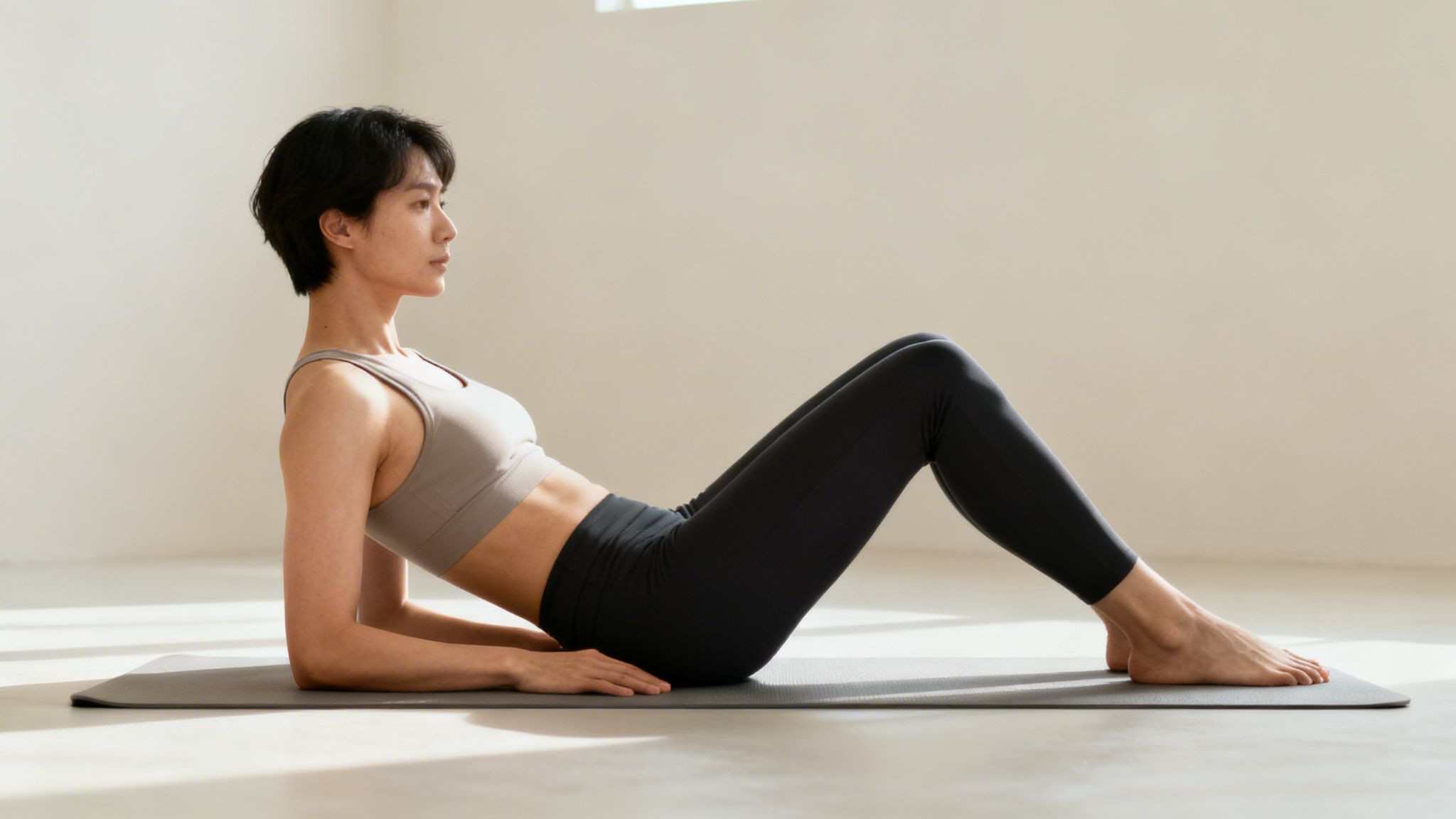
- How to Do It: Sit on the floor. Bend both legs to 90 degrees—one in front of you, one to the side. Keeping your chest up, smoothly pivot your hips to switch your leg positions to the opposite side.
- Sets & Reps: Aim for 2-3 sets of 10-12 switches per side.
Couch Stretch
This is the undisputed king of hip flexor stretches for a reason. It gets into those deep, stubborn muscles that get brick-solid from sitting and high-volume training.
- Why It Matters: Unlocking your hip flexors helps eliminate anterior pelvic tilt—the posture where your butt sticks out and your lower back is stuck in a constant, painful arch. This is critical for deadlift and squat mechanics.
- How to Do It: Kneel in front of a couch or wall and plant the top of your back foot against it. Step your front foot forward into a lunge. Now, squeeze the glute of the kneeling leg and gently drive your hip forward. You'll know when you've found the stretch.
- Sets & Reps: Hold this for 60-90 seconds on each side. Complete 2 sets.
Building a Strong, Stable Core
Mobility without stability is a recipe for disaster. Once you’ve opened up your hips, you need to teach your core how to control that newfound freedom. This is where long-term results are made. You can read more about why this connection is so vital in our guide to a proper dynamic stretching routine.
Dead Bug with a Focus on Ribs Down
This is a core stability heavyweight. It teaches you how to move your arms and legs without your lower back arching off the floor.
- Why It Matters: This is the exact skill you need to protect your spine during overhead presses, pull-ups, or even just running. It trains your core to brace against movement, which is its real job—preventing unwanted motion.
- How to Do It: Lie on your back, arms reaching for the ceiling, knees bent at 90 degrees above your hips. Now, the important part: pull your ribcage down toward your pelvis and smash your lower back into the floor. Slowly lower one arm and the opposite leg toward the ground, fighting to keep that back flat.
- Sets & Reps: Do 2-3 sets of 8-10 quality reps per side.
The most common mistake people make is letting their back arch off the floor as their arm and leg lower. If you can’t keep your back flat, you're not controlling the movement. Shorten your range of motion until you can. Quality over quantity is everything here.
This isn’t just a random collection of exercises. It's a targeted system designed to attack the root causes of your pain by restoring proper function.
If you’ve tried routines like this and still feel stuck—or if you're an active adult in Marlton, Mount Laurel, Cherry Hill, Moorestown, Haddonfield, or Medford who's just sick of the pain cycle—it's time for a professional eye. Schedule your Free Discovery Visit at Valhalla Performance today. Let's build a real plan to get you back to 100%.
Weaving Better Movement Into Your Life (Because Drills Alone Won't Cut It)
Doing mobility drills on the mat is a great start, but if you go right back to moving with the same faulty patterns for the other 23 hours of the day, you're just spinning your wheels. Real, lasting change happens when you integrate better movement into everything—at your desk, in the gym, and even when you're just getting off the couch.
This isn’t about adding another hour to your day. It's about being smarter with your movement and stopping the bad habits that got you into this mess in the first place.
Smart Tweaks For Your Training
Don't just avoid challenging movements. Modify them strategically to build you up, not break you down. This is how you bridge the gap from rehab to hitting new PRs.
-
Fix Your Squat: Can't hit depth without your back rounding? Instead of cutting reps high, elevate your heels on small plates. This simple trick gives your ankles more range, allowing you to keep an upright torso and sink deeper without your lower back compensating.
-
Wake Up Your Glutes: Before you load a barbell for squats or deadlifts, get your glutes online. Slap a mini-band around your knees and crank out some lateral walks, glute bridges, or clamshells. This pre-activates your body’s most powerful muscles so they do the work, taking the load off your lower back.
Overhauling Your 9-to-5 Habits
You spend more time outside the gym than in it, which means your daily routine is either helping you or hurting you. There's no in-between.
Constant sitting is the arch-nemesis of happy hips. It shortens your hip flexors and puts your glutes to sleep. This combo cranks your pelvis into an anterior tilt, leaving your lower back in a constantly arched and stressed-out position. Little changes throughout your day can unwind this damage.
And this isn't a small problem. In 2021, a staggering 452.8 million working-age adults worldwide were dealing with low back pain—a nearly 53% jump since 1990. For lifters and active people, stiff hips are often the sneaky culprit, feeding bad movement patterns that lead straight to back strain.
Our blended strength conditioning and rehab approach is designed specifically to demolish these faulty patterns and build you back stronger.
To fight back against your chair, sprinkle these "movement snacks" into your day:
-
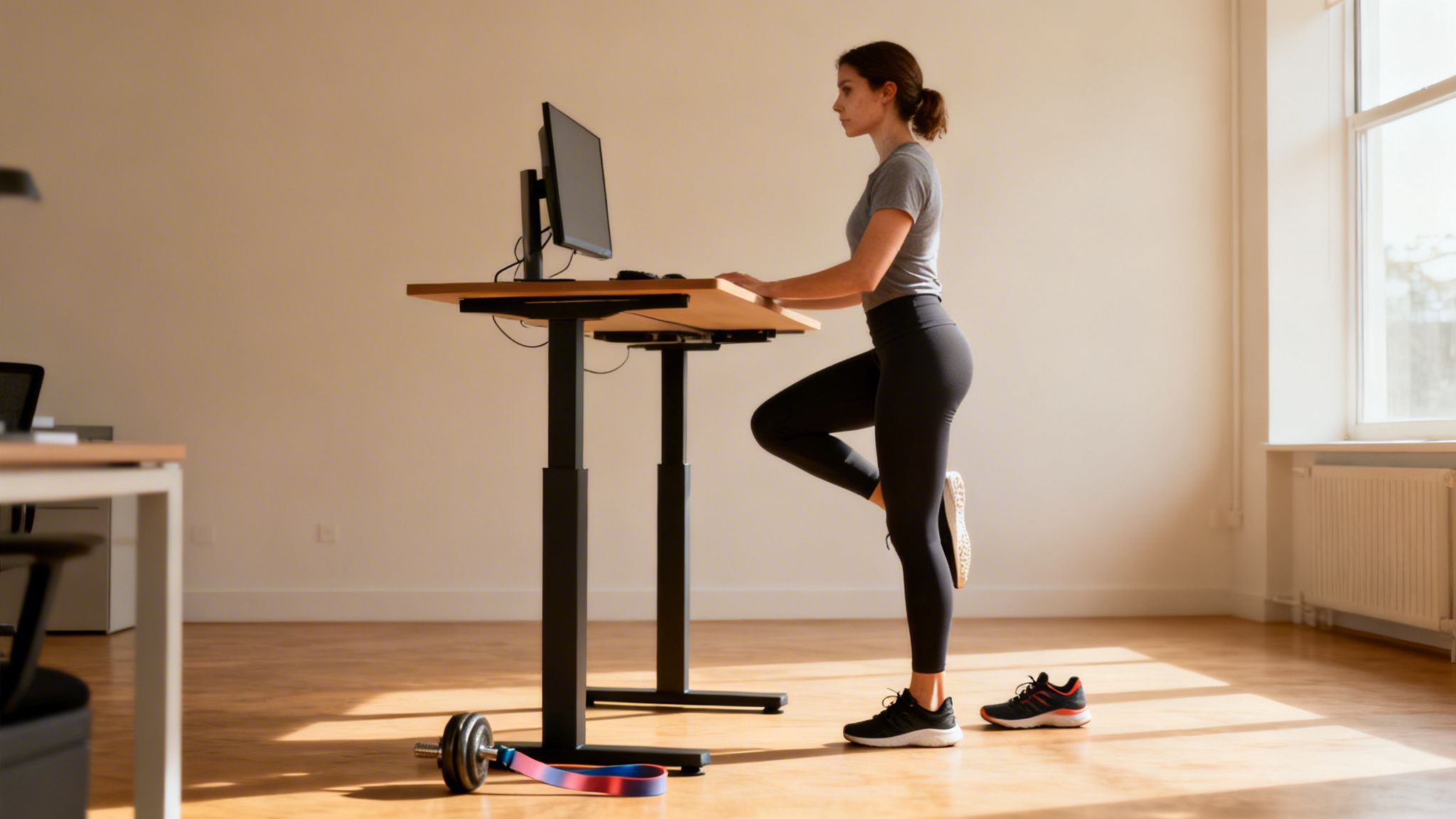
Active Your Workspace: If you have a standing desk, don’t just stand there. Prop one foot up on a small box or footrest. This simple shift takes the strain off your low back. Just remember to switch feet every 20-30 minutes.
-
The Hourly Reset: Set a timer on your phone. Every hour, get up and do a quick standing hip flexor stretch for 30 seconds per side. It’s a tiny investment that stops your hips from turning to concrete.
If you’re in the Marlton, Mount Laurel, Cherry Hill, Moorestown, Haddonfield, or Medford areas and you're still stuck in a cycle of pain and frustration, it might be time for an expert diagnosis. Schedule a Free Discovery Visit with us, and let’s get you training pain-free for good.
When to Get Professional Help for Your Hips and Back
So, you've been doing the drills, but your hips and back are still staging a protest. Let’s be real: you can’t stretch your way out of a structural problem or a deeply ingrained movement fault.
If you’ve been consistent and are still fighting stiff hips and lower back pain, that’s your body telling you it’s time to find an expert who specializes in root-cause diagnosis. Guessing games only lead to chronic pain and bigger injuries down the road.
Stop Ignoring These Warning Signs
Your body doesn’t whisper when something’s wrong—it screams. Ignoring these signs is a one-way ticket to a much bigger problem.
- Radiating Pain: Pain that shoots from your back or hip down your leg isn't just a tight muscle. That’s a major red flag for nerve involvement, like sciatica. You can’t stretch a nerve back to health.
- Numbness or Tingling: If you’re getting “pins and needles,” weakness, or numbness in your legs, feet, or groin, stop what you’re doing. This isn’t something to "wait and see" on. Get a professional diagnosis.
- Pain That Won’t Quit: You’ve put in the work for weeks, but the pain is either laughing in your face or getting worse. This is a dead giveaway that your self-treatment isn't hitting the actual root cause.
If your pain is so bad it wakes you up at night, is constant no matter what position you’re in, or comes with other weird symptoms, don't wait. A professional diagnosis is non-negotiable.
At Valhalla Performance, we are the last stop for active people who are fed up because they've tried everything else—generic PT, chiropractic adjustments, YouTube stretches—and are still stuck in a cycle of pain.
Our approach is different. We don’t just treat the symptom—we find the dysfunction that's causing it.
We blend expert diagnostics and manual therapy with the personalized strength and movement-based rehab of our One80 System. This combination allows us to restore proper joint mechanics and rebuild the movement patterns that keep the pain from coming back, delivering long-term results. You can learn more about how our custom treatment plans maximize your recovery and get results where other methods have failed.
If you’re an active adult in Marlton, Mount Laurel, Cherry Hill, Moorestown, Haddonfield, Medford, or anywhere in South Jersey, and you’re ready to stop guessing, we're here to help. Schedule a Free Discovery Visit and let's find out how our root-cause approach can get you back to your life and your workouts, stronger than before.
Your Next Step to Lasting Relief in South Jersey
Alright, let's cut to the chase. Lasting relief from stiff hips and lower back pain doesn't come from chasing symptoms. It comes from fixing the faulty movement patterns causing the problem in the first place.
You now understand how locked-up hips make your back scream in protest, you have tests to identify your limitations, and you know what kind of movement-based rehab actually restores function. So, what's next? It's time to build a real plan to get you out of this mess for good.
If you’re sick of the endless cycle of foam rolling, temporary stretches, and that nagging ache that always comes back, you’re not alone. You don’t need another temporary fix—you need a personalized battle plan to get back to your sport and your life, stronger and more resilient than before.
A Different Approach for Active Adults
We get it. We speak your language because we live it, too. Whether you're a weightlifter chasing a new squat PR, a CrossFitter staring down a brutal WOD, or an athlete trying to perform without pain, we understand the demands of your sport. At Valhalla Performance, we specialize in getting active people in South Jersey out of the wreckage of persistent injury.
Your body is resilient, but it needs the right roadmap. Lasting results don't come from passive treatments; they come from actively teaching your body how to move correctly and building the strength to make those new patterns stick.
Our clinic, proudly serving Marlton, Mount Laurel, Cherry Hill, Moorestown, Haddonfield, and Medford, is built for people who want to be active participants in their recovery, not just passive patients.
Take Control of Your Comeback
You can stop guessing. You can stop trying to piece together a solution from random internet articles and YouTube videos that don’t understand your specific injury or goals.
Your path to moving and feeling better starts with one thing: a clear, accurate diagnosis of what's broken and a personalized plan to fix it.
That's why we invite you to take the first step, with zero risk.
Stop letting stiff hips and a screaming lower back dictate what you can and can’t do. If you're an active adult in Marlton, Mount Laurel, Cherry Hill, Moorestown, Haddonfield, Medford, or South Jersey ready for a real solution that delivers long-term results, Valhalla Performance is here to help. Take the first step by scheduling a Free Discovery Visit with Dr. Jim to talk about your goals and see if our root-cause approach is the right fit for you.