
You’ve done the exercises. You’ve shown up for appointments. You may have even felt better for a few days, maybe a couple of weeks. Then the shoulder grabs again when you press overhead. The back tightens up after nine holes. The knee starts barking two miles into a run. The neck locks up after rolling at jiu-jitsu.
That cycle is exhausting because it doesn’t just hurt. It chips away at who you are.
When training is part of your identity, “just avoid that movement” doesn’t feel like treatment. It feels like losing ground. You don’t want a life where you can function at work but can’t deadlift, run, golf, lift your kid without bracing, or get back on the mat with confidence.
A good sports chiropractor south jersey athletes can trust has to do more than reduce pain. The job is to find why your body keeps returning to the same breakdown point, rebuild that weak link, and help you return to performance with a plan that holds up under real life.
Why Your Pain Keeps Coming Back After PT and Chiropractic
If your pain keeps coming back, that doesn’t automatically mean your body is fragile or that you “just have to live with it.” More often, it means the model of care you received was built for temporary symptom reduction, not long-term durability.
That distinction matters.
A lot of traditional care is still centered on the painful spot. Low back hurts. Treat the low back. Shoulder hurts. Stretch the shoulder. Knee hurts. Ice the knee, strengthen the quad, hope for the best. You may get some relief, but relief and resolution aren’t the same thing.
The trap of symptom chasing
The temporary-relief model usually looks familiar:
Short visits: A quick adjustment, a few stim-based or passive treatments, then you’re out the door.
Generic rehab: The same band exercises or mobility drills given to everyone with a similar complaint.
No performance context: Nobody watches how you squat, rotate, run, press, hinge, carry, cut, or absorb force.
No clear progression: You feel a little better, then you're told to “ease back in” without objective checkpoints.
That approach can calm things down. It often doesn’t answer why your pain showed up in the first place.
According to American Chiropractic Association data cited by Better Health Chiropractic, 65% of athletes prefer integrated chiropractic-and-strength programs because they yield 25% better outcomes in chronic cases, while passive-only care has a 30% higher recurrence rate. That lines up with what active adults feel every day. If treatment never progresses beyond passive care, the same problem usually returns when life or training demand more from the body.
Practical rule: If your care only helps when you keep coming back for the same relief, you probably haven’t solved the reason the pain started.
Why good intentions still fail
Many people reading this didn’t fail PT or chiropractic. They followed directions. They were compliant. They did the homework.
The problem is that exercises done on a table or floor don’t always transfer to a barbell, a golf swing, a long run, a hard roll in BJJ, or a high-rep CrossFit workout. Your body has to handle force, speed, fatigue, and rotation in active situations. If rehab never reaches that level, pain often returns the moment you demand more.
That’s why movement-based care matters. It looks at your body as a system, not as isolated parts. If you’ve only experienced pain-focused treatment, a more complete model like sports performance physical therapy makes more sense for active adults who need to get back to actual performance, not just basic daily comfort.
Symptom-Based Care vs. Valhalla's Root-Cause Approach
| Aspect | Typical PT / Chiropractic | Valhalla Performance |
|---|---|---|
| Primary focus | Calming the painful area | Finding the driver behind the pain pattern |
| Visit style | Often passive and repetitive | One-on-one, movement-based, goal-driven |
| Exercise selection | General rehab drills | Drills tied to your sport, training, and weak links |
| Measure of success | Pain is lower today | You move better and tolerate load with confidence |
| Return to activity | “Take it slow” | Progressive rebuild with clear purpose |
| Long-term aim | Manage flare-ups | Reduce recurrence by fixing the system |
The real cost isn’t just physical
The worst part of recurring pain isn’t always the pain.
It’s what starts shrinking around it. You stop going as heavy. You hesitate before signing up for the race. You modify every workout. You sit out rounds. You avoid long drives, pickup games, and weekend hikes because you’re already calculating the fallout.
Five years of that changes more than tissue. It changes identity.
The athlete doesn’t disappear all at once. Usually, they get negotiated away one skipped lift, one missed season, one guarded movement at a time.
If that’s where you are, the answer usually isn’t more of the same. It’s a different lens.
Finding the True Source of Your Pain
Pain rarely tells the whole story. It tells you where the body is complaining. It doesn’t always tell you where the problem started.
That’s why a real sports chiropractic evaluation has to go beyond “where does it hurt?” and get into how you move, where you compensate, and what your sport or training asks your body to do repeatedly.
Your body works like a chain
The easiest way to understand this is with alignment.
If a car’s alignment is off, the tire that wears down first isn’t always the part that caused the issue. Your body works the same way. A foot that doesn’t load well can stress the knee. A hip that won’t extend can dump force into the low back. A stiff mid-back can make the shoulder pay the price every time you press, snatch, serve, or swing.
That’s the kinetic chain. One weak or restricted area changes how force travels everywhere else.
A runner may feel shin pain, but the bigger issue might be poor hip control and trunk rotation. A golfer may blame the low back, when the primary issue is limited thoracic rotation plus poor pelvic control. A lifter may chase shoulder pain for months when the ribcage and mid-back never move well enough to support overhead work.
What a real assessment should include
A useful exam doesn’t stop at orthopedic tests and a pain scale. It should look at the body under the kind of demands that matter to you.
That often includes:
Detailed history: Not just your symptoms, but what flares them up, what you've already tried, and what “back to normal” means to you.
Movement observation: Squat, hinge, rotate, reach, carry, lunge, push, pull, single-leg balance, and any pattern tied to your sport.
Nerve and muscle evaluation: To see whether the issue is purely mechanical or whether the nervous system is also involved.
Imaging when needed: Digital X-rays can be useful in select cases, but they should support the bigger picture, not replace it.
GoRise Chiropractic’s overview of sports chiropractic in South Jersey describes this well. Their process highlights meticulous biomechanical assessments, nerve and muscle evaluations, and digital X-rays when necessary to identify kinetic chain imbalances. That same source notes that techniques such as Torque Release Technique, a non-twisting method, can help restore alignment and nervous system function. It also states that 33% of patients with significant pain rate chiropractic care as superior to alternatives like medication.
Root cause usually hides in movement
Most chronic sports injuries aren’t random.
They come from repeated overload, poor load distribution, lost range of motion, or strength that doesn’t match demand. That’s why the painful area often acts more like the victim than the criminal.
If your shoulder hurts every time you go overhead, the answer may not be more shoulder stretching. It may be better ribcage control, thoracic extension, scapular mechanics, and how you create force through the ground.
Many active adults finally gain clarity. The knee isn’t the whole issue. The back isn’t the whole issue. The elbow isn’t the whole issue. Once you see the pattern, treatment stops feeling random.
What this means for your sport
Different activities expose different weak links:
CrossFit and weightlifting: Overhead position, front rack mobility, trunk stiffness, hip drive, bar path consistency.
Running: Single-leg control, foot strike mechanics, pelvic stability, cadence-related compensation.
Golf: Rotation through the hips and thoracic spine, balance transfer, deceleration control.
Brazilian jiu-jitsu: Neck resilience, rotational control, breathing under pressure, asymmetry from preferred positions.
A strong sports chiropractor south jersey athletes trust should be able to connect your pain to those patterns, not just to anatomy on a chart.
When that happens, treatment gets simpler. Not easier, but clearer. You stop chasing symptoms and start correcting the system that created them.
Your Journey Back to Full Strength
Most active adults don’t need more guesswork. They need a roadmap.
When care works, you should know what phase you’re in, what the body is responding to, what still needs to change, and how that connects to getting back under the bar, back on the road, back on the course, or back on the mat. The path back isn’t passive. It’s collaborative.

Phase one gets the full story
The first phase is where individuals often realize why their old care stalled.
You sit down and talk through the complete version of the problem. Not the sanitized version. The full one. “My back’s fine until I hit heavier deadlifts.” “My knee hurts more going downstairs after long runs than during the run.” “My shoulder only pinches when I catch the bar or lock out under fatigue.” Those details matter because they point to load, timing, and compensation.
Then the body gets assessed in motion. Not just what hurts, but what the rest of the system is doing around it.
A lifter with elbow pain might show limited shoulder rotation and poor upper back movement. A runner with hip pain may collapse through one leg and lose pelvic control the moment speed picks up. A golfer with back tightness may have almost no usable rotation where they need it and far too much motion where they don’t.
Phase two combines hands-on work and active correction
Here, treatment starts feeling different from the usual cycle of “adjust, feel better, see you next week.”
Hands-on care still matters. Precise chiropractic adjustments can help restore motion where joints have become restricted. Soft tissue work matters too, especially when fascial restrictions and stubborn tension are feeding bad mechanics. But that can’t be the whole visit.
Alluvium Chiropractic’s sports chiropractic page describes an integrated model that combines adjustments with soft tissue therapies such as myofascial release to break up adhesions and fascial restrictions. That source also notes that this combination corrects kinetic chain dysfunctions and accelerates recovery, prioritizing natural healing and biomechanical correction over simple symptom relief.
That’s the point. Passive care opens the door. Movement keeps it open.
Some bodies need less stretching and more control. Some need less “core work” and more rotation. Some need less rest and a better progression back to load.
In practice, this phase often includes a mix of:
Targeted chiropractic treatment: To restore joint motion that your body can’t currently access well on its own.
Soft tissue techniques: Myofascial release and related work to reduce restrictions that are changing movement quality.
Corrective exercise: Chosen to fix the specific leak in your system, not just to make you feel like you “did rehab.”
Sport-relevant progressions: Drills that start bridging the gap back to lifting, running, grappling, or golf.
Valhalla Performance uses chiropractic care alongside individualized strength and conditioning progressions, including the One80 System, to connect treatment to real movement demands rather than stopping at table-based relief.
Phase three builds a body that holds up
Pain reduction is not the finish line. Capacity is.
This is the phase many people never got in previous care. They were discharged when symptoms improved, not when the body was ready. Then they returned to full activity with the same weak links and old movement strategies.
A real return means rebuilding tolerance to force, speed, volume, and fatigue. You earn your way back to high demand. You don’t jump there.
That may mean:
Relearning the pattern with better mechanics at lower intensity.
Adding load or complexity once control improves.
Testing sport-specific demands before a full return.
If you want that last stage to hold up, strength work matters. Done properly, strength and conditioning for athletes isn’t extra. It’s the insurance policy that helps your corrections stay useful under stress.
What you should feel along the way
A good plan doesn’t promise a magical overnight fix. It gives you signs that you’re moving in the right direction.
You should start noticing things like:
Movements feel cleaner: Less pinching, less guarding, less hesitation.
Flare-ups shrink: When symptoms show up, they’re less intense and less sticky.
Confidence returns: You stop fearing the squat, the long run, the overhead lockout, the scramble.
That last one matters more than is often acknowledged. A body can be technically improved and still feel unreliable. The journey back to full strength has to restore trust, not just motion.
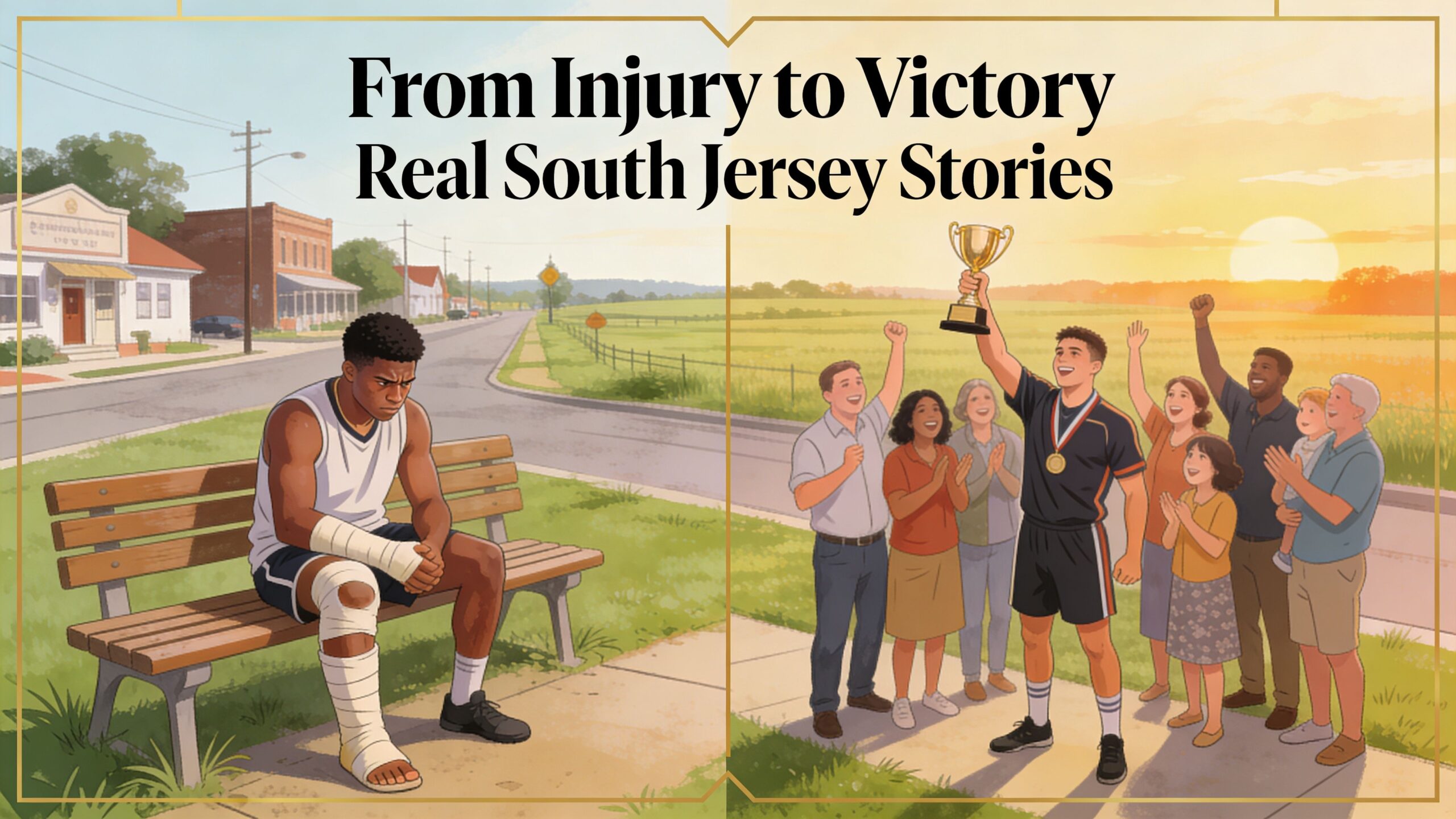
From Injury to Victory Real South Jersey Stories
The hardest part of pain isn’t always the diagnosis. It’s the story you start telling yourself.
You tell yourself the shoulder just can’t handle overhead work anymore. You tell yourself running is out. You tell yourself your back is now something you have to manage forever. That story gets stronger every time treatment gives you a brief window of relief but no real change.
The athletes and active adults who break that cycle usually don’t just need treatment. They need a structured return.
The CrossFit athlete who stopped trusting her shoulder
A Marlton athlete had already tried resting, mobility classes, and repeated treatment aimed only at the painful shoulder. Every time she returned to overhead lifting, the same hesitation came back before the pain did. That’s common. The body remembers failure.
What changed was the shift away from the shoulder as the entire problem. Once the bigger movement pattern is addressed, athletes can stop living in constant negotiation with the barbell. They can rebuild their overhead position, their timing, and their confidence instead of cycling through flare-ups and avoidance.
The runner who was tired of starting over
A Moorestown runner with recurring lower-leg pain didn’t need another generic “take a week off and stretch your calves” answer. Runners lose more than fitness when pain keeps interrupting training. They lose rhythm, routine, and identity. Every missed week becomes mental friction.
What works better is a phased rebuild that gives runners objective checkpoints before they ramp up again. Optimal Health’s discussion of sports injury care in South Jersey points to a major gap in typical care, which is the lack of a clear return-to-sport protocol. That same source states that movement-based chiropractic care has been found to reduce re-injury rates in athletes by 40% through active rehabilitation. That matters because most runners aren’t afraid of hard work. They’re afraid of getting hopeful, building momentum, and ending up right back at zero.
Recovery without a return-to-sport plan is just a pause button.
The golfer who thought back pain was now part of the game
A Haddonfield golfer can often get through daily life just fine, then light up the low back with rotational force and repeated swings. That creates confusion. If it only hurts during golf, it’s easy to think the answer is to swing less or accept a lower level.
But golf exposes limits that normal life can hide. Restricted rotation, poor force transfer, and compensation through the lower back don’t always show up until the swing asks for speed and sequencing. When those pieces improve, golfers usually don’t just feel less pain. They swing with less guarding.
The BJJ practitioner who needed his neck back
A Cherry Hill grappler with chronic neck irritation may already know that rest isn’t a real long-term answer. The sport asks for rotation, pressure tolerance, positional strength, and the ability to stay calm when someone is actively trying to fold you in half.
For people like that, success isn’t “my neck feels okay sitting at my desk.” Success is being able to roll without spending the whole round protecting one area.
Why these stories matter
These examples are different on the surface. Shoulder, leg, back, neck. CrossFit, running, golf, BJJ.
The common thread is this. None of these people need a pain-free existence alone. They need their active life back. They need a process that tells them when to push, when to hold, and how to return without setting themselves up for the same failure again.
That’s what separates temporary improvement from victory.
Your Expert Sports Chiropractor in Mount Laurel and Beyond
South Jersey has no shortage of active adults pushing hard in gyms, on roads, on fields, on courses, and in local training communities. The need for more specific care is real.
According to RWJBarnabas Health sports medicine, extensive sports injury management programs have provided over 40,000 screenings across New Jersey. That reflects the scale of sports-related injury assessment in the state and the broader shift toward specialized athletic care rather than generic pain management.
Local care should match local athletes
If you live in Mount Laurel, Cherry Hill, Marlton, Moorestown, Medford, Haddonfield, or nearby South Jersey communities, you shouldn’t have to settle for a general approach that treats your training like an afterthought.
A true sports-focused clinic should understand the difference between:
A desk worker with back pain and a lifter whose back tightens under heavy hinge patterns
A recreational walker with knee irritation and a runner trying to tolerate impact and mileage again
A person with neck stiffness and a grappler who needs rotational strength under pressure
Those aren’t the same problems just because the body part matches.
What active adults should look for
The right fit usually isn’t the clinic with the most passive options. It’s the one that can connect treatment to performance.
Look for a provider who can:
Assess movement, not just symptoms
Explain your issue in plain language
Tie rehab to your actual sport or training style
Build a progression instead of leaving you with vague restrictions
South Jersey athletes don’t need to be talked out of activity. They need a smarter path back to it.
That’s especially true for adults in the middle years of life. You’re not trying to win a participation trophy for surviving workouts. You’re trying to keep doing the things that make you feel like yourself for years to come.
Stop Guessing and Start Healing Your Free Discovery Visit
By the time individuals search for a sports chiropractor south jersey, they’re not casually browsing. They’re tired.
They’re tired of doing the right things and still ending up back in pain. Tired of being told to stop training without being shown how to return. Tired of feeling like their only options are rest, repeat, or lower their expectations.
If that’s you, hesitation makes sense.
The fear is real
A lot of active adults think, “What if this is just another thing that doesn’t work?”
That’s a fair question. If you’ve already spent time, energy, and trust on treatments that only gave you a short window of relief, you don’t need another sales pitch. You need clarity. You need to know whether your problem is being understood differently this time.
That’s why a Free Discovery Visit matters. It gives you space to talk through your history, your goals, what’s failed before, and whether a root-cause, movement-based approach makes sense for you.
What happens at the first step
This shouldn’t feel like pressure.
A Discovery Visit is a conversation. You explain what’s been happening, what you’ve tried, what you can’t do right now, and what getting better would mean. Maybe that means getting back to heavy squats without guarding. Maybe it means running without planning your week around a flare-up. Maybe it means rolling, golfing, or training hard without wondering what tomorrow will cost.
For people looking at a more performance-based path, this kind of first conversation can be a smart place to start before committing to full treatment. If you’re looking for a local option, sports injury chiropractor near me is a useful place to learn how that approach works and whether it fits your situation.
When to stop waiting
You don’t need to wait until the pain gets unbearable.
You don’t need to lose another training cycle, another race build, another season, or another year of modifying everything around one stubborn issue. If your body keeps sending the same warning sign, listen to it now while the problem is still coachable.
The longer you train around pain, the more your body rehearses the compensation that keeps it alive.
That’s why the goal isn’t to get you dependent on treatment. It’s to help you understand the problem, correct the pattern, and rebuild enough resilience that your life stops revolving around the next flare-up.
If you’re in Marlton, Mount Laurel, Cherry Hill, Moorestown, Haddonfield, Medford, or the surrounding South Jersey area, this is the moment to stop guessing.
If you’re ready to talk through your injury, your failed past treatments, and the fastest path back to the activities that make you feel like yourself, schedule a Free Discovery Visit with Valhalla Performance. It’s a low-pressure first step to see whether a root-cause, movement-based plan is the right fit for you.