
That sharp, zinging pain down your leg isn't just bad luck. It's a fire alarm telling you that something deeper is out of whack. To prevent sciatica pain for good, you have to stop chasing the symptoms with stretches and foam rollers. We need to tackle the real reason the nerve is angry in the first place—usually a cocktail of wonky movement patterns and muscular imbalances that are sabotaging your performance.
Lasting relief isn't about quick fixes. It’s about building a body that's resilient enough to handle your workouts, your sport, and your life.
Why Your Sciatica Pain Keeps Coming Back
If you’re an active person, you’ve probably been told to just "stretch your hamstrings" or pop an Advil when sciatica flares up. But you're reading this, which tells me you already know that’s a dead-end strategy. The pain always comes back, derailing your gym progress or sidelining you from the sports you love.
This frustrating cycle happens because the common advice only puts a bandage on the problem. It doesn't fix it.
True sciatica prevention means getting to the bottom of why the sciatic nerve is being irritated. It’s almost never a single event. It’s a problem of cumulative stress piling up until your body can't take it anymore.
Unpacking the Root Causes
Think of your body like a high-performance machine. If one part is slacking, other parts have to pick up the slack, and eventually, something breaks down. For sciatica, that breakdown often looks like this:
Weak Core and Glutes: When your core and glutes aren't firing properly, they can't stabilize your pelvis and spine. Your lower back ends up taking on way too much strain. We see this all the time with lifters whose deadlift form goes to crap under fatigue, leading to spinal compression instead of a powerful hip hinge.
Garbage Movement Patterns: Repetitive movements with flawed mechanics are a classic culprit. Think of squatting with a "butt wink," where your lower back rounds at the bottom of the movement. Do that enough times, and you’re basically asking to compress the structures around that sciatic nerve.
Sitting on Your Butt All Day: Hours parked at a desk forces your spine into a flexed, C-shape position. This puts sustained pressure on your lumbar discs and can easily irritate the nerve roots. It’s a massive factor, especially when you consider that sciatica hits between 10% and 40% of people. You can explore the data on sciatica prevalence to see just how common this really is.
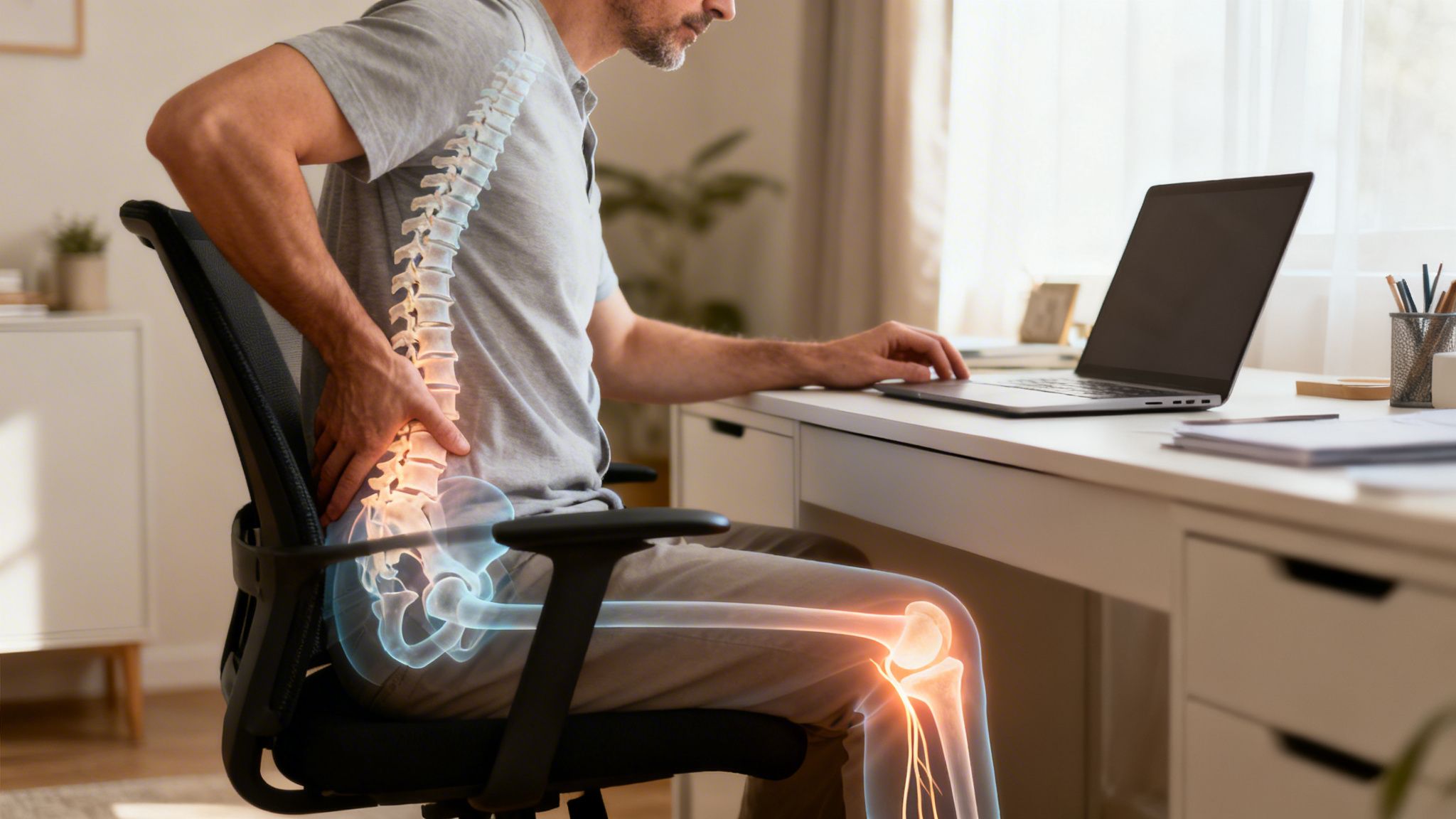
The real issue isn't the pain itself, but the instability or compression causing it. Chasing the pain with stretches might feel good for a minute, but fixing the faulty mechanics is what delivers a permanent solution.
Stop chasing symptoms. It’s time for a smarter approach that builds resilience from the ground up.
Quick Fixes vs. Long-Term Solutions for Sciatica
Here’s a look at why common temporary relief methods fail compared to sustainable strategies that prevent sciatica from returning.
| Common Quick Fix | Short-Term Result | Long-Term Solution | Sustainable Outcome |
|---|---|---|---|
| Stretching the Pain | Temporary relief by "un-pinching" the nerve. | Strengthening Glutes & Core | A stable pelvis and spine that doesn't compress the nerve. |
| Anti-Inflammatory Pills | Masks the pain signal. | Improving Movement Patterns | Efficient, safe movement that removes the source of irritation. |
| Resting & Avoiding Activity | Pain subsides but weakness and instability worsen. | Ergonomic Adjustments & Movement Breaks | Reduces cumulative stress from sedentary positions. |
| Getting an Adjustment | Immediate joint mobility and relief. | Active Rehab & Neuromuscular Re-education | Your body learns to maintain stability and good alignment. |
Chasing temporary relief is a losing battle. The quick fixes feel productive, but they're just kicking the can down the road, allowing the underlying dysfunction to get worse. A real solution addresses the "why" and builds a stronger, more resilient system.
If you're in Marlton, Mount Laurel, Cherry Hill, Moorestown, Haddonfield, Medford or South Jersey and are tired of this vicious cycle, let’s find the actual cause. Schedule your Free Discovery Visit at Valhalla Performance today and let's build a real strategy for long-term results.
Build Movement Habits to Sciatica-Proof Your Day
Lasting relief from sciatica isn’t found in a single magic stretch you saw on Instagram. It’s built, day by day, by weaving smarter movement habits into your life. To actually prevent sciatica pain, you need a real-world blueprint, not generic advice. The goal is to make good movement so automatic that you stop poking the angry bear that is your sciatic nerve.
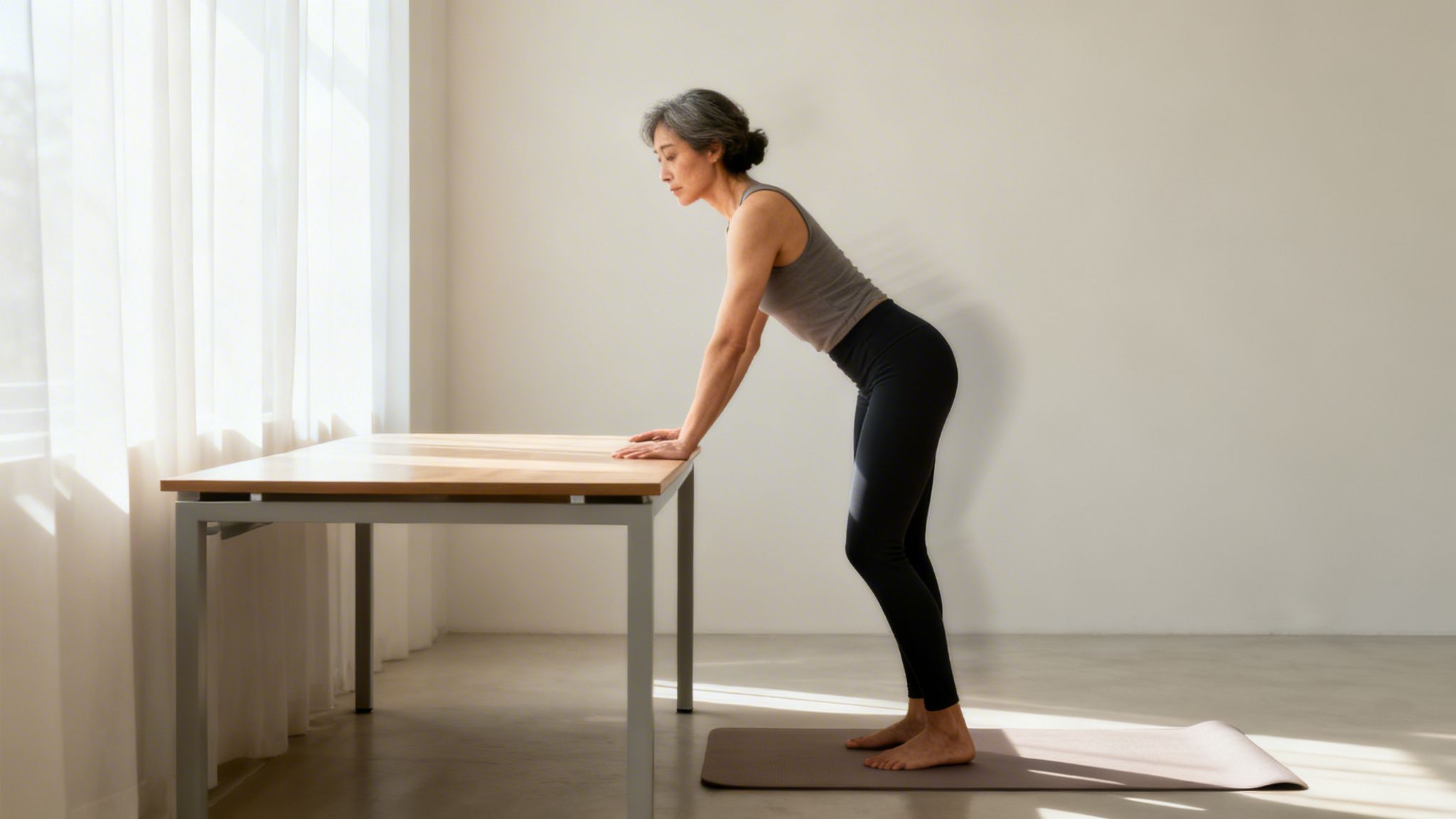
This battle plan starts the second you get out of bed. Instead of rolling out and immediately bending over to put on your socks—a classic spine-loading mistake—take 60 seconds for some spinal hygiene. A few simple cat-cows or gentle twists on the floor can decompress your lower back and set the tone for a pain-free day.
Integrate Mobility Into Your Workday
For most of us, the biggest enemy isn't the gym; it's the damn office chair. Sitting for hours on end glues your hips together and locks up your spine, creating the perfect storm for nerve irritation. The fix? Fight back with some desk-friendly drills.
- Hip CARs (Controlled Articular Rotations): Stand up and slowly move your hip through its entire range of motion. This is like oiling a rusty hinge—it keeps the joint moving smoothly so your lower back doesn't have to pick up the slack.
- Seated Thoracic Rotations: Sit tall, cross your arms over your chest, and gently twist your upper body side to side. Keep your hips locked in place. This move frees up your mid-back, which takes a ton of pressure off your lumbar spine.
The key is consistency. A few minutes of this stuff every hour crushes one long, miserable stretching session at the end of the day. Think of them as "movement snacks."
Smart Modifications in the Gym
No, you don’t have to give up lifting heavy to protect your back. You just have to train smarter. For so many CrossFitters and lifters, it’s not the squat or deadlift that’s the problem—it’s how you’re doing it.
If your lower back rounds at the bottom of a squat (hello, "butt wink"), you’re basically playing Russian roulette with your lumbar discs. Instead of forcing depth you don't own, try this:
- Elevate Your Heels: Pop your heels on a pair of small plates. This simple tweak often cleans up your ankle mechanics, letting you squat deeper with a spine that isn't screaming for mercy.
- Use a Box Squat: Squatting to a box is a game-changer. It forces you to hinge at the hips properly, loading your glutes and hamstrings instead of your lower back.
And for deadlifts? Create tension before the bar even thinks about leaving the floor. "Pulling the slack out" fires up your lats and braces your entire trunk, turning a risky back-pull into a powerful, hip-driven masterpiece. These small changes let you keep training hard while building a back that’s bulletproof, not broken.
If you’re in the Marlton, Mount Laurel, Cherry Hill, Moorestown, Haddonfield, or Medford area and are tired of guessing which movements are helping and which are making things worse, let's build a plan. Schedule your Free Discovery Visit at Valhalla Performance, and we’ll show you exactly how to put these principles to work for good.
Your Best Defense: A Strong Core and Glutes
If you want to kick sciatica to the curb for good, you have to stop just stretching the spot that hurts. That’s like putting a bucket under a leak in the roof instead of fixing the hole.
Think of your spine as a tall mast on a ship. A strong core and glutes are the rigging—the network of ropes providing 360-degree support that keeps that mast stable, especially when the seas get rough. Without that rigging, your spine is left to wobble and strain, eventually pissing off everything around it—including your sciatic nerve.
This is exactly why all those temporary fixes feel great for a day and then fail. They don’t reinforce the rigging. Building a body that doesn't break down means forging this natural armor through smart, functional strength work.

Building Your Foundation From the Ground Up
Before you even think about lifting heavy, you need to master control. This isn’t about flashy gym-bro exercises; it’s about teaching your brain how to fire up the right muscles at the right time.
We start with the basics to build that mind-muscle connection. It’s not sexy, but it’s non-negotiable for real stability.
- The Dead Bug: A classic for a reason. Lying on your back, you learn to keep your core locked in and your spine neutral while your arms and legs are moving. The whole point is to move slow and fight the urge for your lower back to arch off the floor.
- The Bird-Dog: This one, on all fours, attacks your balance and forces your core to stop you from twisting. The goal is to keep your hips as level as a sheet of glass while you extend the opposite arm and leg. No tilting. No wobbling.
This is about quality, not how many reps you can bang out. You should feel those deep abdominal muscles working, not just your back or hips. We’re literally rewiring your body to use the right muscles for the job. If you need more ideas for where to start, check out our guide on lower back and hip exercises that build a rock-solid foundation.
Progressing to Functional Strength
Once you’ve nailed the basics, it’s time to build strength that actually matters in the gym and in your sport. We move off the floor and start adding load in a way that challenges your stability when it’s under pressure.
This is how you build the kind of rugged strength that protects your spine during a heavy deadlift or a lightning-fast play on the field.
Farmer's Carries: This might be one of the most brutally effective exercises to prevent sciatica. Just grab some heavy weights and walk. Your entire core—front, back, and sides—has to go into lockdown to keep you from folding. It builds the postural endurance you need to stop your form from turning to crap when you get tired.
Other powerhouse progressions include:
- Single-Leg Glute Bridges: This move isolates the glute on one side, which is huge for fixing imbalances and making sure each hip does its fair share of the work.
- Goblet Squats: Holding a weight at your chest is a game-changer. It forces your core to fire on all cylinders to keep you upright, drilling in that strong torso position.
The global sciatica treatment market is exploding—from $5.15 billion in 2024 to a projected $10.71 billion by 2033. Why? Because of preventable stuff, like sitting at a desk all day and moving poorly. With data showing some jobs can increase your sciatica risk by 2-3 times, you can’t afford to guess. By pairing smart conditioning with expert care, we attack the root causes and build true resilience. You can read more about the growing need for real sciatica solutions on grandviewresearch.com.
Are you an active adult in Marlton, Mount Laurel, Cherry Hill, Moorestown, Haddonfield, or Medford who’s ready to stop guessing and start building a body that won't quit on you? Schedule your Free Discovery Visit at Valhalla Performance. Let's build a plan that gets you strong, stable, and pain-free for good.
Optimize Your Environment to Stop Daily Strain
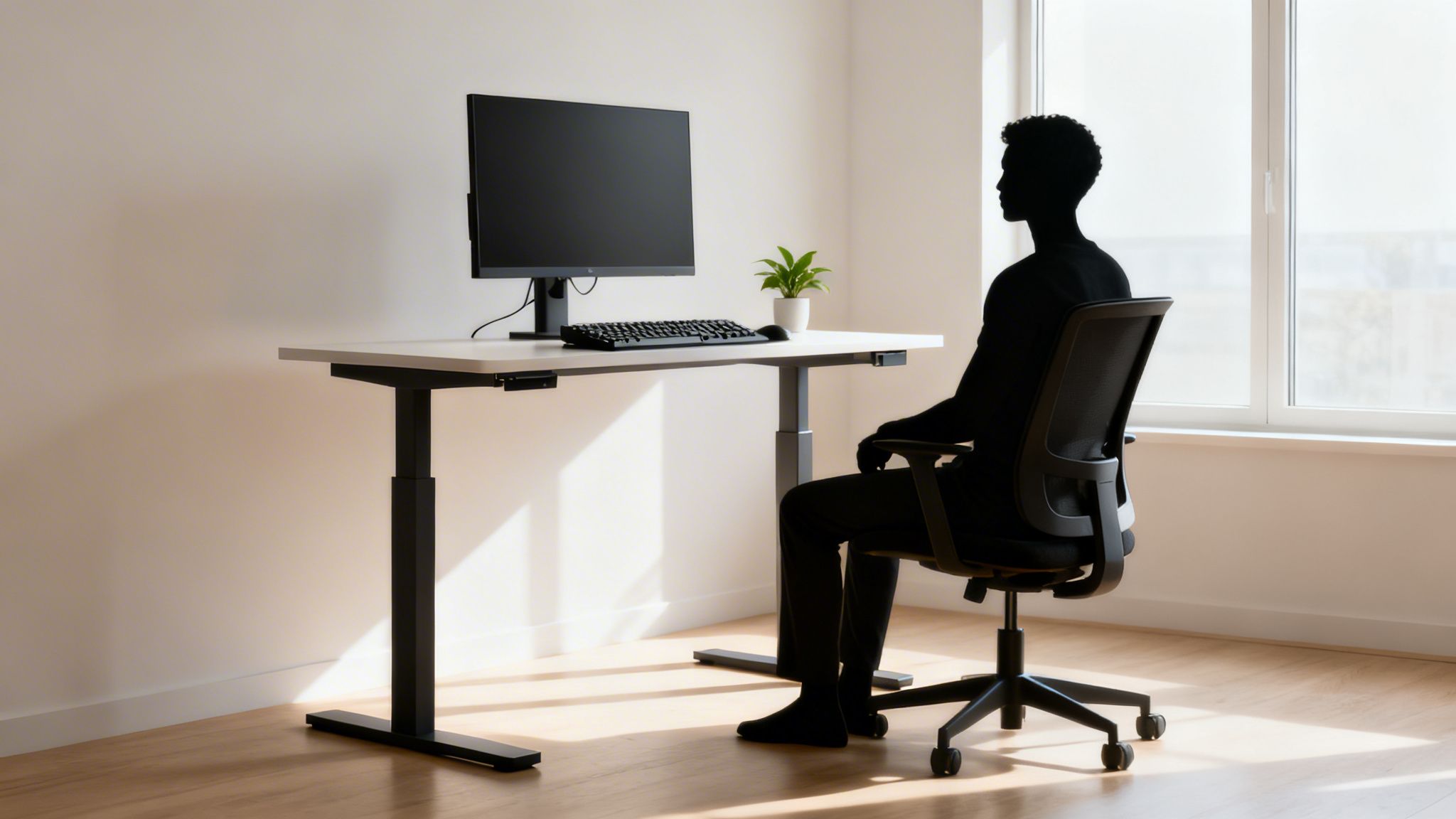
The strength you build in the gym can be completely wrecked by the eight hours you spend slumped over a desk. If you’re serious about how to prevent sciatica pain, you have to look at the places where you spend most of your time. This means turning your daily environments from sources of chronic strain into tools for recovery.
These small, consistent fixes aren't about temporary relief. They're about stopping the daily micro-traumas that pile up until one wrong move triggers a massive flare-up. You have to change the game so your body isn’t constantly fighting a losing battle against bad posture and compression.
Fine-Tune Your Workspace
Let's get one thing straight: a $1,000 ergonomic chair is a complete waste of money if you don't know how to set it up. The goal here is simple: create a workspace that encourages a neutral spine and gets the load off your lower back.
Here’s how to dial it in for real results:
- Monitor Height: The top of your screen should be at or just below eye level. If you're constantly looking down like you're staring at your phone, you’re cranking your neck into a position that sends stress right down your spine.
- Keyboard and Mouse: Get them close enough so your elbows stay bent at a relaxed 90-degree angle. Your shoulders should be down and back, not hunched up around your ears.
- Chair Setup: Jack up the height so your feet are flat on the floor with your knees at or slightly below your hips. A good test? You should be able to slide your fingers under your thighs without a struggle.
Making these tweaks is non-negotiable. Sedentary work is a huge driver of chronic pain, with some reports blaming it for up to 40% of sciatica cases. Proactive ergonomic setups, combined with actual movement, are your best defense.
A well-designed workspace isn't a luxury; it's a critical part of any real pain prevention strategy. It's your first line of defense against the cumulative stress that irritates that sciatic nerve.
Beyond the Desk: Lifestyle Adjustments
Your environment is more than just your office. How you move, what you wear, and even how you sleep are all playing a role in your sciatic nerve health.
For athletes, this is huge. Think about your footwear. Those beat-up, flat-soled lifting shoes might be great for a heavy deadlift, but wearing them for a CrossFit WOD full of box jumps and running is asking for trouble. You’re inviting bad mechanics and extra spinal load. Match your shoes to the activity—period.
Even your sleeping position matters. If you sleep on your stomach, you're forcing your low back into an arch and cranking your neck to the side all night long. Ditch it. Try sleeping on your back with a pillow under your knees or on your side with a pillow between them. This helps keep your spine neutral, giving that nerve a full night to decompress and recover. Our full guide on ergonomics and back pain has even more tips for taking the strain off.
For active adults in Marlton, Mount Laurel, Cherry Hill, Moorestown, Haddonfield, and Medford who are done with the cycle of pain, these daily changes are just the beginning. If you're ready to fix the root cause instead of just chasing symptoms, schedule a Free Discovery Visit with us at Valhalla Performance.
When You Need Professional Help for Sciatica
Let's be real. At-home stretches and fiddling with your desk setup can work wonders to prevent sciatica pain. But there comes a point where you're just guessing.
If you’ve been religiously doing your bird-dogs but still can’t train without that familiar, zinging pain down your leg, it’s time to stop playing doctor.
Pushing through the pain or trying random stretches you found on Instagram can turn a small problem into a big one. What starts as simple nerve irritation can quickly escalate into a full-blown herniated disc. If your pain isn't getting better, is getting worse, or plays peekaboo every few weeks, you owe it to yourself to get a real, root-cause diagnosis.
Red Flags That Demand Immediate Attention
Most sciatica can be handled without panic, but some symptoms are non-negotiable signs that you need a professional evaluation—and fast. Don't ignore these:
- Progressive Weakness: If you notice your foot “slapping” the ground when you walk (a classic sign of foot drop) or you can't push off your toes, that's a signal of serious nerve compression.
- Loss of Sensation: Numbness that spreads or gets worse, especially in the “saddle” area (your groin and inner thighs), is a major red flag.
- Bowel or Bladder Changes: Any new difficulty controlling your bladder or bowels is a medical emergency. Go get checked out immediately.
You don't have to wait for an emergency to get answers, though.
Stop Guessing and Start Solving
The old-school chiropractic model is famous for the quick "pop, crack, see ya later" adjustment. It might feel good for a day, but it rarely fixes the bad movement patterns or weak muscles that caused the problem to begin with. That’s why the pain always comes back.
At Valhalla Performance, we don't do temporary fixes. We start with our comprehensive One80 System assessment. This isn’t just a quick look at your back; it’s a head-to-toe deep dive into how you move. We watch you squat, hinge, and perform other key movements to find the exact weak link that’s putting your sciatic nerve in a chokehold.
A professional diagnosis moves you from a world of "I think this is the problem" to "I know exactly what to fix." It's the difference between guessing and having a concrete, actionable plan.
From there, we build you a battle plan that combines hands-on care with targeted strength work. This isn't about lying on a table for passive treatments. It's an active process where we teach you how to become the hero of your own recovery story. We'll show you how to build the bulletproof core and glute strength needed to protect your spine for good.
The goal isn’t just to get you out of pain—it’s to forge a more resilient body so you can get back to your sport or lifting routine with total confidence. The issues causing sciatica are often the same ones behind disc injuries, which you can read more about in our guide to the best treatments for a herniated disc.
If you’re an active adult in Marlton, Mount Laurel, Cherry Hill, Moorestown, Haddonfield, or Medford and you're sick of the pain-rehab-reinjury cycle, let’s find a real solution. It’s time to stop chasing symptoms and start building a foundation for long-term performance.
Your Free Discovery Visit at Valhalla Performance
So, you've stretched, you've foam rolled, you've probably even cursed at your sciatic nerve. And it’s still there—that nagging, shooting pain that derails your training and makes you second-guess every move. If you're tired of throwing spaghetti at the wall to see what sticks, it's time for a new plan.
This is for the active folks in Marlton, Mount Laurel, Cherry Hill, Moorestown, Haddonfield, Medford, and all over South Jersey who are done with the cycle of pain, rest, and re-injury. You’re ready for real answers.
Your comeback starts with a conversation, not a commitment.
What to Expect During Your Visit
We get it. You've probably been down this road before—maybe with other chiros or PTs who gave you a sheet of exercises and sent you on your way. The results didn't last, and now you're skeptical. Good. You should be.
Our Free Discovery Visit is a straight-up, no-pressure, 20-minute chat with one of our expert doctors. The only goal is to figure out one thing: if our movement-based strategy is the right tool to actually fix your problem for good.
Here’s what we’ll do:
- Actually listen. We want to hear the whole story—the pain, what you've tried, and what you really want to get back to doing in the gym or your sport.
- Show you the "why". We'll pull back the curtain on our process and explain how we hunt down the root cause instead of just chasing the symptom.
- Answer your questions. No smoke and mirrors. You'll leave with a clear picture of what a personalized plan would involve for you.
This isn’t a sales pitch. It’s an honest-to-god assessment to see if we can get you the permanent results you're after. We want to give you clarity and a path forward so you can make a smart decision.
This visit is 100% about you. It’s your chance to see if our approach lines up with your goals—not just to get out of pain, but to get back to your life stronger and more bulletproof than before.
If you’re ready to stop guessing, it’s time for a different approach. We help active people in the South Jersey area get back to lifting, running, and living without constantly looking over their shoulder for that sciatic pain to return. It all starts by finding the real source of the fire, not just stomping on the smoke.
Don't let sciatica call the shots for another day. If you're in or around Marlton, Mount Laurel, Cherry Hill, Moorestown, Haddonfield, or Medford, take the first real step. Schedule your Free Discovery Visit at Valhalla Performance and let’s get to the bottom of this, together.
Click Here to Schedule Your Free Discovery Visit and Start Your Journey to a Pain-Free Life