
Your knee barks every time you squat below parallel. You limp after a run, then pretend it's “just tight.” You roll out of bed stiff, grab the banister on stairs, and keep telling yourself you're not old enough for this.
Then somebody drops the phrase bone-on-bone like a hammer.
For active people, that diagnosis hits harder than the pain. It threatens identity. The CrossFitter who lives for barbell days. The runner who clears their head on long miles. The golfer who wants to walk the course, not ride. The dad who still wants to shoot hoops with his kids. The woman who trains jiu-jitsu and refuses to become the person who “used to be athletic.”
If your answer so far has been rest, ice, random clamshells, and being told to “just stop doing that,” I get why you're frustrated. That advice doesn't rebuild anything. It just teaches you to shrink your life around your knee.
The better question isn't just how to avoid knee replacement. It's how to rebuild a knee, and a body, that can handle the life you want.
That "Bone-on-Bone" Diagnosis Is Not a Life Sentence
You hear "bone-on-bone" after an X-ray, and your brain goes straight to the worst-case script. No more lifting hard. No more runs. No more cutting, climbing, rolling, or dropping into a squat without that sharp warning shot in your knee. Suddenly your future looks smaller.
That diagnosis scares active people because it sounds final. It isn't.
Imaging does not decide what your knee can do
I've watched athletes and hard-charging adults get spooked by ugly scan results, then start living like their knee is one bad rep away from disaster. They stop training. They baby every step. They avoid load, depth, speed, and rotation. Then the true decline starts. Muscles shrink. Coordination gets sloppy. Confidence disappears. Pain fills the gap.
That spiral is common, and it's avoidable.
"Bone-on-bone" describes joint wear. It does not measure grit, strength, movement quality, or how well your body can distribute force. I care far more about how you squat, climb stairs, decelerate, rotate, and recover after training than I do about one scary phrase on a report.
Bone-on-bone is a finding, not a verdict.
The bigger risk is letting fear coach your rehab
If your answer to knee pain is endless protection, you train your body to become fragile. That is the opposite of what an active person needs. Joints need smart load. Tendons need tension. Muscles need a job. Your nervous system needs repeated proof that you can still move without falling apart.
That is why a sports performance physical therapy approach works better for active people than the usual cycle of rest, flare-up, and disappointment. The goal is not to babysit symptoms. The goal is to rebuild capacity so your knee can handle real life again.
Here's the blunt truth:
Stop moving and the knee usually gets weaker, stiffer, and more sensitive.
Chase pain relief alone and you miss the loading problems that keep feeding the pain.
Train the right patterns, at the right dose, and you give yourself a real shot to delay surgery and keep doing the things that matter.
You do not need fantasy. You need a plan that respects the joint, attacks the root problem, and gets you back to acting like an athlete instead of a patient.
Why Traditional Rehab Fails Active People
Most active adults haven't failed rehab. Rehab failed them.
They got a clipboard program. Ten minutes on a bike. A sheet of band work. Maybe some ice, stim, ultrasound, or a quick adjustment. They felt a little looser for a day or two, then right back to pain when life got real. That's not a character flaw. That's a bad model.
The system treats pain, not performance
Traditional rehab often zooms in on the sore spot and ignores the rest of the chain. Knee hurts? Poke the knee. Stretch the quad. Strengthen the VMO. Avoid anything that looks athletic. Keep things safe, bland, and forgettable.
That approach misses what active bodies need.
A runner may have a knee problem driven by poor single-leg control at the pelvis. A lifter may dump load into the front of the knee because the ankle can't move and the hips don't own the squat. A golfer may rotate through a stiff lead hip and hammer the knee every swing. A BJJ athlete may have plenty of strength in a straight line but terrible rotational control when someone changes levels on them.
The knee is often the victim, not the criminal.
Passive care feels good. Then it expires.
I'm not anti-treatment. I'm anti-treatment that never graduates into function. If a hands-on session or adjustment reduces pain enough to move better, good. Use it. But if the whole plan stops there, you're renting relief instead of building capacity.
That's why performance rehab works better for active people. It asks harder questions. Can you hinge? Can you absorb force? Can you rotate without collapsing? Can you control the knee over the foot under fatigue? Can you get back to your sport without your body cheating around the weak link?
Here's the difference in plain English.
| Factor | Traditional "Pain-Chasing" Rehab | Valhalla Performance Rehab |
|---|---|---|
| Primary focus | Quiet the painful knee | Find and train the movement breakdown driving the pain |
| Session style | Passive treatments and generic exercises | One-on-one coaching with targeted progressions |
| Exercise selection | Basic rehab drills with little sport carryover | Strength, mobility, control, and return-to-sport loading |
| View of the body | Knee in isolation | Foot, ankle, hip, trunk, and knee as one system |
| Goal | Temporary symptom reduction | Long-term function and resilience |
| End point | “It hurts less today” | “You can train, move, and trust the knee again” |
Athletes need diagnosis, not guesswork
If you've already done PT or chiropractic and still have the same knee issue, stop collecting random treatments. Get a real movement assessment. That's where performance-based care earns its keep. A proper sports performance physical therapy approach looks at how you squat, lunge, hinge, cut, rotate, decelerate, and recover, not just where you point when asked what hurts.
Practical rule: If your rehab never progressed toward the demands of your sport or training, it was never built for your goal.
Old-school rehab often treats active adults like fragile patients. You're not fragile. You're underprepared for the forces your sport demands. That's fixable.
The Blueprint for Building a Bulletproof Knee
You don't build a resilient knee with random leg raises and hope. You build it the same way you build anything athletic. Assess the weak links, clean up the pattern, load it progressively, and earn your way back to full speed.

Start with strength that actually transfers
The knee likes support. Johns Hopkins and other mainstream guidance push low-impact exercise and physical therapy for a reason, but strength has to be specific if you want lasting change. Harvard Health also notes that losing weight and strengthening muscles may help postpone joint replacement in its article on avoiding knee or hip surgery.
For active people, that doesn't mean endless quad sets.
It means building the muscles that control force at the knee, especially the quadriceps and hamstrings, then connecting them to real movement. Start with positions you can own. Then progress.
A useful sequence looks like this:
Get activation first
Early work can include controlled knee extension work, hamstring engagement, and unloaded patterns that wake up tissues without flaring the joint.Move into supported standing patterns
Split squats to a box, assisted step-downs, sled drags, Spanish squats, and controlled tempo sit-to-stands teach the knee to accept load again.Advance to gym-based strength
Leg press, trap bar deadlifts, step-ups, rear-foot raised split squats, and machine hamstring work can build serious capacity when programmed intelligently.Return to athletic loading
Carries, deceleration drills, low-level hops, directional changes, and sport-specific transitions prepare you for real life and sport.
A CrossFitter might need to rebuild squat depth without dumping into the front of the knee. A runner might need stronger hamstrings and calf control for downhill tolerance. A BJJ athlete might need rotational stability so the knee stops getting yanked around during scrambles.
Mobility matters, but only if it changes movement
A lot of people stretch what feels tight and ignore what's causing the problem.
If your ankle is stiff, your knee may dive forward or cave inward when you squat. If your hip is locked up, your knee may become the rotation point your body steals from. If your trunk control is poor, force leaks everywhere and the knee pays for it.
Use mobility with a purpose:
For lifters: Improve ankle motion and hip rotation so squats and lunges stop jamming the knee.
For golfers: Learn to create turn from the hips and torso instead of twisting through the lead knee.
For runners: Clean up single-leg control so every stride doesn't look like a collapse drill.
For jiu-jitsu athletes: Train position changes, pivots, and base transitions with control, not chaos.
Walking and exercise are not the enemy
A lot of people with knee arthritis still believe they need to baby the joint. That's outdated.
A five-year study on walking and knee replacement risk found that changing just 10 minutes per day from light activity to moderate-intensity walking was associated with a 35% to 37% lower risk of knee replacement in adults with advanced knee osteoarthritis. The same study also found that daily walking volume did not increase knee replacement risk over five years.
That should reset your mindset.
Movement, when dosed well, is medicine for the arthritic knee. Avoidance is not.
A lot of active rehab plans also benefit from blending manual care with progressive loading. One option is a clinic model that combines movement assessment, chiropractic precision, and strength progression, like the strength and conditioning rehab strategies used at Valhalla Performance. The point isn't magic. The point is matching treatment to training so relief turns into function.
Managing Force Your Body's True Currency
Upon hearing “lose weight,” individuals often become discouraged. I get it. It sounds lazy, dismissive, and disconnected from real training. But the core issue isn't appearance. It's force.
Your knee doesn't care about your goals, your excuses, or your macros. It responds to load.

Every pound has a job to do
One clinical review notes that every 5 pounds of body weight adds about 25 pounds of force across the joints, which helps explain why extra body mass accelerates wear and pain in the knee, as described in this review on how to prevent knee problems and avoid surgery.
That's not a cosmetic issue. That's a mechanical one.
If you're carrying extra weight and your knee is already irritated, you feel that on stairs, on box step-ups, on downhill runs, and on every sloppy landing. The fix isn't self-hate. The fix is reducing unnecessary force while increasing the body's ability to handle the force that remains.
Think like an athlete, not a patient
The best frame is load management.
If you're a CrossFitter, maybe you swap high-rep box jumps for bike intervals and sled pushes while the knee calms down. If you're a runner, maybe you choose flatter routes, softer surfaces, and shorter strides while rebuilding tolerance. If you lift, maybe you use a heel wedge, adjust stance, reduce range temporarily, or bias more hinge work while cleaning up your squat mechanics.
You're not quitting. You're editing.
Try this lens:
Cut the nonsense load
Don't waste your knee on repeated high-impact work you can't recover from right now.Keep the productive load
Strength work, cycling, swimming, elliptical training, and symptom-guided walking often let you train without pounding the joint.Earn impact back
The goal isn't permanent avoidance. The goal is to restore your ability to absorb and produce force well.
If your current training beats up the knee faster than your body can recover, your programming is wrong.
Weight loss matters because it changes the game board
For people who are overweight or obese, Johns Hopkins notes that losing weight can help delay replacement, especially when combined with low-impact exercise and strengthening. That's not punishment. That's a powerful tool.
Even modest change can create enough pain relief to improve walking, tolerate better training, and stay consistent long enough to make real progress. In practice, consistency beats heroic effort every time.
Bracing, Injections, and Other Tools in the Toolbox
Some tools help. Individuals often expect too much from them.
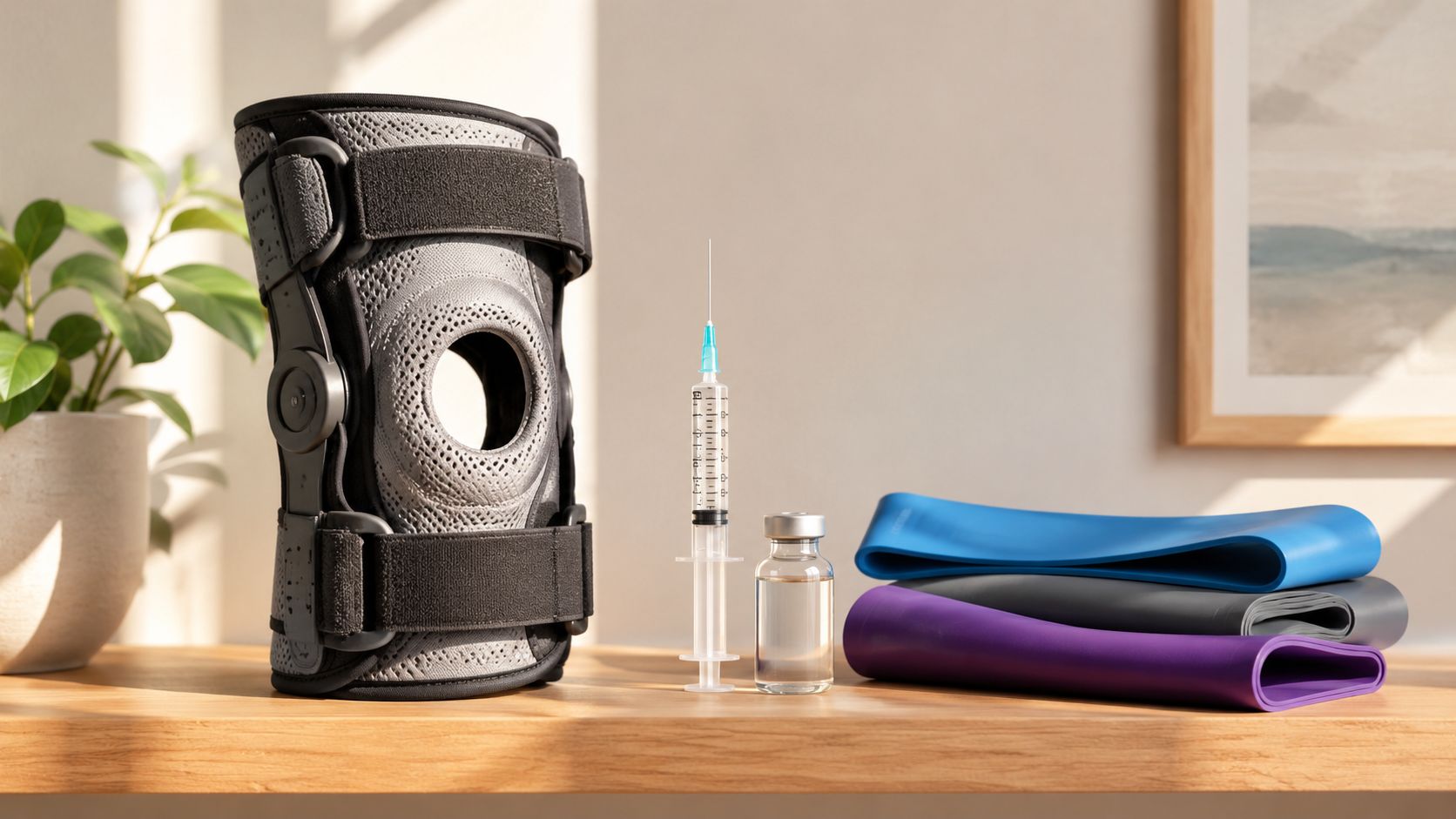
A brace can reduce irritation. An injection can calm symptoms. Certain procedures may buy time. None of those replace the work of restoring strength, movement quality, and load tolerance. Use them as bridges, not finish lines.
Braces help when alignment is part of the problem
If you're bow-legged or knock-kneed, the issue isn't just pain. It's repeated uneven loading through the joint. That changes the math on every step, squat, and golf swing.
An orthopedics source explains that for knees with alignment issues, a special unloader brace can help redistribute load across the joint, especially when paired with low-impact activity, in this article on avoiding total knee replacement surgery. That matters because better alignment can reduce the compartment stress that keeps flaring symptoms.
Braces make the most sense when they let you do the work better. If a brace helps you walk, train, and strengthen without constantly irritating the joint, good. Use it. If you treat it like a cure, you'll stall out.
Injections can create a training window
A lot of people get an injection, feel better for a bit, then go right back to the habits that drove the pain in the first place. That's a wasted opportunity.
A smarter approach looks like this:
Use pain relief strategically
If symptoms decrease, start building mobility, strength, and gait capacity while the window is open.Keep expectations realistic
If the injection only changes pain and nothing else changes in your movement or strength, don't expect a long-term win.Pair tools with a plan
That plan might include strength progressions, low-impact conditioning, and targeted care such as knee pain treatment in Mount Laurel when the focus is restoring function instead of chasing symptoms.
A brace or injection should make rehab easier. It should not replace rehab.
Making the Call When Surgery Is the Smart Play
You wake up at 2 a.m. because your knee is throbbing. You limp through the morning, avoid stairs when you can, and keep telling yourself to just grind harder. Then you try to train and realize your world keeps shrinking. That is the moment to get honest.
There is a point where delaying surgery stops being disciplined and starts being denial.
If you have committed to real rehab, strength work, load management, and smart movement changes, and the knee still controls your day, surgery can be the right call. The goal was never to win a contest for who can suffer the longest. The goal is to get back to living like yourself again.
Know when delay stops helping
As noted earlier, options that buy time do not always hold up for the long haul. That matters if you are stacking temporary fixes while your function keeps dropping.
Make the decision based on what your knee lets you do, not on fear, pride, or a scary phrase from an MRI report. Active people get in trouble here because they keep chasing one more injection, one more round of passive treatment, or one more month of avoiding the issue. That is like taping over a warning light on the dash and calling the engine fixed.
Surgery becomes a smart play when your effort is real and the result is still poor.
Signs it is time to stop toughing it out
Watch for these patterns:
Your sleep keeps getting wrecked
Night pain is a serious signal. Recovery tanks when you cannot sleep, and everything feels harder from there.Basic daily tasks keep slipping
Walking, stairs, getting off the floor, standing at work, or keeping up with your kids should not require a strategy meeting.Training options are gone
Good programming usually gives you ways to work around a cranky joint. If every squat pattern, hinge, carry, bike ride, and long walk lights the knee up, your margin is gone.You already did real conservative care
Real care means a structured plan with progression, not random band exercises, rest, ice, and hope. If you addressed strength, motion, gait, and force tolerance and still cannot function, that matters.Your identity is taking a hit
This part gets ignored too often. If the knee has turned you from an athlete into someone who avoids movement, cancels plans, and second-guesses every step, the cost is bigger than pain alone.
Surgery is a tool. Use it when it gives you the best shot at getting your life back.
If you're in Marlton, Mount Laurel, Cherry Hill, Moorestown, Haddonfield, Medford, or anywhere in South Jersey, and you're stuck between “keep grinding” and “maybe it's time,” schedule a Free Discovery Visit. Get clear on what's driving your knee pain, what conservative care can still realistically do, and whether surgery should stay on the bench or move into the starting lineup.
If you're tired of temporary relief and want honest guidance on how to avoid knee replacement, or how to know when avoiding it no longer makes sense, schedule a Free Discovery Visit with Valhalla Performance. We help active adults in Marlton, Mount Laurel, Cherry Hill, Moorestown, Haddonfield, Medford, and South Jersey figure out the root cause, map out the right next step, and build a plan around getting back to training, sport, and real life.