
Your lower back doesn't usually ruin your life in one dramatic moment. It chips away at it.
First it's the little warning shot during deadlifts. Then it's the stiffness after a long car ride. Then you notice you're rotating weird in your golf swing, cutting your stride short on runs, or hesitating before shooting in at jiu-jitsu because you don't trust your body. You start planning your life around flare-ups. That's when “relief” starts sounding good enough.
It isn't.
If you've already done the standard loop of rest, random stretches, heat, a few adjustments, maybe some generic PT exercises printed on a sheet of paper, and you still can't train the way you want, the problem probably isn't that you're broken. The problem is that you've been handed a low-level strategy for a high-performance body.
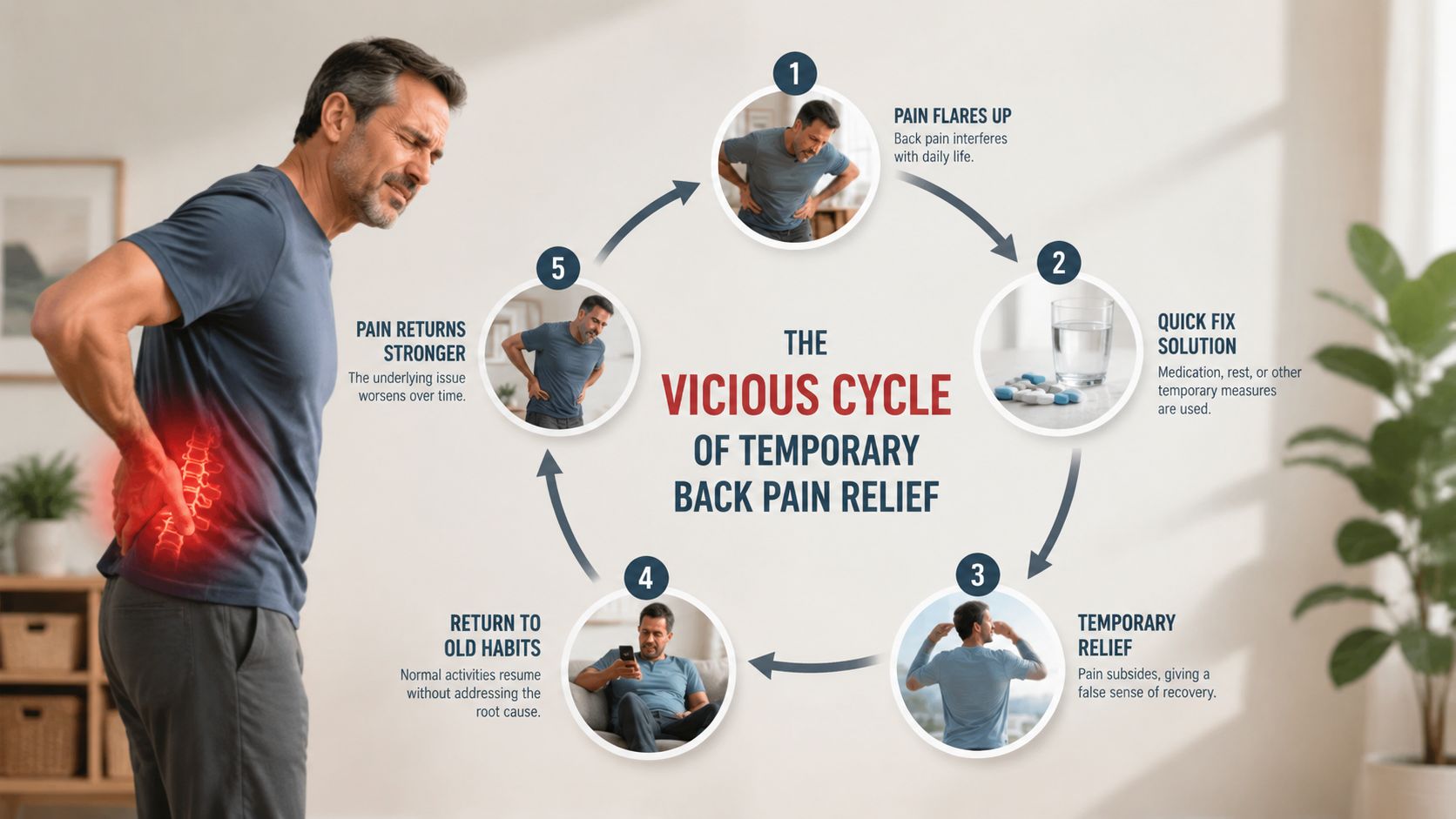
The Vicious Cycle of Temporary Back Pain Relief
For those seeking lower back pain relief, what they're often really chasing is a timeout. They want the pain to back off long enough to survive work, get through a workout, or sleep without feeling like they aged overnight. I get it. When your back lights up tying your shoes, “temporary” feels better than nothing.
But that low bar is exactly what keeps people stuck.
Why the usual playbook keeps failing
Most online advice for chronic low-back pain still revolves around passive symptom-soothing. Ice. Heat. Basic stretching. Massage. Maybe a quick crack and a “see you next week.” The problem is that evidence points active adults toward something very different: a structured shift from symptom management to graded exercise, education, and active rehab for longer-term results and recurrence prevention, as summarized by the NCCIH overview on low-back pain and complementary approaches.
That doesn't mean passive care is useless. It means passive care is a tool, not a destination.
If your whole plan is built around feeling better for the next six hours, don't act shocked when your back keeps acting like the villain in a slasher sequel. It always comes back.
Practical rule: If a treatment gives relief but doesn't change how you move, load, recover, or train, it probably isn't solving the problem.
Relief is not the same as recovery
Here's what the cycle usually looks like:
You get a flare-up: Maybe during a heavy pull, a long run, or a day at your desk.
You shut everything down: You stop training, avoid movement, and baby the area.
You chase comfort: Heat, stretching, rolling, maybe an adjustment or massage.
Pain eases just enough: So you jump back into normal activity.
The same pain returns: Because the underlying driver never changed.
That cycle is brutal because it messes with more than your back. It starts messing with your identity. The runner stops signing up for races. The lifter stops loading the bar. The golfer plays guarded and loses his swing. The parent quits roughhousing with the kids on the floor.
The broken system behind the pain loop
A lot of the rehab industry still treats active people like fragile office furniture. Calm it down. Don't provoke it. Stay comfortable. That mindset is fine if the only goal is surviving the week. It's garbage if your goal is to get back to lifting, rolling, running, rotating, sprinting, and living like an athlete.
Your back usually doesn't need more superstition. It needs a plan.
A real plan asks harder questions. Why does the pain spike under load? Why does it show up after sitting? Why does your hinge look clean at warm-up weights and collapse when the bar gets heavy? Why does your back keep doing work your hips, glutes, trunk, or thoracic spine should be handling?
Those answers don't come from another round of generic “relief.” They come from figuring out the underlying cause and training your way out of it.
Your Smart Action Plan for Acute Flare-Ups
When your back flares up, panic makes people stupid. They either lock themselves in bed like they've been medically retired, or they try to “push through” with the same intensity that got them into trouble. Both moves are bad.
The first 48 hours should be about calming the threat down without turning yourself into a statue.
Know the difference between danger and irritation
Not all pain means damage. Sometimes a flare-up is your system getting loud, not your spine falling apart. You need to separate “this is irritated” from “something is seriously wrong.”
Use common sense. If symptoms are intense, unusual, or feel medically concerning, get checked by the right provider. But if this is the familiar “my low back grabbed” pattern, your first move usually shouldn't be total shutdown.
Don't treat your back like it's made of glass. Treat it like it's annoyed and needs smart management.
What to do in the first two days
Start with positions and movements that reduce guarding.
Change positions often
Don't camp out in one posture. Long sitting usually stiffens people up. Long bed rest often does the same. Rotate between walking, standing, lying down, and supported sitting.Use breathing to drop tension
Try a simple positional breathing setup on your back with your feet supported. Slow breaths can help reduce the “everything is braced and angry” feeling that shows up in flare-ups.Add tiny movement snacks
Cat-cows, pelvic tilts, glute bridges, or short easy walks can help keep things from locking down further. The key is dosage. Small, repeatable, calm.Respect symptoms without worshipping them
Mild discomfort during movement isn't automatically a stop sign. Sharp escalation, spreading symptoms, or movement that clearly cranks things up and stays worse afterward is different.
If you need a place to start, these lower back pain relief exercises are more useful than random social media stretches from someone balancing on a Bosu ball for clout.
What not to do
A flare-up is not the time for hero behavior.
| Bad move | Better move |
|---|---|
| Testing your max deadlift “to see if it's better” | Rehearsing pain-free hinge patterns and easy walking |
| Stretching aggressively into pain | Using gentle range that settles symptoms |
| Lying still all day | Frequent low-threat movement |
| Waiting for pain to vanish before moving | Moving early, but intelligently |
A lot of people create a second injury by reacting badly to the first one. They twist weird getting out of bed, brace like crazy during every transition, or spend all day sitting crooked because they're afraid to move normally.
Use pain as feedback, not as your boss
If a movement makes things feel a little stiff but then you loosen up after, that's often useful information. If a movement spikes symptoms and leaves you worse for hours, that's also useful information. Your job isn't to avoid all sensation. Your job is to find the lane where your body tolerates movement and starts rebuilding trust.
The biggest mistake during a flare-up is thinking the answer is to do nothing until your back “heals.” For active adults, complete rest often turns a manageable problem into a longer, nastier one.
Finding the True Culprit Behind Your Back Pain
The “you just need to strengthen your core” line has done a lot of damage. It's rehab fortune-cookie advice. Short. catchy. mostly useless.
Yes, trunk strength matters. No, your back pain is not automatically a punishment for forgetting planks.
The body is a chain, not a stack of isolated parts
Persistent back pain is often driven by a mix of factors. Current guidance pushes back on the lazy “core weakness” story and points toward more individualized contributors like hamstring tightness, posture, sleep habits, lifting mechanics, and overall movement tolerance, as discussed in this Spine-health overview of overlooked lower back pain relief factors.
That's exactly why so many active people stay frustrated. They get treated where it hurts, not where the problem starts.
Here's what that looks like in real life:
A CrossFit athlete with stiff hips keeps borrowing motion from the low back at the bottom of the squat.
A runner with poor trunk control and tired glutes starts dumping force into the lumbar spine late in the run.
A golfer with limited thoracic rotation asks the low back to create turn it was never built to own.
A BJJ athlete spends hours in flexed positions, then wonders why bridging and scrambling lights up the same irritated area.
Common culprits that masquerade as back pain
Sometimes the pain generator isn't the pain driver. That distinction matters.
Stiff hips
If your hips don't flex, rotate, and extend well, your low back will often do extra work in squats, hinges, and change-of-direction tasks. That's a lousy trade.
If that sounds familiar, this breakdown on stiff hips and lower back pain can help you understand why the issue keeps showing up in training.
Bad breathing mechanics
A lot of active adults live in a constant extension pattern. Ribs flared. Low back arched. “Chest up” taken way too far. That might look athletic in a mirror, but it can turn your back into the body's overworked intern.
Low movement tolerance
This one gets missed all the time. Some people aren't weak in one isolated muscle. They don't tolerate enough movement or load well anymore. Their system has lost capacity. Every workout becomes a test instead of training.
Your back may not be the weak link. It may be the overworked employee covering for everyone else.
Why generic treatment misses the mark
A sheet of bird dogs and dead bugs isn't a diagnosis. A five-minute adjustment isn't a diagnosis either. Neither is someone poking the sore spot and calling it a day.
Root-cause work means looking at your sport, your training history, your recovery habits, your movement quality, and the exact positions that trigger symptoms. It means asking why your back hurts during a kettlebell swing but not a split squat. Why sitting wrecks you but walking helps. Why one side loads differently than the other.
That's the puzzle. And if nobody has examined the full puzzle, don't be surprised that your results keep stalling.
How to Build a Resilient and Bulletproof Back
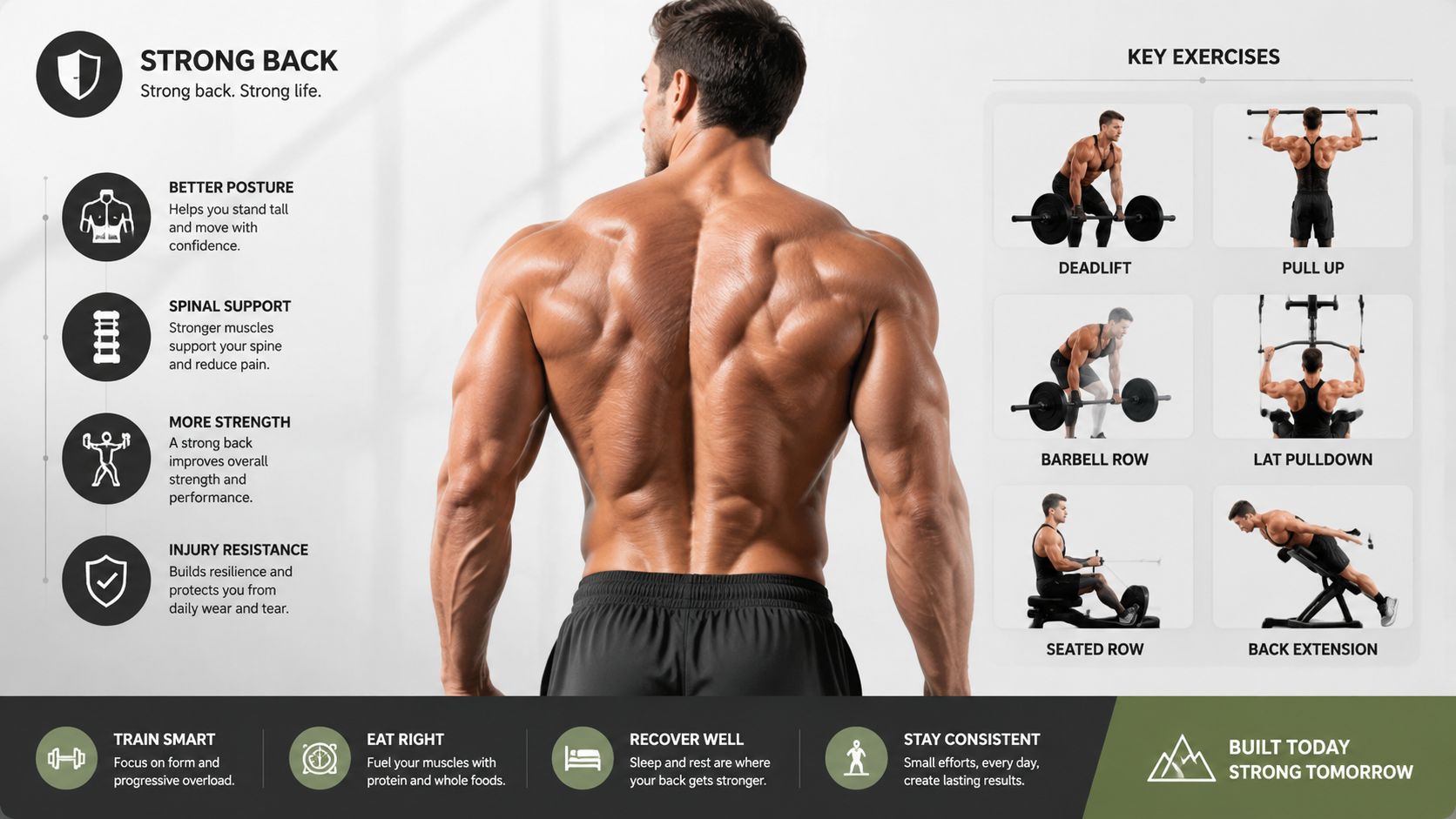
A strong back isn't built by avoiding your back. It's built by teaching the whole system to share load the right way.
That means mobility where you need mobility, stability where you need stability, and strength where life and sport demand it. Not circus exercises. Not rehab cosplay. Real progression.
Start with mobility that changes the game
If your hips and thoracic spine are locked up, your lower back usually pays the bill.
That doesn't mean you need an hour of stretching while listening to whale noises. It means you target the restrictions that are forcing your low back to become the emergency backup plan. Hip rotation work, hip flexor mobility, thoracic rotation drills, and better breathing positions can all matter when they match the person in front of you.
Then build stability that actually transfers
Many rehabilitation paths diverge here. People hear “stability” and think it means lying on the floor doing baby exercises forever. No. Stability is the ability to control position under real demand.
For the lifter, that means bracing without hinging from the lumbar spine. For the runner, it means holding pelvic control when fatigue hits. For the BJJ athlete, it means producing force through the hips instead of cranking through the low back during scrambles and guard work.
A few examples:
For squats and deadlifts: Learn to stack ribs over pelvis, own the hinge, and brace before the load owns you.
For golf: Improve rotation above and below the low back so your swing stops punishing the same segment over and over.
For running: Build glute strength and trunk control so late-mile form breakdown doesn't turn into post-run stiffness.
Add strength and capacity without acting scared
This is the part too many people never reach. They get pain reduced, then rehab stops. That's like getting your car out of the shop and deciding never to drive above twenty again.
Evidence supports individualized exercise-based care here. A meta-analysis covering more than 10,000 chronic low-back-pain patients found that personalized exercise improved pain-relief success rates by 38% compared with standard treatment, and when individualized care was combined with coaching on pain beliefs such as CBT, pain-relief success was 84% higher than standard care, according to this ScienceDaily summary of the meta-analysis.
That matters because generic rehab gives generic results.
Build a back that can do your life. Don't stop at a back that can survive the couch.
A simple progression that makes sense
| Phase | What you're doing | What it should prepare you for |
|---|---|---|
| Mobility | Opening the hips, thoracic spine, and breathing mechanics | Cleaner movement with less compensation |
| Stability | Bracing, trunk control, glute engagement, patterning | Better control under bodyweight and light load |
| Strength and capacity | Squats, hinges, carries, split stance work, sport-specific loading | Return to training, work, and sport with confidence |
One option for this kind of assessment-driven progression is Valhalla Performance, which combines chiropractic manipulation with personalized strength and conditioning inside a one-on-one model for active adults.
The point isn't that everyone needs the same exercise. The point is the opposite. Your back gets more resilient when your plan matches your body, your sport, and your actual weak links.
The Difference Between Treatment and Transformation
A lot of clinics sell treatment. Very few deliver transformation.
Treatment is “Does this hurt less today?” That's a fine question, but it's not enough. Transformation asks better ones. Can you hinge without fear? Can you train three days this week without paying for it? Can you get through eighteen holes, a long shift, or a tough class without managing your spine like a hostage negotiation?
Stop accepting vague wins
The rehab world often gets sloppy. People say they're “better,” but nobody defines what that means.
Clinical research does a better job. In procedural back-pain literature, success is often measured by responder thresholds, not vague impressions. In the benchmark data summarized for the Intracept procedure, roughly 65 to 69% of patients achieved at least 50% pain reduction, about 36.2% reached at least 75% pain reduction, roughly 70% returned to prior activity levels, and only about 22 to 38% reported complete pain relief, as outlined in this review of Intracept success-rate benchmarks.
That should wake people up.
Complete pain relief is not the only meaningful outcome. Return to activity matters. Big reductions matter. Clear benchmarks matter.
What a real recovery plan should measure
If your provider can't tell you how progress will be measured, you're basically buying vibes.
A serious plan should track things like:
Pain thresholds: Are you seeing meaningful reduction, not just random good days?
Function: Can you sit, sleep, hinge, rotate, run, lift, or grapple better?
Return to activity: Are you getting back to your prior level?
Confidence under load: Can you move without bracing for disaster every rep?
Your environment matters too. Your desk setup, your driving posture, and how you spend your workday can keep poking the bruise if nobody addresses them. That's why a practical guide on ergonomics and back pain belongs in the conversation when symptoms keep getting stirred up outside the gym.
What treatment looks like when it's done right
Transformation means the care plan is built around your actual goal. Not “less pain someday.” Real goals. Back to heavy deadlifts. Back to weekend golf. Back to jiu-jitsu rounds without second-guessing every bridge and inversion.
It also means your provider acts like a coach, not a human TENS unit. They assess movement. They explain what's driving the issue. They progress you. They adjust the plan when your response changes. They help you build capacity so you don't need endless tune-ups just to function.
If your current plan depends on forever maintenance without stronger movement, better tolerance, or a clear path back to performance, that isn't transformation. That's a subscription model.
Stop Managing Pain and Start Building Performance
You don't need another lecture about sitting up straight and stretching your hamstrings twice a day. You need a better standard.
Your lower back pain is not just an annoying symptom to suppress until the next flare-up. For active adults, it's usually a signal that your system isn't handling load, movement, recovery, or mechanics the way it needs to. That's fixable. But only if you stop chasing comfort as the finish line.
Choose the path that actually leads somewhere
You've got two options.
One is the same recycled loop. Short-term relief. Temporary calm. Quick return. Same setback. Same frustration. Same slow erosion of the things that make you feel like yourself.
The other is harder at first, but far more honest. Find the driver. Build a plan around how you move. Train the weak links. Restore capacity. Return to your sport stronger and less fragile than before.
That second path is the one that gives people their life back.
The real win isn't just getting rid of pain. It's trusting your body again.
What this means for your future
If your back feels this limiting now, don't assume time will magically clean it up while you keep doing the same things. It usually doesn't work that way. The golfer swings around it. The runner shortens stride. The lifter avoids heavy days. The BJJ athlete changes positions to dodge pain and starts losing edge.
That's how people slowly become spectators in their own lives.
You're not supposed to spend the next decade “being careful” with a body that used to feel powerful. You're supposed to rebuild it. Smarter than before. Stronger than before. More aware of what drives symptoms and what fixes them.
If you live in Marlton, Mount Laurel, Cherry Hill, Moorestown, Haddonfield, Medford, or anywhere in South Jersey, and you're done wasting time on generic PT, passive chiropractic, and random internet fixes, the next move is simple. Have a real conversation with someone who looks at the whole picture and gives you a plan built around your goals.
If you're ready to stop chasing temporary relief and start solving the underlying problem, schedule a Free Discovery Visit with Valhalla Performance. If you're in Marlton, Mount Laurel, Cherry Hill, Moorestown, Haddonfield, Medford, or elsewhere in South Jersey, this is the easiest way to talk through your back pain, your goals, and whether a root-cause, movement-based plan makes sense for you.