
You know the feeling. You step onto the first tee, take one practice swing, and your lower back gives you that warning shot. Not enough to make you quit on the spot. Just enough to make you start negotiating with your own body before the round even starts.
So you shorten the backswing. You stand up out of posture. You try to “swing easy.” Then you go home irritated, not just because you played badly, but because the thing you use to compete, decompress, and feel like yourself is turning into a weekly argument with your spine.
If you've already tried basic PT, random stretches off Instagram, or the usual crack-and-go chiropractic visits, I get why you're skeptical. You don't need another temporary reset. You need a body that can handle the violent rotational demands of golf.
That Swing Is Your Identity Until It Becomes Your Injury
For a lot of golfers, the problem doesn't start as a dramatic injury. It starts as a pattern.
You feel tight getting out of the car before the round. Your lead hip feels blocked halfway through the backswing. Your mid-back won't turn, so your lower back tries to do the job. You still play. You always play. But now every range session comes with a cost.

Pain doesn't just ruin the round
This is bigger than soreness. Golf isn't just a hobby for you.
It's your competitive outlet. It's the thing you do with your friends, your clients, your spouse, your dad. It's the sport you planned to keep playing for decades because unlike football or wrestling, it was supposed to age with you.
Then your body starts making decisions for you.
You skip early tee times because you know your back won't loosen up. You avoid practicing because the next day is miserable. Your handicap creeps the wrong way, and you tell yourself it's just a rough stretch. Deep down, you know it's not. Your body is changing your swing, your confidence, and your identity as an athlete.
Golf pain hits differently because it doesn't usually take you out all at once. It steals pieces of your game until you don't recognize it anymore.
The future gets ugly if you ignore it
If your body can barely tolerate a round now, what happens after more years of desk work, more travel, more stress, and less recovery?
That's the part most golfers avoid thinking about. A stiff, achy back at this stage isn't just annoying. It's a preview. If you keep chasing symptom relief and never rebuild the system underneath it, you're not managing the problem. You're rehearsing it.
I see this same mindset in lifters, runners, and jiu-jitsu athletes. They keep trying to out-tough a mechanical problem. Golfers do it too, just in a polo instead of a singlet.
You don't need more grit. You need a better plan.
Your Body Is Not Built for Your Desk Job and Your Golf Swing
Golf looks smooth. It isn't.
A real swing is a high-speed coil and uncoil. Your body stores force, transfers force, then dumps that force through the club. If your hips move well, your mid-back rotates, and your rib cage can expand and turn, that force has somewhere to go. If those areas are locked up, your lower back becomes the desperate substitute.

Your swing is a spring, not a casual twist
Think of your swing like a loaded spring. You coil into the backswing, then fire in the other direction. That only works when the spring is built from multiple segments doing their job.
Your hips need to rotate. Your thoracic spine needs to rotate. Your rib cage needs to move with your breathing. Your lead side needs to accept force. If even one link gets rusty, another link takes the hit.
That is why golfers don't just “have a bad back.” They usually have a body that has lost the ability to share load well.
A golf-focused review notes that about 85% of reported golf injuries are related to the spine and low back pain, and lower-back pain is also a dominant reason people seek chiropractic care, with nearly half of chiropractic patients, 46%, visiting for lower-back pain according to the summary discussed in this review on why golfers often seek chiropractic care.
Your desk is training you too
A lot of golfers train in the gym and think they're doing enough. But if you sit all day, commute hunched over, then ask your body to rotate hard at speed, you're trying to play a power sport with joints that have been marinating in one position for hours.
That's why “posture advice” by itself is useless. The fundamental issue is capacity.
- Stiff hips: If your hips won't rotate, your lumbar spine starts borrowing motion it shouldn't.
- Frozen mid-back: If your thoracic spine can't turn, you lose separation and dump stress into the low back.
- Poor rib movement: If you can't breathe and rotate well together, you lose control under speed.
- Weak lead side: If you can't absorb force on the front side, your swing gets loud, sloppy, and painful.
If this sounds familiar, your golf problem probably starts before you ever pick up a club. That's why fixing your workstation and daily movement habits matters. If you spend most of your week folded into a chair, start with better ergonomics and back pain habits that stop feeding the problem.
Practical rule: If your body only feels “free” right after warming up or getting treatment, you don't have a solved problem. You have a temporary workaround.
Why Traditional Chiropractic Is a Losing Game for Golfers
Let's say the quiet part out loud. A lot of golfers have already tried chiropractic, and it helped for about a day and a half.
You got adjusted. Maybe your back felt looser. Maybe your turn improved for the rest of the afternoon. Then the stiffness came back, the same side kept grabbing, and you found yourself scheduling another visit just to get back to baseline.
That's not a long-term strategy. That's renting relief.
The pop isn't the plan
A joint adjustment can be useful. I use them. But golfers get into trouble when they treat the adjustment like the whole program instead of one tool inside a bigger system.
If your thoracic spine is restricted, opening it up can matter. If your ribs are stuck, restoring movement can help. But if your body still has the same weak patterns, poor motor control, and bad load transfer, you'll keep driving the same compensation right back into the same area.
It's like prying open a rusty door hinge without fixing the frame, cleaning the hinge, or teaching the door to move right. It might open today. It still isn't fixed.
What the evidence actually supports
Golfers need honesty, not hype. The cleaner message is simple.
The evidence that passive adjustments alone directly improve performance metrics like clubhead speed or handicap is weak, while the more supported position is that integrated, active care can reduce pain and improve function, which gives performance a real foundation. That's the key distinction outlined in this discussion of chiropractic evidence in golf and musculoskeletal care.
So if somebody is promising that a quick crack will magically add speed, shave strokes, and keep you pain-free without any retraining, that's marketing. Not a plan.
If treatment ends when the table session ends, you're not being rebuilt. You're being reset.
Dependency is not durability
Traditional PT can fall into the same trap, by the way. Different tools, same mistake.
If nobody checks how you rotate, load your lead side, control your pelvis, or absorb force through the trunk, then care stays too local. It chases the pain site instead of the reason the pain site keeps getting overloaded.
If you're looking for a more root-cause approach, this is the category I mean by a functional chiropractor near me. Not someone who just finds what's tight. Someone who finds why it keeps tightening in the first place.
The Real Fix A System Built for Performance
Golfers don't need more random treatment. They need a process.
That starts with figuring out whether the pain is coming from a mobility restriction, a control problem, a strength deficit, a volume issue, or some ugly combination of all four. Frequently, that answer goes undiscovered. Instead, treatment often focuses solely on the area of discomfort.
Phase one is finding the leak
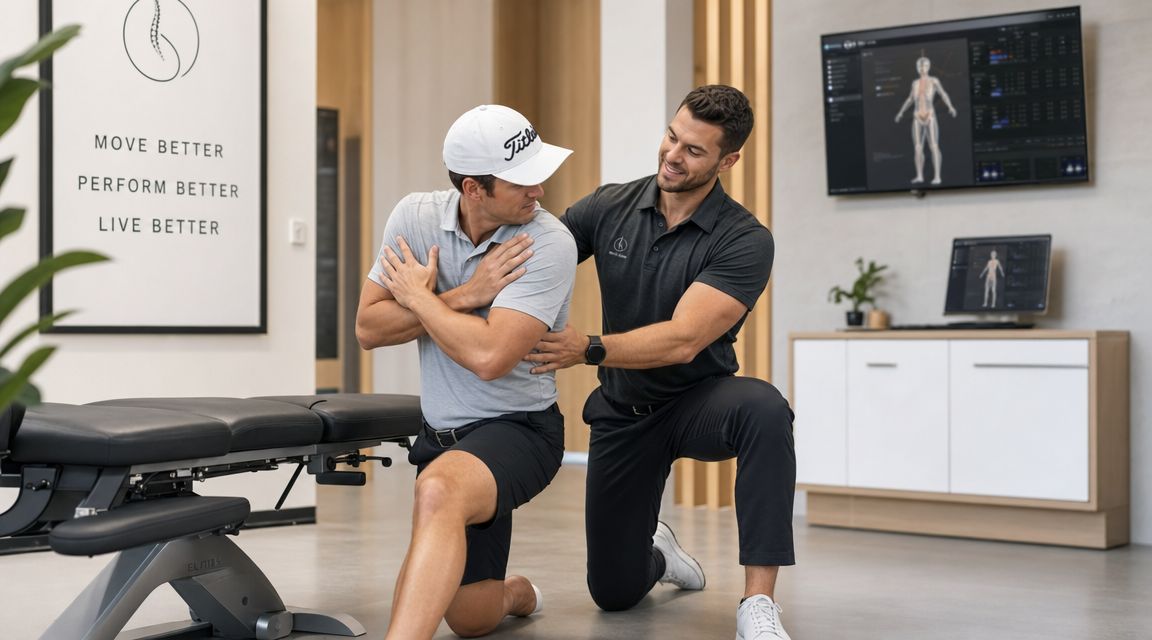
A real evaluation for golf and chiropractic shouldn't stop at your low back.
It should look at hip rotation, thoracic rotation, rib cage movement, pelvic control, lead-side stability, single-leg balance, and how you move from setup through finish. If your back hurts during golf, the back may be the victim. Not the criminal.
I want to know right away:
- Where do you lose motion first: Is it your lead hip, trail hip, mid-back, or rib cage?
- What do you do to compensate: Do you early extend, stand up, sway, or over-rotate through the lumbar spine?
- What loads you badly: Range volume, uneven lies, driver swings, bunker work, deadlifts, long car rides?
- Can you own new motion: If I improve mobility today, can your body control it tomorrow?
That last one matters most. A body that can't control motion will always slide back into protection.
Phase two is building a body that can keep it
Most treatment plans collapse at this juncture. They create a small opening, then do nothing with it.
An adjustment or manual therapy session can restore motion. Good. Now earn it. You need strength, positional control, and progressive exposure to golf-specific demand so that new motion becomes usable instead of temporary.
A commonly cited milestone in golf and chiropractic research came from a 2009 study in the Journal of Chiropractic Medicine. In that study, golfers who received spinal manipulative therapy combined with stretching improved significantly in full-swing performance by the fourth day, while the stretching-only group did not, with the strongest reported statistical result at P = .005, as described in the PubMed Central version of the study.
That doesn't mean manipulation alone is magic. It means integration matters. Open the system, then train the system.
What this looks like in practice
At a clinic using this style of care, the treatment isn't “get adjusted and hope.” It blends manual therapy with exercise progressions that match what your swing demands. One example is The One80 System at Valhalla Performance, which combines chiropractic care with individualized strength and rehab work to address root causes and build movement capacity.
A golfer with low-back pain might need manual work to free up the thoracic spine and ribs, then anti-rotation control work, then split-stance loading, then rotational power drills, then a graded return to range volume. That's a very different experience from lying on a table, hearing a pop, and being told to come back next week.
The adjustment creates an opportunity. The exercise keeps it.
If your care doesn't progress toward resilience, it isn't performance care. It's maintenance by another name.
How to Rebuild a Golfer From the Ground Up
Most golfers get one of two terrible instructions after treatment. “Rest for a bit,” or “just keep stretching.”
Neither solves the underlying problem.
If your body has been using the lower back as a substitute rotator, you need a rebuild. Not a random mobility drill. A progression. The point is to restore motion, teach control, then load it in a way that matches the sport.
Start with the area that's usually cheating your back
A common issue is poor thoracic rotation. When the mid-back can't rotate, the lumbar spine tries to fake it. That's where a lot of golfers get that familiar ache on one side after a bucket of balls or a full round.
This is the sequence I like for that pattern. Not because it's flashy, but because it respects how bodies learn.
| Phase | Exercise | Goal |
|---|---|---|
| Mobility | Open-book rotation or side-lying thoracic rotation | Restore usable mid-back rotation without cranking the low back |
| Control | Quadruped thoracic rotation with a stable pelvis | Teach the body to separate thoracic motion from lumbar motion |
| Stability | Half-kneeling lift or press variation | Build trunk control while the hips and rib cage stay organized |
| Integration | Split-stance cable or band rotation | Transfer new rotation into a loaded athletic position |
| Return to play | Controlled swing progression with volume limits | Reintroduce golf without dumping stress back into the same tissues |
What each phase should feel like
The first phase should feel like you're accessing motion, not forcing it. If you're yanking yourself into range with the lower back, you're rehearsing the same bad strategy that got you hurt.
The control phase is where impatient athletes get exposed. This is the boring part. It's also the part that changes everything. If you can't rotate the thoracic spine while keeping the pelvis quiet, your body doesn't own the motion yet.
Then comes stability and integration. That's where you teach the body to hold shape and produce force. Half-kneeling drills, split-stance presses, cable rotations, and anti-rotation work matter because golf doesn't reward loose movement. It rewards controlled violence.
Your body needs to earn speed. If you can't control rotation slowly, you have no business chasing it fast.
Returning to golf without screwing it up again
A huge gap in golf injury advice is the handoff back to practice and play. Durable results require a plan for maintaining strength, controlling practice volume, and preserving spine tolerance, which is why active, movement-based rehab matters for recurrence prevention, as discussed in this return-to-play discussion focused on active care in golfers.
Here are the rules I give golfers once symptoms calm down:
- Cap your volume early: Don't go from no swings to a full range session because you had one good treatment week.
- Keep two strength anchors in your week: Hips, trunk, and single-leg control need ongoing work, even in season.
- Respect next-day response: If your back lights up the morning after golf, your current load still exceeds your capacity.
- Train the lead side: A lot of golfers keep mobilizing forever and never build the front-side strength that helps absorb force.
- Use pain relief as a green light to train smarter, not harder: Feeling better is when athletes often sabotage themselves.
This is the same rule set I use with lifters returning to deadlifts and runners returning to speed work. The sport changes. The principle doesn't. You build capacity, expose it gradually, and stop pretending pain relief equals readiness.
Stop Chasing Pain and Start Building a New Game
If your current plan is to wait until your back flares up, get worked on, feel better for a minute, then repeat the cycle, you're not protecting your golf game. You're draining seasons out of it.
Golf and chiropractic can work well together. But only when chiropractic is part of a bigger performance system. Not a replacement for strength. Not a substitute for motor control. Not a magic trick.
What serious golfers need to accept
You are not fragile. But you are specific.
Your body adapts to what you repeatedly do. If you repeatedly sit, rush, lift with compensation, and swing through restrictions, your body will become very efficient at moving badly. Then one day you call that pattern “getting older.”
No. It's accumulated compromise.
Here's the shift that matters:
- Stop asking: “What can make this stop hurting by Saturday?”
- Start asking: “What does my body need so Saturday stops beating me up?”
That's the whole game. Different question. Different outcome.
You don't need another reset button
You need a full rebuild around how you move, how you train, and how you return to the course.
That means finding the root cause. It means accepting that passive care alone won't carry you. It means treating yourself like an athlete again, even if your sport happens in spikes instead of cleats. Golf is still rotational power, force transfer, deceleration, balance, and resilience. Train for that, and your body gives you a chance. Ignore that, and you're just hoping your back stays quiet long enough to finish the front nine.
If you're in Marlton, Mount Laurel, Cherry Hill, Moorestown, Haddonfield, Medford, or anywhere in South Jersey, and you're sick of temporary fixes, make a different move this time.
If you're ready to stop chasing symptoms and figure out why your body keeps breaking down during golf, schedule a Free Discovery Visit with Valhalla Performance. You'll get a clear conversation about what's driving the problem, whether a movement-based plan makes sense for you, and what it would take to get back to playing without negotiating with your back every round.