
If you’re an active adult stuck in a frustrating loop of stretching your tight hips or shoulders only to have the pain and tightness boomerang back the next day, you’re not alone. And no, you’re not broken. You’re just aiming at the wrong target.
Lasting relief doesn't come from just yanking on a muscle (flexibility). It comes from finding the root cause of your pain and building active control over your range of motion (mobility). It’s about teaching your body it’s safe and strong enough to move, not just forcing it into a position it can’t handle.
Why Your Stretching Routine Is a Dead End

Here's a story we hear all the time from people in our gym: you feel tight after a workout, you stretch, you feel better for a hot minute, and then you wake up feeling like a human pretzel all over again. Sound familiar?
This happens because we’re all conditioned to believe tightness means a muscle is too short. But what if that “tight” feeling is actually your nervous system slamming on the emergency brakes to protect an unstable or weak area?
That’s the game-changing difference between passive flexibility (how far a trainer could move your leg) and active mobility (how far you can move your leg and control it). Endlessly stretching a muscle that your brain is actively trying to lock down is like trying to win a tug-of-war against yourself. It’s a battle you’ll never win.
That Tightness? It's a Symptom, Not the Disease.
Let’s talk about the classic “tight hamstrings” that stop you from deadlifting properly. You could stretch them until the cows come home, but you still can't get to the bar without your back rounding like a scared cat.
Nine times out of ten, the hamstrings aren't the villain here. The real culprit is often a weak, unstable core. When your brain senses it can’t protect your spine during a lift, it instinctively shortens the leash on your hamstrings. It’s a defense mechanism, a warning shot telling you, "Don't go there! I can't control it!"
No amount of hamstring stretching will fix a core stability problem. You need to teach your nervous system the position is safe by getting stronger. We see the same exact thing with chronic hip tightness, which is almost always a sign of weak glutes. You can learn more about why stretching won't fix your muscle tightness in your hips and what to do instead.
That feeling of tightness is your body's alarm system. It's screaming that something lacks stability, not just length. If you want to shut off the alarm for good, you have to fix the underlying weakness.
Mobility Is More Than Just Squatting Deeper
Getting a handle on your usable range of motion isn't just about gym performance—it's a critical piece of the puzzle for long-term health and avoiding injury.
A 2026 study in the Scandinavian Journal of Medicine & Science in Sports found a shocking connection between flexibility and longevity. Researchers discovered that women with low flexibility scores were nearly five times more likely to die prematurely over the 13-year study. You can read more about how greater flexibility is linked with longer lives.
If you’re done with temporary fixes and ready to find the root cause of your pain, we can help. If you live in or around Marlton, Mount Laurel, Cherry Hill, Moorestown, Haddonfield, or Medford, it's time to stop guessing. Schedule a Free Discovery Visit with us and let’s build a plan to get you results that actually stick.
Finding Your Real Movement Restrictions
If you're tired of chasing symptoms and want to fix the real problem, you have to stop guessing and start assessing. Mindlessly stretching everything that feels “tight” is like throwing darts in the dark. It’s time to become a movement detective.
Let's use a few simple, functional screens to pinpoint exactly where your movement is breaking down. These aren't complicated medical tests—just straightforward movements that expose the weak links in your chain. Forget generic advice; this is about getting specific intel on your body.
The All-In-One Screen: The Deep Squat Assessment
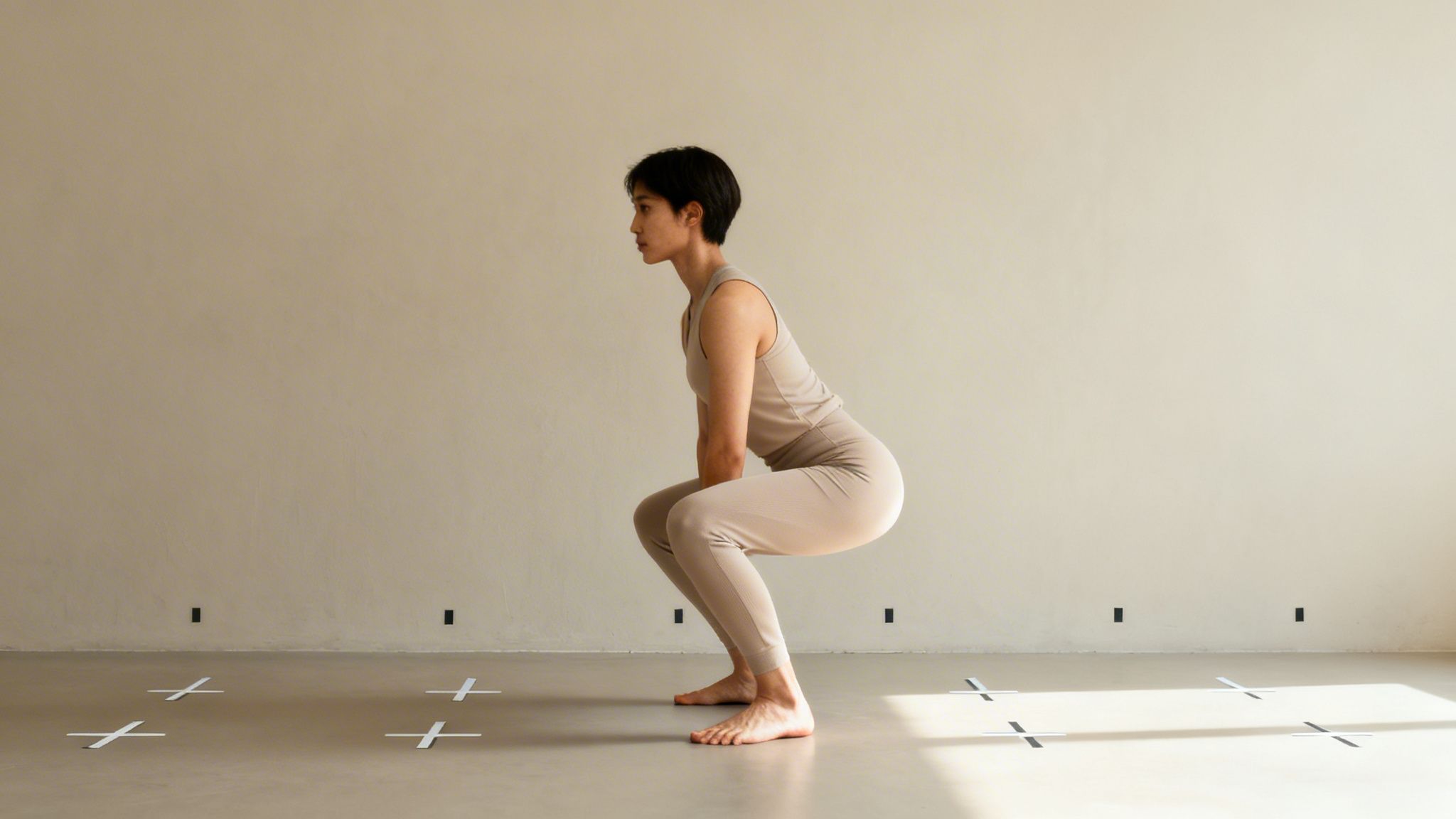
The overhead squat is a powerful diagnostic tool disguised as an exercise. It’s a full-body interrogation, simultaneously challenging the mobility of your ankles, hips, and upper back. You get a complete snapshot of your movement system in one go.
Grab a broomstick, PVC pipe, or a light band and hold it overhead with a wide grip. Stand with your feet about shoulder-width apart, toes pointed forward or slightly out. Now, squat down as low as you can while keeping your heels flat, chest up, and the bar directly over your head.
So, what just happened?
- Heels Popped Up? Classic sign of angry, restricted ankles. If your ankles can't bend enough, your body will cheat by lifting your heels, which murders your squat depth and puts a ton of stress on your knees.
- Lower Back Rounded (aka "Butt Wink")? That little tuck-under at the bottom means you've run out of room in your hips. This could be legit stiff hips or a core that checked out and can't stabilize your pelvis. We see this all the time. Learn more about how we fix stiff hips and lower back pain.
- Chest Fell Forward? If you folded like a cheap lawn chair, your thoracic spine (upper back) is likely the culprit. A stiff t-spine makes it impossible to keep an upright torso, forcing you to compensate and putting your lower back and shoulders in a terrible position for lifts like cleans or snatches.
This single test gives us a roadmap. It tells us where to start digging.
Common Movement Faults and What They Mean
| Movement Screen | Common Fault Observed | Potential Root Cause |
|---|---|---|
| Overhead Squat | Heels lift off the floor | Ankle dorsiflexion restriction |
| Overhead Squat | Lower back rounds ("butt wink") | Hip mobility deficit or poor core control |
| Overhead Squat | Torso collapses forward | Thoracic spine mobility restriction |
| Active Straight Leg Raise | Limited range (under 80°) | True hamstring shortness or poor core stability |
| Active Straight Leg Raise | Range improves with core bracing | Primarily a core stability/motor control issue |
Remember, this table is a starting point. It's about gathering clues, not making a final diagnosis. The key is to test, not guess.
Are Your Hamstrings Really Tight?
Every lifter and their mother claims to have "tight hamstrings." For many, the real issue is a core stability problem in disguise, and the Active Straight Leg Raise (ASLR) is the perfect test to call its bluff.
Lie flat on your back, legs straight. Keep one leg glued to the floor and raise the other one as high as you can without bending the knee. How high did it go? A solid range is somewhere around 80-90 degrees.
If you got stuck, don't just grab a stretching strap. Try this first: brace your abs like you're about to take a punch, then do the leg raise again. If you magically gained more motion, your hamstrings were never the problem. Your brain was just slamming on the emergency brake because it sensed instability.
Your brain's number one job is to protect your spine. If it senses a lack of core control, it will artificially "tighten" your hamstrings and hip flexors to create stability. No amount of stretching will fix that—only a stronger core will.
By running through these simple tests, you shift from a passive stretcher to an active problem-solver. You’re gathering data to build a smarter plan. The goal isn't just to "get more flexible," but to target the specific roadblocks holding you back.
If you’ve done these screens and are still scratching your head, or if you’ve been stuck on the same issues for months, it’s time for an expert eye. For those in Marlton, Mount Laurel, Cherry Hill, Moorestown, Haddonfield, Medford, and the South Jersey area, the guessing games are over. Schedule your Free Discovery Visit with us at Valhalla Performance. We’ll connect the dots and build a plan that actually works.
Building Your Movement-Based Mobility Toolkit
So you've figured out where you're restricted. Now what? The real work begins. It’s time to move beyond useless, aimless stretching and build a toolkit that creates real, usable range of motion—the kind that makes your lifts feel better and your daily movements pain-free.
This isn't about becoming a contortionist. It’s about a smart, systematic approach that teaches your body to own new ranges of motion, not just passively visit them for a few seconds. We'll use a powerful three-step method you can plug right into your warm-ups for immediate results that actually last.
First, Tell Your Muscles to Chill Out
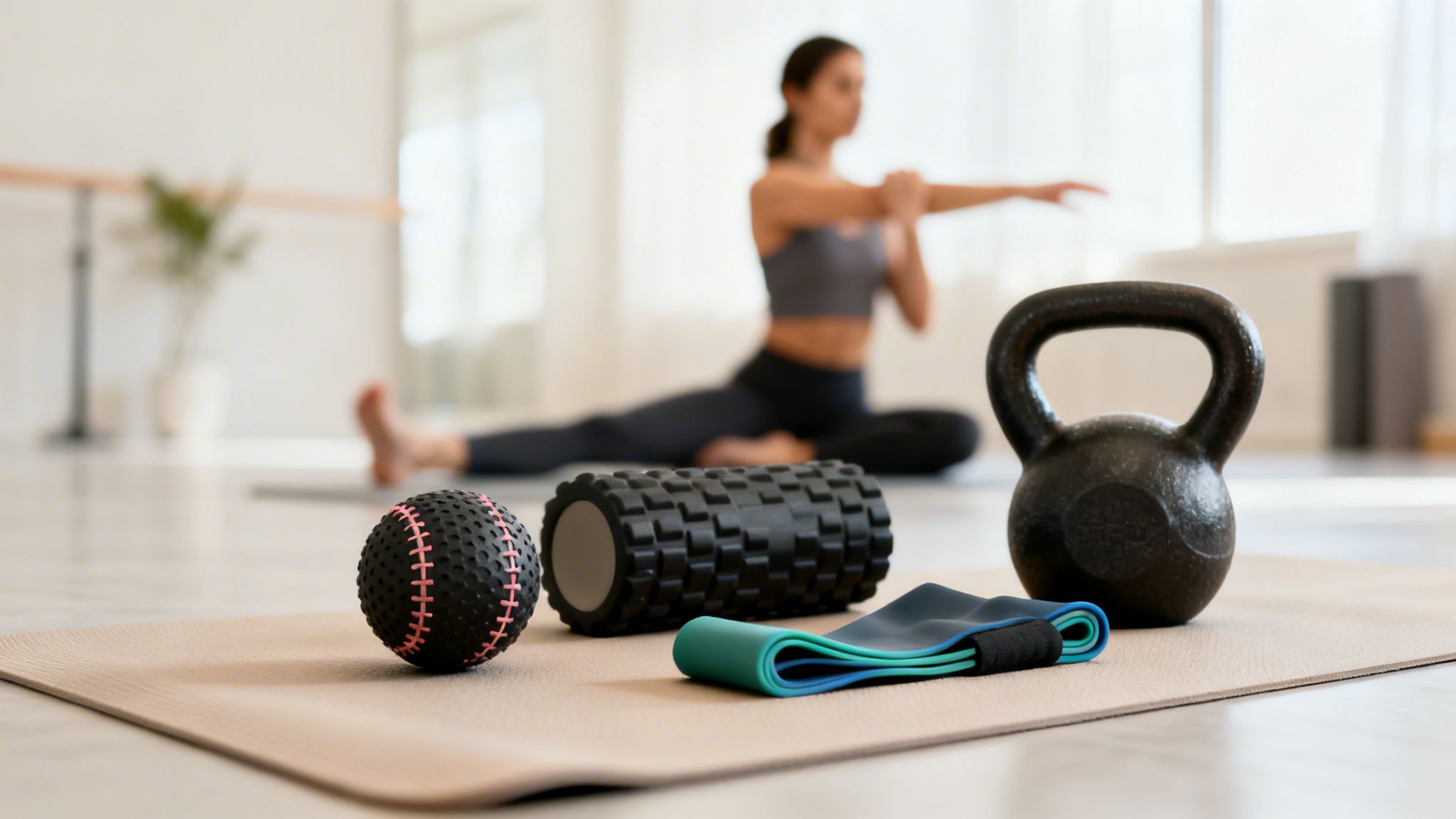
Before you can get a joint to move better, you have to calm down the overactive, "guarding" muscles surrounding it. This is where targeted soft-tissue work comes in. Think of it as sending a signal to your nervous system that it’s safe to release its death grip.
This isn’t about smashing your muscles into oblivion. It’s about precise, intentional pressure to release tension. A lacrosse ball, foam roller, or massage gun are your best friends here.
- For the CrossFit Athlete: Before a WOD with overhead squats, grab a lacrosse ball and pin it between your pec minor and a wall. That little muscle gets ridiculously tight from pull-ups and pressing, yanking your shoulder forward and killing your overhead position. A minute of focused work here can be a game-changer.
- For the Weightlifter: Can't hit depth in your squat? Spend some quality time with a lacrosse ball in your glutes and TFL (that muscle on the front/side of your hip). Releasing these can make you feel less "blocked" at the bottom of your squat.
The key is the "tack and floss" method: apply pressure to a tender spot, then gently move the joint through its range of motion. This is infinitely more effective than just rolling around like a log.
Next, Claim That New Real Estate
With the tissues prepped, it's time to actively explore and claim that new range of motion. This is the secret sauce for making mobility stick. You're teaching your brain and nervous system how to control the joint from end to end.
This is where active drills like Controlled Articular Rotations (CARs) are king. CARs are all about moving a joint through its largest possible pain-free circle, slowly and with max intention. This lubricates the joint, dials in motor control, and reinforces your usable range.
A shoulder CAR isn't some fast, sloppy arm circle. It’s a slow, deliberate movement where you’re trying to draw the biggest, cleanest circle possible, isolating the motion entirely at the shoulder. You should feel muscles working that you didn't even know you had.
True mobility isn't just about how far a joint can go; it's about whether you can control it when it gets there. Active drills like CARs build that control, turning passive flexibility into useful, injury-preventing movement.
And the best part? It's incredibly efficient. A landmark 2026 meta-analysis from the University of South Australia reviewed 188 studies and found flexibility gains maxed out at just three minutes per muscle per session and eight minutes per week. You can read more about these findings on how to improve flexibility with less time.
Finally, Lock It in With Strength
This is the glue. This is what makes your mobility gains permanent. After you prep the tissue and actively move the joint, you must immediately load it with a light strength exercise. This tells your nervous system, "See? This new position is not only safe, it's strong."
We call this Mobility-Strength pairing, and it’s a total game-changer. That newfound range of motion is fragile. If you don't use it, you lose it. Loading it solidifies the brain-muscle connection.
Here’s how it looks in the real world:
- Prep: Use a lacrosse ball on the front of your ankle and calf to improve dorsiflexion (1-2 minutes).
- Activate: Perform Rocking Ankle Mobilizations to actively explore that new range (10-15 reps).
- Lock-In: Immediately drop into a set of deep, paused Goblet Squats. Focus on driving your knees forward over your toes while keeping your heels glued to the floor.
You create a powerful feedback loop. The squat feels better because of the mobility work, and the mobility work sticks because you immediately used it in the squat. This is how you stop chasing the same tight spots forever and start making permanent change.
If you’ve been spinning your wheels with generic stretches and are ready for a system that actually works, we’re here to help. For active adults in Marlton, Mount Laurel, Cherry Hill, Moorestown, Haddonfield, Medford, and the greater South Jersey area, stop guessing. Schedule your Free Discovery Visit at Valhalla Performance and let’s build a personalized toolkit to get you moving and feeling your best.
How to Program Mobility for Real-World Results
So you’ve got a handful of mobility drills. Cool. Now what? Knowing the moves is one thing, but turning them into a habit that actually fixes your pain is a whole different beast.
Let’s be clear: the goal isn’t to slap another hour-long session onto your already packed week. The secret is weaving smart, targeted work into what you’re already doing.
Consistency will always crush intensity. You'll get way better, more permanent results from 10-15 minutes of focused work most days than you will from some heroic, once-a-week mobility marathon. Think of it like brushing your teeth—you don't do it for an hour on Sunday and expect it to work. It’s the daily grind that keeps things from falling apart.
This is how you keep your joints happy and teach your nervous system that this new range of motion is safe to use.
Making It Stick: Where to Fit Mobility In
The easiest way to make sure this stuff actually gets done? Bolt it onto your existing workouts. Use it as a strategic warm-up or a targeted cool-down. That way, it’s not just getting done—it’s actively making your training session better.
Here’s what that looks like in the real world:
- You're a CrossFit Athlete with Junky Shoulders: Before a WOD with snatches or pull-ups, your warm-up becomes a 10-minute surgical strike. You'll hit thoracic spine extensions on a foam roller, mash your pec minor with a lacrosse ball, and do some shoulder CARs to pry that overhead position open.
- You're a Weightlifter Who Can't Hit Depth: On squat day, your warm-up is all hips and ankles. That means ankle dorsiflexion drills to get your knees over your toes, 90/90 hip rotations to un-glue your hips, and paused goblet squats to own that newfound depth. If your lower back and hips are a constant battle, our guide on some of the best exercises for your lower back and hips is a good place to start.
Suddenly, your warm-up isn't just about breaking a sweat. It's a productive session that directly attacks your weaknesses.
How Do You Know If It’s Working?
Progressing your mobility isn’t about adding more weight or reps. It’s about quality. You don't need a thousand different drills; you need to become a master of the few that matter for you.
Stop guessing and ask yourself these questions:
- Does it feel smoother? Is the drill less clunky and more controlled than it was last week?
- Can you go further? Are you getting deeper into the position without compensating or feeling a pinch?
- Do you feel more stable? Are you less wobbly at the end range? Do you feel "locked in"?
If you can say yes, it's time to level up. Add a little complexity or a light load. That basic hip CAR on your hands and knees can become a standing hip CAR, which forces you to own the movement with more balance and core control.
True progress isn't about finding a "harder" stretch. It's about earning the ability to control your body in a larger, more stable range of motion. Once you own the movement, you've earned the right to advance it.
But if a drill still feels like a wrestling match, stay there. Your body is telling you that you haven’t milked it for all it’s worth yet. Patience and quality are how you build a body that doesn't break.
If you’re in Marlton, Mount Laurel, Cherry Hill, Moorestown, Haddonfield, Medford, or the surrounding South Jersey area and you're tired of the stop-start cycle, it’s time to get a real plan. Schedule a Free Discovery Visit at Valhalla Performance and let’s build a mobility program that actually delivers.
When Your Body Hits the Brakes
Look, a smart, consistent mobility routine is a game-changer. It can often unravel knots you thought were permanent and show you just how much progress you can make on your own—especially when you ditch passive stretching for an active, movement-first approach.
But sometimes, your body sends a signal you just can't ignore. Pushing through certain kinds of pain isn't just a bad idea; it's a fast track to a bigger injury. Your self-care toolkit is powerful, but it has its limits. Knowing when you’ve hit that wall is the key to getting a proper diagnosis and finding the real root of the issue.
Red Flags Your Body Is Screaming At You
If you’re in the middle of a drill and feel a sharp, stabbing, or pinching pain—that's not the "good burn." That’s your body pulling the emergency brake. It’s a dead-stop signal that a joint, nerve, or something important is being compromised. Pushing through that is asking for a disaster.
Pay close attention to any numbness, tingling, or weird sensations shooting down your arms or legs. That’s often a sign of nerve irritation. No amount of foam rolling is going to fix that. It needs a professional eye to figure out what's really going on under the hood.
Other signals to stop immediately include:
- A sudden drop in strength in a specific muscle.
- Pain that gets worse at night or actually wakes you up.
- A joint that feels unstable, clicks, or locks up when you move.
- Hitting a hard plateau where your progress has totally stalled for weeks, even with smart, consistent work.
When you hit that kind of plateau, it usually means you've fixed all the low-hanging fruit. Your self-diagnosis has taken you as far as it can, but the real culprit is still hiding.
Why an Expert Diagnosis Is a Game-Changer
This is where a professional, movement-based diagnosis changes everything. Self-screens are great for finding general tightness, but an expert eye connects the dots in a way you simply can't. We can figure out why your ankle is locked up or why your core won't fire, uncovering the root cause that's been holding you back this whole time.
At Valhalla Performance, we don’t chase symptoms. We use advanced diagnostic systems to get the full picture of how you move. Then, we build a personalized plan that combines expert chiropractic care with targeted strength work to fix the problem for good.
It’s true that consistent effort is powerful. A recent 30-day stretching study found that within just one month, 67.33% of participants had significant pain reduction and 77.69% saw measurable flexibility improvements. But when red flags pop up or progress grinds to a halt, it proves consistency alone can't fix a deeper mechanical issue. You can read the full study on the effects of daily stretching.
If you’re tired of guessing and ready for a clear plan that actually works, it’s time for a different approach.
For active adults in Marlton, Mount Laurel, Cherry Hill, Moorestown, Haddonfield, Medford, and the surrounding South Jersey area, you don’t have to figure this out alone. Schedule a Free Discovery Visit at Valhalla Performance today. Let’s talk about your goals, find the real problem, and build the plan that gets you back to moving like you’re supposed to.
Your Mobility Questions, Answered
If you're ditching the old "stretch and pray" method for a movement-based approach that actually works, you've probably got questions. Good. It means you're tired of wasting time on temporary fixes.
Let's cut through the noise and get you some straight answers. This is about giving you the clarity to move forward and get the kind of results that last.
What's the Real Difference Between Mobility and Flexibility?
This is the big one. Get this wrong, and you’ll spin your wheels in the same cycle of pain and tightness forever.
Think of flexibility as what someone else can do to you. It’s a passive range of motion. It’s your trainer shoving your leg toward your face for a hamstring stretch. It’s just how far a muscle can lengthen.
Mobility, on the other hand, is what you can do yourself. It's your ability to actively control that range of motion. Can you lift your own leg to that same height without any help? That's mobility.
You can be super flexible but have garbage mobility if you don't have the strength to own that range. We focus on mobility because active control is what keeps you from getting hurt and what actually makes you stronger in the gym and in life.
How Long Until I Actually See Improvements?
You’ll probably feel a difference right away. A single, targeted session can leave you feeling "unlocked," which is a great sign you're hitting the right spot.
But making that change stick? That takes consistency. Most people feel a massive difference in how their joints feel and how their lifts move within 3 to 4 weeks. That usually means putting in about 15 minutes of focused work, 4 to 5 times a week.
The secret is attacking the root cause. If you spend forever stretching a "tight" hamstring that’s just protecting a weak core, you'll be stretching until you're 90. Fix the weak link, and the "tightness" often disappears surprisingly fast.
Lasting change isn’t about how hard you can yank on a muscle. It’s about consistently proving to your brain that a new range of motion is safe and strong. That’s a game of weeks, not minutes.
Should This Stuff Be Painful?
Absolutely not. Productive discomfort? Sure. You might feel some muscle soreness when you wake up muscles that have been asleep for years. That’s the good stuff, just like after a solid workout.
But you should never feel sharp, pinching, or nervy pain—the kind that zings or tingles. Pain is your body’s fire alarm. It’s telling you to stop, back off, and figure out what’s wrong.
Pushing through that kind of pain is how minor issues become major injuries. If an exercise consistently lights you up with bad pain, that's a red flag. You need a professional to figure out the why before you do real damage.
Can I Do This With Arthritis or an Old Injury?
Yes, and honestly, it’s one of the best things you can do.
For something chronic like arthritis, controlled, active movement is like oil for your joints. It helps lubricate the cartilage and builds up the muscles around the joint to support and protect it from further damage.
For an old injury, mobility work is your ticket to breaking bad habits. It helps you restore proper movement patterns after your body learned to cheat and compensate for the original problem. It can even improve the quality of old scar tissue.
The golden rule is to always work in a pain-free range. Progress slowly. This is exactly where getting a personalized diagnosis and plan is a game-changer, so you know what you’re doing is safe and actually helping.
If you're an active adult in Marlton, Mount Laurel, Cherry Hill, Moorestown, Haddonfield, Medford, or the greater South Jersey area and you're done guessing, we'll find the answers. Stop chasing temporary relief and let's build something that lasts.
At Valhalla Performance, we don’t just treat symptoms—we hunt down the root cause. Schedule your Free Discovery Visit today to talk about your goals and see how our movement-first approach can get you out of pain and back to crushing it.