
If you’ve been battling chronic back pain, you know the cycle. You try rest, ice, maybe some painkillers, and hope it goes away. For a little while, it might even feel better.
But then you go for a heavy deadlift, play a round of golf, or even just pick up your kid, and—bam. The pain is back, maybe even worse than before.
It’s a frustrating cycle, and it happens because you’re trying to silence the alarm instead of putting out the fire. This guide is for active adults who are tired of temporary fixes and ready for long-term results.
Why Chasing Symptoms Is a Losing Battle
You're an active adult, but your back makes you feel 20 years older. You’ve probably tried a collection of temporary fixes: pills, ice packs, maybe a few generic stretches you found online. But the ache always returns, wrecking your gym sessions and undermining your confidence.
These quick fixes are like putting a piece of tape over your car’s check engine light. It doesn’t fix the engine.

Relying on medication or endless rest is just hitting the mute button on a critical signal. Your pain is your body’s way of telling you that something is fundamentally wrong with how you move and stabilize your spine. Masking it just allows the real problem—the root cause—to get worse.
The Real Problem: Root Causes, Not Symptoms
Lasting relief only comes when you figure out why your body is sending pain signals in the first place.
Consider a common scenario for a weightlifter or CrossFit athlete: you feel that all-too-familiar twinge in your low back during a deadlift. The easy response is to stop, pop an ibuprofen, and rest for a week. Sound familiar?
But the real problem—the root cause—is almost always a movement fault:
- Poor Hip Hinge Mechanics: You’re lifting with your back, not your hips.
- Inactive Glutes and Hamstrings: Your lower back is overworking because your powerful posterior chain isn't doing its job.
- A Disengaged Core: You’re not creating the 360-degree stability needed to protect your spine under load.
Unless you fix these movement issues, the pain is guaranteed to return. This is why any effective plan to relieve chronic back pain must be built on active, movement-based rehabilitation.
Lasting relief isn’t found in a pill bottle or on a massage table. It's built in the gym by identifying root causes, moving with purpose, and getting strong in the right places.
You’re Not Alone in This Fight
If your back pain makes you feel isolated, know this: you’re part of a massive club.
In 2020, a staggering 619 million people worldwide were dealing with low back pain, making it the number one cause of disability. And it’s getting worse, with projections hitting 843 million by 2050. It’s a global problem that needs real solutions, not more band-aids. You can learn more about the global burden of low back pain on healthdata.org.
If you're in Marlton, Mount Laurel, Cherry Hill, Moorestown, Haddonfield, Medford, or anywhere in South Jersey and you’re sick of the temporary-fix merry-go-round, it’s time for a new strategy.
It's time to stop guessing and start fixing the root cause. Schedule a Free Discovery Visit at Valhalla Performance. Let's find out why you're in pain and build a plan to make you stronger and more resilient than ever before.
Stop Guessing: Become Your Own Pain Detective

Before you can fix your chronic back pain, you have to stop guessing what’s wrong. The first step toward a long-term solution is to become an expert on your own body by identifying your specific pain triggers.
This isn’t about self-diagnosis. It's about gathering intelligence. By understanding exactly what movements, positions, and loads make your back flare up, you create a starting point for a strategy that actually works.
Your Mission: Start a Pain Journal
For the next one to two weeks, your only job is to observe and record. Use your phone's notes app or a notebook. The mission is to connect the dots between your daily activities and your pain.
Every time you feel that familiar twinge, ache, or flare-up, write down these key details:
- The Activity: What were you just doing? Be specific. Was it "the first rep of a back squat," "sitting at my desk for an hour," or "getting out of bed"?
- The Sensation: What does it feel like? Is it a sharp, stabbing pain? A dull, constant ache? Does it radiate down your leg? Is it just a feeling of stiffness?
- The Time of Day: Does it hurt most in the morning? Or does the pain build throughout the day?
- The Intensity: On a simple scale of 1 to 10 (where 1 is minor and 10 is severe), how bad is it?
After a few days, you'll start to see patterns. These aren't random pains; they're clues pointing directly toward the root cause.
From Vague Pain to Actionable Clues
Let’s translate these clues into practical information, especially for an active individual.
Gym & Sport-Specific Examples:
The Clue: "Sharp pain in my lower back at the bottom of my squat."
- The Potential Cause: This often indicates "butt wink"—where your pelvis tucks under at the bottom of the squat. This is usually a symptom of poor ankle or hip mobility, forcing your lower back to flex under load, a recipe for injury.
The Clue: "A dull ache across my entire lower back after a 5k run."
- The Potential Cause: This could be a sign that your core and glutes lack endurance. When your primary running muscles fatigue, your lower back muscles work overtime to stabilize you, leaving them sore and achy.
The Clue: "A sharp twinge on one side of my back during a kettlebell swing."
- The Potential Cause: This often points to a core that can't resist rotation. A proper swing requires a rigid core to transfer power from your hips. If your core is a weak link, your spine can twist under load.
By finding these specific triggers, you stop being a victim of your pain and start taking control. You're no longer fighting a mystery; you're building a plan based on evidence from your own body.
Your daily life provides clues too. If your back hurts after sitting, your workspace setup might be a problem. For a deeper dive, check out our guide on how ergonomics can impact back pain.
This detective work is the foundation for everything that follows. Once you have a clear picture of your triggers, you can use targeted strategies that attack the real problem.
If you’re in Marlton, Mount Laurel, Cherry Hill, Moorestown, Haddonfield, or Medford and need help interpreting the clues, we can guide you. Schedule a Free Discovery Visit at Valhalla Performance, and let's uncover the root cause together.
Restore Foundational Movement to Calm the System
You’ve played detective and have a better idea of what makes your back angry. Now, we begin the real work. This is where we stop chasing pain and start building a body that’s resilient enough to not have pain in the first place.
When you’ve been hurting for a while, your nervous system gets stuck in “threat” mode, becoming overly sensitive and quick to send pain signals. Our first job is to dial that sensitivity down and prove to your body that movement can be safe again.

This phase isn't about setting a new deadlift PR. It's about calming irritated tissues and restoring basic, pain-free motion to help your nervous system relax.
Your First Moves Toward Freedom
The goal here is gentle, controlled movement, not aggressive stretching. We're re-educating your body and re-establishing a safe connection between your brain and your back.
Here are a few foundational drills to start:
Cat-Cow: This is more than a simple stretch; it's a tool for teaching your spine to move segment by segment. As you arch up (cat), focus on creating space between each vertebra. As you dip down (cow), aim for a smooth, controlled curve without just collapsing into your low back.
Pelvic Tilts: Lie on your back with knees bent. Gently flatten your low back into the floor, then create a small arch. This small, controlled movement should come from your deep core muscles, re-establishing control over the muscles that support your pelvis and spine.
90/90 Hip Switches: A huge percentage of back problems start at the hips. When your hips are stiff and can't rotate properly, your low back takes on stress it was never designed to handle. This drill works on restoring that lost hip rotation, which takes a massive load off your lumbar spine.
The goal is simple: prove to your brain that movement is safe. When your brain feels safe, it dials down threat signals, which in turn reduces pain.
A quick fix might feel good for a day, but it won't solve the underlying problem. Let’s contrast temporary relief with a root-cause approach.
Contrasting Quick Fixes with Foundational Solutions
| Symptom-Focused Quick Fix | Potential Downside | Root-Cause Foundational Solution | Long-Term Benefit |
|---|---|---|---|
| Popping your own back | Creates instability and hypermobility. | Gentle spinal segmentation (Cat-Cow). | Restores controlled, segment-by-segment spinal movement. |
| Using a massage gun | Provides only temporary relief to tight muscles. | Diaphragmatic breathing. | Calms the nervous system and relaxes deep core tension from the inside out. |
| Aggressively stretching a "tight" hamstring | Can irritate the sciatic nerve if done improperly. | Improving hip mobility (90/90 Hip Switches). | Allows the hips to move freely, taking stress off the low back and hamstrings. |
| Wearing a back brace all day | Teaches your core muscles to become lazy and weak. | Learning core control (Pelvic Tilts). | Re-educates deep stabilizers to actively support the spine. |
As you can see, the quick fix is a dead end. Building a solid foundation is the only path to lasting results.
Breathe Your Way to a Calmer Core
One of the most powerful tools for managing back pain is your own breath. When you're in pain, you tend to take shallow, rapid breaths from your chest. This pattern keeps your nervous system on high alert and your deep core muscles tense.
Diaphragmatic breathing, or "belly breathing," changes this. By learning to breathe deep into your abdomen, you directly calm your nervous system and gently mobilize your deep core from the inside out.
Try this for 5 minutes a day:
- Lie on your back with knees bent.
- Place one hand on your chest and the other on your belly.
- Breathe in slowly through your nose, focusing on making the hand on your belly rise. The hand on your chest should stay relatively still.
- Exhale slowly, letting your belly fall.
This simple practice can drastically lower your baseline muscle tension and pain perception. For more ideas on restoring movement, check out our dynamic stretching routine.
If you’re in the Marlton, Mount Laurel, Cherry Hill, Moorestown, Haddonfield, or Medford area and ready to build a real foundation for long-term relief, we can help. Schedule a Free Discovery Visit at Valhalla Performance.
Armor Up: Build a Resilient Core and Master Your Movement
Now that we’ve calmed the pain signals, it's time to build a fortress around your spine. This is where we transition from temporary relief to building a body so strong and intelligent that it actively prevents future back pain.
Forget endless crunches. A truly resilient core isn’t about a six-pack; it's about creating 360-degree stability. Think of it as a muscular corset that braces your spine from every angle, turning your torso into a solid, uncrushable cylinder.
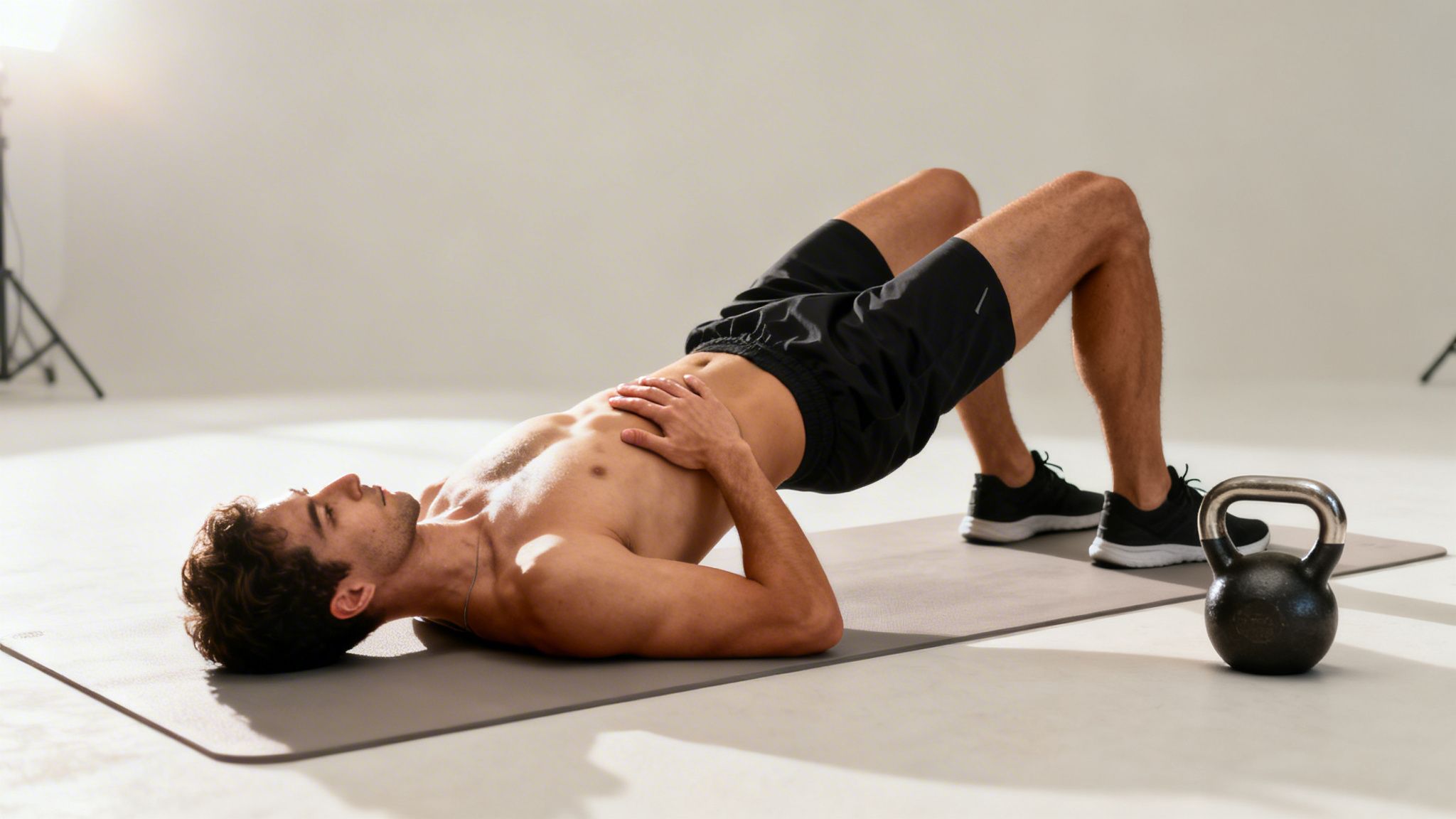
This is how we build a foundation that supports your active life, whether you're a CrossFitter, a weightlifter, or just trying to keep up with your kids without your back giving out.
Building Your 360-Degree Core Canister
Your spine's best defense is a core that resists unwanted movement under load. When you lift something heavy, your torso shouldn't bend, twist, or fold. It needs to be a rock-solid pillar.
These moves are the bedrock of that stability:
- The Bird-Dog: This isn't about how high you can lift your arm and leg. It's about keeping your spine perfectly still while your limbs move. You're training your core to fight rotation and extension—a non-negotiable skill for any athlete.
- The Dead Bug: Think of this as a bird-dog on your back. Your only job is to keep your low back connected to the floor as you lower an opposite arm and leg. This is a masterclass in abdominal control.
- The Side Plank: This hammers the muscles on the side of your torso (your obliques and QL) that are critical for keeping your pelvis and spine stable when you run, lunge, or perform any single-leg activity.
The secret to a strong back isn’t a flexible spine; it’s a stable one. These exercises teach your core to resist movement, which is its most important job in protecting you.
Re-Educating Your Movement and Mastering the Hip Hinge
With a more stable core, we can finally fix one of the biggest culprits of chronic back pain: a faulty hip hinge.
So many people initiate lifts by bending their spine instead of pushing their hips back. This bad habit puts massive shearing forces on your lumbar discs and is a direct path to injury. Learning to hinge properly is non-negotiable. It means you generate power from your glutes and hamstrings—the strongest muscles in your body—while your spine remains rigid and safe.
How to Master the Hip Hinge:
- Grab a PVC pipe or broomstick and hold it along your back, touching your head, upper back, and tailbone.
- With a slight bend in your knees, push your hips straight back as if trying to touch a wall behind you.
- The stick must stay in contact with all three points. If it comes off your low back, you’re rounding your spine.
- You should feel a deep stretch in your hamstrings.
- To stand up, squeeze your glutes hard and drive your hips forward.
This single pattern is the blueprint for deadlifts, kettlebell swings, and even just picking a box up off the floor safely. Our guide to essential lower back and hip exercises has more progressions to help you master this.
The market for chronic low back pain treatments was valued at USD 2351.2 million in 2026 and is growing, largely due to ineffective, temporary fixes. You can read the full research on the chronic low back pain treatment market and see the scale of the problem. It's time to get off that expensive, ineffective treadmill.
If you’re in Marlton, Mount Laurel, Cherry Hill, Moorestown, Haddonfield, or Medford and you're ready to build a body that’s truly resilient, let's talk. Schedule your Free Discovery Visit at Valhalla Performance today.
It’s Time to Get Back in the Fight
This is the moment you've been working for. You’ve calmed the pain, improved your movement patterns, and built a resilient core. Now, it's time to get back to the activities you love without the fear of your back giving out.
This final phase isn't about just surviving your workouts—it’s about owning them. We'll do this by using a core training principle: progressive overload. This means we strategically and safely increase the demand on your body, building not just raw strength, but unwavering confidence in your back.
From Bodyweight to Barbell: Earning Your Strength Back
Loading the perfect movement patterns you’ve been practicing is how we make them permanent. We take that flawless, pain-free hip hinge and teach it to perform under pressure. But this must be done with an obsessive focus on perfect form.
We don't jump from a bodyweight hinge straight to a one-rep-max deadlift. The progression must be methodical to ensure long-term success.
Goblet Squat: Before putting a bar on your back, the goblet squat is your best friend. Holding a kettlebell at your chest forces your core to engage and helps you squat with an upright torso, protecting your lower back.
Romanian Deadlifts (RDLs): This is the ultimate tool for loading your hip hinge. Using dumbbells or a kettlebell, you can master the "hips back" motion, strengthening your glutes and hamstrings while keeping your spine neutral.
The rule is simple: earn the right to add weight. If your form breaks down with a 25-pound kettlebell, you have no business touching a 50-pound one. Master the movement, then add load.
A Sample 4-Week Progression to Reclaim Your Strength
Here’s what this looks like in practice. This isn't a full workout, but a template for progressing key lifts. Perform these twice a week, prioritizing quality over everything else.
Week 1: Master the Movement
- Goblet Squats: 3 sets of 10 reps (light weight). Focus on perfect form and depth.
- Light Dumbbell RDLs: 3 sets of 12 reps. Focus on feeling the hamstring stretch with a flat back.
- Benchmark: You can complete all reps with zero pain and perfect form.
Week 2: Introduce More Load
- Goblet Squats: 3 sets of 8 reps (moderate weight).
- Dumbbell RDLs: 3 sets of 10 reps (moderate weight).
- Benchmark: Your form remains locked in, even with more weight. No pain during or after.
Week 3: Increase Intensity
- Goblet Squats: 4 sets of 6 reps (challenging weight). This should feel hard but controlled.
- Barbell RDLs: 3 sets of 8 reps (start with just the bar and add weight slowly).
- Benchmark: The movements feel strong, stable, and are becoming second nature.
Week 4: Test Your Resilience
- Front Squats (with barbell): 3 sets of 5 reps (light to moderate). This demands serious core stability.
- Conventional Deadlifts (from floor): Work up to a few sets of 3-5 reps with very light weight. Focus on a perfect setup and driving with your legs.
- Benchmark: You’re performing these complex lifts with confidence and absolutely no pain.
How to Modify Workouts for Long-Term Success
Getting back to CrossFit or your lifting program doesn't mean picking up where you left off. You have to be smart. This is especially critical when you realize that 70% of years lost to disability from back pain affect working-age adults (20-65)—the very people filling our gyms. People get hurt because they push too hard, too soon. You can learn more about the global impact of back pain from the IASP.
Here’s how to outsmart common gym scenarios:
CrossFit WODs: See a workout with "Deadlifts for time"? That’s a trap for re-injury. Ignore the clock. Treat it as skill practice. Use a much lighter weight and focus on a perfect, deliberate setup for every single rep.
Weightlifting Programs: If your program calls for heavy back squats but you still feel a twinge, swap them for front squats or heavy goblet squats to continue building leg strength without compromising your back.
Running and Endurance: If your back gets achy during a run, your core and glutes are likely fatiguing. Before you run, activate them with drills like bird-dogs and glute bridges to improve your endurance.
Your journey to end chronic back pain doesn't finish here—it transforms. You now have the knowledge and strength to pursue your goals safely.
If you’re in Marlton, Mount Laurel, Cherry Hill, Moorestown, Haddonfield, or Medford and need an expert guide to navigate this crucial stage, we're here. Schedule a Free Discovery Visit at Valhalla Performance and let’s build a bulletproof plan to get you back in the game for good.
Your Next Move to a Pain-Free Life in South Jersey
The path out of chronic back pain isn't paved with magic pills or wishful thinking. It’s about taking smart, decisive action that fixes the real problem, not just chasing symptoms.
You've learned how to identify your triggers and how to start building a more bulletproof body. Now it’s time to stop guessing and start winning.
Guesswork is what keeps you trapped in the endless pain-rehab-reinjury cycle. It's time to ditch the "I think this is right?" approach and get clear, professional direction built for your body and your goals.
The real win isn't just getting out of pain. It's building a body so resilient that pain doesn't get a vote anymore.
Your Invitation to a Long-Term Solution
If you live or work in Marlton, Mount Laurel, Cherry Hill, Moorestown, Haddonfield, Medford, or the surrounding South Jersey area, your next step is right here. We invite you to schedule a Free Discovery Visit at Valhalla Performance.
This is your opportunity to sit down one-on-one with a specialist who understands the demands of an active life. We don't use cookie-cutter plans. We build a specific roadmap to get you back to your sport, your gym, and your life—without pain holding you back.
Take back control. Stop letting pain dictate your life and start building a strong, confident, and pain-free future.
Book your Free Discovery Visit with Valhalla Performance today and let's get you back in the game for good. Schedule your visit now.