

If you’re an active adult with persistent muscle tightness in hips, you’ve probably been told to just stretch more. But if you’re tired of stretching your hip flexors into oblivion with zero lasting results, it’s because you’ve been sold a lie.
That tightness is rarely a stretching problem. It’s a symptom of something much deeper, and if you're serious about your training, you need to address the root cause, not just the symptom.
The Real Reason Your Hips Are Always Tight
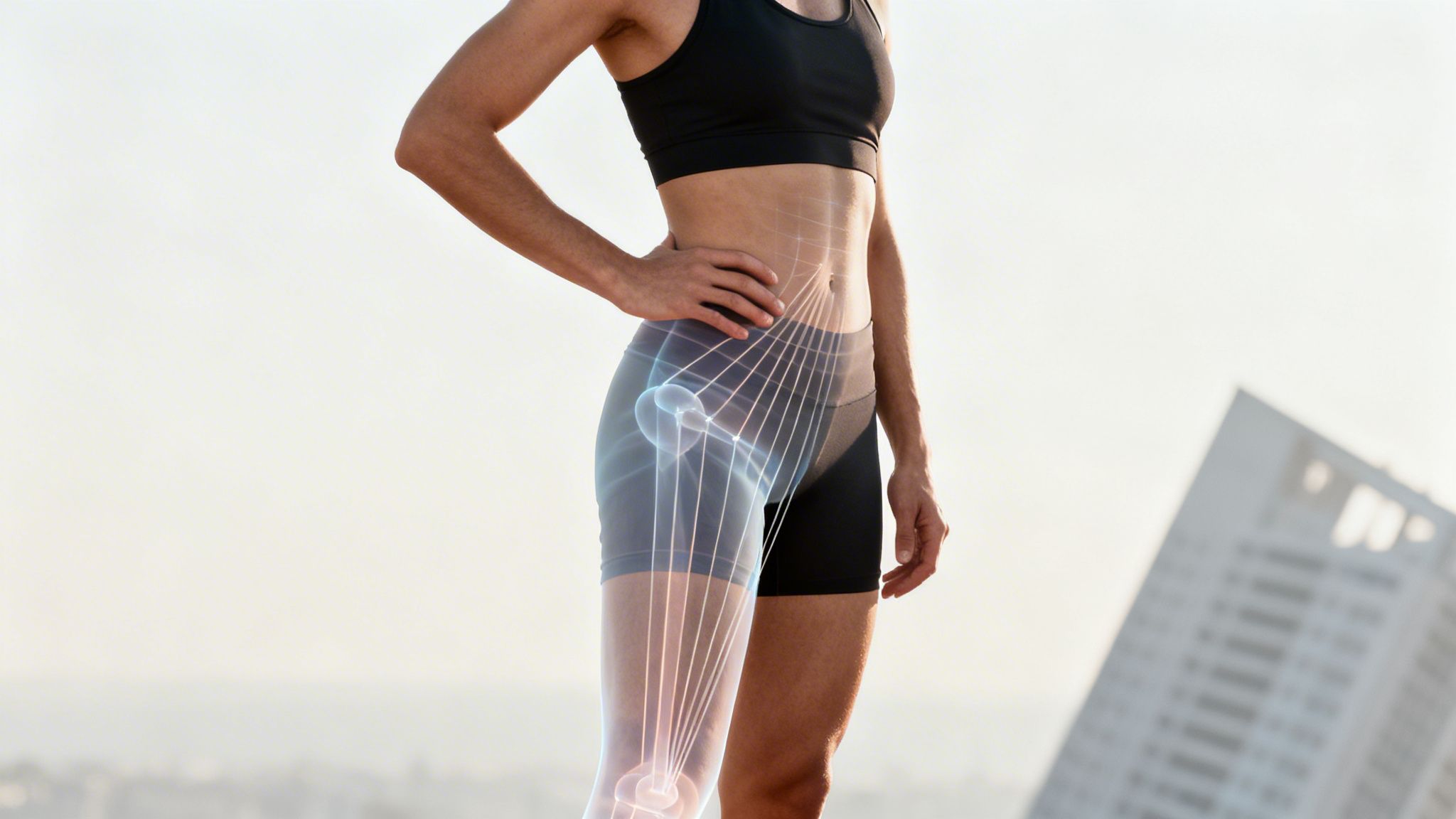
That nagging, recurring tightness isn't a sign that your muscles are physically too short. It's a distress signal from your brain. This is called protective tension, and it's your body’s emergency brake.
Your brain senses instability somewhere—usually around your hips or core—and slams on the brakes by tightening the surrounding muscles. It’s creating a feeling of security where there is none.
Think of it like the emergency parking brake in your car. If your actual brakes failed, you’d yank that handle to avoid a crash. Your body is doing the exact same thing. When your hips and core lack the strength to control movement, especially during a heavy lift or fast-paced WOD, your brain creates that locked-down, tight feeling as a last-ditch defense mechanism.
Why Your Brain Puts Your Hips in a Straightjacket
For anyone who lifts, runs, or does CrossFit, your hips are ground zero for almost every movement. Any hint of weakness or instability in that area sends a major threat signal straight to your nervous system.
In response, your brain does two things:
- Guards the Joint: It tightens muscles like the hip flexors, glutes, or hamstrings to create a muscular "cast," stopping you from moving into ranges it thinks are unsafe.
- Limits Your Mobility: That tightness is your brain’s way of yelling "STOP!" before you move into a position where you could get hurt, like the bottom of a heavy squat.
The constant feeling of muscle tightness in your hips is not a stretching deficiency. It's your body's intelligent, protective response to a lack of stability. The tightness is the symptom, not the root cause.
This is the critical piece of the puzzle. If all you do is stretch those “tight” muscles, you’re literally fighting your body’s own survival instincts. You might get a few minutes of relief, but your brain will just crank up the tension again the second it senses that same old instability.
This is exactly why you can stretch your hip flexors every single day and still feel like you’re hitting a brick wall at the bottom of a squat.
To get real, lasting relief, you have to change the conversation with your nervous system. You have to prove to your brain that your hips are strong, stable, and ready for anything you throw at them. Only then will it finally release the parking brake and let you move freely.
If you’re done with the endless stretching cycle and ready to fix the root cause of your hip tightness, we can help. For active adults in Marlton, Mount Laurel, Cherry Hill, Moorestown, Haddonfield, Medford, and South Jersey, our entire approach is built on finding the root cause and building resilience from the ground up. Schedule a Free Discovery Visit at Valhalla Performance and let’s figure out how to get you moving better and living pain-free for good.
Pinpointing Your Source of Hip Tightness
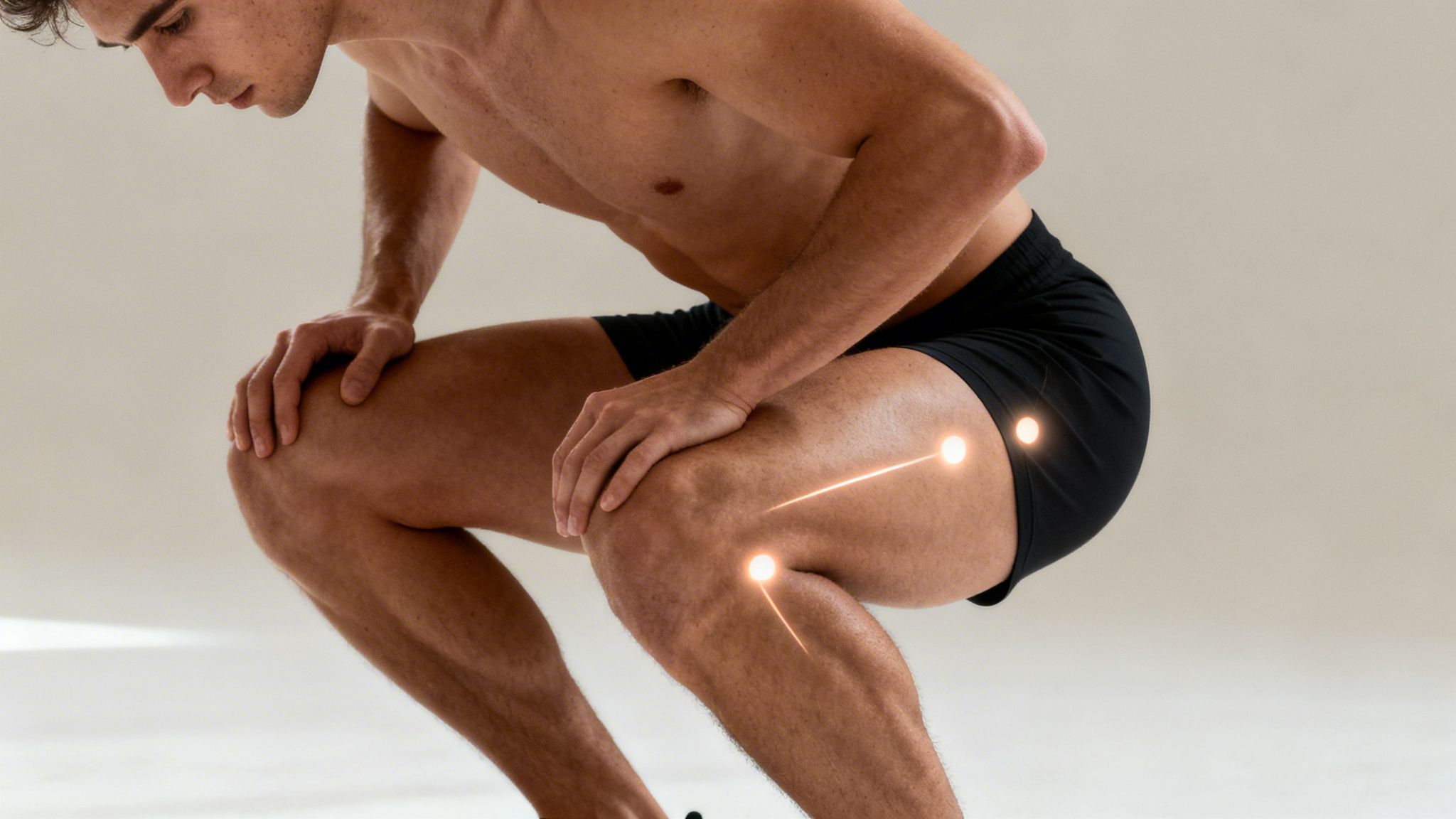
That nagging feeling of muscle tightness in hips is a liar. It tells you one thing—"my hips are tight"—when the real story is usually a lot more complicated.
Think of it like the "check engine" light in your car. It’s a general warning, not a specific diagnosis. You wouldn't just put tape over the light and hope for the best, so why do that with your body? To actually fix the problem, you have to pop the hood and find out what’s really going on.
Is the tightness in the front, the side, or deep in your glutes? Does it bite you at the bottom of a squat, creep in during a long run, or greet you after a day chained to your desk? The where and when are your first clues to solving the mystery.
Let’s break down the usual suspects.
The Front of Your Hip: The Angry Hip Flexors
If you’re an active person, especially in sports like CrossFit or weightlifting, the front of your hip is probably public enemy number one. This is home to your hip flexors, and they love to make a scene.
You’ll feel this as a sharp pull or a deep ache right in the crease where your thigh meets your pelvis. It tends to show up at the worst times:
- Deep Squats: That annoying pinch at the bottom of a heavy back squat or overhead squat that kills your depth.
- Running: A dull ache that gets progressively louder the longer you run, especially on hills or during sprints.
- Kipping Movements: That sharp "pull" during kipping pull-ups or toes-to-bar.
Here’s the kicker: this tightness is often your brain slamming on the brakes. It senses your core is unstable or your pelvis is out of position during a lift, so it puts the hip flexors on high alert to protect your spine.
The Side of Your Hip: The IT Band and Its Accomplice
Pain on the outside of the hip almost always gets blamed on the IT band. But the iliotibial (IT) band is a thick, stubborn piece of connective tissue—it doesn't "tighten" like a muscle. It's more like a victim than a villain.
More often than not, that "IT band tightness" is really a sign that the muscles underneath are weak or overworked. The main culprit? Your gluteus medius. This muscle is a rockstar stabilizer for your pelvis. When it gets lazy during single-leg movements like lunges or running, other structures pick up the slack, leading to that trademark sharp, burning sensation down the side of your leg.
Key Insight: Most muscle "tightness" is just a smoke signal for weakness or bad coordination. The muscle feels tight because it's working overtime, trying to do a job it wasn't designed for.
The Back of Your Hip: The Pesky Piriformis
What about that deep, nagging ache right in the glutes? That’s often the piriformis muscle screaming for attention. It's a small muscle buried deep behind your glute max, and it gets seriously overworked when it has to compensate for weak glutes or an unstable pelvis during movements like heavy deadlifts.
When the piriformis gets chronically tight, it can even start to bully the sciatic nerve, which runs nearby, causing pain that shoots down your leg. This is a classic complaint for everyone from heavy deadlifters to weekend warriors who spend their weeks at a desk.
Telling this apart from other issues is non-negotiable for getting results. Understanding how Valhalla Performance creates custom treatment plans shows you why a targeted attack plan crushes a "stretch and pray" approach.
Wait, Is It My Hips or My Back?
Here’s where things get really confusing. Sometimes, what feels like muscle tightness in hips is actually pain that’s being referred from your lower back. A grumpy disc or an irritated nerve in your lumbar spine can send pain signals that your brain interprets as coming from your hip, glute, or groin.
So how can you tell the difference?
- A True Hip Problem: The pain is usually sharp and easy to pinpoint. It reliably shows up with specific hip movements, like deep squatting or twisting.
- Referred Back Pain: This pain is often more vague, achy, or even burning. It might come with tingling or numbness, and it can be inconsistent, showing up even when you're resting.
Getting this right is everything. If you spend weeks stretching a "tight" hip when the real problem is a nerve in your back, you're just spinning your wheels and getting more frustrated. This is exactly why a full-system diagnosis is the only way to go.
To help you start connecting the dots, we've put together a quick guide to the most common culprits.
Common Types of Hip Tightness and Their Symptoms
| Muscle Group | Location of Tightness | Common Triggers | Feels Like |
|---|---|---|---|
| Hip Flexors | Front of the hip, in the crease | Squatting deep, running, kipping movements | A deep ache or sharp "pinching" |
| Glute Medius/IT Band | Side of the hip, down the thigh | Running, lunges, single-leg movements | A sharp or burning sensation |
| Piriformis/Deep Glutes | Deep in the buttock | Deadlifts, running, prolonged sitting | A deep, nagging, persistent ache |
| Referred Back Pain | Varies: groin, glute, front of hip | Can be random or with back movements | A diffuse ache, burning, or tingling |
This table should give you a better idea of what might be going on, but remember, it’s just a starting point.
And make no mistake, this isn't a small issue. A 2022 study showed a direct link between hip tightness and low back pain, finding that 35.59% of participants had tight hip flexors and 40.67% had tight piriformis muscles. This reflects a massive global problem, with low back pain affecting an estimated 619 million people in 2020. Your tight hips aren't just an annoyance; they're part of a much bigger pattern.
If you’re in Marlton, Mount Laurel, Cherry Hill, Moorestown, Haddonfield, or Medford and you're done guessing, it's time for a real answer. Schedule your Free Discovery Visit with us at Valhalla Performance. Let's find the true source of your hip pain and build a battle plan to get you out of it for good.
Why Endless Stretching Is a Losing Battle for Your Tight Hips
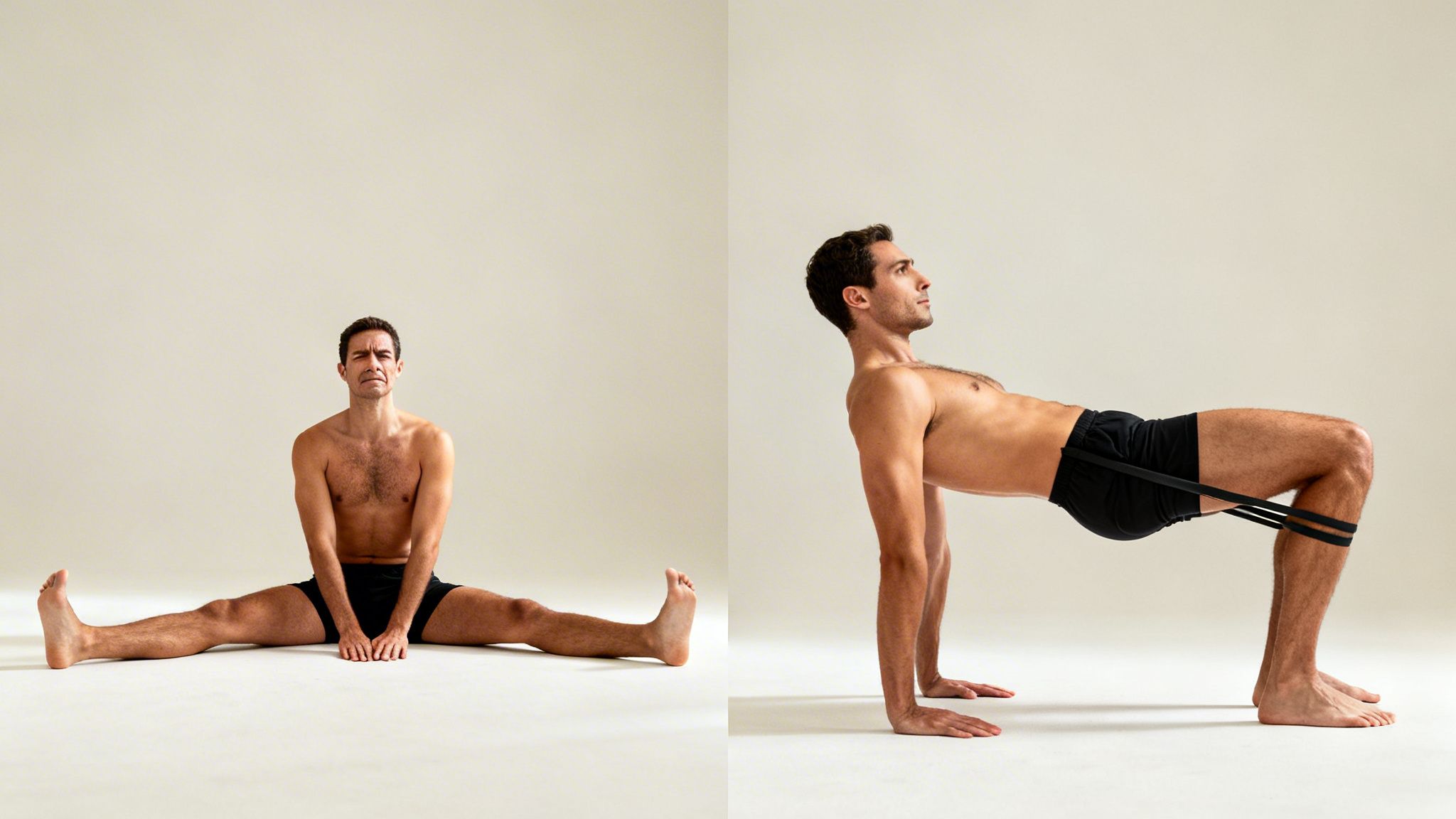
If you’ve been waging war against muscle tightness in your hips, you’ve probably spent more time on the floor than you’d like to admit, yanking your knee to your chest or pretzeling yourself into a pigeon pose. And what do you get for it? A few minutes of relief before the tightness comes roaring back. It’s frustrating as hell, and there’s a simple reason why it keeps happening: you’re yanking on a symptom, not fixing the root problem.
Here’s the deal: that stubborn tightness isn’t because your muscles are physically too short. No, this is neurological tightness. It’s your brain actively slamming on the brakes.
Why would it do that? Because it senses instability. When your core is asleep at the wheel or the smaller muscles meant to stabilize your hip joint are weak, your brain panics. It sees any deep movement—like the bottom of a snatch or a deep lunge—as a threat. So, it tightens up the big guys—like your hip flexors and glutes—to act as an emergency brake system, stopping you from moving into a range of motion it can’t control.
The Problem with Stretching a Weak Muscle
Trying to stretch a muscle that’s tight because it’s weak and unstable is like yelling at a guard dog for barking. The dog isn’t being bad; it’s barking because it feels threatened. Yelling just confirms its fears and makes it bark louder.
It’s the same with your body. When you force a stretch on a muscle your brain is using for protection, you’re sending a giant threat signal to your nervous system. Your brain’s interpretation? "This joint is even more unstable than I thought!" The result is that it doubles down on the protective tension, often making the muscle feel even tighter once you’re done.
Static stretching gives you a temporary illusion of more flexibility. True mobility, however, is about earning that range of motion by demonstrating strength and control to your nervous system.
This is exactly why you can stretch every single day and still hit a wall at the bottom of your squat or feel a pinch when you run. You haven't proven to your body that you can own that position safely.
Time for a New Game Plan: The Movement-Based Approach
The only way to win this fight is to change the conversation with your nervous system. You need to stop demanding more length and start building more strength and stability. That’s the entire foundation of our movement-based rehab philosophy at Valhalla Performance.
Instead of just passively pulling on things, we combine two powerful elements:
- Targeted Mobility Drills: These are not your yoga teacher’s stretches. These are active, controlled movements designed to teach your hip joint how to actually function. Think controlled articular rotations (CARs) that show your brain what safe, full-range motion feels like. You can get a taste of this in our guide to a better dynamic stretching routine.
- Progressive Strengthening: As soon as we open up a little motion, we lock it in with strength. By firing up the small, lazy muscles around the hip—like your gluteus medius—we build a rock-solid support system for the joint.
Let's look at a classic gym example: hamstrings that feel tight during a deadlift.
- The Old Way (Temporary Relief): You finish a set of deadlifts, immediately flop down for a 30-second static hamstring stretch. It feels a little better for a minute, but on your next warm-up set, the tightness is right back where it was.
- The New Way (Long-Term Solution): Between your deadlift sets, you perform a set of controlled glute bridges. This wakes up your glutes, which stabilizes your pelvis and sends a signal to your brain that it’s safe to let the hamstrings lengthen. The result isn't just a fleeting feeling—it’s better deadlift mechanics and less tightness for good.
When you prove you’re stable, your nervous system finally gives you permission to release that protective tension. It trusts that your hips are secure, unlocking new ranges of motion you can actually use under load.
If you’re an active adult in Marlton, Mount Laurel, Cherry Hill, Moorestown, Haddonfield, or Medford and you're sick of the stretching runaround, it’s time for a real strategy. We invite you to schedule a Free Discovery Visit at Valhalla Performance. Let's uncover the real reason your hips are locked down and build a plan to fix it for good.
The 3-Step Framework for Unlocking Your Hips
If you've been stretching your hips into oblivion with zero results, listen up. The problem isn’t that your muscles are just “tight.” The problem is your brain has slammed on the emergency brake and refuses to let go.
Fixing persistent muscle tightness in hips isn't about finding some magical stretch. It’s about executing a smart, progressive plan that proves to your nervous system it's safe to move again. This isn't a temporary fix. It's about rebuilding from the ground up to create hips that are not just mobile, but strong and bulletproof for your sport.
We break it down into three simple, powerful steps.
Step 1: Restore Motion and Calm the Nerves
Before you can even think about strengthening, you have to get your brain and your hips back on speaking terms. This first step is all about gentle, controlled movements that re-introduce your hip to its full, safe range of motion. Think of it less like stretching and more like exploring the territory.
The goal here is to turn off the threat signal. By moving the joint slowly and with intention, you're sending a direct message to your brain: "See? We can move here. It's okay. You can ease off the emergency brake."
Practical Examples:
- Hip Controlled Articular Rotations (CARs): This is the gold standard for a reason. Stand, hold onto a squat rack for support, and slowly move your hip through the biggest, smoothest, pain-free circle you can manage. Speed is the enemy here; control is everything. You're teaching your brain what the hip can actually do.
- Quadruped Rockbacks: Get on your hands and knees and slowly rock your hips back toward your heels. This gently moves you into deep hip flexion—a position that often feels sketchy during a squat. By doing it slowly and unloaded, you're proving to your body that this position is safe.
The point of this phase isn't just to gain flexibility; it’s to restore function. By calming that protective tension, you open a window to build real, usable strength.
Step 2: Activate and Stabilize
Once you’ve earned a little bit of new motion, you have to lock it down with strength—immediately. This step is about waking up the muscles that were supposed to be doing the stabilizing work all along but have been on a long coffee break. We're talking about your deep core and, most importantly, your glutes.
When you fire up these support muscles, your brain finally gets the memo that it can stop using your hip flexors and other big muscles as emergency stabilizers. That constant feeling of tightness starts to fade. There's a well-known link between hip tightness and low back pain, especially in men. One study found that among men prone to low back pain, hamstring tightness was present in 63% and hip flexor tightness in 35%, hitting the 18-29 age group the hardest. This is a massive piece of the global puzzle of why so many people are sidelined by musculoskeletal pain.
Practical Examples:
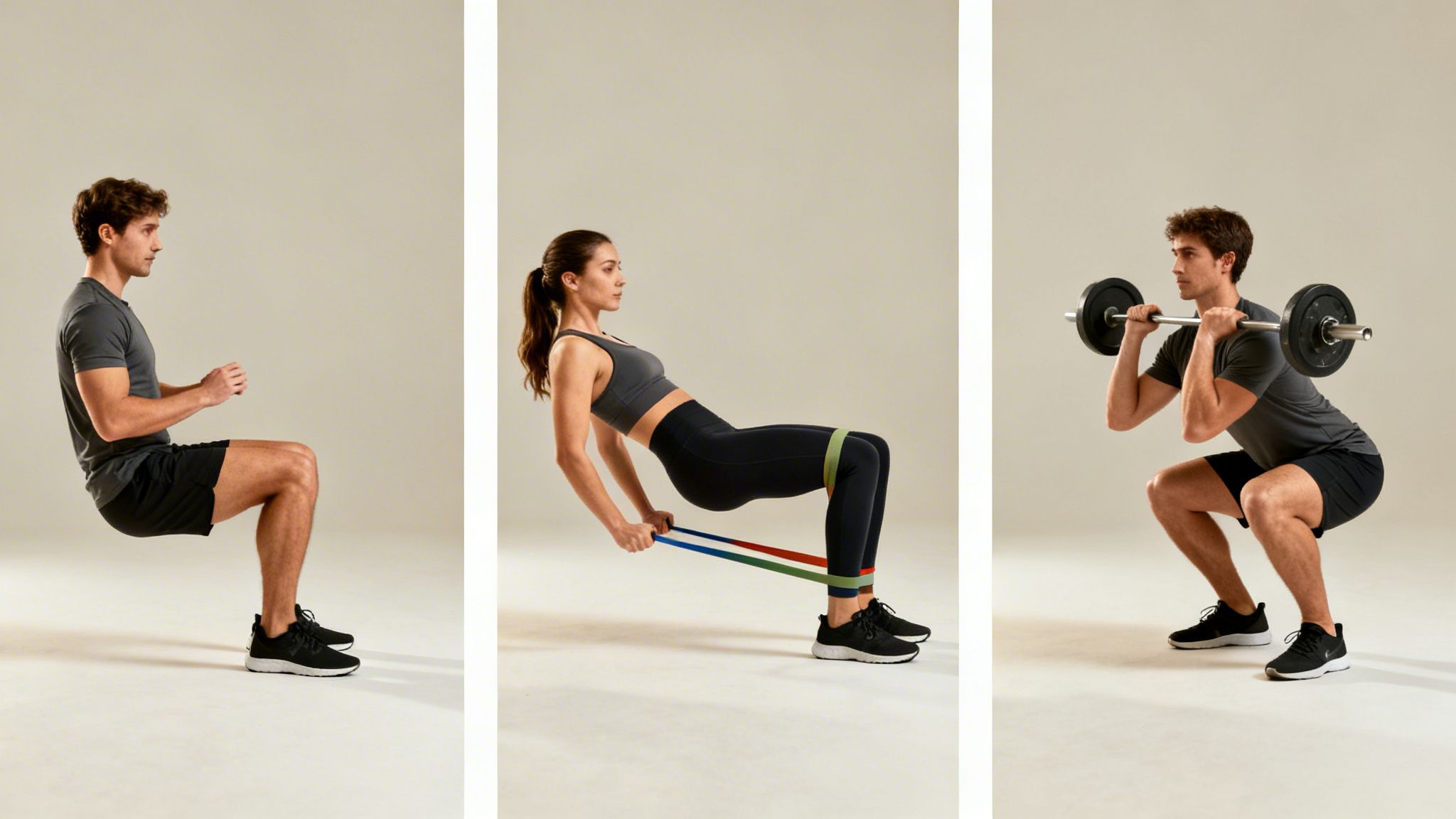
- Banded Glute Bridges: Put a resistance band around your knees. As you lift your hips, your main job is to drive your knees out against the band. This doesn't just hit your glute max; it forces your glute medius to wake up and provide that crucial side-to-side stability.
- Dead Bugs with a Foam Roller: Lie on your back and jam a foam roller between your knees and hands. Now, slowly lower one opposite arm and leg without letting that roller drop. This forces your deep core to fire on all cylinders, locking down your pelvis so your hip flexors can't take over.
Step 3: Integrate Strength and Build Resilience
This is where it all comes together. You've got more motion and a stable foundation. Now, you have to teach your body how to use it all during the complex, loaded movements you actually do in the gym or your sport. It’s about re-patterning your squat, deadlift, or running stride with your new and improved support system.
The goal is to make this better, more efficient movement pattern your new normal. This is how you create lasting change and ensure that muscle tightness in hips doesn't just creep back in a week later. You're not just stronger; you're moving better under load. For a deep dive into this philosophy, check out how we approach strength, conditioning, and rehab.
Practical Examples:
- Goblet Squats with a "Pry": Grab a kettlebell, sink into a deep squat, and use your elbows to gently "pry" your knees outward. Then, actively pull them back in slightly. This move teaches your hips to stay active and stable in the most vulnerable part of the squat.
- Romanian Deadlifts (RDLs) with a Hip Focus: Forget about just "stretching your hamstrings." Instead, think about starting the movement by driving your hips straight back. This forces your glutes and hamstrings to do the loading, taking the pressure off your low back and preventing that all-too-common compensatory tightness.
This 3-step framework isn't a quick fix—it’s a system for rebuilding your hips from the inside out. If you are an active adult in Marlton, Mount Laurel, Cherry Hill, Moorestown, Haddonfield, Medford, or South Jersey and you’re done with the endless stretching that goes nowhere, it's time for a real diagnosis and a plan that actually works. Schedule your Free Discovery Visit at Valhalla Performance and let’s start building stronger, more resilient hips today.
Finding Your Root Cause with Expert Guidance
Let's be honest. Following generic YouTube videos for your muscle tightness in hips is a recipe for frustration. True, lasting relief doesn’t come from some cookie-cutter script. It comes from digging deep to find your unique “why.” At Valhalla Performance, we don’t just treat symptoms—we hunt down the root cause. It’s the only way to get you faster results and build long-term resilience.
Picture this: a CrossFit athlete from Cherry Hill, we'll call him Alex, walks into our gym. He’s got this nagging, persistent tightness in his left hip flexor. It pinches at the bottom of his squats and feels like it's been concreted in place after a few box jumps. He’s been stretching it like his life depends on it for months, but the tightness always snaps right back, sometimes even angrier than before.
The Problem Isn't Always Where the Pain Is
During our evaluation, we pop the hood to see what’s really going on under the surface. And for Alex, the problem wasn't his hip at all. That constant feeling of tightness was just a symptom—a warning light on the dashboard for two bigger issues happening elsewhere.
The actual culprits were:
- A Weak Core Brace: When Alex went to lift heavy, he wasn't creating solid intra-abdominal pressure. His brain, sensing this instability, freaked out. In a desperate move to protect his spine, it slammed the brakes on his hip flexors to create a false sense of stability.
- Zero Ankle Mobility: We also found he had ankles stiffer than a two-by-four, especially in dorsiflexion (pulling your toes toward your shin). That limitation made it impossible for him to squat to depth without his hips taking a beating and working overtime.
His "tight" hip was just the victim, screaming for help because it was getting hammered trying to compensate for weakness and stiffness elsewhere. This story is incredibly common, and it’s exactly why stretching the spot that hurts is a losing battle.
Chasing the symptom is like trying to fix an engine knock by turning up the radio. You might drown out the noise for a bit, but you’re still driving a broken machine.
Building a Plan That Actually Works
Once we knew what was really wrong with Alex, the fix became dead simple and laser-focused. Instead of more pointless stretching, we built a plan to attack the source. This is what we do—we blend expert chiropractic care with our One80 System for strength and personalized rehab.
Alex's battle plan looked like this:
- Targeted Adjustments: To get his restricted ankle joints moving again and address any related spinal segments that were adding to the mess.
- The One80 System for Strength: We didn't just throw generic core work at him. We programmed specific drills to teach him how to brace and create stability under a heavy barbell, which translated directly to his CrossFit performance.
- Personalized Movement Rehab: We gave him targeted ankle mobility work and coached him on tweaking his squat pattern to work with his current mobility, not fight against it.
This integrated approach proves a critical point: hip tightness is often a signal flare for a bigger problem. In fact, our modern lives of sitting and inactivity have sparked a silent epidemic. A 2023 study found that a staggering 94.3% of young adults showed signs of hip flexor tightness, a condition directly linked to the low back pain that plagues 619 million people worldwide. You can discover more about this study's findings on hip tightness.
By fixing Alex’s core and ankle issues, we gave his nervous system the "all-clear" signal it needed to finally release that death grip on his hip. He didn't just get rid of the tightness—he smashed his old squat PR, all because we fixed the real problem. That’s what root-cause diagnosis looks like in the real world. You can get a better sense of our philosophy from our lead doctor at Valhalla Performance.
If you live in Marlton, Mount Laurel, Cherry Hill, Moorestown, Haddonfield, Medford, or anywhere in South Jersey and you're sick of chasing symptoms, let us help you find the root cause. Schedule your Free Discovery Visit today and see how a precise diagnosis can unlock lasting relief and get you back to peak performance.
Take Control of Your Hip Health for Good
Alright, let's cut to the chase. It’s time to stop the endless cycle of stretching, foam rolling, and hoping for a miracle.
The key takeaway is this: that nagging muscle tightness in your hips isn’t a stretching problem. It’s a smoke signal from your body, telling you there’s a bigger fire that stretching will never put out.
Lasting relief doesn't come from forcing your muscles into submission. It comes from building the kind of strength and stability that finally convinces your brain it's safe to let go of that protective tension. When you prove you’re strong enough to handle the load, your body rewards you with mobility.
The goal isn’t just to get rid of the tightness. It’s to build a body so ridiculously resilient that the tightness never has a reason to show up in the first place. This is how you go from being injury-prone to genuinely bulletproof.
Flipping your mindset—from stretching to strengthening—is the single most important move you can make. It's about understanding that your body isn't fighting you; it's desperately trying to protect you. Once you address the real problem, you can finally fix it for good. If that sounds like a strategy that makes sense, you should check out our article on how lifting heavy things strategically can save your body.
If you're an active adult in Marlton, Mount Laurel, Cherry Hill, Moorestown, Haddonfield, Medford, or anywhere else in South Jersey, and you’re done chasing symptoms, we’re here to help you get to the root of it.
Schedule a Free Discovery Visit at Valhalla Performance today. This is a no-strings-attached conversation where you can talk to an expert, find out what’s actually causing your pain, and see how our approach can get you back to your life—stronger and more durable than ever.
Your Questions About Hip Tightness, Answered
We get it. You've tried stretching, you've tried foam rolling, and your hips are still screaming at you. Here are the no-BS answers to the questions we hear all the time from people fed up with stubborn hip issues.
The big takeaway? Real, lasting relief isn't about chasing the pain. It’s about finding the root cause and building strength, not just slapping a temporary fix on the problem.
How Long Does It Take to Fix This Mess?
Everyone’s body is a different story, but most of our clients feel a real, noticeable difference in their mobility and tightness within just the first few sessions. Our goal isn’t a quick crack-and-go fix; it’s a permanent solution that stops the problem from ever coming back.
Building true strength and stability takes consistency. When you stick with the plan for a few weeks, you’re not just getting rid of tightness—you’re forging a more resilient body. The real win is when you can squat, run, and lift without muscle tightness in your hips even crossing your mind.
Is My Nagging Knee or Back Pain Actually a Hip Problem?
One hundred percent. Your hips are the command center for pretty much all movement. When they’re unstable or not pulling their weight, other joints—especially your knees and lower back—are forced to pick up the slack. They start taking on stress they were never designed to handle.
This is exactly why you get that nagging low back ache during deadlifts or that annoying pinch in the front of your knee during squats. More often than not, once we fix the dumpster fire at the hips, these other "mystery" pains vanish because the whole system is finally working as a team again.
The body is a connected chain. A problem in one link almost always creates chaos up or down the line. That knee pain you're blaming on your running shoes? It's probably a hip problem in disguise.
I've Tried PT Before and It Didn't Work. How Is This Different?
This is a big one, and it’s a completely fair question. We see it all the time. Many traditional PT or chiro clinics focus on treating the symptom—the spot that hurts. They give you a generic handout of clamshells and some passive treatments that feel good for about a day, but the problem always comes roaring back.
Our approach at Valhalla Performance is fundamentally different. We start with a deep-dive diagnostic process to find the ‘why’ behind your tightness. We don't just hand you a sheet of exercises and hope for the best. We build a personalized game plan that combines targeted adjustments, our advanced One80 System strength protocols, and movement coaching that’s actually specific to your body and your goals in the gym or your sport.
We don't put a Band-Aid on it. We fix the root cause, so the results actually stick.
If you're an active adult in Marlton, Mount Laurel, Cherry Hill, Moorestown, Haddonfield, Medford, or anywhere in South Jersey, and you’re ready to stop guessing and start fixing, it's time to take the next step. Schedule a Free Discovery Visit at Valhalla Performance to finally understand the root cause of your pain. Let's build a plan to get you back to your active life, stronger and more resilient than ever.