
If you're an active adult who’s been sidelined by persistent lower back and hip pain, you’ve probably tried it all—stretching, foam rolling, maybe even generic PT handouts. But if that ache still returns after a heavy squat day, a long run, or just sitting at your desk, you’re not alone. The problem isn’t that you’re broken; it’s that you’re chasing symptoms instead of fixing the root cause.
Lasting relief doesn't come from temporary fixes. It comes from diagnosing and correcting the deep-seated muscle imbalances that are causing the problem in the first place. This means waking up dormant glutes, mastering your core brace, and building a resilient foundation that can handle the demands of your training and your life.
Why Your Pain Keeps Coming Back
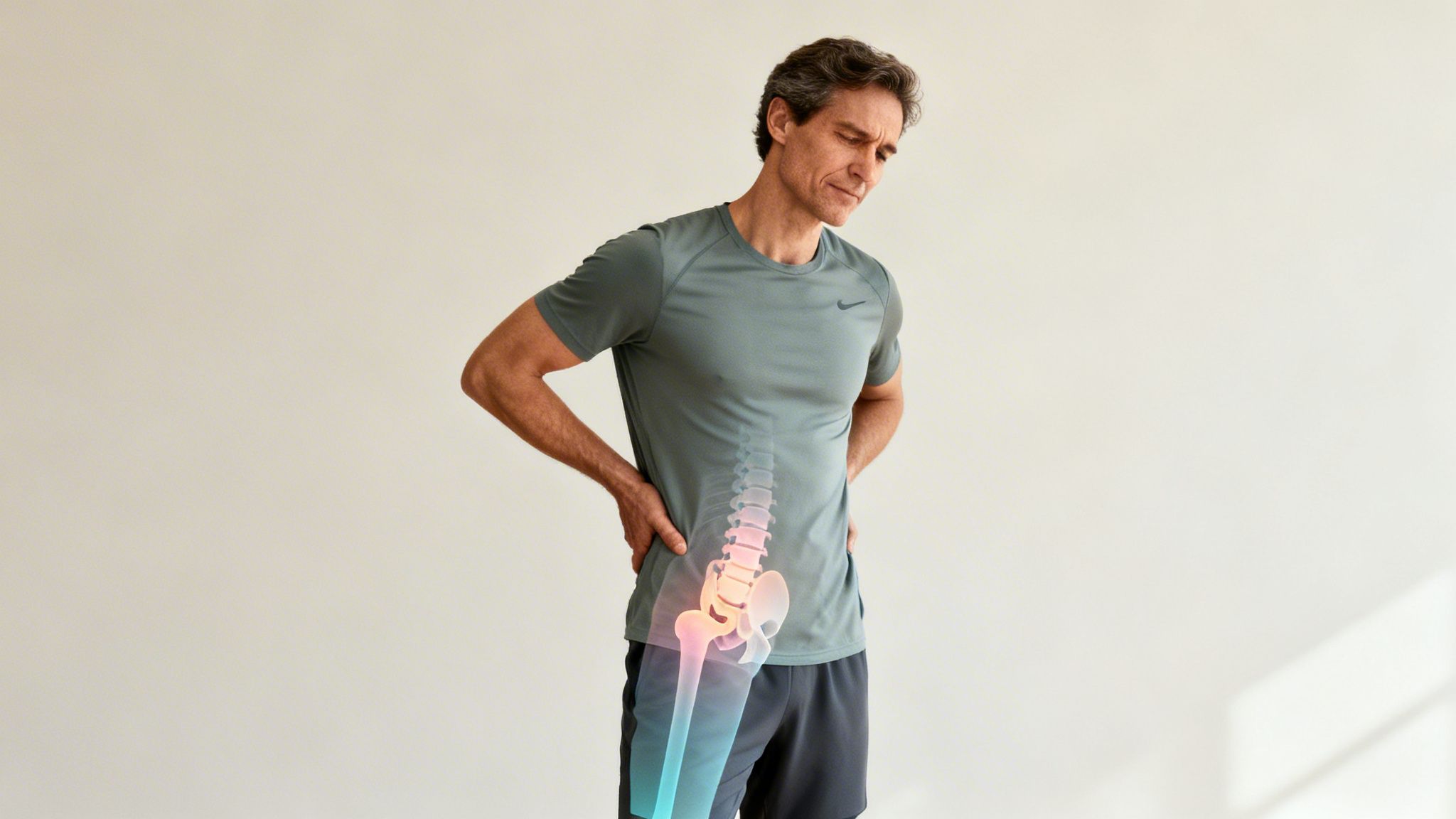
You’ve been here before. You feel okay for a day or two, but then you try to hit a new deadlift PR, play a round of golf, or even just sit through a long meeting, and that familiar, nagging pain comes roaring back. It’s a frustrating cycle of temporary relief and recurring injury.
This isn’t a sign you’re doomed to hurt forever. It’s a clear signal that your current approach is missing the mark. You’re putting a bandage on the symptom, not fixing the source of the fire.
The Problem with Chasing Symptoms
Most conventional advice for lower back and hip pain is a trap. It focuses on the areas screaming the loudest—the tight hamstrings, the angry hip flexors, the achy lower back—without ever asking the most important question: why are those muscles so overworked in the first place?
Pain is usually a cry for help from a muscle that’s being forced to do the job of another muscle that’s slacking off. Stretching a muscle that’s already overworked is like yelling at an employee doing three people’s jobs. It will never be a long-term solution.
For most active adults, especially those in the gym or playing sports, the real culprits are hiding in plain sight:
- Glutes on Vacation: Your glutes are the powerhouse of your lower body. When they don’t fire correctly during a lift or a run, smaller, less-equipped muscles around your hips and lower back have to pick up the slack. This is a direct path to hip impingement, hamstring pulls, and a constantly irritated lower back.
- A Hollow Core: This isn't about having a six-pack. It's about the deep stabilizing muscles that wrap around your midsection like a natural weightlifting belt. Without a strong, functional core brace, your lower back is left unstable, taking a beating with every move you make.
- Junk Movement Patterns: Your brain loves shortcuts. If you’ve spent years lifting with faulty mechanics—maybe your hips shoot up too fast in your deadlift or your knees cave in during squats—your brain has hardwired those dysfunctional patterns. It defaults to the path of least resistance, reinforcing the very issue causing your pain.
A Connected System Needs a Connected Fix
Your lower back and hips are partners. When one partner (the glutes) decides to clock out, the other (the lower back) is stuck working overtime until it’s stressed, exhausted, and eventually, injured.
This is exactly why just doing isolated "back exercises" or "hip stretches" is a failing strategy. You can stretch your hip flexors all day, but if your core is weak and your glutes are asleep, the root problem remains.
And this isn’t a minor annoyance. As of 2020, an estimated 619 million people dealt with low back pain, a problem that hits active folks hard, often peaking around age 50-55. You can read more on the World Health Organization's website.
To break this cycle for good, you need a strategy that gets your core, glutes, and lower back working as a team again. It starts with a proper diagnosis to find the weak link, followed by targeted exercises to reteach your body how to move correctly.
If you’re in Marlton, Mount Laurel, Cherry Hill, Moorestown, Haddonfield, Medford, or anywhere in South Jersey and you’re sick of the pain-and-repeat cycle, it’s time for a professional diagnosis. Schedule a Free Discovery Visit to uncover the root of the problem and build a battle plan for getting you strong and pain-free for good.
A Practical Self-Assessment You Can Do Today
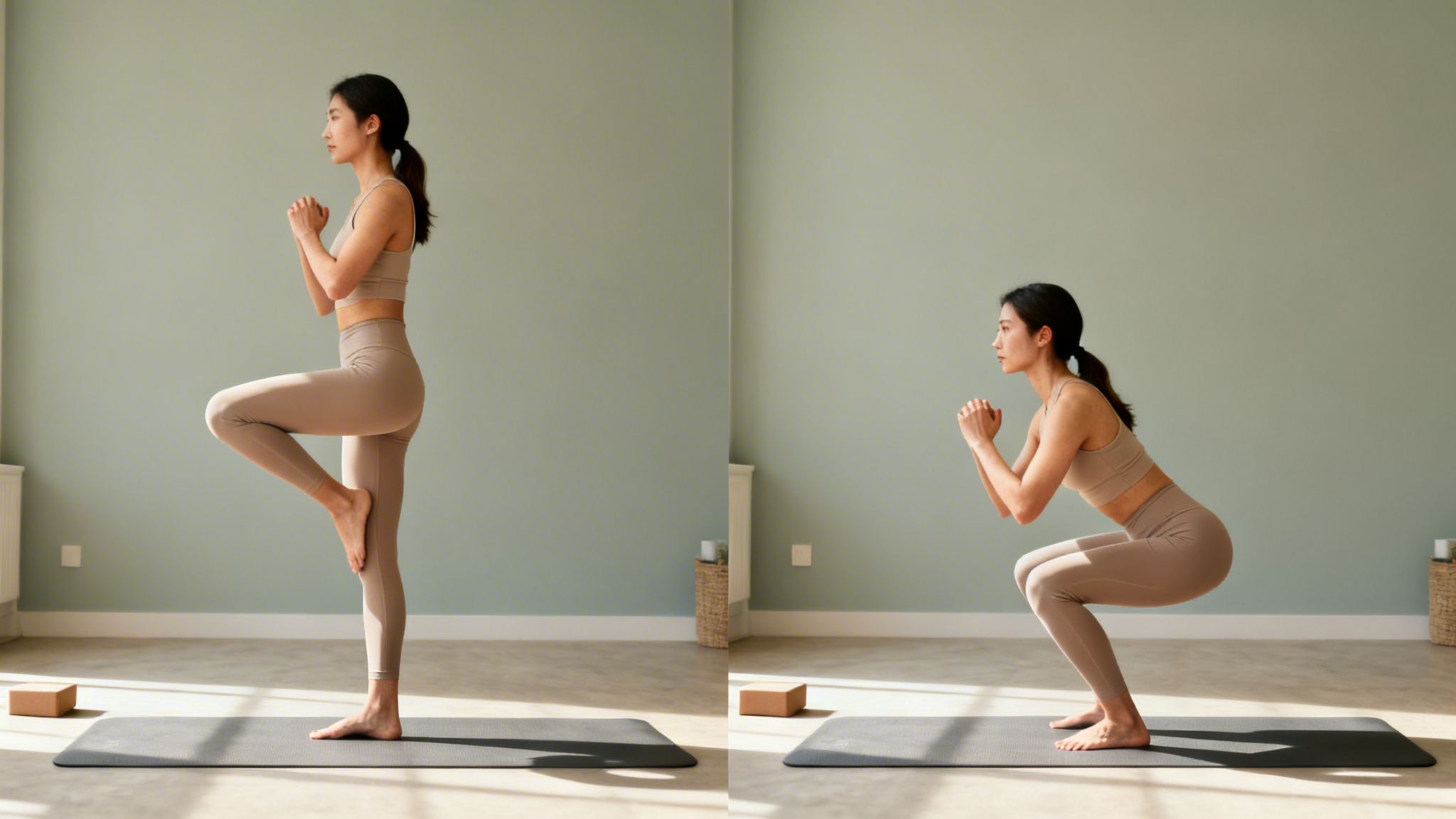
Before you jump into a single exercise, you need to understand why you hurt. A smart assessment isn't about self-diagnosis; it's about identifying the faulty movement patterns that are at the root of your pain.
These simple movements are your diagnostic tools. They’ll expose where your body is cheating, where it’s weak, and which parts are picking up the slack for others. Pay close attention. This is where real, long-term change begins.
The Bodyweight Squat Test
The squat is a fundamental human movement. It’s also a giant flashing sign that reveals everything wrong with your hip and core function. What happens when you try to sit deep with zero weight?
Find some room, stand with your feet shoulder-width apart, and drop your hips down and back. Go as deep as you can without pain.
- Knees Caving In (Valgus Collapse): A classic sign of weak glute medius muscles—the stabilizers on the sides of your hips. When they don’t do their job, your inner thigh muscles yank your knees inward. This is common in athletes and lifters and puts immense stress on both your knees and lower back.
- Lower Back Rounding (Butt Wink): Does your pelvis tuck under at the bottom of the squat? This "butt wink" often points to poor hip mobility or ankle stiffness. Your body can’t find more range at the hips or ankles, so it steals it from your lumbar spine—a dangerous habit, especially under load.
- Heels Lifting Off the Ground: If your heels pop up, you likely have poor ankle dorsiflexion. This limitation shoves your weight forward, contributing to knee stress and that dreaded butt wink.
The Single-Leg Stance Test
This dead-simple test tells a brutal story about your hip stability. Stand tall and lift one foot off the floor. Try to hold it for 30 seconds. Film yourself or use a mirror.
The goal isn’t just to stay upright. It’s to see how your body cheats to maintain balance. The subtle compensations reveal the truth.
Here’s what to look for:
- Hip Drop: Does the hip of your lifted leg sag? That means the gluteus medius on your standing leg is weak. When this muscle fails, your lower back often side-bends to compensate, leading to a tight, angry QL muscle and one-sided pain. For a runner or athlete, this happens on every single step.
- Torso Leaning: Are you leaning your whole upper body to the side? That’s another compensation. Your body is desperately trying to find its center of gravity because your hip stabilizers went on vacation, putting uneven stress right on your spine.
The Basic Hip Hinge Test
The hip hinge is the foundation for deadlifts, kettlebell swings, and picking up anything heavy. Getting this wrong is the fastest way to injure your back.
Stand with your feet hip-width apart, knees soft. Put one hand on your belly and the other flat against your lower back. Now, push your hips straight back and let your chest drop toward the floor. Keep your spine completely straight.
The number one fault? Starting the movement with your spine. So many people initiate by rounding their lower back instead of hinging from the hip. If you feel your lower back start to curve immediately, you've ingrained a pattern that puts your discs at risk every time you bend over.
Seeing these patterns isn't a life sentence. It's a starting point. These are fixable problems.
For residents of Marlton, Mount Laurel, Cherry Hill, Moorestown, Haddonfield, or Medford, these tests are just the beginning. To get a professional, in-depth analysis and a plan that actually works, schedule your Free Discovery Visit at Valhalla Performance. Let's find the root cause and build the strategy to end it for good.
Building a Foundation That Lasts
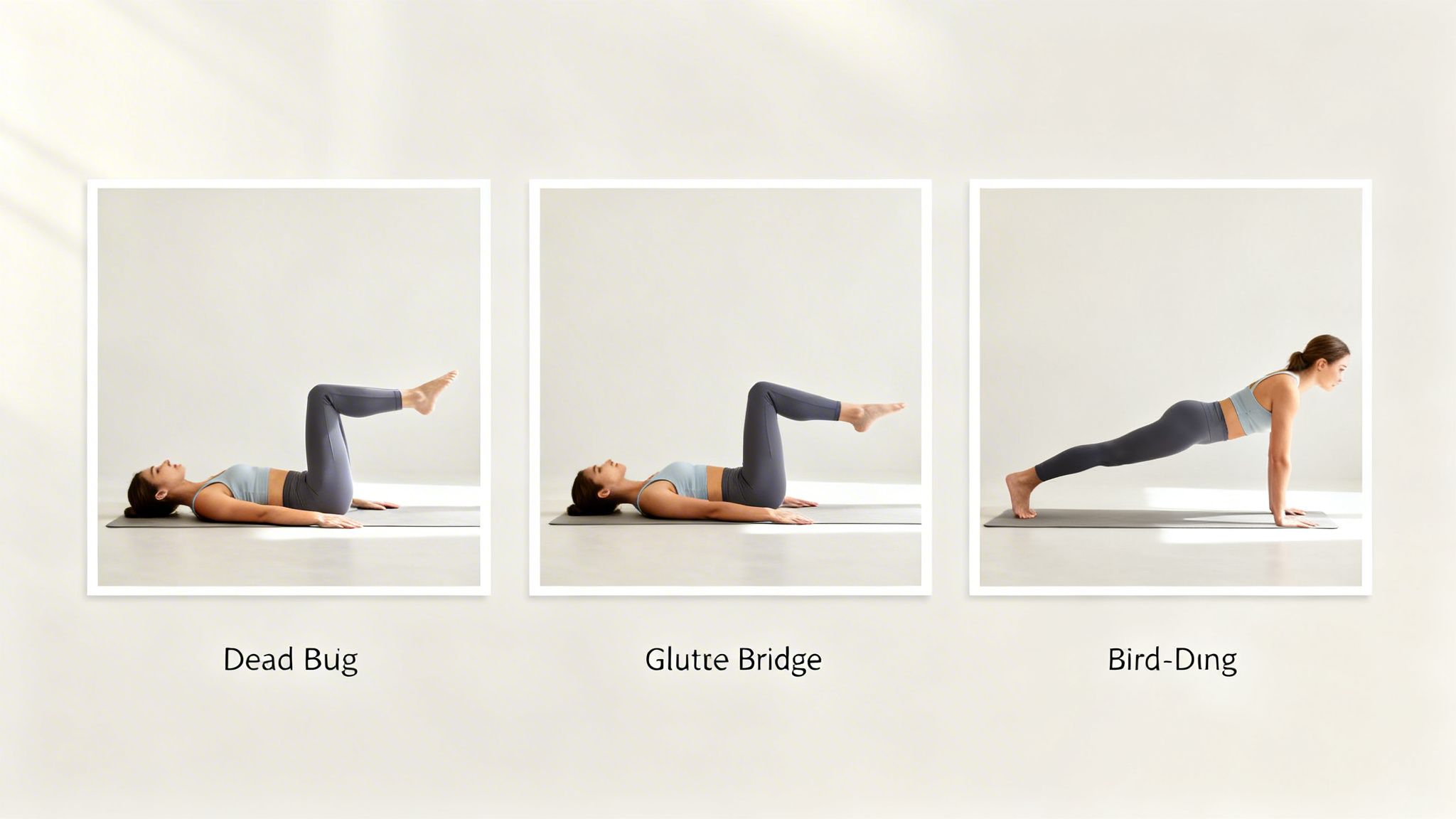
So, your self-assessment turned up a few weak links. A wobbly hip, a back that rounds, or glutes that just won't fire. Good. Now we have a target.
Lasting relief isn't found in heavy PRs. It’s built right here, on the floor, with a few deceptively simple exercises that will fundamentally rewire how your brain and body communicate. We're going after the root cause by teaching your deep core muscles how to stabilize your spine and waking your glutes from their long nap.
The Art of the Core Brace
Before you move, you must master the brace. This isn't just sucking in. This is about creating 360-degree tension around your middle, like a natural weightlifting belt.
Imagine someone is about to give you a friendly punch to the gut. That instinctive tightening? That’s it. You should feel the muscles in your front, sides (obliques), and low back all fire up at once. You should still be able to take shallow breaths while holding it. This one skill is the single biggest difference between people who get strong and people who get injured.
Foundational Lower Back and Hip Drills
Your ticket to bigger lifts without the pain is mastering these movements with perfect form. The goal here isn't fatigue; it's activation. Focus on slow, controlled reps and feeling the right muscles working.
1. The Dead Bug
This looks easy. It’s not. The Dead Bug is a masterclass in core control, teaching you to move your limbs while your lumbar spine stays locked in place. It's the exact skill that protects your back during a heavy squat or run.
- How to Do It: Lie on your back, knees bent at 90 degrees, shins parallel to the floor. Arms point to the ceiling. Gently press your low back into the floor.
- The Movement: Brace your core. Slowly lower your right arm and left leg toward the floor. Only go as low as you can without your back arching. Exhale as you lower, inhale as you return to the start. Switch sides.
2. The Glute Bridge
If you have a desk job, your glutes are probably asleep. The Glute Bridge is the alarm clock. It teaches your glutes to fire again so they can do their primary job of extending your hips—a job your hamstrings and low back have likely been covering for.
- How to Do It: Lie on your back, knees bent, feet flat and hip-width apart.
- The Movement: Squeeze your glutes first. Then, drive through your heels to lift your hips until you have a straight line from shoulders to knees. Hold the top for a 2-second count, squeezing your glutes hard. Lower slowly. If you feel your low back, you’re arching too high.
3. The Bird-Dog
Like the Dead Bug, the Bird-Dog challenges your core to fight against rotation and extension. It’s fantastic for building a rock-solid connection from your shoulders to your hips.
- How to Do It: Get on all fours, hands under shoulders, knees under hips. Find a neutral spine.
- The Movement: Brace your core. Slowly reach your right arm forward and your left leg straight back. The goal is to keep your hips and shoulders perfectly square to the floor—pretend you have a glass of water on your low back. Hold, then return to the start with control.
Research confirms that programs combining lumbar stabilization (Dead Bugs, Bird-Dogs) with hip strengthening (Glute Bridges) are the gold standard for kicking non-specific low back pain to the curb. This two-pronged attack consistently leads to significant drops in pain and major improvements in movement quality.
If you’re wondering why your hips are so stubborn, you can learn more about the common causes of muscle tightness in your hips in our detailed guide.
If you live in Marlton, Mount Laurel, Cherry Hill, Moorestown, Haddonfield, or Medford and you're done guessing, we can help. Schedule a Free Discovery Visit at Valhalla Performance. Let's build a real plan to get you back to 100%.
Progressing to Functional Strength
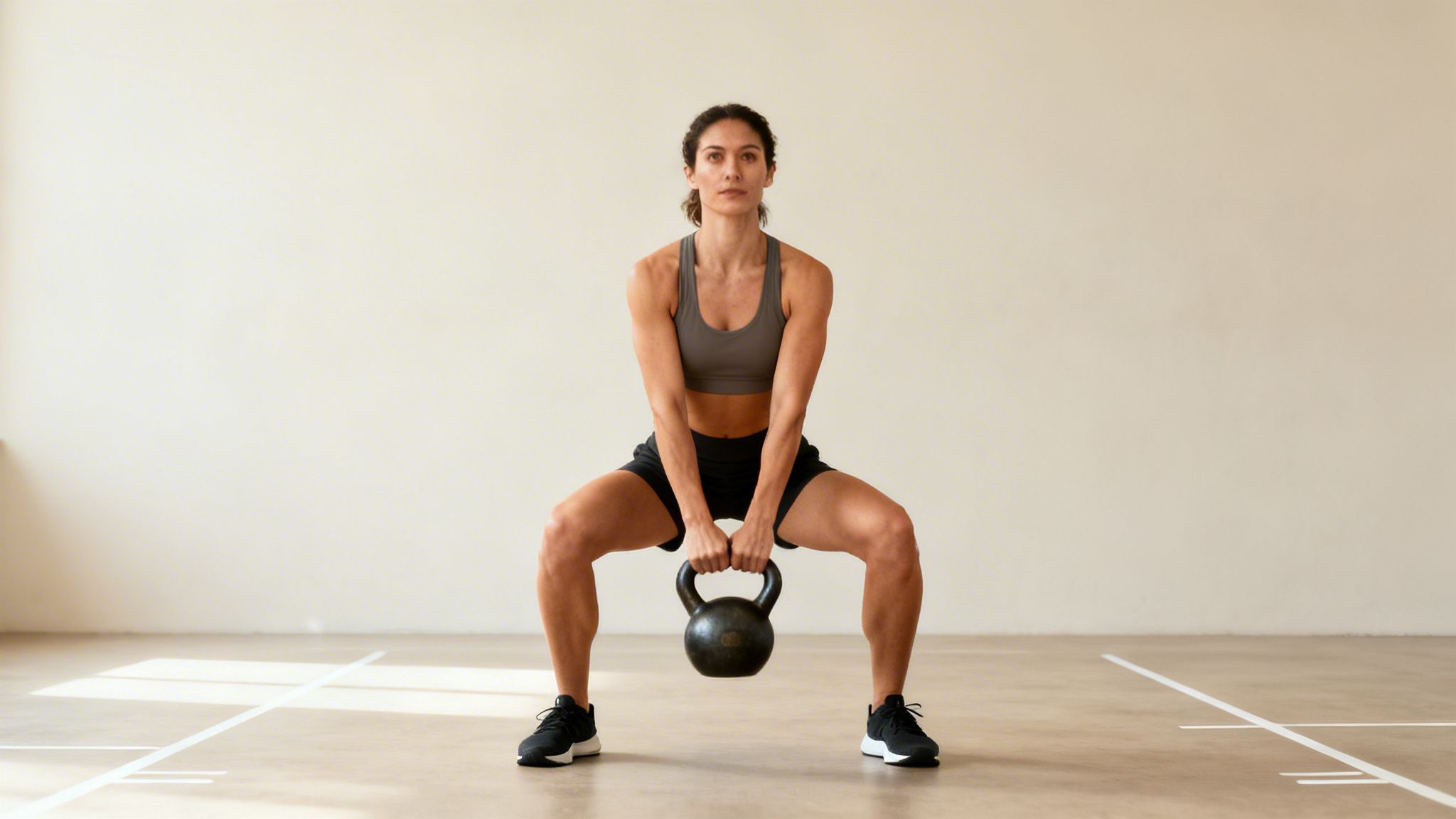
You've put in the work on the floor. Your core knows how to brace, and your glutes are finally awake. Now it's time to take that hard-earned stability and forge it into real-world strength.
This is the bridge from "rehab" to "performance." We’re building resilience with lower back and hip exercises that mimic the demands of sport and life. Nailing these movements with perfect form will armor-plate your body, whether you're pulling a PR deadlift or moving furniture.
The Goblet Squat: Your Gateway to Safe Squatting
The Goblet Squat is the best squat variation for anyone who's had back pain. Holding a weight at your chest acts as a counterbalance, forcing you into an upright position and making your core fire reflexively. It's a self-correcting movement that takes stress off your lumbar spine.
How to Do It Right:
- The Setup: Grab a kettlebell or dumbbell and hold it tight against your chest. Stand with feet slightly wider than shoulder-width.
- The Drop: Take a big breath, brace your core, and push your hips back and down. Think "sit between your heels." Keep your chest up.
- The Bottom: Go as deep as you can while keeping a perfectly flat back. No "butt wink."
- The Drive: Drive through your heels and squeeze your glutes hard at the top.
Start light. The goal is flawless form for 3 sets of 8-12 reps. Only add weight when your form is locked in and pain-free.
Master the Hip Hinge with the Kettlebell RDL
The Romanian Deadlift (RDL) is a masterclass in how to safely pick anything up. A perfect RDL is a perfect hip hinge under load. Ever felt your back "go out" lifting something? That’s because you bent with your spine instead of hinging at your hips. The Kettlebell RDL builds a bulletproof posterior chain that acts as a bodyguard for your lower back.
Your hips are a powerful door hinge. Your spine is the expensive wooden door. You want the hinge doing all the work, not the door. The RDL trains the hinge.
How to Nail the Technique:
- Stand with feet hip-width apart, holding a kettlebell in front. Keep a "soft" bend in your knees.
- Brace your core and push your hips straight back. Imagine trying to tap a wall behind you with your butt.
- Keep the kettlebell close to your shins, maintaining a completely flat back. No rounding.
- Lower until you feel a deep stretch in your hamstrings (usually mid-shin).
- Reverse the movement by driving your hips forward and squeezing your glutes hard. Do not pull with your back.
Building Single-Leg Strength with Split Squats
Back and hip pain is often asymmetrical. Single-leg (unilateral) work is non-negotiable for fixing these imbalances. Split Squats torch your glutes, quads, and hip stabilizers one leg at a time, ruthlessly exposing and correcting your weak links.
The Progression:
- Bodyweight Split Squat: Get into a staggered stance. Lower your back knee straight down, keeping your front shin vertical. Master balance and control.
- Dumbbell Split Squat: Once you own the bodyweight version, grab dumbbells. This adds load and forces your core to work harder to prevent tipping.
- Rear-Foot-Elevated Split Squat (Bulgarian Split Squat): The next level. Put your back foot on a bench. The increased range of motion and stability demand is intense, building serious glute strength and hip stability.
Building Your Weekly Routine
Knowing the exercises is one thing; programming them is another. A smart structure is key.
Sample Weekly Exercise Structure
| Day | Athlete Routine (Performance Focus) | Desk Worker Routine (Pain Relief Focus) |
|---|---|---|
| Day 1 | Strength: Goblet Squats (4×6-8), Kettlebell RDLs (3×8-10) | Foundations: Bird Dog (3×10/side), Glute Bridge (3×15) |
| Day 2 | Accessory/Recovery: Bodyweight Split Squats (3×12/side), light mobility flow | Strength: Goblet Squats (3×8-12, light), Dead Bug (3×8/side) |
| Day 3 | Rest or Active Recovery | Rest |
| Day 4 | Strength: Rear-Foot-Elevated Split Squats (3×8-10/side), Plank variations (3×45-60s) | Foundations: Cat-Cow (2×10), Side Plank (3x30s/side) |
| Day 5 | Full Body: Kettlebell Swings (5×15), Farmer's Carries, light conditioning | Strength: Kettlebell RDLs (3×10-12, light), Bodyweight Split Squats (3×10/side) |
| Day 6/7 | Rest or Active Recovery | Rest or light activity like walking |
Notice the difference? The athlete's routine builds top-end strength, while the desk worker's plan prioritizes re-establishing foundational patterns to alleviate pain. Both use the same core principles, just applied differently.
If you’re a weightlifter, CrossFit enthusiast, or athlete in the South Jersey area who's been sidelined by nagging pain, a list of exercises isn't a full battle plan.
For those in Marlton, Mount Laurel, Cherry Hill, Moorestown, Haddonfield, or Medford, it's time to stop guessing and start fixing the real problem. Schedule a Free Discovery Visit at Valhalla Performance. Let's build a real strategy to get you back to doing what you love—strong, confident, and without fear.
Your Plan for Long-Term Success in South Jersey
You have a list of exercises. But a list of exercises isn't a plan—it’s a to-do list without a strategy. Real, lasting results don’t come from randomly trying exercises. They come from a precise diagnosis, consistent application, and smart progression.
For active adults in Marlton, Mount Laurel, and Cherry Hill who are sick of the chronic pain cycle, the answer isn’t more random stretches from YouTube. It’s a personalized game plan built on a root-cause diagnosis.
From Exercises to a True Solution
A generic online program can't see the subtle ways your body cheats when you squat or hinge. It doesn't know your injury history, your goals in the gym, or the specific demands of your sport. This is where an expert diagnosis becomes non-negotiable.
The consequences of fumbling around with unmanaged pain are huge. The global burden of low back pain is staggering, not just on the healthcare system but on your ability to perform. A movement-based rehab plan is the only way to achieve long-term results.
The goal isn’t to just stop the pain for a week. The goal is to build a body so resilient that pain is no longer part of the conversation.
This means moving past temporary fixes and committing to a system that fixes the underlying mechanical faults for good.
Your Next Step in South Jersey
If you're an active adult living in Moorestown, Haddonfield, Medford, or anywhere else in South Jersey, and you’re ready to stop guessing and start fixing, it's time to take action.
We offer a Free Discovery Visit at Valhalla Performance. This is a no-pressure conversation with a doctor of chiropractic about your pain, your history, and what you want to get back to doing. It’s your opportunity to see if our movement-based approach is the right fit to finally solve your pain and get you back to performing at your best—in the gym, on the field, and in life.
Your Questions, Answered
When you're ready to ditch the quick fixes and commit to ending your back and hip pain for good, questions come up. Here are the answers we hear most often from active adults who are ready to get serious about a solution.
How Do I Know When It’s Time to Level Up?
Progress isn't about following a calendar; it’s about earning the right to advance. We live by the “pain-free and perfect” rule. Can you perform 3 sets of 10-12 reps with flawless form and absolutely zero pain?
If it’s a confident "yes," you’re probably ready for the next challenge—adding weight, more reps, or a tougher variation. But if you feel a twinge of pain or see your form break down, you're not ready. Your body is telling you to stay put and master the basics.
An expert eye is a game-changer here. A coach spots the tiny form breakdowns you can’t see, ensuring you’re building real strength without causing a flare-up.
I’m a Weightlifter/CrossFitter. Can I Do This Stuff on Training Days?
Absolutely. Think of it as a non-negotiable part of your warm-up. Foundational moves like the Bird-Dog, Glute Bridge, and Dead Bug are the perfect "movement prep" to do before touching a heavy barbell. You’re waking up your core and glutes and reminding them to fire correctly during your big lifts—a secret weapon for both performance and injury prevention.
As for bigger strength exercises like Goblet Squats and RDLs, weave them into your accessory work. Focus on perfect form over heavy weight, especially when you’re undoing bad habits that led to your injury. Do them right, and you'll see your main lifts get stronger as a result.
How Is This Any Different From the Physical Therapy I Already Tried?
We see so many people who are fed up after trying traditional PT, where they got a hot pack and a generic handout of exercises that did little more than poke the bear.
Our approach is worlds apart. We start with a deep-dive movement assessment to find the root cause of your pain—not just chase the symptom. Our plans are active, one-on-one, and blend hands-on chiropractic care with a real strength and conditioning program.
We don’t just give you a sheet of paper and send you on your way. We coach you through functional movements that directly translate to your sport and your life. We build resilience so the problem doesn't return, bridging the massive gap between rehab and performance. We get you back in the game stronger and more confident than before.
If you’re ready to stop the endless cycle of pain and get a personalized plan that actually works, Valhalla Performance is ready for you. For active adults in Marlton, Mount Laurel, Cherry Hill, Moorestown, Haddonfield, Medford, and South Jersey, your comeback story starts with one conversation. Schedule your Free Discovery Visit today and let’s find the root of the problem and build your battle plan for lasting results.