
Your comeback doesn't wait for an invitation. It starts the second you wake up from surgery.
The first thought is always the same: "When can I get back to my life?" For the active adults we see from all over South Jersey, that means getting back to the gym, the CrossFit box, or the field. But the standard advice to "just rest" is old-school, lazy, and flat-out wrong for anyone serious about long-term results.
You don’t rebuild by sitting still. You rebuild by starting the right work, right away.

This isn’t about blowing off your surgeon's orders. It’s about doing the right things at the right time to give your body a head start on building real, lasting strength.
Your body is already sending signals. In fact, research out of Stanford University showed that what certain immune cells are doing in the first 24 hours after surgery can predict how fast you’ll bounce back from pain and fatigue. The study found these early changes accounted for 40% to 60% of the difference in recovery times between patients.
The takeaway? What you do from day one matters. A lot.
This Isn't Your Average Rehab
At Valhalla Performance, we see proof of this every single day. A successful comeback isn't about following a generic, one-size-fits-all timeline. It’s about executing a smart, personalized battle plan designed for long-term results.
Standard physical therapy often just zooms in on the incision, handing you a sheet of basic exercises for temporary relief. Our integrated chiropractic and One80 Strength System digs way deeper.
We’re focused on:
- Fixing the Real Problem: We look past the surgery site to find the root cause—the weak links and bad movement patterns that probably led to the injury in the first place.
- Real-World Goal Setting: Your goal isn't just to "bend your knee." It's to squat heavy, sprint hard, and jump without thinking twice. We build your plan around that.
- Active, Movement-Based Rehab: We don’t just give you a to-do list. We teach you the "why" behind every movement, making you the expert on your own recovery. You can get more details on our philosophy in our guide to active recovery.
The game changes when you stop seeing yourself as a patient and start seeing yourself as an athlete in training. Right now, your sport is 'getting back to 100%.' And practice starts today.
If you're in Marlton, Mount Laurel, Cherry Hill, Moorestown, Haddonfield, or Medford and you're ready to fix the root cause of your pain for good, your journey begins with a real plan.
Done with generic rehab and temporary relief? Schedule your Free Discovery Visit at our South Jersey clinic today and let's map out your return to full strength.
Protect, Heal, and Gently Wake Your Body Up
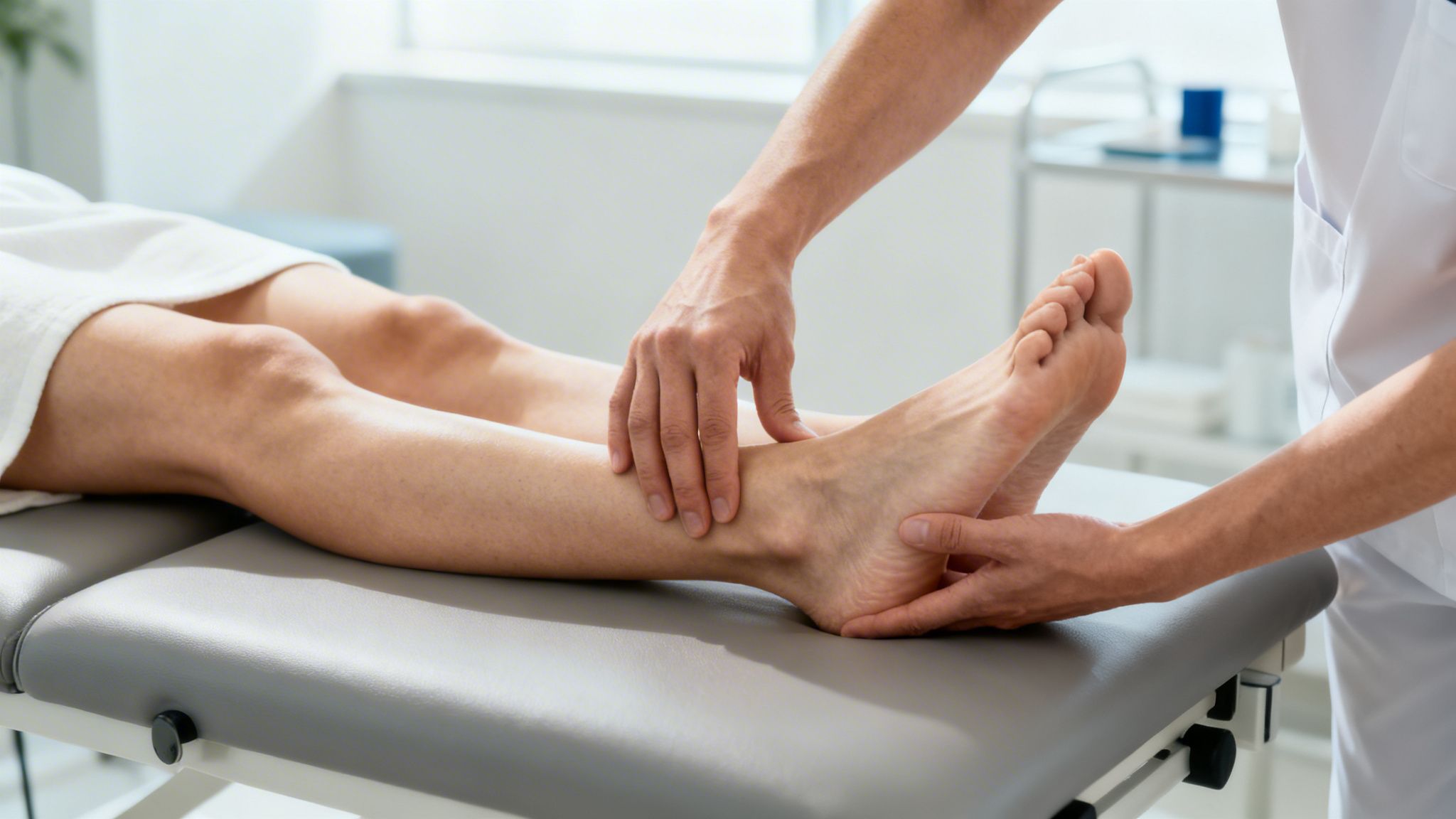
The first few days and weeks after surgery are tricky. Your body is in full-on healing mode, but "rest" doesn't mean becoming a permanent fixture on your couch. Honestly, doing nothing is one of the worst things you can do for long-term results.
This early stage is all about smart, targeted, movement-based rehab. It's a critical time to protect the surgical site while stopping the rest of your body from getting stiff and weak. If you skip this, you’re basically begging for compensation patterns and future injuries to show up uninvited.
The Power of Pain-Free Movement
Right now, the goal isn't to build monster strength. It's to gently wake up your system. Surgery, pain, and inflammation can effectively "unplug" the connection between your brain and your muscles. Gentle, pain-free movement is how we plug it back in.
Think about it: after ACL surgery, your quad muscle is essentially asleep at the wheel. Just thinking about tensing that muscle (a quad set) starts the process of getting it to fire again.
A few practical examples of what this looks like for an active adult:
- Knee Surgery: Ankle pumps, quad sets, and gentle heel slides. These get blood flowing to the area to speed up healing without putting any stress on that new ACL graft, preventing stiffness that can derail your ability to squat or run later.
- Shoulder Surgery (like a Rotator Cuff Repair): Pendulum swings, gentle grip squeezes, and pinching your shoulder blades together. This keeps the joint from freezing up and reminds the supporting muscles in your back—critical for heavy lifts like deadlifts and overhead presses—that they still have a job to do.
These movements might feel ridiculously small, but they’re laying the foundation for getting your real strength back. They crush swelling, manage pain, and remind your body how to move without cheating.
Your body is built to heal, but it heals best with motion. The trick is giving it the right dose of movement at the right time. This isn’t guesswork; it’s a science.
Your First Move Matters More Than You Think
This isn’t just our opinion. Modern medical protocols are finally catching on. Enhanced Recovery After Surgery (ERAS) programs prove that active, movement-based recovery isn't just a nice idea—it gets measurable results.
One major analysis found that patients in these programs got out of the hospital nearly two days earlier than those getting standard "rest-and-wait" care. The same evidence showed that supervised movement just twice a day helped more people walk on their own by day five post-op. You can check out the findings on accelerated functional recovery for yourself.
This highlights the massive difference between a passive recovery and a proactive, performance-focused one.
Early Post-Op Recovery: Standard vs. Performance-Focused Approach
Most recovery plans treat the early weeks as a waiting game. We see it as a head start on building long-term results.
| Recovery Aspect | Standard 'Wait and Rest' Approach | Valhalla Performance's Active, Movement-Based Approach |
|---|---|---|
| Initial Focus | Passive rest, immobilization, pain medication. | Pain modulation through gentle, pain-free movement. |
| Mindset | "Don't move it until it stops hurting." | "Move what you can, as soon as you can, without pain." |
| Muscle Activation | Significant muscle atrophy and shutdown are accepted as normal. | Immediate focus on neuromuscular re-education (e.g., quad sets, glute squeezes) to prevent shutdown and address the root cause of weakness. |
| Outcomes | Slower return to function, increased stiffness, more compensation patterns. | Faster reduction in swelling, less stiffness, and a solid foundation for real strength work. |
The takeaway is clear: waiting for the pain to magically disappear just digs you into a deeper hole of weakness and stiffness.
At Valhalla Performance, we get to work on day one. Our combo of hands-on chiropractic care and the One80 Strength System is built for this. We help manage your pain while guiding you through the exact low-level movements that will put you on the fast track, all without messing with your surgeon's work.
If you live in the South Jersey area, including Marlton, Mount Laurel, Cherry Hill, Moorestown, Haddonfield, or Medford, and want a smarter way back to 100%, it starts right here.
Ready to build a rock-solid foundation for your comeback? Schedule your Free Discovery Visit at our South Jersey clinic and see how our expert-guided approach can give you a head start on recovery.
Building Functional Strength For The Real World
Okay, your surgeon gave you the all-clear and the initial healing is done. Now the real work starts. This is where we close the gap between feeling "repaired" and feeling genuinely strong, building long-term results instead of temporary relief.
It’s time to strategically add weight and relearn how to get your strength back in a way that preps you for real life—not just a life without pain.
This isn’t about cannonballing back into your old gym routine. That’s a one-way ticket to a setback. This is about being smarter, reintroducing resistance in a controlled, progressive way that builds you up without breaking you down.
Beyond Generic Rehab Drills
Standard post-op rehab often stalls out with clamshells and leg lifts. That’s not going to cut it. Not for the CrossFit enthusiast dreaming of overhead squats or the weightlifter chasing a new deadlift PR.
To get back to the things you actually love, you have to train for them with a movement-based approach.
This means graduating from basic activation drills to loaded, functional movements that actually look like what you do in the gym or on the field. The key here is progressive overload: gradually increasing the demand on your body so it’s forced to adapt and get stronger.
It’s a careful dance—pushing just hard enough to make progress without pushing so hard you cause a flare-up.
The goal is to build strength on a foundation of perfect movement. Loading a faulty or asymmetrical pattern is the fastest way to get a new injury and end up right back where you started.
From Rehab To Real-World Strength
So, what does this actually look like in practice? It’s all about starting with a stable, controlled version of a movement and then slowly cranking up the complexity and load.
Here’s how we might approach it for different athletes:
- For the CrossFit athlete with Shoulder Surgery: We’d skip the heavy barbells for now. You might start with resistance band pull-aparts to get your scapular muscles firing correctly. Then, move to light kettlebell halos to challenge shoulder stability. Eventually, you’ll progress to a landmine press, a much safer way to reintroduce overhead pressing mechanics before trying snatches or jerks.
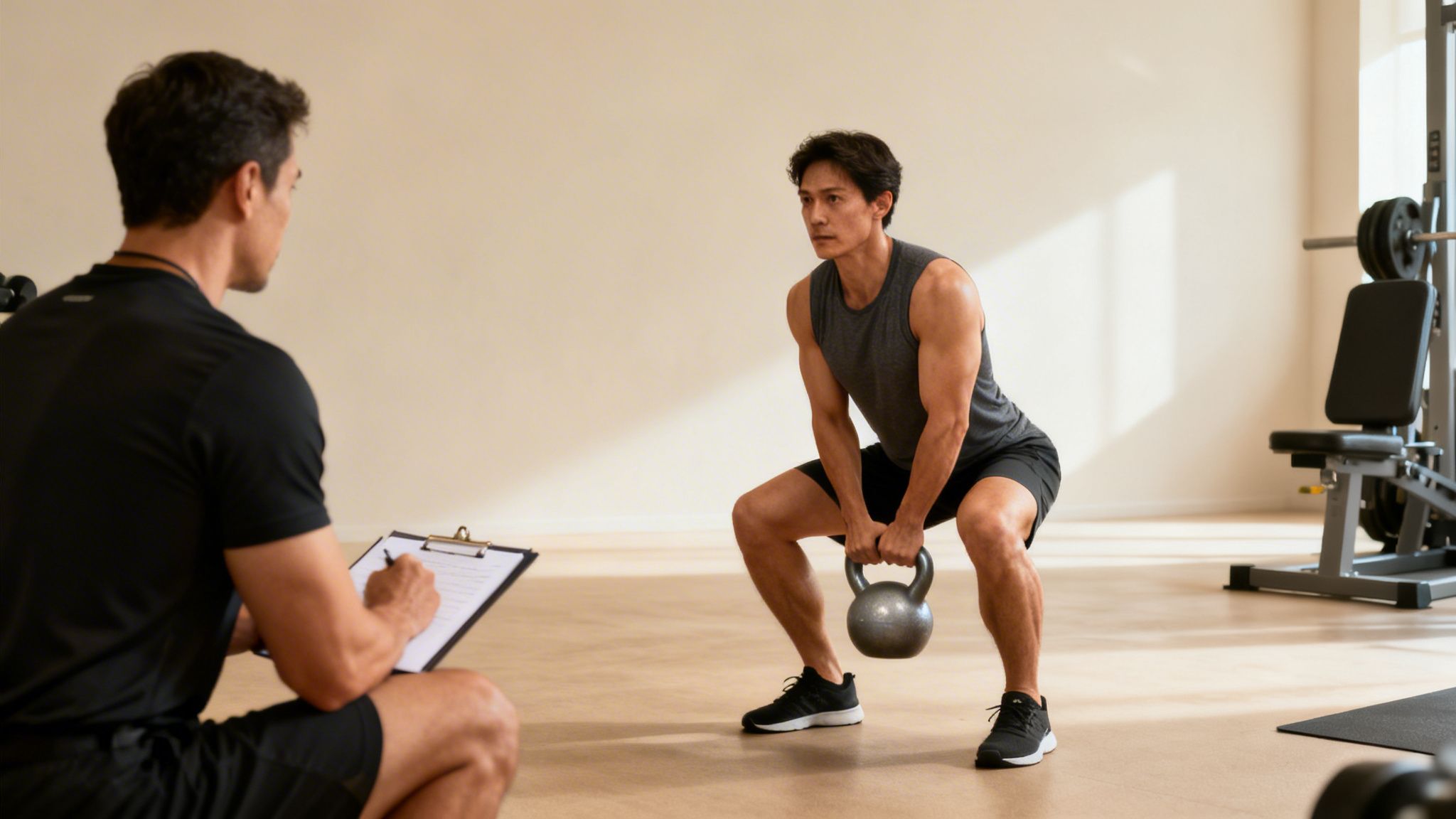
- For the Weightlifter with Knee Surgery: Your journey could begin with simple bodyweight box squats, focusing on flawless form to rebuild the pattern. From there, you could add a little weight with a goblet squat to challenge your core and leg strength. The final step might be moving to split squats to build the single-leg strength and stability that’s absolutely critical for a heavy back squat or clean.
Each step is a deliberate building block. You only earn the right to move to the next level once you’ve mastered the current one without pain or compensation.
The Problem With “Guessing” Your Way Back
This is where most people get lost. They feel better, so they dive back into their old workouts, get a nasty flare-up, and get massively frustrated.
Here’s the deal: pain-free does not equal strong or stable. Surgery creates chaos in your body, leaving behind imbalances and asymmetries that are the root cause of future problems if not fixed.
Research backs this up. One study showed that about 49% of patients hadn't fully recovered their physical function even three months after surgery. But here's the kicker: that same study found that patients who were more physically active just one month post-op had way better outcomes long-term. You can discover more about these findings on physical functioning recovery here.
What you do in these crucial weeks is a massive predictor of your success.
This is why a generic plan from the internet is a recipe for disaster. You need a system that finds your specific weak links and gives you the exact exercises to fix them. Our approach to strength, conditioning, and rehab is built on this principle. Using our One80 Strength System, we diagnose your movement asymmetries and build a plan that corrects them as you get stronger. We make sure you’re loading good patterns, not reinforcing the bad habits that got you hurt in the first place.
This is how we bridge the gap from boring rehab to true, resilient strength. We don’t just get you out of pain; we get you ready to perform.
If you’re an active adult in the Marlton, Mount Laurel, Cherry Hill, Moorestown, Haddonfield, or Medford area, you don’t have to play this guessing game. It's time to stop messing around and start building with a plan that's as serious about your goals as you are.
Ready to move beyond basic rehab and build real-world strength? Schedule your Free Discovery Visit at our South Jersey clinic today and let us show you the path back to peak performance.
Testing Your Limits For A Safe Return To Sport
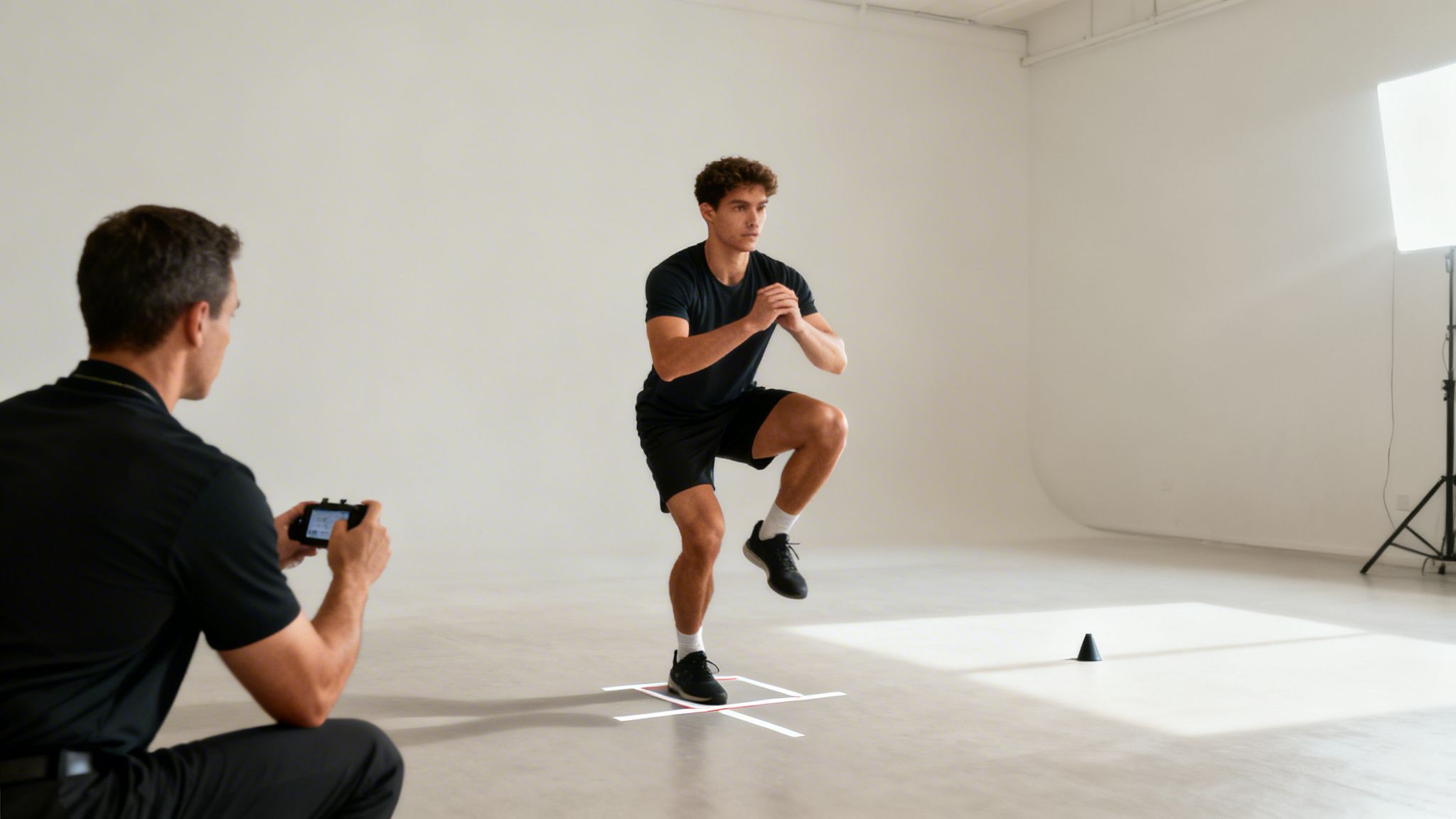
Feeling strong in the gym is a huge win. But don't mistake gym-strong for game-ready. They are two completely different beasts. This is where the real work begins—closing the gap between the controlled, predictable world of the clinic and the pure chaos of your sport.
Too many active adults make a classic, devastating mistake right here. They get cleared by their surgeon based on time, feel pretty decent, and dive headfirst back into their sport. The result? A frustrating, and almost always preventable, re-injury.
Here's the hard truth: your calendar has no idea if your knee is ready for a box jump or if your shoulder can handle a heavy clean and jerk. But data does.
This is where we stop building general strength and start proving you can handle the specific demands of your activity. To actually get back to your sport for good, you need to pass a series of objective, movement-based tests that diagnose any remaining weak links.
Ditching Guesswork For Hard Data
Before you even think about going all-out, we need to see cold, hard proof that your body is up to the task. We're talking measurable benchmarks that show your repaired side isn't just tagging along for the ride—it's ready to work.
It all boils down to symmetry and control. We're hunting for things like:
- Symmetrical Strength: Can your surgical leg single-leg squat at least 90% of what your non-surgical leg can? For most lower body recoveries, this is a non-negotiable pass/fail test.
- Dynamic Control: When you land from a jump, does your knee stay stable or does it cave inward? Can you cut and change direction with confidence, or do you hesitate?
- Mental Readiness: That slight hesitation or subconscious guarding of the surgical site? That's not just in your head. It's a measurable indicator that you're not ready to trust your body yet.
Trying to return to your sport without hitting these targets is like playing Russian roulette with your recovery. It ignores the root cause of potential failure and prioritizes hope over evidence.
What Return-To-Sport Testing Actually Looks Like
These aren't your typical physical therapy exercises. We’re not just watching you do a few lunges. These tests are designed to mimic the exact forces and split-second decisions you'll face in a game or a heavy lift.
Practical examples:
- A basketball player post-ACL surgery: We're not just checking their squat. We’re hammering them with plyometric drills. Single-leg box jumps, lateral hurdle hops—we need to see how that knee absorbs and generates force explosively, without the compensation patterns that lead to re-injury.
- A weightlifter recovering from shoulder surgery: Before they even dream of hitting a snatch, we need to see bulletproof overhead stability. Think timed single-arm kettlebell holds and bottoms-up presses to prove they own that end range of motion under load.
- A CrossFit athlete after back surgery: We need to see that their core bracing doesn't turn to mush under fatigue. We might test this with a max-rep set of dead bugs immediately followed by light kettlebell swings to see if their technique holds up when they're tired, ensuring they’re not setting themselves up for another back injury.
You don't build resilience by accident. You build it by systematically finding your breaking points in a controlled setting, then relentlessly attacking those weak links until they're gone.
Your Final Checkpoint Before Full Go
This is the phase where our whole approach clicks. The chiropractic side makes sure your joints are moving correctly for these high-level tasks. Then, the One80 Strength System programming is built specifically to crush these performance tests.
If you fail a benchmark, we don't just tell you to "try harder." We dissect the movement, find the root cause—whether it's a mobility restriction, a stability issue, or a strength deficit—and we fix it.
This is how you get back to your sport not just "healed," but genuinely prepared and more bulletproof than before you got hurt. You can get a deeper look at our methods in our guide to return-to-sport physical therapy.
If you're in the South Jersey area—Marlton, Mount Laurel, Cherry Hill, Moorestown, Haddonfield, or Medford—and you’re serious about coming back stronger, it's time to stop guessing and start testing.
Don’t leave your comeback to chance. Schedule your Free Discovery Visit today and let’s build a plan to get you back in the game, better than ever.
Dealing with Setbacks and Knowing When to Call for Backup
Let’s get one thing straight: your post-surgery recovery isn’t going to be a perfect, linear path to glory. It never is. You’ll have days where you feel like a superhero and other days where you feel like you’ve taken ten steps back.
Expecting setbacks, hitting plateaus, and having moments of frustration is all part of the game. It's completely normal for active adults pushing their limits.
The real skill is learning to tell the difference between the good kind of hurt—the kind that builds you back stronger—and the red-flag pain that’s your body screaming "STOP!" Pushing through the wrong kind of pain is the fastest way to turn a small hiccup into a full-blown disaster. Listening to your body isn't just a suggestion; it's a non-negotiable part of a smart comeback.
Good Soreness vs. Bad Pain
You have to learn to translate what your body is telling you. Not all pain is created equal, especially when you're clawing your way back to full strength after an operation.
Productive Soreness: This is that deep, satisfying ache in the muscles you just put to work. It typically shows up 24-48 hours after a solid session. It feels like your muscles are tired, but it doesn't stop you from moving. This is the feeling of progress. It's the good stuff.
Red Flag Pain: This is a different beast entirely. We’re talking sharp, shooting, or radiating pain. It might jump out at you mid-movement, stick around long after you’ve stopped, or come with friends like new swelling, numbness, or a sudden, noticeable loss of motion. This is a sign of irritation, not adaptation.
If you feel a sharp, "stop-right-now" kind of pain, listen to it. That is your body’s emergency brake. Backing off isn't a sign of weakness—it's a sign you're smart enough not to get re-injured.
When to Bring in the Reinforcements
Sometimes, the signals are loud and clear. If you experience any of these, it’s time to hit the brakes and get a professional set of eyes on it immediately:
- Sudden, significant swelling or a hot-to-the-touch feeling around the surgical site.
- Sharp, stabbing, or electrical zaps of pain during or after an exercise.
- A feeling of instability, like the joint is about to "give out."
- Suddenly losing range of motion you had just yesterday.
- Any signs of infection, like gnarly redness, pus, or a fever.
These aren’t "wait and see" problems. They are your body waving a giant red flag, telling you the plan needs an immediate, expert-led adjustment. A "more is better" attitude here will only dig you into a deeper hole.
This is exactly where having an expert in your corner is priceless. At Valhalla Performance, we’re your guide through this minefield. We help you read the signals and make the right call—when to push, when to pull back, and how to tweak the plan so you keep moving forward without blowing up your progress.
For our clients in Marlton, Mount Laurel, Cherry Hill, Moorestown, Haddonfield, and Medford, this partnership kills the guesswork. Instead of stressing about whether you’re doing too much or too little, you get a clear, confident path to get you back to 100%.
Tired of the guesswork? Ready for an expert-guided plan to make sure a small setback doesn’t derail your entire comeback? Schedule your Free Discovery Visit at our South Jersey clinic today. Let's get you back in the fight.
Your Post-Surgery Recovery Questions, Answered
Every week, we see motivated, active adults walk through our doors. You’re fresh out of surgery, ready to get back to the gym or your sport, and sick of moving gingerly. But you’re also walking on eggshells, lost in a sea of confusing, generic advice.
Here are the no-fluff answers to the questions you're probably asking yourself.
How Do I Know If I'm Pushing Too Hard Or Not Hard Enough?
This is the classic post-surgery tightrope walk. You know you need to push to get stronger, but go too far, and you’ll cause a flare-up that sets you back. The secret is learning the difference between productive muscle soreness and pain that signals a problem.
Productive discomfort feels like tired muscles or a deep ache where you worked. It’s that feeling you get 24-48 hours after a solid workout that tells you you’re building strength. It doesn’t stop you from moving, and it fades on its own. That’s your green light.
Harmful pain is your body slamming on the emergency brakes. It’s sharp, sudden, or sticks around way too long. It might bring friends, like new swelling or a wobbly feeling in the joint. If you have to modify your form on a lift to avoid the pain, you’ve gone too far.
Think of it like a traffic light. Mild soreness is a green light. Pain that makes you compromise your form is a yellow light—a clear sign to back off the weight or reps. Sharp, immediate pain is a red light. You stop. No questions asked.
This is exactly where a good coach is invaluable. We help you stay in that productive yellow-light zone to maximize progress without ever hitting red.
Why Did My Pain Come Back After I Started Feeling Better?
First of all, don't panic. This is almost always a "flare-up," and it's a totally normal part of a movement-based rehab program. Think of it as direct feedback from your body saying, “Whoa there. That was a bit much.”
A flare-up does not mean you’ve undone the surgery or re-torn anything. It’s usually just your tissues telling you they weren’t quite ready for that last jump in weight, volume, or a new exercise you tried. It’s a lesson in load management, not a sign of failure.
The worst thing you can do is freak out and stop moving entirely. The smart play is to dial it back for a few days, focus on gentle, pain-free movement, and let the irritation settle down. Then, you ease back into it, armed with the knowledge of where your body's current boundary is.
How Is This Different From Standard Physical Therapy?
This question gets right to the heart of why so many active adults get stuck in the rehab cycle. Traditional PT clinics are often a numbers game, where temporary relief is the main goal. The exercises feel generic, and they usually stop right when you need to start building real-world strength.
Getting you pain-free enough to walk your dog is one thing. Getting you strong enough to deadlift 400 pounds or compete in a CrossFit competition is another beast entirely. Standard PT is great at the first part but often leaves a massive gap between being "discharged" and being "ready to perform."
At Valhalla Performance, we are built to bridge that gap. Here’s the difference:
- One-on-One, Always: Every single minute of your session is with your Doctor of Chiropractic. No aides, no being passed off to someone else. Just you and an expert focused on your long-term results.
- We Find the Root Cause: We don't just put a band-aid on the pain. Our blend of chiropractic diagnostics and the One80 Strength System attacks the underlying movement dysfunctions that led to your injury.
- We Get You Ready for Your Sport: We speak your language. Our job isn't done until you're back to setting PRs in the gym or competing without a second thought. We close the gap from the treatment table to the gym floor.
We don’t just get you back on your feet. We partner with you to rebuild, making sure you return stronger, smarter, and more resilient than you were before.
If you're an active adult in Marlton, Mount Laurel, Cherry Hill, Moorestown, Haddonfield, Medford or anywhere in South Jersey and you're tired of the generic rehab cycle, it's time for a plan that matches your ambition. At Valhalla Performance, we help you move beyond just healing and start performing.
Schedule your Free Discovery Visit today and let's build your comeback plan together.