
If you’re an active person who also happens to have a stubborn, nagging back, let’s get one thing straight: the link between ergonomics and back pain is more than just buying a better chair. Poor ergonomics aren’t just giving you a sore back; they’re actively sabotaging your body, creating weaknesses that follow you straight into the gym and mess with your life.
The real solution isn’t found in an office supply catalog. It’s about understanding how your environment is programming your body for failure—and then reprogramming it for long-term results.
How Your Desk Is Wrecking Your Back
Ever stand up after a few hours at your desk and feel that familiar, dull ache in your lower back? You’re not alone. It’s a quiet epidemic affecting millions of active adults who are constantly held back by pain that seems to materialize out of nowhere.
And the main culprit is hiding in plain sight: your workstation.
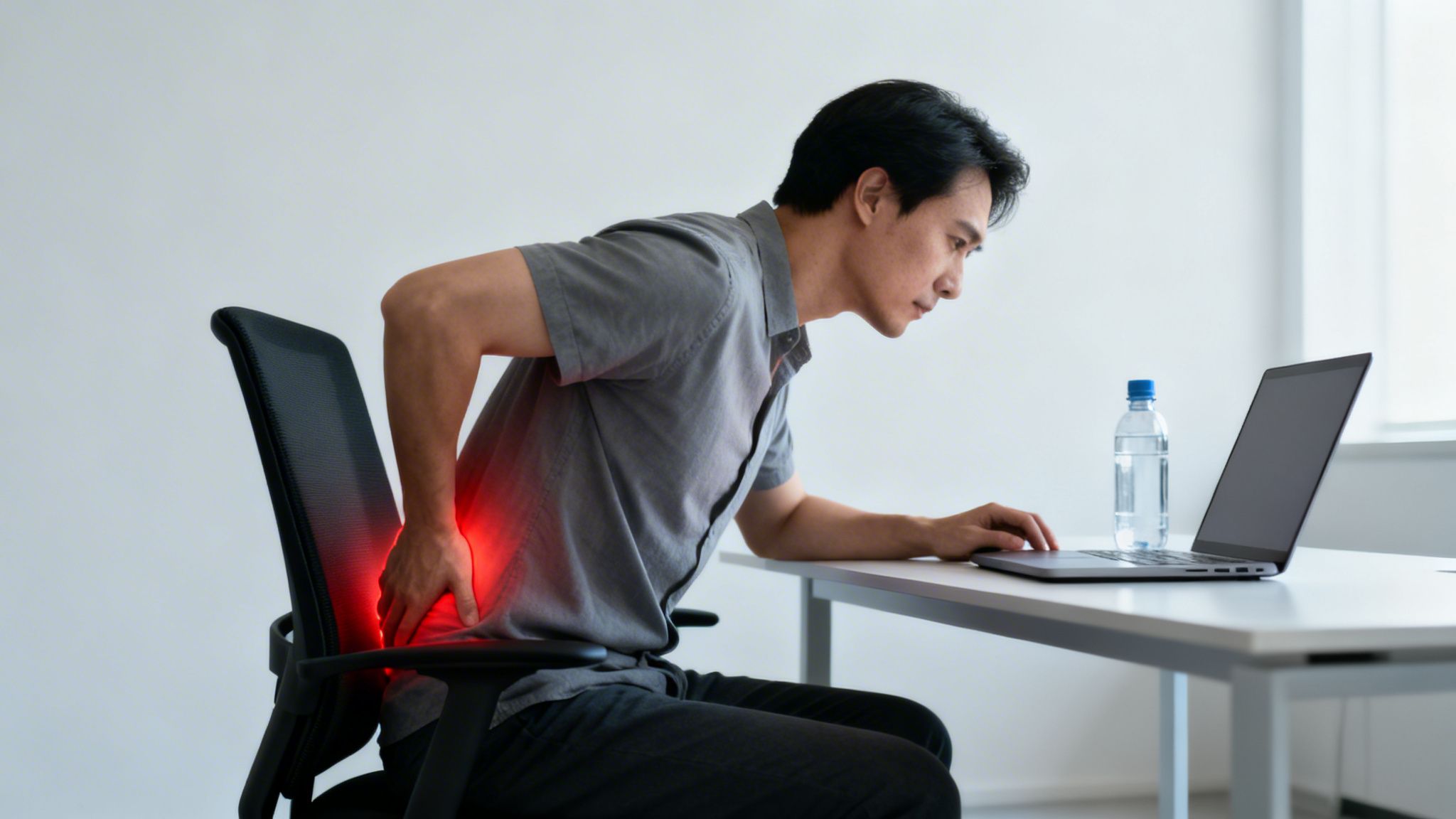
This isn't just about being uncomfortable. Low back pain is the single biggest cause of disability on the entire planet, impacting an estimated 619 million people in 2020. That number is projected to climb to a ridiculous 843 million by 2050. It’s a global health disaster.
For anyone who cares about their fitness, that stat should be a massive red flag. It shows exactly how our desk-bound work lives are building the perfect foundation for injury and killing our performance. You can read the full, grim details in this in-depth report on low back pain from The Lancet.
The Problem With Temporary Relief
When that back pain hits, what’s the first move? Usually, it’s a desperate search for a quick fix. You throw money at an expensive ergonomic chair, a standing desk, or a lumbar pillow, praying it makes the problem vanish.
While those things might offer a little temporary relief, they almost never fix the root cause.
Think of it like this: If your car's alignment is shot, it’s going to chew through tires. You can keep buying new tires (the temporary fix), but the problem will keep happening until you fix the alignment (the root cause). Your body is no different.
A fancy chair doesn’t magically fix the muscle imbalances and dysfunctional movement patterns you’ve built over years of sitting. It won’t wake up your dormant glutes or loosen up the brick-tight hip flexors that are actually yanking on your spine. This is why so many people are stuck in a frustrating loop: feel a little better, then hurt all over again.
It All Comes Back To Movement
We see a lot of people who get stuck on the idea of finding the "perfect" static posture to hold for eight hours. That's a myth.
True ergonomic health isn't about being a statue. It's about building a body that’s resilient enough to handle whatever you throw at it—whether you're at your desk or under a barbell.
Most people don't realize that their desk job is training their body, just not in a good way. It creates a very specific pattern of dysfunction. Let’s break down what’s really going on.
Common Back Pain Culprits And Their Root Causes
When we look at back pain, we don't just see the symptom. We see the chain reaction that caused it. This table shows the difference between chasing temporary relief and fixing the real problem.
| Common Activity or Symptom | The 'Temporary Fix' Approach | The Real Root Cause We Address |
|---|---|---|
| Low back pain from sitting | Buy an expensive chair or pillow | Weak Glutes & Poor Core Control: Your glutes have "fallen asleep," forcing your low back to do all the work. Your deep core isn't firing to stabilize your spine. |
| Squatting feels "off" or pinches | Stretch your hips for 5 minutes | Stiff Thoracic Spine: Your rigid upper back can't move, so your low back and hips have to overcompensate, leading to poor mechanics and pain. |
| Tight, aching hips | Foam roll the hip flexors | Chronically Tight Hip Flexors: Hours of sitting have locked your hips in a flexed position, constantly pulling your pelvis out of alignment and straining your lumbar spine. |
| Deadlifting strains your back | Stop deadlifting or lower the weight | Poor Movement Patterns: Your body has forgotten how to hinge at the hips properly, so you lift with your back instead. This is a brain-body connection problem, not just a strength issue. |
See the pattern? The temporary fix puts a bandage on the problem. Our approach rebuilds the system from the ground up so the problem doesn't come back.
These issues don't stay at the office. They follow you to the gym, turning your workouts into a minefield. That’s why your squat feels wrong, your deadlift is a back-breaker, or that nagging hip pinch just won’t die.
The problem may have started at your desk, but its consequences are everywhere. Fixing it for good means restoring proper movement and building real strength from the inside out.
If you’re done with the cycle of pain and ready to attack the root cause, you need a different battle plan. If you live or work in Marlton, Mount Laurel, Cherry Hill, Moorestown, Haddonfield, Medford or anywhere in South Jersey, your next move is simple. Click here to schedule your Free Discovery Visit and start your journey to a stronger, pain-free life.
Why Your Office Job Sabotages Your Gym Performance
You put in the work. You hit the gym consistently for CrossFit, weightlifting, or your sport of choice. But no matter how hard you train, you’re stuck—hitting plateaus, fighting off nagging aches, or worse, getting sidelined by injuries that kill your momentum.
You’ve probably blamed everything else: your programming, your lifting form, maybe even just getting older. But the real saboteur might be the eight hours a day you spend chained to your desk. Your 9-to-5 life isn't separate from your 5-to-9 passion. They're locked in a battle, and right now, your desk is winning.
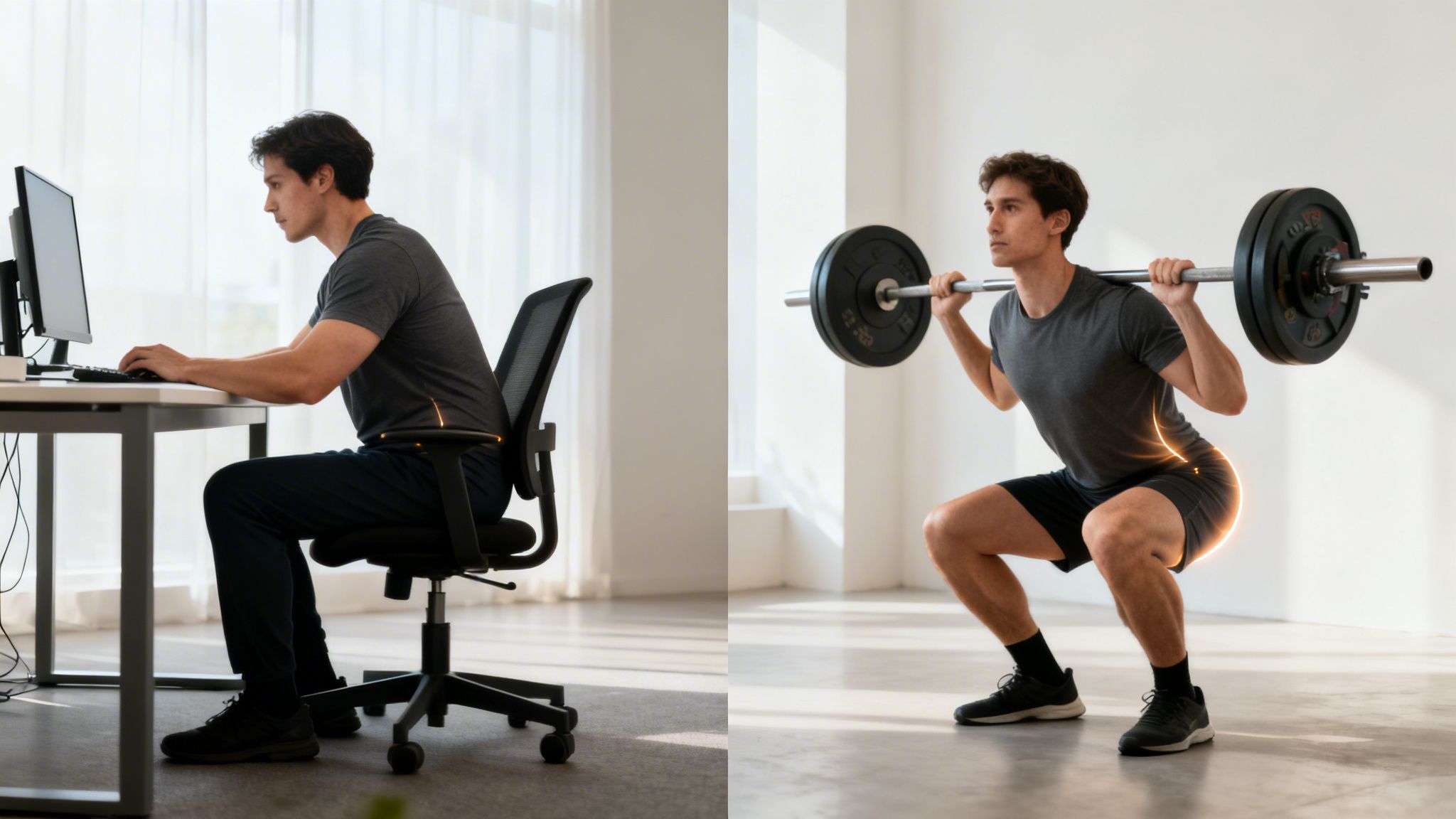
The link between poor ergonomics and back pain is just the start. All that sitting actively de-conditions your body, wiring in a specific and destructive pattern of muscle imbalances. You’re not just being inactive; your body is adapting to become an expert sitter, which makes it terrible at high-performance movements.
The Seated Body Dysfunction
Think of your body like clay. The more time you spend in one position, the more it hardens into that shape. Hours slumped in a chair teaches your body two very dangerous habits:
- It strangles your hip flexors. The muscles at the front of your hips get chronically short and tight. This constantly pulls your pelvis forward, cranking on your lower back.
- It puts your glutes to sleep. Your glutes—the most powerful muscles you own—basically go into hibernation from disuse. We call this "gluteal amnesia," and it’s a performance killer.
This one-two punch is a recipe for disaster. Your tight hip flexors yank on your lumbar spine, creating non-stop tension. At the same time, your sleepy glutes have checked out, failing to do their main job of stabilizing your pelvis and driving hip extension.
So, who picks up the slack? Your lower back and hamstrings. They're forced to do a job they were never designed for, and they're not happy about it.
It's a classic case of terrible office management. Imagine your strongest employee (your glutes) gets sent on permanent vacation, and the already-overworked intern (your low back) is told to do their job, too. Burnout isn't a possibility; it's an inevitability.
This dysfunction doesn't stay at your desk. It follows you right into the gym.
How Desk Life Wrecks Your Lifts
Let’s connect the dots. That nagging pain or form breakdown you keep experiencing isn’t random. It was programmed at your desk, hour by hour.
- That Pinch in Your Squat: You drop into a deep squat and feel a sharp pinch in the front of your hip. That’s your chronically tight hip flexors screaming because they have zero room to move. This is a common complaint for weightlifters and CrossFit athletes who also have desk jobs.
- Your Back Rounds in a Deadlift: You cue yourself to keep a flat back, but it rounds the second the weight gets heavy. This is classic gluteal amnesia. Your brain has forgotten how to fire your glutes, so it defaults to lifting with your spine. Bad idea.
- Your Knees Cave In: During squats or lunges, your knees collapse inward like a house of cards. This is often a sign of weak glute medius muscles that have gone dormant from sitting, leaving your hips completely unstable.
The issue isn't that you’re not strong enough. The issue is that your body is moving with the emergency brake pulled. You can't out-train a faulty movement pattern.
And this isn't just a hunch; it's a massive problem. Research shows that from 1990 to 2021, the global years lived with disability from low back pain caused by occupational ergonomic factors skyrocketed by 40.63%. This spike proves how sedentary work is fueling an epidemic of pain. You can read more about how occupational factors drive back pain in this detailed study.
Fixing this isn’t about more random stretching or foam rolling. It’s about breaking the bad habits your desk job created and reteaching your body how to move correctly from the ground up for long-term results.
If you’re an active adult in Marlton, Mount Laurel, Cherry Hill, Moorestown, Haddonfield, or Medford and you’re sick of your desk job undermining your fitness, it’s time to flip the script. We invite you to schedule a Free Discovery Visit at Valhalla Performance. Let's find the real source of your pain and build a body that's resilient both in the office and under the bar.
Find Your Body's Glitches With Simple Movement Tests
You feel it, don't you? That pinch deep in your squat, the deadlift that seems to magnetize right to your lower back, or just a general, nagging stiffness that no amount of stretching seems to touch. The problem isn't that you’re not trying hard enough. The problem is you’re flying blind, guessing at what's wrong.
Generic advice fails because it wasn't made for your body and its unique set of compensations—those "weak links" forged by countless hours slumped over a desk. Before you can fix the problem, you have to diagnose it. This is where you stop guessing and start testing.
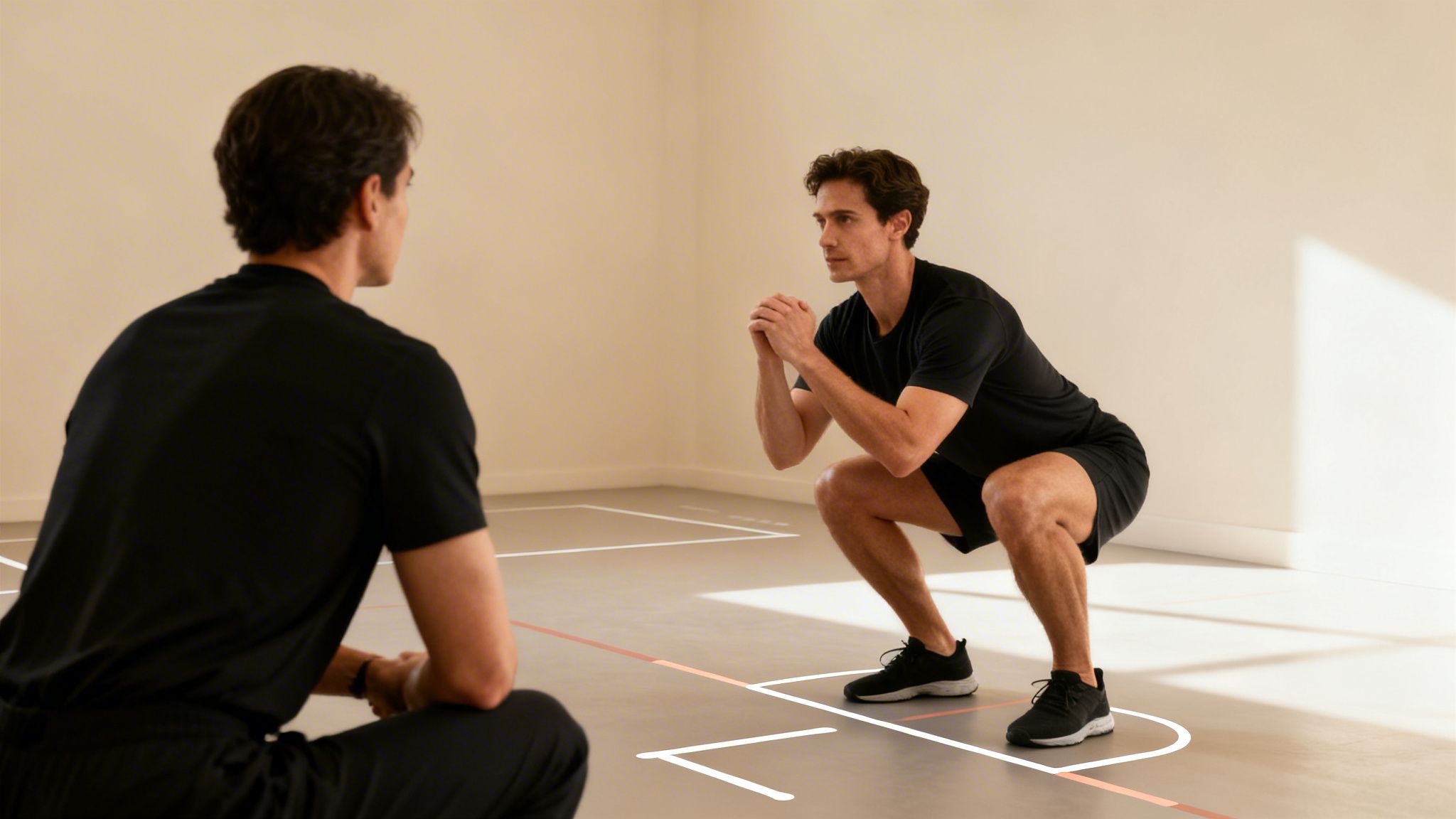
Think of these tests less like a diagnosis and more like reconnaissance. You’re becoming a detective for your own body, gathering the intel needed to understand why you hurt and why temporary fixes have been a waste of your time.
The Bodyweight Squat Test
The squat is fundamental. It’s a full-body memo on how you move, revealing everything from your hip mobility and core stability to whether your ankles are holding you hostage.
How to Do It:
- Stand with your feet about shoulder-width apart, toes pointed out slightly.
- Keep your chest up and look straight ahead.
- Drop your hips down and back like you're sitting in a chair. Go as deep as you can without pain or your heels lifting.
- Drive through your feet to stand back up.
What to Look For:
- Knees caving in? A classic sign of sleepy glutes. When the glute medius doesn’t do its job of stabilizing your thigh, your body recruits other muscles, leading to knee pain and instability, especially in sports that require cutting or jumping.
- Lower back rounding early? This points to a few usual suspects: a weak core, locked-up hips, or you simply don’t know how to hinge properly. Your body is sacrificing your spine to find depth. Bad trade.
- Heels lifting off the floor? This usually screams tight ankles. That lack of mobility down low forces compensations all the way up the chain into your knees and hips.
- A pinch in the front of your hips? That’s the tell-tale sign of tight hip flexors blocking the joint. We see this constantly in desk workers who also lift weights.
The Hip Hinge Test
The hip hinge is the engine behind powerful, back-safe movements like deadlifts, kettlebell swings, and cleans. If you can’t nail this, you’re basically programming your body to lift with your spine.
How to Do It:
- Stand tall, feet hip-width apart.
- Grab a broomstick or PVC pipe and hold it vertically along your back. It must touch your head, upper back, and tailbone.
- With a soft bend in your knees, push your hips straight back. Imagine trying to tap a wall behind you with your butt.
- Keep all three points of contact with the pipe the entire time.
- Go as far as you can, then squeeze your glutes to return to standing.
What to Look For:
- Pipe lifts off your lower back? That’s your lumbar spine rounding. You’ve stopped moving from the hips and started bending with your back—the most common and dangerous compensation in lifting.
- Pipe loses contact with your head or upper back? This means your upper back is rounding out, usually due to stiffness and a failure to keep your lats engaged.
These tests expose your body’s default settings—its unconscious strategy for getting from point A to point B. When one area is stiff or weak, another part has to go into overdrive to pick up the slack. This compensation pattern is the real root cause of your chronic pain and why you’ve hit a wall in the gym.
Seeing these patterns is the critical first step. It’s also the moment you realize why a one-size-fits-all approach is doomed to fail and why a professional, personalized assessment is non-negotiable for achieving long-term results.
If you're in the Marlton, Mount Laurel, Cherry Hill, Moorestown, Haddonfield, or Medford area and you’re done with the guesswork, we invite you to schedule a Free Discovery Visit. Let's find your weak links together and forge a plan to build a stronger, more resilient body.
The Valhalla Method: A Movement-Based Approach to Lasting Results
You’ve tried the quick fixes. The fancy ergonomic chair gave you a week of relief. The standing desk just made your feet ache. And the endless stretching routines have done nothing to stop that nagging back pain from crashing your workouts.
Sound familiar? It’s the frustrating cycle we see every day—active people failed by a system that only chases symptoms instead of fixing the root cause.
At Valhalla Performance, we don’t put a Band-Aid on a bullet wound. We rebuild the entire system. Our approach is worlds away from traditional methods that offer only temporary relief. Lasting freedom from issues like chronic ergonomics and back pain demands a two-part, movement-based assault.
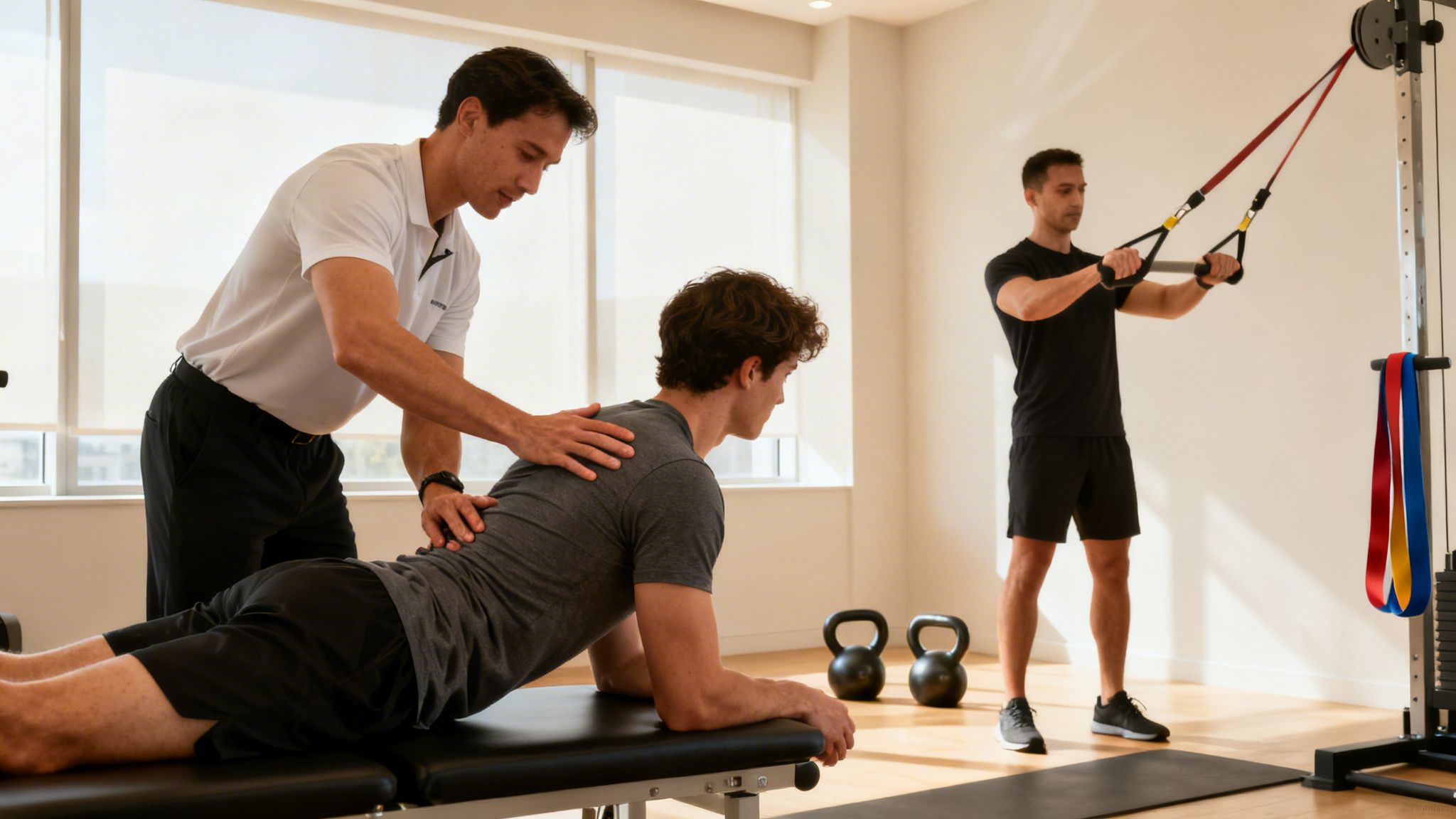
This isn’t a small problem. It's an epidemic. For the working-age population, low back pain cases exploded to 452.8 million globally in 2021—a staggering 52.66% increase since 1990. This is the reality for active adults in Marlton and Moorestown who feel that all-too-familiar ache after a day at their desk. You can dig into the numbers yourself in this detailed study from the National Library of Medicine.
Step 1: Mobilize The Joint
First, we have to break up the "rust" that has seized your system. Years of sitting, repetitive movements, and old injuries cause joints in your spine and hips to get stiff and lock up. No amount of strength training will fix a joint that physically can’t move through its full, proper range of motion.
This is where precise, hands-on treatment comes in. Our doctors use targeted manual therapy and chiropractic manipulation to restore mobility to these "stuck" segments.
Think of it like a seized-up engine. You don't just floor the gas and hope for the best. First, you have to get in there, clean out the gunk, and get the parts moving freely again. Manual therapy is that initial tune-up.
This isn't about chasing a "crack" for a moment of relief. It’s about restoring the fundamental mechanics of your body so it can move correctly and perform at its best.
Step 2: Stabilize The Movement
Here’s the part where most other approaches completely fall apart. Unlocking a joint is only half the battle. A mobile joint without stability is just an injury waiting to happen.
This is where our movement-based rehab shines.
Immediately after we restore mobility, we have to teach your body how to control it. This means waking up and strengthening the right muscles to support that newfound range. We guide you, one-on-one, through a custom-built strength plan designed to:
- Activate Dormant Muscles: We wake up those sleepy glutes and deep core stabilizers that your desk job has put into hibernation.
- Re-Educate Movement Patterns: We literally reteach your brain how to move. You'll learn to execute movements like a squat or a deadlift using your powerful hips and core instead of your vulnerable low back.
- Build True Resilience: We then progressively load these new, better patterns. This builds real-world strength that makes your body robust and injury-proof, whether you’re lifting a barbell or your kid.
This integrated attack—Mobilize, then Stabilize—is the key to long-term results. We don’t just get you out of pain; we build a body that’s stronger and more resilient than it was before the injury. Every session is one-on-one with your doctor, ensuring every rep is perfect and your plan is constantly evolving with you.
If you’re tired of the pain-and-failure cycle and live in Marlton, Mount Laurel, Cherry Hill, Moorestown, Haddonfield, or Medford, it’s time to stop messing around. Schedule a Free Discovery Visit at Valhalla Performance. Let's show you how our movement-based method can finally deliver the solution you've been looking for.
Your Path to a Pain-Free Life Starts in South Jersey
We've broken down why your back hurts. You’ve seen how your desk job is actively programming your body for failure and how simple movement tests can pinpoint your unique weak links. And you’ve seen how our movement-based method targets those root causes with precision.
The message should be clear by now. Back pain isn’t a life sentence—it’s a problem that can be solved. But you have to stop chasing symptoms and start fixing the root cause. Real ergonomics isn't about buying a fancy chair; it's about building a body that can actually move well. The only way to achieve long-term results is by combining smart mobility with targeted strength.
Stop Guessing and Start Fixing the Root Cause
If you're stuck in that endless cycle of pain, frustration, and treatments that go nowhere, it's time to do something different. You don’t have to accept daily aches as your new normal. You don’t have to give up hitting a new PR in the gym, playing with your kids, or just surviving a workday without that throb in your lower back.
This is about more than just getting out of pain. It's about taking back control. It's about understanding your body is designed to be resilient, and with the right plan, you can rebuild that resilience from the ground up.
For far too long, the advice has been to just rest or do generic stretches. That is generic advice that leads to temporary relief at best. Real, long-term results come from a smarter, active approach that fixes the underlying mechanical issues for good.
Your Invitation to Find a Real Solution
If you live or work in Marlton, Mount Laurel, Cherry Hill, Moorestown, Haddonfield, Medford, or anywhere in the greater South Jersey area, your first step is simple. And it costs you nothing.
We invite you to schedule a Free Discovery Visit at Valhalla Performance. This isn't a sales pitch. It's a real conversation about your pain and your goals.
During this no-obligation visit, here's what happens:
- You'll sit down with one of our expert doctors to talk about your pain, what you’ve tried, and what you actually want to get back to doing.
- We will listen and connect the dots on your history to start diagnosing the real source of the problem, not just where it hurts.
- You'll learn about our unique, movement-based approach and see if our integrated method is the right fit to finally get you the long-term results you’ve been chasing.
This visit is 100% about you. It's your chance to ask questions, get clarity, and find out if we're the right people to help you. No cost, no commitment—just an honest opportunity to find a real path forward.
Stop accepting a life where pain calls the shots. Take the first—and most important—step today.
The Desk Jockey's Dilemma: Your FAQs Answered
We've laid out the battlefield, but the war between your desk job and your back pain usually sparks a few more questions. Let's tackle the ones we hear most from active people dealing with persistent pain.
Is a Standing Desk Going to Fix My Back?
Short answer: no. A standing desk is a tool, not a cure. Its real value is in prompting you to move and change positions, not just trading eight hours of sitting for eight hours of standing like a statue. Standing for hours with locked knees and a hunched-over posture will just create a new set of hip and back problems.
The goal is a dynamic workstation—one where you shift between sitting, standing, and moving. But more importantly, a desk doesn't fix the underlying root causes: weak muscles and dysfunctional movement patterns. A standing desk can be part of the solution, but the real fix comes from movement-based rehab that builds a resilient body.
I Stretch My Hamstrings All the Time, So Why Does My Back Still Hurt?
This is a perfect example of why chasing symptoms is a losing game. That feeling of "tight" hamstrings is often a protective lockdown signal from your brain.
When your nervous system senses your core is unstable and your glutes are asleep, it tightens your hamstrings to create fake stability and guard your lower back. Yanking on them with more stretching can make the problem worse. The root-cause solution isn't more stretching—it's activating your glutes and bracing your core to tell your brain it’s safe to let go of the parking brake.
How Is Your Method Different From Traditional PT or Chiropractic?
Traditional chiropractic often stops at the adjustment, and many PT clinics provide generic exercises. We bridge that gap by integrating the best of both worlds and adding the one thing that ensures long-term results: personalized strength training.
Our movement-based process is brutally effective:
- Diagnose & Mobilize: We use precise, hands-on treatment and chiropractic manipulation to unlock the specific joints that aren't moving right. No guesswork.
- Stabilize & Strengthen: We immediately lock in that new mobility with one-on-one strength training. You spend the entire session with your doctor, ensuring every single rep is rebuilding your movement patterns and strengthening your body, not reinforcing bad habits.
This isn't a passive approach that offers temporary relief. We don’t just get you out of pain; we rebuild you from the ground up so the problem doesn't come back. We build a more resilient body.
At Valhalla Performance, we believe you shouldn't have to sacrifice your active life because of your career. If you're an active adult in Marlton, Mount Laurel, Cherry Hill, Moorestown, Haddonfield, Medford, or South Jersey and you're done with temporary fixes for your persistent pain, it's time for a real diagnosis.
Schedule your Free Discovery Visit. Let's find out if our approach is the long-term solution you've been looking for.
Click here to schedule your Free Discovery Visit at Valhalla Performance.