
Working on your balance and coordination isn't about just doing a few wobbly exercises. It's about getting your body’s internal GPS system back online by rebuilding a solid mind-muscle connection. This is how you move past temporary fixes and attack the root cause of your instability—that communication breakdown between your brain and your muscles that happens after an injury or from doing the same damn movements over and over.
Why Your Balance and Coordination Are a Bigger Deal Than You Think
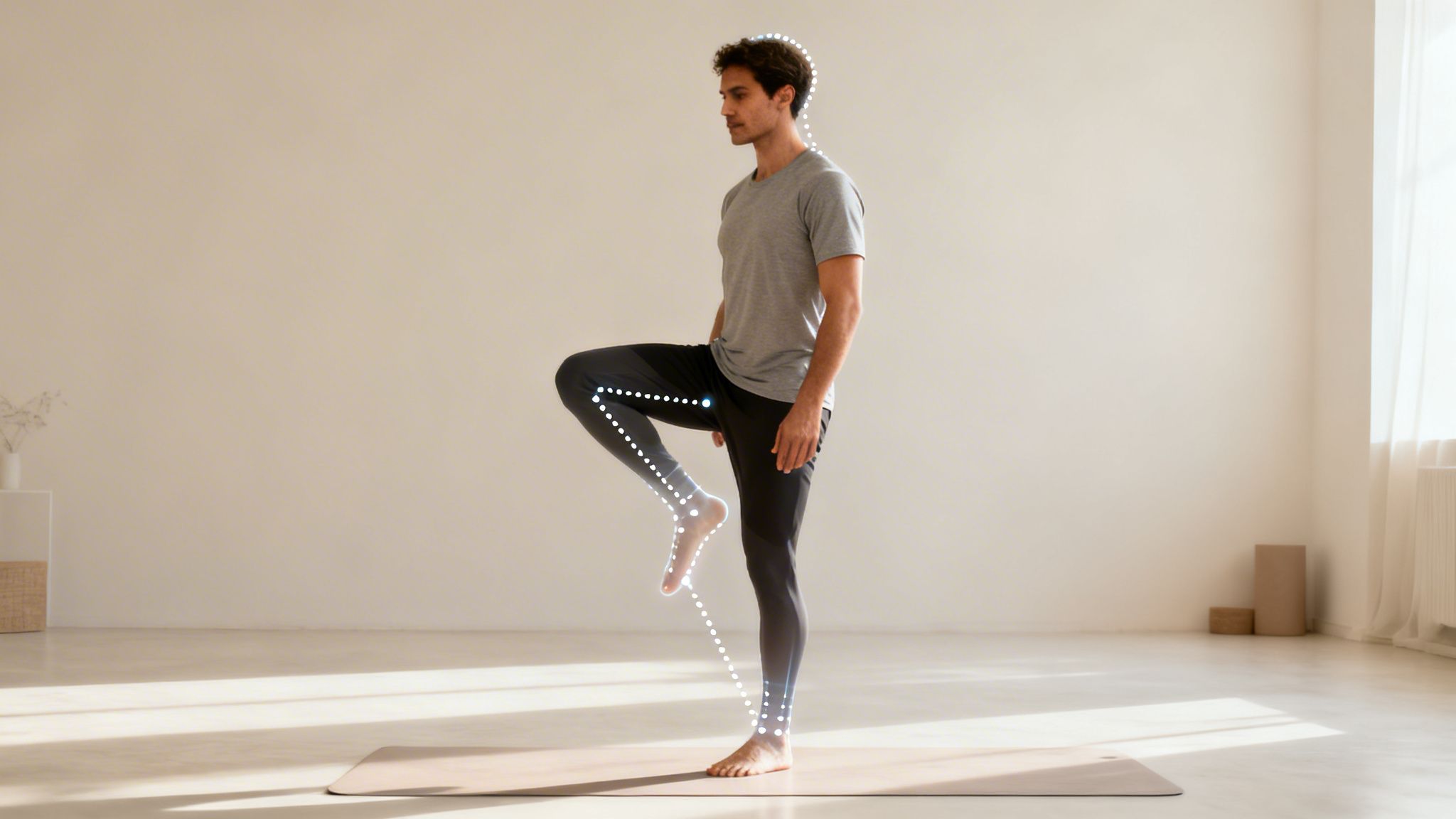
If you're an active adult dealing with nagging pain, you know the feeling. It’s the ankle that gives out during a CrossFit WOD, a stiff lower back sabotaging your deadlift, or that wobbly, untrustworthy feeling when you try to plant your foot in a pickup basketball game. It’s easy to blame getting older or just bad luck, but the real enemy is usually a shoddy connection in your body’s communication network.
This internal GPS is what we call proprioception—your brain’s map of where your body is in space. After an injury, from sitting at a desk all day, or even from your regular training routine, that map can get fuzzy. The signals between your muscles, joints, and brain become less reliable, and that’s when coordination and balance take a nosedive, leading to persistent pain.
The Problem with Compensation
Think of your body like a car with bad alignment—the tires wear out unevenly. Your body does the exact same thing. When your main stabilizing muscles aren’t firing on all cylinders because of poor proprioception, other muscles have to jump in and do a job they weren't designed for. This is precisely why your hip flexors feel chronically tight or your shoulder screams at you during overhead presses.
Your body is incredibly smart and will always find a way to get a movement done. But when it's forced to compensate for underlying instability, it locks in a pattern of strain that leads directly to the chronic pain and recurring injuries you can’t seem to shake.
This is exactly why generic stretches and foam rolling might feel good for a minute but never actually solve anything. They're a temporary patch for the overworked muscles but do nothing to address the root cause—the faulty movement pattern and the communication breakdown that started it all. You're just patching up worn-out tires, knowing they’ll blow out again.
Beyond a Physical Skill
Learning how to improve balance and coordination is about way more than just not falling over. It’s about cranking up your athletic performance, building a body that’s resilient to future injuries, and getting back to your sport without pain.
Take a weightlifter in their 40s, training hard in Mount Laurel, NJ, only to get sidelined by a knee that feels unstable in the bottom of a squat. A 2017 study showed that just 12 weeks of targeted balance circuit training can seriously improve physical balance and cognitive function. The research makes it clear: balance work is a full-body-and-mind game that translates directly to better, safer performance in the gym and on the field.
For active adults, that connection is everything. It’s not just about fall prevention—though that's obviously important, as our guide on preventing falls explains. It’s about building a body that moves powerfully and efficiently, without pain, whether you're lifting in Cherry Hill, running in Haddonfield, or playing sports in Medford.
If you’re sick of the endless cycle of pain, temporary relief, and re-injury, it’s time to stop chasing symptoms. If you're in the South Jersey area, including Marlton or Moorestown, and you're ready to finally fix the root cause of your instability, schedule a Free Discovery Visit with us. Let's figure out what's really going on and build a plan to get you long-term results.
Let's See How Wobbly You Really Are: At-Home Balance Tests
Before you can fix your balance, you need a clear, no-BS snapshot of where your body is failing you. These tests are designed to be an eye-opener. They expose the stability problems that are the root cause of your nagging aches and pains. This isn't about feeling bad about your performance; it's about getting cold, hard data so you know exactly what needs to be fixed.
The Single-Leg Stance Test
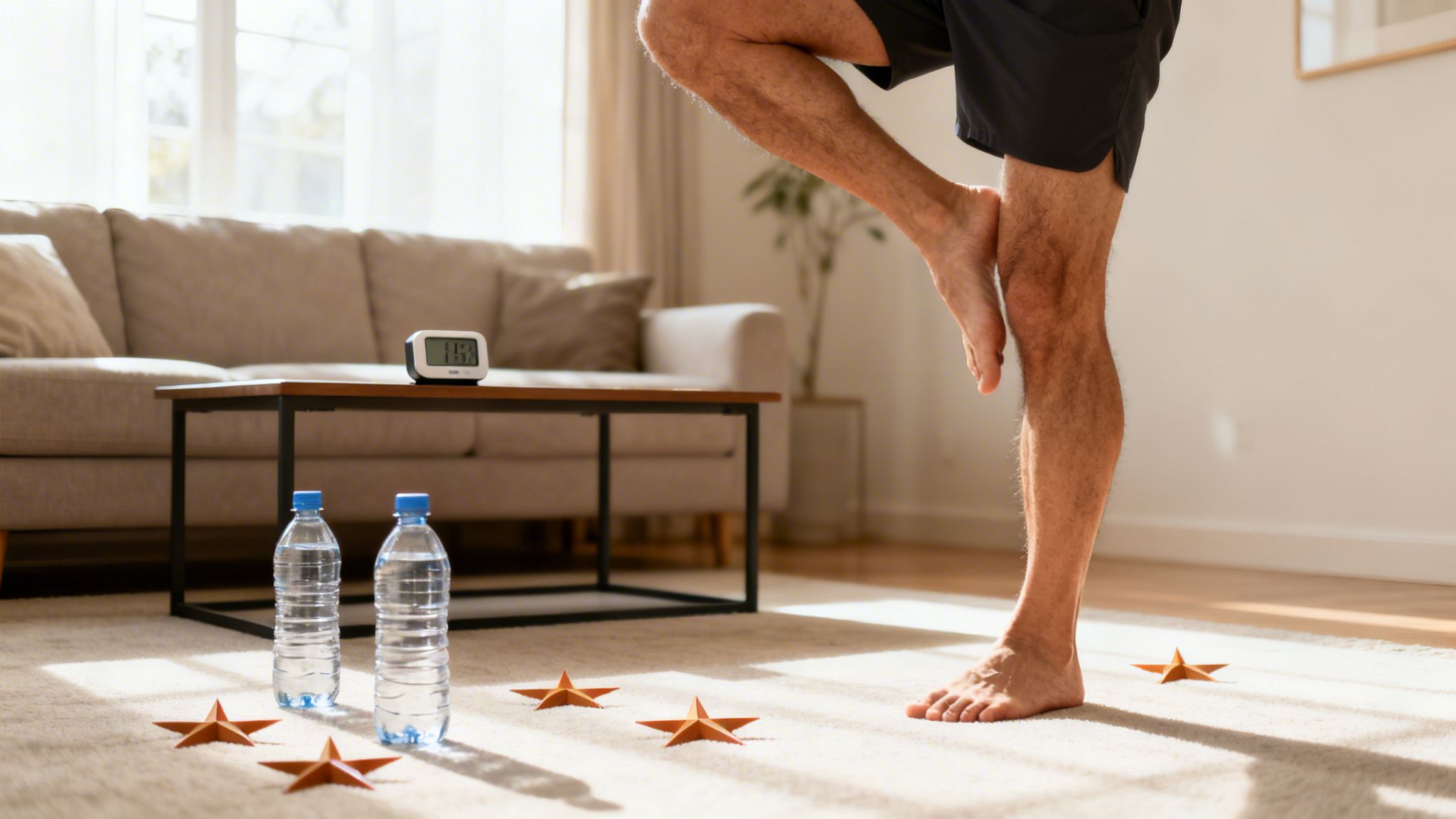
This is the gold standard for a reason. It's brutally simple and tells you almost everything you need to know about your baseline stability. Find some open space and stand near a wall or a sturdy chair, just in case.
- Round 1: Eyes Open. Lift one foot a few inches off the floor. Stare at a spot on the wall and start a timer. Your goal is to hold it for at least 30 seconds without your other foot touching down or your arms flailing.
- Round 2: Eyes Closed. Okay, here's where the truth comes out. Same stance, but this time, close your eyes. Without your vision to cheat, your body has to rely solely on its internal GPS (proprioception).
Struggle to last more than 10 seconds with your eyes shut? That's a huge red flag. Now you know why you feel shaky when you lunge for a tennis ball or plant your foot for a heavy deadlift. That wobble you just felt is the exact instability that’s causing your pain and holding back your performance.
The Water Bottle Star Test
You don’t need a high-tech lab to test your balance in motion—the kind that actually matters in sports and life. This modified Star Excursion Balance Test will do the trick with stuff you already have lying around.
Grab four water bottles (or shoes, or anything, really) and set them up in a “+” shape. One in front, one behind, and one on each side of you.
- Stand on one leg right in the middle of your "star."
- Keeping all your weight on that standing leg, reach your other foot forward and gently tap the bottle in front of you. Come all the way back to the start without putting your foot down.
- Now do the same for the bottle behind you, and then to each side.
Could you tap all four bottles without wobbling, putting your foot down, or bending over at the waist? Did one side feel way harder than the other? This test perfectly exposes the weak hips and unstable core that are holding you back in the gym and contributing to your recurring injuries.
These tests give you a baseline. If you're an active adult in South Jersey—from Marlton and Mount Laurel to Cherry Hill and Moorestown, or Haddonfield and Medford—and these results were a wake-up call, it's time to stop guessing. Don't let these weaknesses turn into your next big injury. Schedule a Free Discovery Visit at Valhalla Performance, and let's build a plan to fix the real source of your instability for good.
Your Foundational Program for Better Balance and Coordination
If you're dealing with persistent pain or an injury that won't quit, generic advice won't cut it. You can’t just do a few random balance drills and expect a serious movement dysfunction to magically disappear. You need a structured, progressive plan that rebuilds your stability from the ground up by addressing the root cause.
This is a roadmap to systematically rewire that mind-muscle connection. Think of it like this: you have to learn the alphabet before you can write a masterpiece. Each phase here builds on the last, so the stability you build actually shows up when you’re lifting, running, or playing your sport.
Phase 1: Reconnect The Wires
This is where it all begins. After an injury or years of moving poorly, the communication lines between your brain, feet, and core go quiet. The goal here is simple: wake them up and get them talking again with static holds and drills that force your body to pay attention. This is the non-negotiable groundwork. You can't build a stable house on a shaky foundation.
Key Exercises:
- Tandem Stance: Stand with the heel of one foot directly in front of the other, touching the toes, like you're on a tightrope. Hold for 30-60 seconds on each side. If that’s a breeze, try closing your eyes.
- Single-Leg Stance: Just like the self-test, but now we're aiming for rock-solid holds. Actively grip the floor with your foot and keep your hips dead level.
- Foot Tracing: Stand on one leg and use your other foot to slowly “draw” the alphabet in the air. This forces all those tiny stabilizer muscles in your standing leg and ankle to fire like crazy.
You might feel ridiculous drawing imaginary letters, but this is a killer drill for honing the motor control that stops you from rolling an ankle when you step off a curb or cut to chase a ball. It directly attacks the proprioceptive deficits that lead to chronic instability.
Do these drills 3-4 times per week. Aim for 3 sets of 30-60 second holds or 1-2 rounds of the alphabet per leg. Quality over quantity, always. A controlled 30-second hold is far better than a wobbly, 60-second mess.
Phase 2: Build Dynamic Control
Okay, the wires are hot again. Now it’s time to challenge them with movement. Life and sports aren’t static. This phase introduces controlled motion and unstable surfaces to teach your body how to stay balanced while things are changing. This is how you bridge the gap between basic rehab and real-world performance, bulletproofing yourself against re-injury.
Key Exercises:
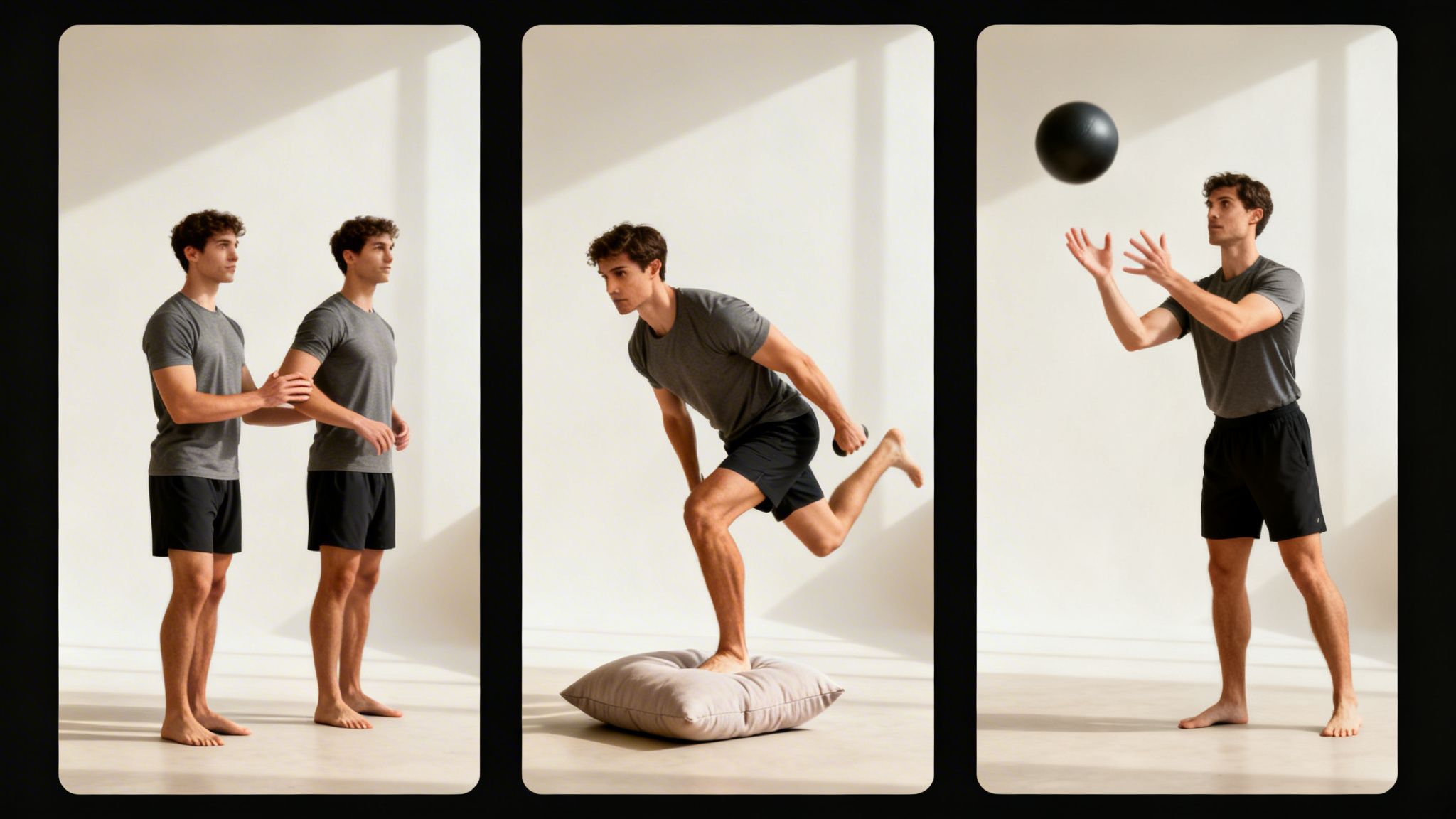
- Walking Lunges with Torso Twist: Step into a lunge. At the bottom, slowly twist your torso over your front leg. That rotation challenges your core and hip stability in a way a standard lunge can't.
- Single-Leg RDL on a Pillow: The single-leg Romanian Deadlift is already a balance beast. Now, do it on an unstable surface like a pillow or foam pad. Your foot and ankle will be working overtime to stabilize.
- Step-Ups with a Pause: Step onto a box or bench, but at the top, pause on one leg for a full 2-3 seconds before stepping back down. This controlled pause kills momentum and forces true single-leg stability.
A weightlifter shaky in the bottom of a squat will feel a direct carryover from the hip stability gained in single-leg RDLs. A runner who feels unstable on trails will benefit immensely from the reactive demands of walking lunges with a twist. The core and hip stability here are critical, and you can find more targeted movements in our guide on lower back and hip exercises.
During this phase, aim for 3 sets of 8-12 reps per side. Go slow. If you have to rush to stay balanced, you’re not in control—you’re just surviving.
Phase 3: Integrate Sport-Specific Skills
This is where it all comes together. You've re-established the connection and built dynamic control; now it's time to make it automatic in movements that look and feel like your sport or activity. The goal is for balance and coordination to be an unconscious, resilient part of how you move.
3-Phase Balance Progression Program
Here’s a snapshot of how it all fits together. This is a sample 12-week layout to take you from foundational stability to sport-ready movement. Stick with each phase for a solid 4 weeks before moving on.
| Phase | Focus | Sample Exercises | Frequency & Duration |
|---|---|---|---|
| Phase 1 | Foundational Stability & Proprioception | Tandem Stance, Single-Leg Stance, Foot Tracing | 3-4x/week; 30-60 sec holds |
| Phase 2 | Dynamic Control & Unstable Surfaces | Walking Lunge with Twist, Single-Leg RDL on Pillow, Step-Up with Pause | 3x/week; 3 sets of 8-12 reps |
| Phase 3 | Sport-Specific Integration & Power | Box Jumps with Stabilized Landing, Lateral Hops, Medicine Ball Tosses | 2-3x/week as part of warm-up or accessory work |
This structure ensures you’re not just throwing random exercises at the wall. You’re building a stronger, more resilient system, piece by piece.
Key Drills:
- Box Jumps with a Stabilized Landing: Don't just rebound off the box. Stick the landing. Hold it for 2-3 seconds, with your hips back and knees out. This teaches you how to absorb force like an athlete.
- Medicine Ball Tosses While Balancing: Stand on one leg (or in a tandem stance) and have a partner toss you a light medicine ball. Catching and throwing forces your core to react instantly to maintain balance.
- Lateral Hops with a Pause: Hop sideways over a line on the floor, landing on one leg. Hold that landing for a solid 2-count before hopping back. Fantastic for any sport that requires quick changes of direction.
Integrate these drills into your warm-ups or as accessory work 2-3 times per week. The focus here is flawless execution. This is about programming your brain for better movement, not just burning calories.
The 3 Balance Killers Sabotaging Your Progress
Putting in the work but still feeling wobbly, stuck, or in pain? It's a maddeningly common problem. Many dedicated people grind away at their training, only to sabotage their own efforts by making these critical mistakes.
Going Too Hard, Too Soon
Eagerness is great. Impatience is a progress killer. We see it constantly: an athlete tries to jump straight into advanced single-leg pistol squats before they can even hold a basic one-legged stance for 30 seconds. That’s like trying to sprint before you can walk. When you skip the foundation, your body has no choice but to cheat, reinforcing the exact problem you’re trying to fix and skyrocketing your risk of injury.
Ignoring Your Core
Think balance is all in your feet and ankles? Think again. Your core is the central anchor for your entire body. If your midsection is weak or isn't firing correctly, your arms and legs are just flailing around without a stable base to work from.
Imagine trying to fire a cannon from a canoe. No matter how powerful the cannon, the wobbly base eats up all the force, making it useless. Your arms and legs are the cannon; your core is the canoe. A weak core makes balance and power all but impossible.
This is a massive blind spot for many lifters and CrossFitters. They might have a rock-solid six-pack but lack the deep core stability needed to control rotation—the very thing that keeps you from tipping over during a heavy lift or complex movement. Better mobility is tangled up in this, too; you can see how it all connects in our guide on how to improve mobility and flexibility.
Only Training on Stable Surfaces
The gym floor is predictable. Life and sports are not. If you only do balance drills on a perfectly flat, stable surface, you're preparing for a world that doesn't exist. Real life happens on uneven trails, grassy fields, or even just stepping awkwardly off a curb. Your body needs to learn how to react to these unexpected shifts. By sticking to stable ground, you miss the chance to sharpen your proprioception and reactive stability.
These mistakes all point to one thing: you can't get long-term results without a smart, individualized plan. If you're in the South Jersey area—including Marlton, Mount Laurel, Cherry Hill, Moorestown, Haddonfield, or Medford—and you’re sick of spinning your wheels, let's fix it. Schedule a Free Discovery Visit at Valhalla Performance today, and we'll help you build a plan that attacks the root cause of your instability.
When Your DIY Balance Plan Isn't Cutting It
Trying to fix your balance with a handful of YouTube drills is a noble effort. But there’s a point where you’re not just spinning your wheels—you’re digging a deeper rut. Knowing when to call in a professional isn't admitting defeat. It’s the smartest play you can make when your body is sending you signals that something is seriously wrong. Pushing through is how a little wobble turns into a full-blown injury that benches you for good.
Red Flags That Your Body Is Screaming for Help
If any of these sound familiar, it's time to stop guessing and get a real movement assessment.
- Sharp, Stabbing Pain: This isn’t the “good” burn of a tough workout. This is your body’s air-raid siren. It’s a sign that a movement is causing damage, likely because the root cause of your instability is still lurking.
- You've Hit a Wall. Hard. You’ve been diligent for weeks, maybe even months, but you’re still as wobbly as a baby deer. If you’re not getting better, you're not working on the right problem. Period.
- One Side is a Hero, The Other is a Zero: Does your right side feel rock-solid while your left side feels weak and unstable? Big imbalances are a recipe for disaster. The strong side overcompensates until it eventually burns out or breaks down.
- Dizziness or Vertigo: Feeling like the room is spinning when you’re just trying to stand on one foot is a massive red flag. This could point to a problem with your vestibular system—your inner ear's GPS—which needs a specialist's eye.
Continuing to push through these signs is like driving your car while the check engine light is flashing and smoke is billowing from the hood. A total breakdown is coming.
Why Your Guesswork Is Failing You
Most DIY balance programs are a shot in the dark. They throw generic exercises at you without ever asking why you’re unstable in the first place.
Think about an active office worker from Marlton, NJ, struggling with nagging low back pain that sabotages his deadlifts. This isn’t just a "weak core." A massive 2024 meta-analysis covering 93 studies showed that highly targeted exercise is a game-changer for balance. The research confirmed that specific Balance Training (BT) created huge jumps in functional test scores. The science is clear: the right exercises get you better, faster, and safer. You can dig into the full findings of this powerful research on balance training yourself.
This is where a real movement diagnosis separates the pros from the pretenders. We don’t just throw more drills at you. We figure out what broke. Is it a stiff hip? A faulty firing pattern in your core? An old ankle sprain that never truly healed?
A generic plan that gives every person the same three exercises will never find that. A real diagnosis looks at how your entire body moves as a system to find the weak link that’s causing chaos everywhere else. It's the difference between slapping a patch on a leaky pipe and actually replacing the cracked section for a long-term fix.
If you're an active adult in South Jersey who's done with the guesswork and ready for a plan actually built for your body, this is your sign. We help people in Marlton, Mount Laurel, Cherry Hill, Moorestown, Haddonfield, and Medford get to the bottom of their pain and instability. Schedule your Free Discovery Visit at Valhalla Performance. Let's find out why you're unstable and build the plan that gets you back to your life—stronger and more resilient than before.
Take Control of Your Movement and End Pain for Good
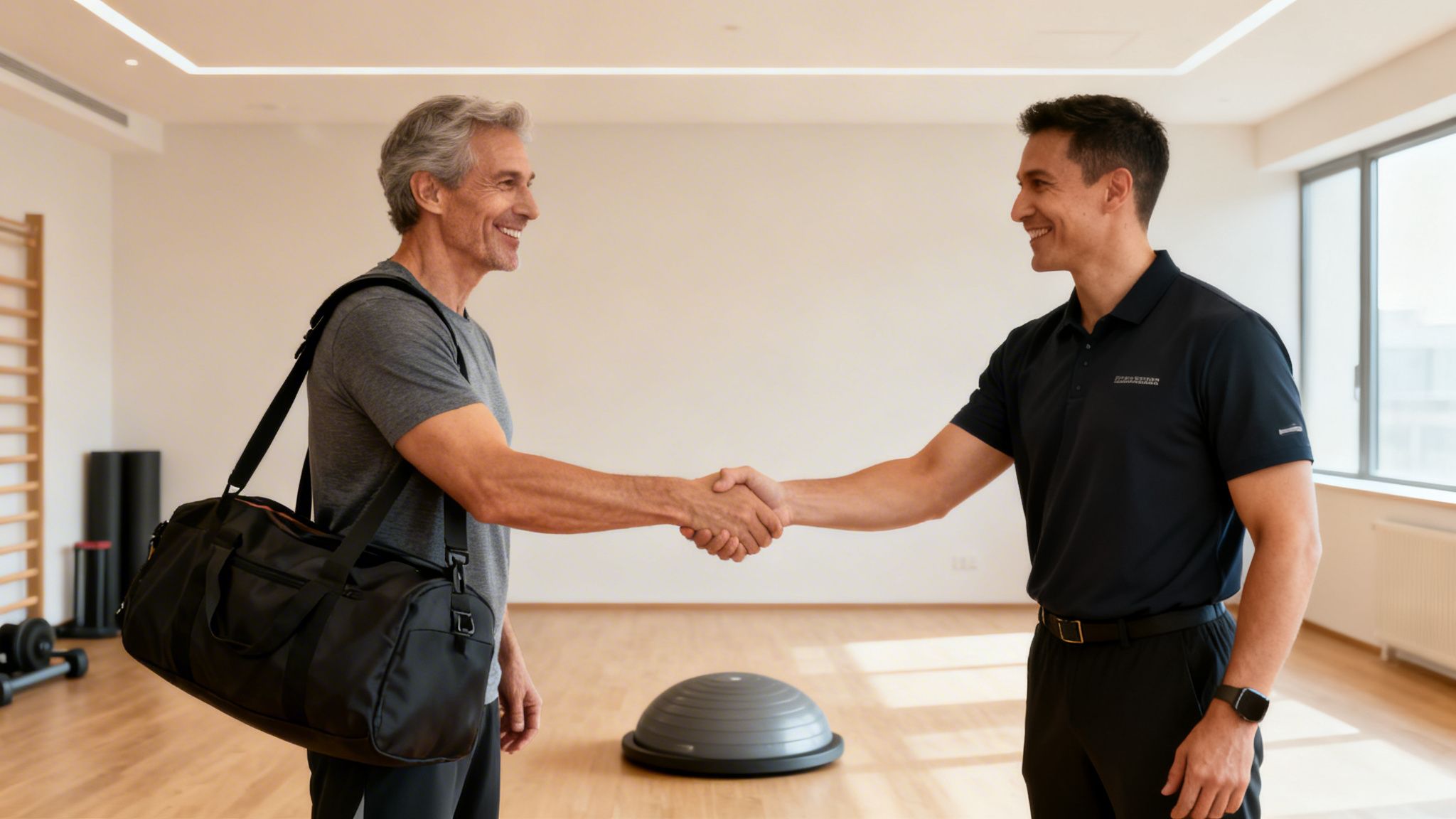
Let's be real. You're here because you want an answer that actually works. You're sick of the temporary fixes, the endless foam rolling, and the generic YouTube exercises that don't touch the real problem. Long-term results aren't about popping a pill or getting a quick adjustment; it’s about fixing the junk mechanics that are causing your instability in the first place.
If you're an active adult in South Jersey—whether you're hitting WODs in Marlton, playing golf in Mount Laurel, or running the trails in Cherry Hill—you know this dance. You get a treatment, feel okay for a day or two, and then—bam—the same old pain and shakiness come roaring back. It's time to stop chasing symptoms.
Your Body Deserves a Real Diagnosis, Not a Guess
You wouldn't put a high-performance engine in a car with a bent frame and expect it to win a race. So why are you trying to build strength on a body that's fundamentally unstable? Every single time you push through a workout with a faulty movement pattern, you're just reinforcing the very dysfunction that's causing your pain. The "aha" moment isn't finding a new stretch. It's finally understanding why you're unstable.
- Is it that old ankle sprain you never properly rehabbed, which is now making your hip and back pay the price?
- Is it a garbage core firing pattern that can’t stabilize your pelvis, turning every lunge into a wobbly mess?
- Is it poor mobility in your mid-back that's forcing your shoulder to do a job it was never designed for during an overhead press?
A generic list of "Top 5 Balance Exercises" can't answer these questions. You need a diagnostic approach that looks at your entire system to find the root cause. You need a plan built for your body, your history, and your goals.
This is where the mindset shifts from "How do I get rid of this pain?" to "How do I fix the movement problem creating this pain?" That shift is everything. It's the difference between being a victim of your pain and taking ownership of your body for long-term results.
Imagine What's Actually Possible
Seriously, think about it. Imagine hitting the gym without that nagging fear of a shoulder pinch. Imagine signing up for your next 10K in Moorestown or Haddonfield, confident that your knees won't betray you at mile 5. Imagine feeling powerful and athletic, not fragile and one wrong move away from another injury.
This isn't a fantasy. It's what happens when you commit to a movement-based plan that delivers real, long-term results. It’s about building a body that’s actually resilient and ready for whatever you throw at it. For those in Marlton, Mount Laurel, Cherry Hill, Moorestown, Haddonfield, Medford and all of South Jersey, this is your chance to break the cycle of pain. This is your chance to take back control.
At Valhalla Performance, we offer a different path. We don’t just put a Band-Aid on your pain; we find the root cause and give you the tools to fix it for good. If you're ready for answers and a personalized plan that works, it's time to act.
Schedule your Free Discovery Visit today and let's start building a stronger, more resilient you.