
When you're an active adult sidelined by an injury, hearing someone say "just rest and ice it" is enough to make you want to throw something. It’s the most frustratingly passive advice on the planet.
You know that getting back to your sport, whether it's CrossFit, weightlifting, or just hitting the gym, takes more than just sitting around and waiting for the pain to magically disappear.
A real comeback isn't about avoiding movement. It’s about systematically and intelligently rebuilding your body to be stronger and more resilient than it was before. This guide is for active adults dealing with persistent pain who are ready for a real solution, not another temporary fix.
Moving Beyond Rest and Ice for Injury Recovery
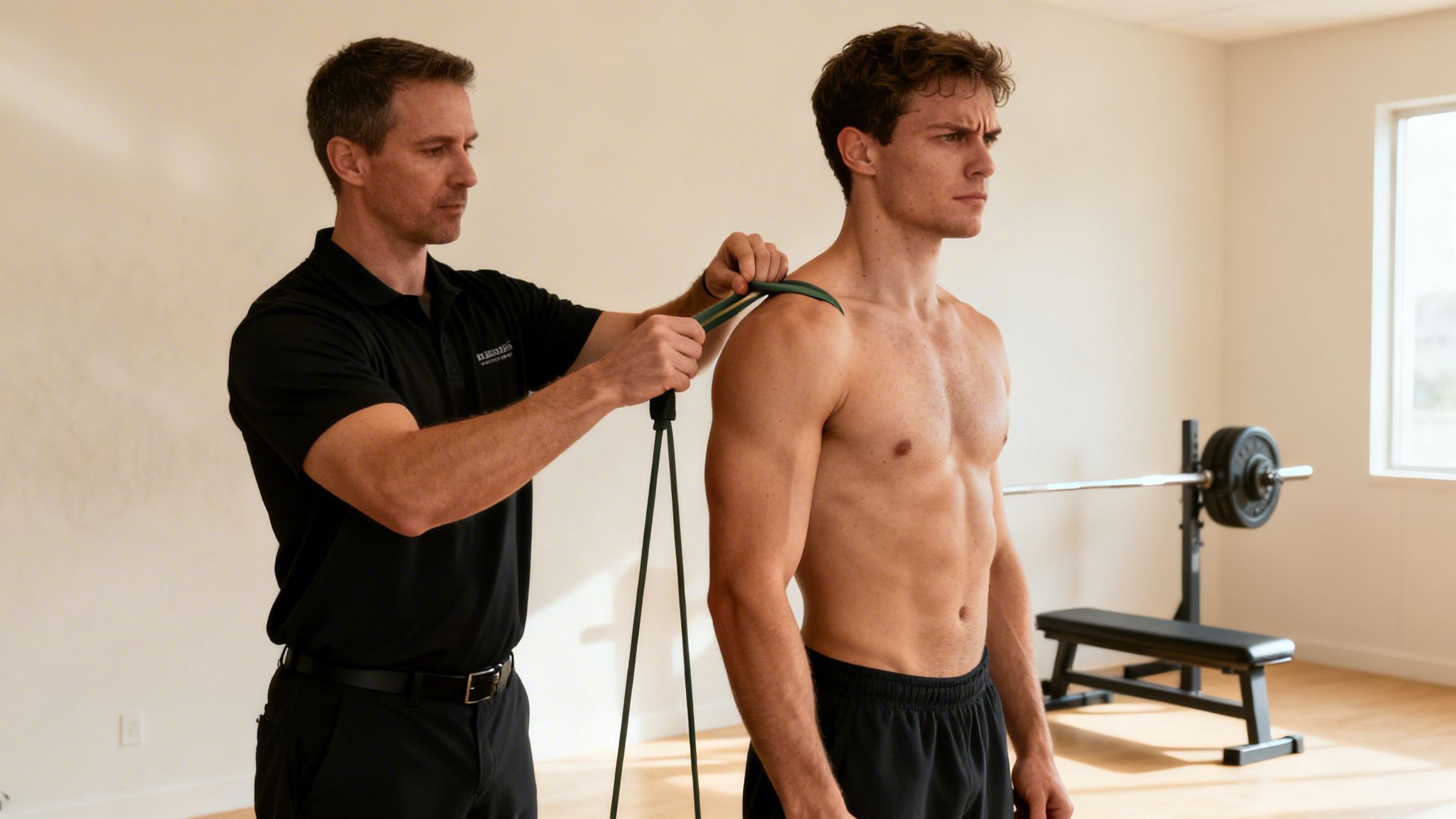
The old-school "rest and ice" model is a broken strategy for long-term results. Why? Because it only numbs the symptoms; it does absolutely nothing to fix the root cause of the problem.
This is exactly why so many active adults get trapped in a brutal cycle of re-injury. They rest, feel a little better, jump back into training too soon, and—BAM. They’re right back where they started, or worse.
The Problem With a Symptom-Based Approach
Let's use a practical example. You're a CrossFitter dealing with that nagging shoulder pain every time you press overhead. The typical, generic advice you'd get is garbage:
- Stop pressing for a few weeks.
- Ice your shoulder whenever it twinges.
- Pop some painkillers to get through your day.
This might give you some temporary relief, sure. But it doesn't solve a single thing. The pain isn't the problem—it's just a loud-mouthed signal that something else is seriously wrong with how your body moves.
Maybe your mid-back is as stiff as a board, preventing proper overhead motion. Maybe your shoulder blade has no idea how to move properly, or your rotator cuff lacks the strength to stabilize the joint under load. Until you identify and fix the "why," the pain will always come back.
True recovery isn’t about avoiding painful movements forever. It's about earning the right to perform them safely and confidently by building a body that can actually handle the stress you want to put on it.
A Smarter Path to Lasting Results
Modern return to sport physical therapy flips this entire script on its head. Instead of just waiting, we get active and strategic with movement-based rehab. This isn't about "rest" so much as it's about intelligent loading.
We find what your body can do without pain and use that as the foundation to rebuild from the ground up.
For that CrossFitter with the angry shoulder, we don't just tell them to stop pressing. We dig in, find the root cause—that stiff thoracic spine or those weak stabilizers—and build a plan to fix it. This process is all about active rehab that directly translates to better performance and bulletproof durability.
We believe that learning to train smart is the most critical part of any recovery, which is why we show our clients how lifting heavy things strategically can save your broken body. This philosophy is the key to getting you back in the game, not just pain-free, but stronger and more resilient than ever before.
If you’re in Marlton, Mount Laurel, Cherry Hill, Moorestown, Haddonfield, Medford, or anywhere in South Jersey and you're sick of temporary fixes, it's time for a different conversation. Stop chasing symptoms and start building a real, permanent solution by scheduling a Free Discovery Visit with our team.
Your First Step: The Comprehensive Movement Assessment

If you want a world-class recovery, you need a world-class diagnosis. Period. For any active person trying to get back to their sport, the initial assessment is the single most important step. This is where we stop chasing the ouch and start hunting down the real problem.
Forget those quick, five-minute exams that just poke the sore spot. A real assessment goes way beyond the site of your pain to investigate your entire body as one connected system. We need to find the root cause—the "why" behind your injury.
Uncovering The Real Villain
Think of your body like a kinetic chain. When one link is weak or rusty, another part of the chain takes a beating. This is exactly why a symptom-based approach fails so many active people.
Let’s take a weightlifter with nagging low back pain during squats. The problem might have nothing to do with the back itself. The real culprit is often hiding somewhere else:
- Weak Glutes: Your hip muscles are the powerhouse for stability. If they're not firing correctly, your low back can end up taking on load it was never meant to handle.
- Poor Ankle Mobility: Stiff ankles are a classic. If you can't achieve proper depth in your squat, your body may compensate by rounding your lower back, leading to pain and injury.
- A Stiff Mid-Back: If you can’t maintain an upright torso, your chest collapses, forcing your lower back to overextend and strain under the bar.
Without digging deep to find these movement faults, any relief you get is just temporary. The pain will come roaring back the second you ramp up your training because the underlying issue is still there, lurking. This is why our process always starts by looking at the big picture.
What a Root-Cause Diagnosis Looks Like
A quality assessment for an athlete is a deep dive into your movement, strength, and goals. It’s the blueprint for your entire return-to-sport physical therapy program, and it has to include a hard look at how you actually move.
At Valhalla Performance, we use systems like the One80 System® to screen your movement patterns from head to toe. This isn't about checking boxes; it's about seeing how your body solves movement problems in real time. We also run specific strength tests to smoke out asymmetries and weaknesses that put you at risk.
A diagnosis that only names the painful body part is incomplete. A true diagnosis explains why that body part became painful and gives you a clear plan to fix the root cause for good.
This detailed evaluation is critical. The data reveals a pretty stark truth: tons of athletes think they’re ready, but their bodies tell a different story. One study showed that only 26% of athletes actually pass comprehensive return-to-sport tests on their first try. The other 74% show persistent strength and movement deficits.
These findings prove why rushing back to your sport without hitting objective goals is one of the biggest predictors of re-injury. You can see more about how criterion-based screening is revolutionizing physical therapy and patient outcomes on True Sports Physical Therapy.
This upfront investment in a proper assessment allows us to build a program that is 100% yours. We don’t do generic templates because your body, your injury, and your goals aren't generic. You can learn more about how we design custom treatment plans to maximize your recovery and build long-term resilience.
If you're an active adult in Marlton, Mount Laurel, Cherry Hill, Moorestown, Haddonfield, or Medford and you're ready for a real diagnosis and a permanent solution, your journey starts here. Take the first step and schedule your Free Discovery Visit with us today.
The Four Phases Of A Successful Return To Sport

Making a comeback from an injury isn't a race. It's not about circling a date on the calendar and hoping for the best. A real comeback is a strategic mission, broken down into clear stages. Instead of guessing, we use a phased, movement-based approach with objective goals to make sure you’re not just feeling better, but are genuinely ready for the demands of your sport.
This methodical progression is the heart of effective return to sport physical therapy. It’s about rebuilding your body's capacity, one layer at a time, so you return stronger and more resilient than you were before you got hurt. Each phase builds on the last, slowly adding stress and complexity until you’re back to 100%.
Let’s walk through this with a real-world example: a CrossFit athlete recovering from a tweaked back during deadlifts. This same framework applies just as easily to a runner with a nagging knee or a soccer player nursing an ankle sprain.
Phase 1: Quiet Things Down, Start Moving Well
Right after an injury, the goal isn’t to be a hero and push through the pain. It’s to calm the angry tissues down and get back to basic, pain-free movement. This is where we lay the foundation for everything to come. Think less about getting strong and more about restoring quality movement and reminding the body it's safe to move.
For our CrossFit athlete with the bad back, this phase looks like:
- Restoring Pain-Free Patterns: Gentle movements like cat-cows and bird-dogs to re-establish core control and spinal movement without pain.
- Waking Up the Support Crew: Simple drills like glute bridges and core bracing to make sure the hip and abdominal muscles—the ones that protect the spine—are actually firing.
- Hands-On Work: Using manual therapy to improve how the joints in the spine and hips move and to reduce muscle guarding.
Trying to build strength on a dysfunctional foundation is a recipe for re-injury. This first phase makes sure the surrounding joints can move like they’re supposed to and the supporting muscles are awake before we even think about adding weight.
Phase 2: Build Real-World, Foundational Strength
Once the pain is manageable and you have your basic movement patterns back, we shift gears. Now it's time to build back raw, usable strength. This is where we re-establish a solid base of control and support, moving from simple activation drills to loaded exercises that start looking like actual gym training.
This is the step everyone wants to rush. But you have to earn the right to be explosive by first proving you can control your body through foundational strength patterns.
Our CrossFit athlete’s progression now involves:
- Mastering the Hip Hinge: Practicing Romanian Deadlifts (RDLs) with light weight to perfect the movement pattern of a deadlift without stressing the low back.
- Building Core Stiffness: Doing loaded carries like farmer's walks and suitcase carries to build full-body tension and a rock-solid core.
- Strengthening the Posterior Chain: Goblet squats and hip thrusts to build the glute and hamstring strength needed to support heavy lifts.
For more on this, check out some of our effective strength and conditioning rehab strategies for sports injuries.
True strength isn’t just about how much weight you can move. It’s about how well you can control that weight through a full range of motion. This is the bedrock of athletic durability and long-term results.
This is precisely why a structured, goal-driven plan works. One study of 216 athletes found that a tailored rehab program led to a staggering 63.89% successfully returning to sport, with 86.11% seeing a major drop in pain. Even better, only 8.80% got re-injured. That’s the power of building a safe path back to competition instead of just guessing.
Phase 3: Develop Power and Sport-Like Speed
You’ve built your strength base. Now it's time to add speed back into the equation. This phase is the bridge between the controlled environment of the gym and the unpredictable demands of your sport. We bring in plyometrics and sport-specific drills to retrain your body to produce and absorb force—fast.
The goal here is to get your muscles and tendons ready for the explosive, reactive nature of competition. For our CrossFit athlete, this is where it starts to get fun again:
- Jumping and Landing: Starting with box jumps to rebuild explosive power and, just as importantly, safe landing mechanics to absorb impact.
- Explosive Hinging: Introducing kettlebell swings to practice a fast, powerful hip hinge that translates directly to Olympic lifts and deadlifts.
- Medicine Ball Throws: Using rotational and overhead throws to bring back that full-body power production.
A weightlifter with a shoulder injury might start re-learning the "jerk" with just an empty bar, focusing on speed and snappy technique, not load. This phase is all about teaching the nervous system to be fast again.
Phase 4: Get Back in the Game, Unrestricted
This is it—the final transition back to full-contact, unrestricted activity. At this point, your training should look almost identical to your sport. We’re re-integrating sport-specific skills under fatigue, pushing the intensity, and making sure your body can handle the exact demands you’re about to throw at it.
Think of it as the final stress test. Our CrossFit athlete will start slowly adding heavy deadlifts or complex Olympic lifts back into WODs, paying close attention to how their body responds under fatigue. A soccer player will now be in non-contact drills, then controlled scrimmages, and finally, be cleared for a full game.
Progressing through these phases isn't about time; it's about hitting objective milestones. If you're an active adult in Marlton, Mount Laurel, Cherry Hill, Moorestown, Haddonfield, or Medford and you're sick of being stuck in the injury loop, this methodical, movement-based approach is your way out. Schedule your Free Discovery Visit at Valhalla Performance, and let's build your personalized roadmap back to the top.
How To Know When You Are Truly Ready To Return
So, you’ve put in the work. The pain is gone, you’re feeling stronger, and that date your surgeon circled on the calendar six months ago has finally arrived. Time to jump right back into the game, no questions asked, right?
Not so fast.
Relying on a calendar to clear you for action is one of the most outdated and dangerous ideas in sports recovery. It’s a passive approach that completely ignores the only question that matters: is your body actually capable of handling the demands of your sport again?
This is where modern return to sport physical therapy draws a hard line in the sand. We don't guess; we test. A safe return for long-term results is built on objective, performance-based data, not just watching the clock.
Ditching The Calendar For Cold, Hard Data
The old way of thinking—the time-based approach—is exactly why so many active adults end up re-injured within months of their “comeback.” It runs on the flawed assumption that everyone’s tissues heal at the same predictable rate.
The modern, criterion-based model is a total game-changer. It says you're ready when, and only when, you can prove you have the physical capacity your sport demands. This means passing a battery of tests that measure your strength, power, and stability with hard numbers.
Think about it: a weightlifter recovering from a knee injury shouldn't just be cleared after 12 weeks. They need to prove their quad strength on the injured leg is at least 90% of the strength of their good leg. Anything less, and you're just begging for a compensation pattern that leads straight to another injury.
What Does Objective Testing Actually Look Like?
These aren't random gym exercises; they are specific, measurable tests designed to expose any weak link still hiding in the chain. Passing them gives you both the physical readiness and, just as importantly, the psychological confidence to go all out without holding back.
Common objective tests we use include:
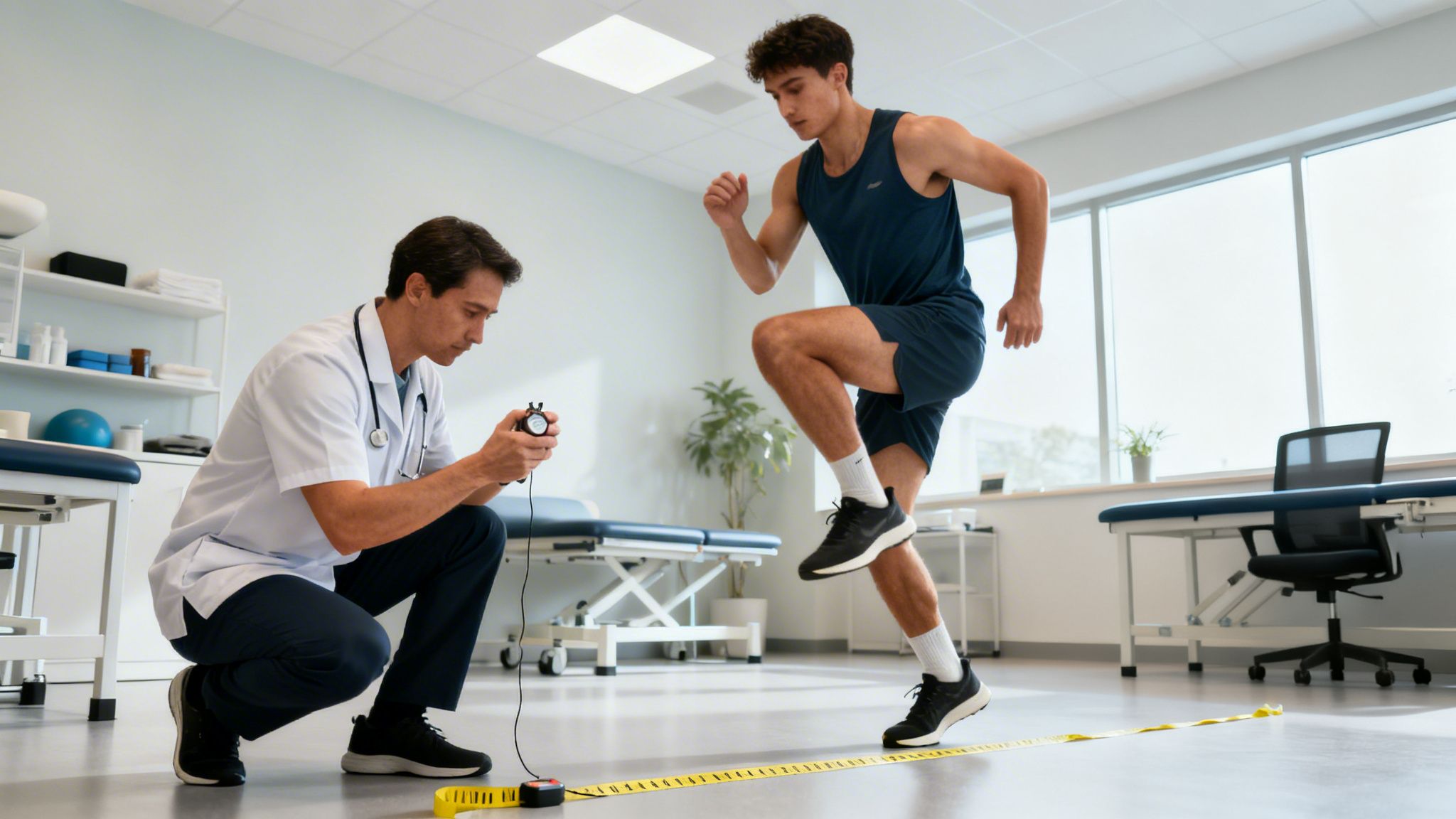
- Limb Symmetry Index (LSI): This is a huge one. We compare the performance of your injured limb to your uninjured one. For something like a single-leg hop for distance after a knee injury, we want to see that injured leg hit at least 90-95% of the distance of your good leg. No cheating.
- Strength Testing: We use dynamometers and rep-max testing to get undeniable numbers on muscle output. A soccer player with a nagging hamstring strain needs to show symmetrical strength in hamstring curl tests before they even think about sprinting again.
- Movement Quality Under Fatigue: Can you still nail a perfect landing or hold your form when you’re gassed? We test this because most non-contact injuries happen when you’re exhausted and your form breaks down.
A massive side benefit here is confidence. You aren't just hoping you're ready; you know you are because you've seen the proof in your test results. You can find some great movements to prep for these demands in our guide to a perfect dynamic stretching routine.
The shift to criterion-based clearance isn't just a trend; it's a fundamental change in how we define "ready." The numbers don't lie, and they are your best defense against re-injury.
And the data backs this up, big time. One incredible study on athletes post-ACL reconstruction found that a program using objective clearance criteria saw a staggering 84% of them return to their pre-injury sport level. This completely demolishes the typical return-to-sport rates of less than 50% seen in broader studies. As you can discover in the full study on criterion-based rehab, basing readiness on performance—not a clock—gets insanely better results.
Time-Based vs. Criterion-Based Return To Sport
The difference between hoping you're ready and knowing you're ready is everything. Let's put the old way up against the Valhalla way.
| Factor | Time-Based Approach (Old Way) | Criterion-Based Approach (The Valhalla Way) |
|---|---|---|
| Clearance Driver | Calendar dates (e.g., "6 months post-op") | Passing objective performance tests (e.g., >90% limb symmetry) |
| Focus | Passive healing and waiting for pain to disappear | Actively rebuilding strength, power, and bulletproof movement |
| Athlete Confidence | Based on hope and the absence of pain | Based on proven, measurable data and physical competence |
| Re-Injury Risk | High, due to unaddressed functional weakness | Significantly lower, because functional capacity is restored and tested |
At the end of the day, you can't fake strength. You can't fake stability. And you can't fake readiness.
If you're an active adult in Marlton, Mount Laurel, Cherry Hill, Moorestown, Haddonfield, or Medford, and you're tired of the guesswork, it's time to demand a better standard. Stop wondering if you're ready and start proving it. Schedule your Free Discovery Visit at Valhalla Performance today and let's build your path back to peak performance, backed by data.
Your Path to Dominating, Not Just Participating, in South Jersey
This is it. This is where your comeback story gets written. We've torn down the flimsy, outdated models and shown you what a real recovery looks like: an active, intelligent, and deliberate process built for long-term results.
If you're an active person in South Jersey who's sick and tired of being sidelined by pain that just won't quit, consider this your wake-up call. Stop listening to anyone who tells you to just "wait and rest." That's a one-way ticket to getting weaker, developing bad habits, and having the same damn injury pop up again in a few months.
Why Your Comeback Starts With Us
That vicious cycle of getting hurt, resting, feeling a little better, and getting hurt all over again? It's exhausting. It murders your confidence and makes you wonder if you'll ever hit a new PR, run a race, or just play your sport without that voice in the back of your head screaming "don't move that way!"
At Valhalla Performance, we exist to shatter that cycle. We specialize in return to sport physical therapy built for people who don't just want to be "pain-free"—they want to be dominant.
Our philosophy is brutally effective:
- Find the real "why" behind your pain. We do this with a deep-dive movement assessment to find the root cause, not by just poking the spot that hurts and guessing.
- Build you back stronger than before. You'll get a personalized, movement-based plan that forges real strength and resilience, not just temporary relief.
- Give you cold, hard proof that you're ready. We use objective, data-driven testing so you can get back in the game with 100% confidence, not just wishful thinking.
Your body doesn't need more rest; it needs a smarter plan. It needs to be systematically reloaded and retrained to handle the hell you want to put it through. This is how you build a body that's genuinely bulletproof.
Stop Guessing. Start Building.
Think about the weightlifter who can't press overhead without that searing shoulder pain. Or the CrossFit athlete whose back lights up during every deadlift. The answer isn't to just avoid those movements for the rest of your life. The answer is to earn the right to do them again by fixing the broken movement patterns and building the rock-solid foundation to support them.
This is the very core of what we do. We combine expert manual therapy with progressive strength and conditioning into a single, seamless plan that attacks your specific goals. You can see exactly how we blend these powerful tools by checking out our performance and recovery services.
We work with driven adults every single day from Marlton, Mount Laurel, Cherry Hill, Moorestown, Haddonfield, Medford and all over the region to get them back to the things they're passionate about. Our one-on-one sessions guarantee you get the focused, expert attention you need to see real, permanent results.
An Invitation to a Real Solution
If you're ready to break the endless loop of frustration and take command of your recovery, the next step couldn't be simpler. It's time to talk about your goals and see if our way of doing things is the answer you've been looking for.
We invite you to schedule a Free Discovery Visit at our clinic. There's zero obligation and zero pressure. It's your chance to talk one-on-one with a Doctor of Physical Therapy, finally understand the root cause of your problem, and see a clear path forward. If you’re an active adult in Marlton, Mount Laurel, Cherry Hill, Moorestown, Haddonfield, Medford, or South Jersey, this is your first step.
Stop waiting for the pain to magically disappear. It won't. Take the first real step toward becoming stronger and more resilient than you were before. Let's build your plan to get you back in the game—for good.
Your Questions, Answered (The No-BS Edition)
When you're trying to get back in the game after an injury, you've got questions. And you deserve straight answers, not a bunch of medical jargon and vague timelines. Here's the stuff people ask us all the time.
How Long Until I’m Back to 100%?
This is always question number one. The honest answer? It depends on your performance, not the calendar.
We threw outdated, time-based deadlines in the trash a long time ago. Instead, we use a criterion-based approach. You only "graduate" to the next phase—or get cleared for your sport—when you can prove you’ve hit specific, objective strength and movement goals. It's that simple.
A weightlifter with a back injury, for instance, has to show us they can hold a rock-solid brace and lift a certain percentage of their old max with perfect form before they even think about pulling heavy from the floor again. Your timeline is dictated by the injury, how hard you work, and how fast your body adapts—not by a date someone pulled out of thin air.
What Makes You Different From the Last Place I Went To?
A lot of people come to us fed up with the typical clinic experience—you know the one. Short visits, a generic sheet of exercises, and getting passed off to an aide who watches you count reps.
We are the exact opposite. You get true one-on-one care with a Doctor of Physical Therapy for the entire session, every single time. We blend expert manual therapy with a serious strength and conditioning mindset. We don’t just poke the spot that hurts; we fix the reason it started hurting in the first place by finding the root cause.
Our goal is to deliver a permanent solution, not a temporary band-aid.
We use comprehensive diagnostic frameworks like the One80 System® to analyze your movement from head to toe. This is how we build a program that doesn't just get you out of pain—it builds a more resilient, higher-performing body that's damn hard to break.
This is the key to finally ending that frustrating cycle of getting hurt over and over again. We're not chasing symptoms. We're building you back stronger so you can get back to CrossFit, lifting, or running with total confidence.
Do I Need to See a Doctor First?
Nope. In New Jersey, direct access laws mean you can come see a physical therapist without a physician's referral.
This is huge for active people because it means no more waiting around while the problem gets worse. You can take action right now and get a head start on your recovery.
The easiest first step is to book a Free Discovery Visit. It’s a no-pressure chat where you can meet us, tell us what’s going on, and see if our approach is the right fit. No commitment, no strings attached. Just a real conversation about your goals.
If you live in Marlton, Mount Laurel, Cherry Hill, Moorestown, Haddonfield, Medford, or anywhere else in South Jersey and you’re ready for a permanent solution to your pain, we’re here to help. At Valhalla Performance, we build warriors. We’ll create the plan to get you back to the activities you love, stronger and more bulletproof than before.
Take the first step. Schedule your Free Discovery Visit today at thevalhallaperformance.com.