
If you're an active adult between 25 and 55 dealing with nagging pain or a frustrating injury, someone has probably told you to “stretch more.” But what if the way you’re stretching isn't just unhelpful—what if it's actually making things worse?
Let’s be honest: the classic advice to grab an ankle and hold a static stretch before your gym session, CrossFit WOD, or run is outdated. For many of us struggling with chronic pain, it’s downright counterproductive to long-term results.
Why Your Old-School Warm-Up Is Killing Your Gains
Think of a cold muscle like a stiff, frozen rubber band. Just yanking on it does nothing to prepare it for the explosive demands of a heavy squat or a tough workout. It’s temporary relief at best, and at worst, it ignores the real reason you feel tight in the first place.
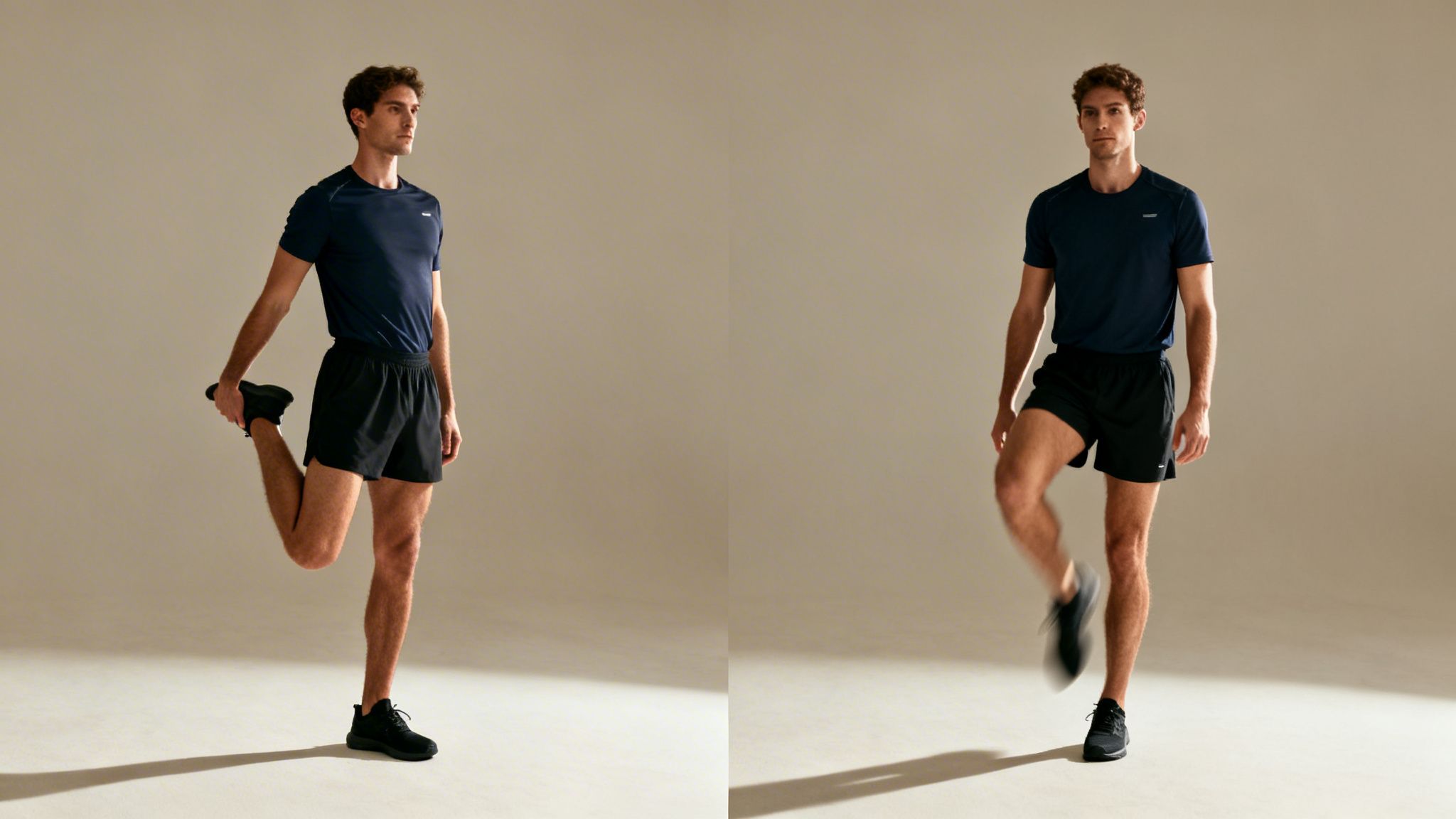
In fact, holding a static stretch before you train can send a signal to your nervous system to relax and lengthen the muscle. This can actually decrease its ability to produce force. That's the exact opposite of what you need when you're about to lift, jump, or sprint. It's a temporary fix that masks the underlying problem.
From Static Holds to Smart Movement
A dynamic stretching routine works completely differently. It’s about active, movement-based preparation to prime your body for what’s to come. Instead of holding a pose, you're actively moving, which accomplishes several critical tasks for long-term health:
- It cranks up your core temperature. Active movements generate heat, making your muscles more pliable and less prone to strain.
- It boosts blood flow. More blood means more oxygen delivered to your working muscles, getting them ready for the battle ahead.
- It wakes up your nervous system. This is a wake-up call for your mind-muscle connection, improving coordination and stability.
This is about preparation, not just chasing a temporary feeling of looseness. A weightlifter doing leg swings before a heavy deadlift is actively rehearsing the motion of hip extension. That's a whole lot more useful for preventing a back injury than sitting on the floor holding a hamstring stretch for 30 seconds.
The goal of a warm-up isn't just to get loose; it's to get ready. A dynamic routine prepares your body for the specific patterns of your workout, addressing the root causes of movement restriction rather than just chasing a feeling.
Power Up, Don’t Power Down
The science backs this up. A 2018 study put static and dynamic stretching head-to-head to see how they affected athletic power. The results were crystal clear: a dynamic stretching routine led to a significant improvement in power output. Static stretching, on the other hand, showed zero benefit and even trended toward a decrease in performance.
Here’s a quick comparison of the goals and outcomes of dynamic versus static stretching when performed before physical activity.
| Attribute | Dynamic Stretching (Movement-Based) | Static Stretching (Holding Poses) |
|---|---|---|
| Primary Goal | Prepare body for activity; improve performance | Increase resting flexibility; cool down |
| Effect on Power | Increases power and strength output | Can decrease power output temporarily |
| Muscle Temperature | Increases muscle and core temperature | Little to no effect on muscle temperature |
| Nervous System | Activates and "wakes up" the nervous system | Calms the nervous system; signals relaxation |
| Best Time to Use | Before workouts, sports, and intense activity | After workouts or on rest days for flexibility |
As you can see, the two methods have completely different intentions. One gets you ready to perform, and the other helps you cool down and relax. Using the wrong one at the wrong time can hold you back and mask the real reasons you feel stiff or get injured.
This is why we focus on movement-based rehab. Instead of just treating symptoms, we work to build a more resilient and prepared body. If you feel like you're stuck in a cycle of warming up but still feeling stiff or getting hurt, it’s time to change your approach. A smart dynamic warm-up, similar to how we strategically prescribe lifting heavy things to build a more robust body, is a game-changer for long-term results.
If you’re in Marlton, Mount Laurel, Cherry Hill, Moorestown, Haddonfield, Medford, or anywhere in South Jersey and are tired of quick fixes that don’t last, we can help. Schedule a Free Discovery Visit with us at Valhalla Performance to find the root cause of your pain and build a plan that actually works.
The Science Behind a Smarter Warm-Up
If you’re still slogging through the first 15 minutes of every workout feeling stiff, creaky, and unprepared, your warm-up is broken. It’s time to stop just “getting loose” and start understanding what’s actually happening inside your body when you prepare for battle.
A real warm-up does more than just make you feel warm. It fundamentally rewires how your body handles stress, and knowing the "why" is the key to building a truly resilient machine that doesn't just feel better, but is better.

When you kick off a dynamic stretching routine, you're not just flopping your limbs around. You're triggering a powerful chain reaction that optimizes your body for performance and drastically cuts your injury risk by addressing movement deficits head-on.
Boosting Your Engine Temperature
The first thing that happens is your core muscle temperature climbs. Think of your muscles and tendons like cold taffy—stiff, brittle, and ready to snap. Active, controlled movements generate heat from the inside out, making those tissues pliable and ready for action.
This matters. A lot. It means your muscles can produce and absorb force without fighting you every step of the way. For a weightlifter in Cherry Hill, that’s the difference between hitting a smooth, deep squat and having your hips and ankles scream in protest. For a runner in Medford, it means hamstrings that glide, not pull.
A warm muscle is a responsive muscle. Dynamic stretching isn't just about feeling warmer; it's about making your muscles physically more capable of handling the demands of your workout, which is the first line of defense against common strains and pulls.
Waking Up the Brain-to-Muscle Hotline
Beyond just heating things up, a dynamic warm-up is a wake-up call for your nervous system. We call it neuromuscular activation, but you can think of it as flipping the "on" switch for your entire body.
Every leg swing, every torso twist sends a direct message from your muscles to your brain and back again. It strengthens the pathways that control your coordination, power, and stability. You’re essentially giving your brain a preview of the main event, telling it which muscle fibers to recruit and when to fire them.
This is exactly why a CrossFit athlete doing inchworms and thoracic rotations before a WOD feels more "locked in" during their overhead lifts. They’ve already rehearsed the patterns, telling their body precisely how to stabilize the load. It’s a targeted rehearsal, not a passive stretch.
The Real Payoff: Gains That Actually Last
This is where dynamic stretching leaves old-school static stretching in the dust. We’re not chasing a temporary feeling of looseness; we’re building lasting change by preparing the body to move correctly.
The research backs this up. One study showed that after a dynamic stretching protocol, athletes saw huge increases in their range of motion and a drop in muscle stiffness. The best part? These improvements lasted for up to 60 minutes after they were done. For athletes in sports where tight hamstrings contribute to up to 16% of all injuries, that kind of sustained readiness is a game-changer. You can dig into the findings on dynamic stretching here.
This is the core of our philosophy at Valhalla Performance. We don’t do temporary fixes. We build real, measurable improvements in movement that fix the root cause of your pain and limitations. We’re in the business of creating a body that’s not just ready for today, but more bulletproof for every day that follows.
If you’re in Marlton, Mount Laurel, or anywhere in South Jersey and you're tired of warm-ups that feel like a waste of time, you need a smarter plan. We invite you to schedule a Free Discovery Visit to see how a program built for your body can deliver long-term results and get you back to crushing it, pain-free.
Your Foundational Dynamic Stretching Routine
Alright, enough theory. Let's get to the part that actually matters—the doing. This is a foundational dynamic stretching routine designed to wake your body up before you hit a heavy lift at a Marlton gym or step onto the field for a weekend soccer game in Medford.
This isn’t about just mindlessly swinging your limbs around. We’re targeting the big troublemakers for active adults with persistent pain: the hips, hamstrings, glutes, spine, and shoulders.
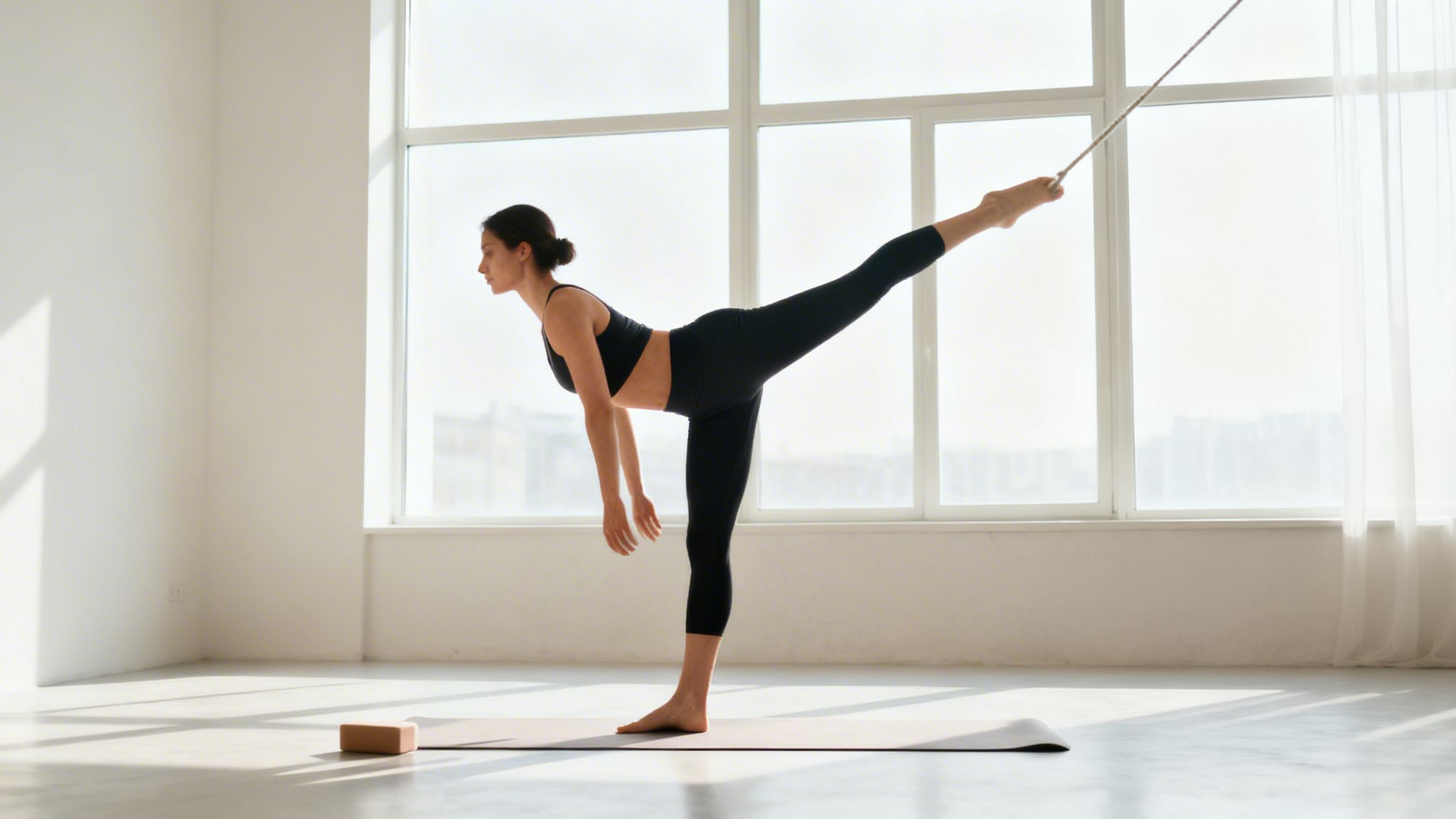
The name of the game is controlled, intentional movement. Speed is not the goal. Every single rep is a message to your brain and muscles, telling them it's time to get to work.
Leg Swings (Forward & Back)
This is a classic for a reason. Leg swings are fantastic for opening up the hips and firing up the hamstrings and glutes without causing lower back pain.
- How to do it: Stand next to a wall or squat rack for support. Lock in your core, keep your torso upright, and swing one leg forward and backward like a pendulum. The movement has to come from your hip, not from arching your back.
- Pro Cue: Picture a steel rod running from the top of your head down through your standing leg. That part of your body doesn't move. Only the swinging leg does. This stops you from cheating by borrowing momentum from your spine.
- Target: Hamstrings, glutes, and hip flexors.
- Reps: Go for 10-15 swings on each leg.
Leg Swings (Side-to-Side)
Now we switch planes. This movement wakes up the muscles on the inside and outside of your hips—the ones that keep you stable when you squat, lunge, or make sharp cuts in sports.
- How to do it: Face the wall, both hands on it for balance. Swing your leg side-to-side across the front of your body. Again, the movement has to start from the hip.
- Pro Cue: Keep your hips pointing straight at the wall. It's tempting to twist your body to get more range of motion, but that completely defeats the purpose. We’re working on hip mobility here, not spinal rotation.
- Target: Hip adductors (inner thigh) and abductors (outer hip/glute medius).
- Reps: Aim for 10-15 swings per leg.
The single biggest mistake I see with dynamic stretching is people rushing. Your goal isn't to see how fast you can flail your limbs. It’s to actively move your joint through its full, comfortable range of motion. Slow down. Own the movement.
Cat-Cow
Your spine needs to be able to move before you ask it to handle heavy loads from weightlifting or the demands of sport. Cat-Cow is a simple but powerful way to get each segment of your thoracic and lumbar spine moving. This is non-negotiable if you sit at a desk or deal with back stiffness.
- How to do it: Get on your hands and knees. Inhale, drop your belly toward the floor, and look up, arching your back (Cow). Exhale, round your spine up to the ceiling, and tuck your chin to your chest (Cat).
- Pro Cue: Try to move one vertebra at a time, like a wave starting at your tailbone and rippling all the way to your neck. This promotes real spinal segmentation instead of just hinging from one or two stiff spots.
- Target: Spinal erectors, abs, and lats.
- Reps: Flow through 8-10 full cycles.
Thoracic Spine Rotations
So many of us are locked up in our upper backs, which is a fast track to shoulder and neck pain. These rotations specifically attack that stiffness, improving your ability to twist and extend—key for overhead lifts in CrossFit, throwing, or just reaching for something on the top shelf without wincing.
- How to do it: From the same hands-and-knees position, put one hand behind your head. Rotate that elbow down toward your opposite wrist. Then, open it all the way up toward the ceiling, letting your eyes follow your elbow.
- Pro Cue: Your hips and lower back should stay rock-solid. Brace your core like you're about to take a punch. This isolates the rotation to your upper back, which is exactly where we want it.
- Target: Thoracic rotators, rhomboids, and obliques.
- Reps: Do 8-10 rotations on each side.
This is a great starting point, but a warm-up is just one piece of the puzzle. To really bulletproof your body, you can dig deeper into our guide on how to avoid becoming a human pretzel and prevent common sports injuries.
Shoulder Pass-Throughs
If you do any CrossFit, weightlifting, or sport that requires healthy shoulders, this is a must. It greases the grooves of the shoulder joint and warms up the entire shoulder girdle, addressing a common source of pain.
- How to do it: Grab a PVC pipe or a resistance band with a wide grip. Keeping your arms straight, bring the pipe from in front of your hips up, over your head, and down to touch your back. Then reverse the motion back to the start.
- Pro Cue: Don't let your ribcage flare out when the pipe goes overhead. Squeeze your glutes and keep your abs tight to maintain a stable core. If you feel a sharp pinch or have to bend your elbows, your grip is too narrow—widen it.
- Target: Pecs, lats, and the entire shoulder capsule.
- Reps: Complete 10-12 slow, controlled reps.
This routine is a solid foundation. But listen to your body. If you feel a sharp pinch or real pain during any movement, stop. Pain is a signal, not a challenge. Pushing through it is a recipe for disaster and a clear sign the issue isn't tightness.
If you’re dealing with nagging pain that won’t go away no matter how much you warm up, it’s a sign that the root cause is still hiding. For our neighbors in Marlton, Mount Laurel, Cherry Hill, Moorestown, Haddonfield, Medford, and greater South Jersey, let's find it. Schedule a Free Discovery Visit. We'll have a real conversation about what's going on and build a battle plan to get you moving pain-free for good.
Customizing Your Routine for Specific Goals
That foundational routine we just covered? It's a great starting point. But a one-size-fits-all approach is a recipe for mediocre results and recurring injuries. Real, long-term success happens when you stop following a generic checklist and start tailoring your warm-up to your specific goals, activities, and the nagging aches you’ve been ignoring.
Think of your warm-up as a diagnostic conversation with your body. Where are you feeling tight? What’s restricted? The answers tell you exactly where to focus. This is how you turn your warm-up into a precision tool for movement-based rehab.

For the Weightlifter or CrossFit Athlete
If you live under a barbell, your success and safety hinge on your ability to access a full range of motion in your hips, shoulders, and thoracic spine. A generic warm-up just won’t cut it when you’re chasing a PR in the snatch or trying to bury a heavy squat without pain.
Your top priority is prying open the joints that take a beating during heavy lifts. We need to add drills that directly prep you for those demands.
Add these to your arsenal:
- Deep Squat with T-Spine Rotation: Drop into a deep "goblin" squat, shoving your elbows inside your knees. Plant one hand on the floor and rotate the other arm up to the ceiling, letting your eyes follow. This move is a two-for-one, unlocking your hips and upper back simultaneously.
- Walking Spiderman with Rotation: This is a powerhouse. Lunge forward, placing both hands on the floor inside your front foot. Now, rotate your torso and reach the arm on the same side as your lead leg toward the ceiling. You'll hit your hip flexors, groin, and thoracic spine all in one go.
For lifters, mobility is armor. A stiff thoracic spine forces your shoulders to compensate during an overhead press, leading to impingement. Tight hips stop you from hitting depth in a squat, which puts a ton of nasty stress on your lower back. Your dynamic routine is your first step in diagnosing and fixing these root-cause issues.
For the Runner or Field Sport Athlete
Whether you're pounding the pavement around Medford or playing soccer in Cherry Hill, your performance is all about generating efficient, powerful strides. Your enemies are tight hamstrings, sleepy glutes, and locked-up hip flexors—the unholy trinity behind most running injuries.
Your warm-up needs to wake up your posterior chain and get your legs ready to both absorb and produce force.
Add these essentials to your routine:
- Glute Bridges: Lie on your back, knees bent. Drive through your heels and squeeze your glutes hard to lift your hips skyward. This is non-negotiable for firing up the engine that powers your running and jumping and countering chronically tight hips.
- High Knees & Butt Kicks: These classics are classics for a reason. They prime the exact muscles you need for sprinting. Focus on a quick, springy contact with the ground, not just flopping your legs around.
This kind of targeted prep isn't just theory—it gets results. A 2012 study on male soccer players found that a sport-specific dynamic stretching routine over eight weeks led to major gains in squat jump height (up to 5.3%) and hip flexibility (up to 57.6%) without losing speed. For any athlete, that’s a massive competitive edge. You can see how the study connected this work to power gains.
For the Desk Worker with Back and Neck Pain
If you spend your days chained to a desk, your body is losing a war against gravity and bad posture. Your hip flexors get short and tight, your glutes check out, and your upper back rounds forward into that familiar hunch that creates chronic neck and back pain.
Your dynamic routine needs to be a rescue mission. The goal is to gently reintroduce movement to all the areas that have been stuck in a postural prison all day.
Focus on these gentle-but-mighty movers:
- Wall Slides: Get your back against a wall and bring your arms up into a "goalpost" position. Slowly slide your arms up the wall, fighting to keep your elbows and wrists in contact with it. This is your number one weapon against forward-slumped shoulders.
- Standing Hip Flexor Stretch: Forget aggressive lunges on the floor. Use a gentle standing version. Step one foot back, gently tuck your pelvis under (think "tuck your tail"), and squeeze the glute of your back leg until you feel a light stretch in the front of your hip. It's safer and more targeted for reversing desk posture.
This targeted, problem-solving approach is the cornerstone of our strength and conditioning rehab programs. We don't hand out generic exercise lists. We find the root cause of your limitation and build a plan to attack it head-on for long-term results.
If you’re in Marlton, Mount Laurel, Cherry Hill, Moorestown, Haddonfield, Medford, or anywhere in South Jersey and feel like your current routine is just spinning its wheels, it’s time for a change. Schedule your Free Discovery Visit at Valhalla Performance today. Let’s have a real conversation about your goals and build a plan that actually delivers the results you deserve.
What To Do When Your Warm-Up Isn’t Enough
A solid dynamic stretching routine is a fantastic tool. It gets your body ready for action, slashes your injury risk, and can absolutely boost your performance.
But let’s be real—sometimes, a great warm-up just isn’t the answer.
If you’re diligently doing your leg swings and thoracic rotations but that same old pinch in your shoulder or ache in your lower back keeps crashing the party, it’s a massive red flag. It’s telling you the problem isn’t your prep work; it’s that the real, underlying issue—the root cause—is still hiding out.
When Your Warm-Up Waves a Red Flag
Think of your dynamic warm-up as a truth serum for your body. When you move through a range of motion and feel pain, a block, or that wobbly, unstable feeling, your body is sending you a crystal-clear signal. The warm-up isn't failing you—it's doing its job by exposing a weak link in the chain.
Ignoring these signals is one of the fastest ways to turn a minor annoyance into a full-blown, sidelined-for-months injury. Pushing through that pinch during a shoulder pass-through or a sharp twinge in a deep squat is like slapping duct tape over your car's check engine light. You might get a little further down the road, but a breakdown is inevitable.
Pain during your warm-up isn't a sign to stretch harder. It’s a sign to stop guessing and start investigating. The pain is just the symptom, not the cause. Your warm-up is simply shining a spotlight on the real problem that needs a real solution.
At Valhalla Performance, this is where we live. We don't just tell you to stretch more. We dig in and figure out why that movement hurts in the first place.
From Good Intentions to a Real Diagnosis
Here’s a classic scenario: a weightlifter from Mount Laurel feels a sharp pinch in their hip at the bottom of a squat, even after a thorough dynamic warm-up. A generic approach would be to just stretch the hip flexors into oblivion.
But what if the root cause is a weak core that’s forcing the hip flexors to work overtime? Or maybe it’s poor ankle mobility that’s jamming the hip into a bad position. No amount of "warming up" is ever going to fix that. It demands a specific diagnosis and a targeted, movement-based rehab plan. This shift from guessing to assessing is what keeps our athletes healthy long-term and is central to how we approach sports recovery for our athletes.
This is our battle plan:
- Find the Glitch: We use your warm-up and other movement screens to pinpoint the exact motion that's causing the trouble.
- Diagnose the Root Cause: Through a full-body assessment, we uncover the why behind the what. Is it a mobility restriction, a stability problem, a motor control issue, or something else entirely?
- Build a Bulletproof Solution: We create an active, movement-based rehab plan that attacks the root cause, not just the symptom, for results that last.
This is the approach that gets you back in the game without the constant fear of re-injury. You stop chasing pain and start building true, unshakable resilience.
Your Invitation to Find the Real Answer
If you're an active adult in Marlton, Mount Laurel, Cherry Hill, Moorestown, Haddonfield, Medford, or anywhere in South Jersey, and you feel stuck in a loop of warming up, feeling pain, and then backing off—it’s time for a new strategy. Stop guessing. Start getting answers.
We invite you to schedule a Free Discovery Visit at Valhalla Performance. This is a no-pressure, no-obligation conversation to listen to your story, figure out your goals, and help you understand what’s really going on with your body.
It’s the first step toward moving beyond temporary fixes and getting the long-term performance and pain-free life you deserve.
Common Questions About Dynamic Stretching
Switching up your warm-up always brings up questions. You start doing something new, and suddenly you're wondering if you're even doing it right. It’s normal.
Let's clear the air and tackle the most common questions we hear from clients in our clinic so you can implement a better warm-up with confidence.
How Long Should My Dynamic Warm-Up Be?
Keep it short and focused. Your dynamic stretching routine should last between 5-10 minutes, max.
The goal isn't to get tired; it's to get ready. You want to feel warm, mobile, and like your brain is connected to your body—all without draining your tank before the real work begins. A solid routine primes you for the exact movements you’re about to perform.
Can I Do Dynamic Stretching on Rest Days?
Absolutely. In fact, you probably should. Think of it as active recovery or movement maintenance.
This isn’t a gut-busting workout. A light dynamic routine gets blood flowing to your muscles, helping to flush out metabolic waste that makes you sore. It's the perfect way to keep your body from feeling stiff on your days off, without adding any real training stress.
A key takeaway: Pain during a stretch is a stop sign, not a challenge. It's your body's way of signaling that something is fundamentally wrong. Pushing through it is a fast track to injury and ignores the root cause of the problem.
What if I Feel a Pinch During a Stretch?
Stop. Immediately. Pain—especially a sharp, pinching feeling—is your body's air raid siren. It is not a sign of "tightness" that needs to be forced.
This is the exact moment when "just stretch more" becomes the worst advice on the planet. That pinch is a symptom of a bigger problem, like joint instability, nerve irritation, or a faulty movement pattern. Trying to blindly stretch your way through it will only make things worse. This is when you need a professional assessment to find the why behind the pinch.
For more answers to common concerns, check out our full FAQ page.
Is Static Stretching Ever Okay?
Yep, but timing is everything. Static stretching—where you hold a stretch for 20-30 seconds—is effective for improving your long-term, passive flexibility.
The catch? Do it after your workout or on a rest day. That's when your muscles are warm and the nervous system is ready to relax. Do it before you lift, run, or compete, and you can actually decrease your power output and make your joints less stable—the exact opposite of what you need for peak performance and injury prevention.
If your dynamic warm-up consistently reveals pain points or you feel like you're stuck in a loop of stiffness no matter what you try, it’s time to stop guessing and get a real diagnosis.
At Valhalla Performance, we help active adults in Marlton, Mount Laurel, Cherry Hill, Moorestown, Haddonfield, Medford, and South Jersey find the real source of their pain. Schedule a Free Discovery Visit today and let’s get you a plan that actually delivers long-term results.