
The surgeon hands you a photocopied sheet with a few shoulder surgery recovery exercises on it, then sends you home. If you lift, roll, golf, or train hard most weeks, that sheet doesn't feel like a roadmap. It feels like a gamble.
What eats at you isn't just pain. It's the doubt. The thought that starts creeping in when you reach overhead, set up under a bar, or post on an arm on the mats. Maybe this shoulder heals. Maybe it doesn't. Maybe your body starts feeling less capable and more fragile in this condition.
That fear gets worse when the plan is vague. You're told to rest, protect it, then “start moving when cleared,” but an active person needs more than permission. You need a progression you can trust. That's why a real rebuild looks less like a generic handout and more like a system, the same kind of thinking behind regaining strength after surgery with a staged return to load. Healing the incision and restoring confidence under load are not the same job.
Your Guide to Shoulder Surgery Recovery That Actually Works
A lot of post-op advice is built around daily life. Can you get dressed, sleep, drive, and reach a shelf again? That matters, but it's not the full standard for a lifter, BJJ athlete, runner, or golfer. Your shoulder doesn't only need to exist without pain. It needs to accept force, transfer force, and let the rest of your body trust it again.
Shoulder injuries also aren't a small niche problem. Approximately 67 percent of shoulder injuries involve rotator cuff damage, which is why targeted rehab matters so much for long-term function, according to this overview of shoulder rehab timelines and exercise dosing. The problem is that many athletes get handed the same broad precautions without enough explanation of how to progress from protection to performance.
You don't rebuild confidence by avoiding movement. You rebuild it by earning the next layer of movement with a plan.
That's a common sticking point. They either do too little for too long because they're afraid, or they push too hard because they're tired of feeling limited. Neither works well. The shoulder needs a sequence. Your nervous system does too.
Why Standard Rehab Protocols Fail Athletes
Most standard protocols miss one important fact. Surgery changes tissue, but it doesn't erase compensation.
Before surgery, your body was already finding workarounds. If the cuff was irritated or unstable, you likely changed how you pressed, threw, slept, rotated, and absorbed load through your trunk and scapula. After surgery, those patterns don't disappear just because the tissue was repaired. They wait. Then they show up when training gets heavier and faster.
Daily function isn't the same as athletic demand
A shoulder that can tolerate household tasks is not automatically ready for kipping, catching a barbell, posting in a scramble, or controlling a golf club at speed. That gap is where a lot of athletes lose faith in rehab. They followed the sheet. They did the motions. But the plan never rebuilt the chain around the shoulder.
That chain matters because the shoulder is not a solo joint. It depends on rib cage position, thoracic rotation, scapular timing, trunk control, and how the hips and feet manage force. If one link is late or weak, the shoulder pays for it.
A generic exercise sheet isn't a plan for an athlete. It's a hope that things don't break again.
Fear slows recovery more than people think
There's also a psychological cost to vague rehab. A 2025 AAOS study found that 68% of patients delay active Range of Motion initiation beyond 6 weeks due to fear, while active movement can safely begin at 4 to 5 weeks for rotator cuff repairs with therapist clearance, as noted in the AAOS shoulder surgery exercise guide.
When people don't have clear milestones, they guess. Guessing usually turns into guarding. Guarding becomes stiffness, hesitation, and more compensation.
Here's the trade-off in plain language:
- Protect too aggressively: you reduce stress on the repair, but you can build stiffness and fear.
- Push too soon: you challenge the repair before the tissue and control are ready.
- Progress with checkpoints: you protect healing tissue while teaching the shoulder, scapula, and trunk to work together again.
That middle path is what athletes need. In performance medicine, that process is less about chasing the sore spot and more about reading the whole system. Diagnose what's compensating. Rebuild what's missing. Integrate it back into real movement. Fortify it so the first hard week of training doesn't undo the work.
The Phased Plan to Rebuild Your Shoulder

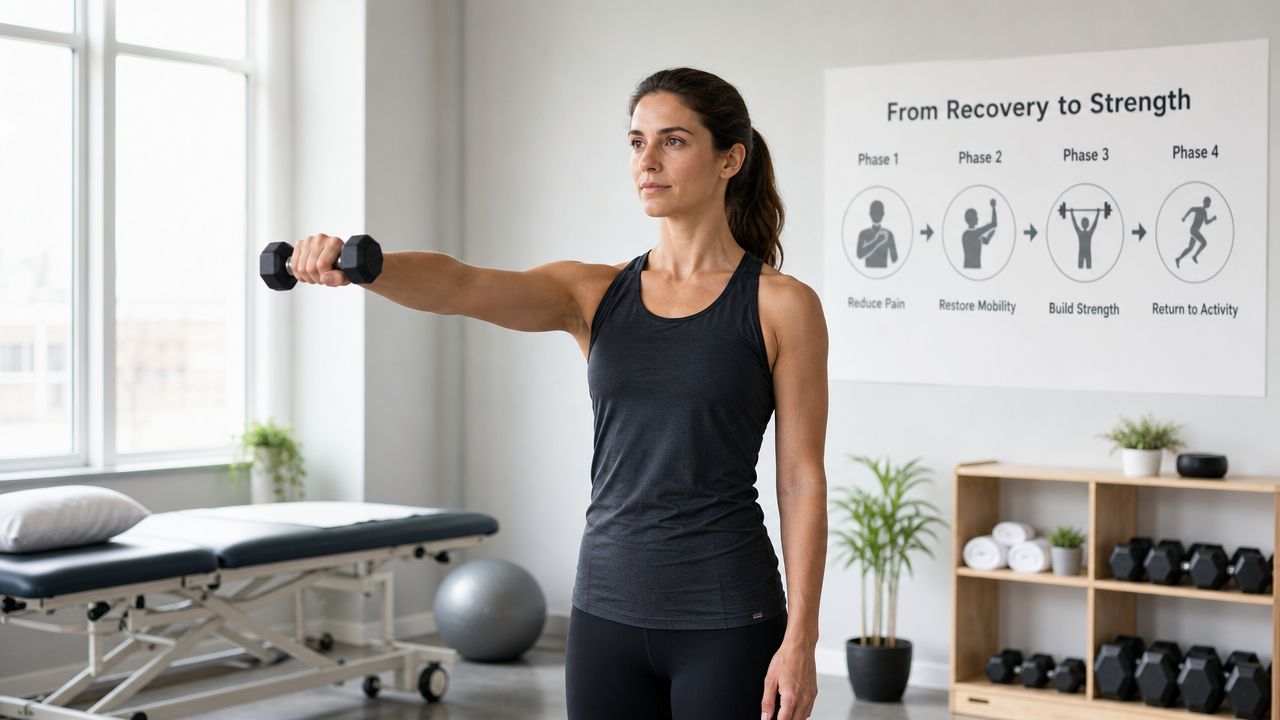
The best shoulder surgery recovery exercises change with healing stage. Early on, the goal is simple. Protect the repair, keep the joint from getting stiff, and start restoring motion without asking the shoulder to generate force it can't yet handle.
Phase 1 with passive protection
The early protocol is more precise than often understood. Pendulum exercises begin on post-op day 2 for 10 to 15 repetitions, 3 times daily. Stick-assisted forward elevation follows for 10 repetitions with a 10 to 15 second hold, 3 times per day. A key precaution is avoiding anything heavier than a cup of coffee, based on this week-by-week shoulder surgery recovery progression.
For rotator cuff repair, passive range of motion also needs to start early enough to prevent the shoulder from tightening down. The MOON immediate therapy protocol recommends passive therapy within 7 days post-op, including forward elevation, external rotation, and abduction in a comfortable range, supervised by a therapist 1 to 3 times weekly with home work on the other days, according to the University of Iowa protocol PDF.
Practical rule: Early movement should calm the shoulder down, not provoke guarding. If every rep makes you brace, the dose is wrong.
What works here is boring on purpose. Pendulums. Supine passive motion. Stick-assisted elevation. Therapist-guided movement. Not testing strength. Not “seeing what happens” with daily tasks. The win in this phase is controlled motion without irritation.
Phase 2 with active-assisted movement and early strength
Around the middle of recovery, the shoulder starts moving from being carried to contributing. At this point, active-assisted work becomes important. The recovering arm starts helping, but the non-surgical arm or a tool like a stick still shares the load.
A simple way to think about this phase:
| Focus | What it looks like |
|---|---|
| Motion quality | Active-assisted elevation and rotation with control |
| Early activation | Gentle isometrics without joint movement |
| Load tolerance | Light band work only when cleared and tolerated |
Isometrics are one of the most useful bridges in this stage because they let you create tension without moving the joint through a demanding arc. Post-surgical isometric shoulder work is commonly done by pressing into a wall or pillow, holding for 10 to 15 seconds, repeated 10 times, 3 times daily, as demonstrated in this shoulder isometric exercise reference.
That matters for athletes because tension is information. Your cuff, scapular stabilizers, and nervous system start relearning how to create force safely.
A more structured clinic-based progression also supports this. Between 7 and 12 weeks, elbow range of motion, grip strengthening, and scapula retraction may be prescribed for 30 repetitions performed three times daily. Isometric contractions are held for 5 to 15 seconds for 8 to 10 reps, typically 2 to 3 times daily. Later, strengthening often shifts to 3 to 4 times per week with 1 to 2 sets of 12 to 15 repetitions, beginning with the lightest resistance bands and progressing every 1 to 2 weeks as tolerated, according to UCSF Health's shoulder replacement exercise guidance.
That's the bridge between Rebuild and Integrate. If you want to return to lifting, rolling, or swinging with confidence, the shoulder has to prove it can handle force in context, not just in isolation. That's the same principle behind return-to-sport physical therapy for athletes rebuilding under real demand.
From Rehab to Resilient The Fortify Phase

The final phase is where most athletes either rebuild trust or stay stuck in hesitation. This is when strength work becomes more deliberate, usually with controlled bands, light weights, and movement patterns that start looking more like sport again. For many protocols, heavier strengthening doesn't show up until weeks 15 through 22, while return to usual activities often happens around six weeks and full recovery may extend up to 6 months, depending on the surgery and adherence, as summarized in the earlier shoulder rehab timeline review.
Learn the difference between threat and training
This is also where pain gets misread. Recent 2025 research shows that 42% of post-surgery patients experience mild, acceptable pain rated 2 to 3 out of 10 during therapeutic loading, and that response aligns with neuromuscular adaptation rather than re-injury, according to this discussion of shoulder rehabilitation pain during loading.
That doesn't mean all pain is fine. It means pain has to be interpreted.
- Productive discomfort: dull, brief, and settles after the session.
- Concerning pain: sharp, rising, protective, or the kind that lingers and changes your mechanics.
- Bad sign during loading: if you start shrugging, twisting, or holding your breath to finish the rep, the shoulder isn't owning the work.
Mild discomfort during the right exercise can be part of adaptation. A movement that makes you guard harder usually isn't the right dose yet.
Fortify the whole athlete
During this recovery, a stronger shoulder is built, but also a more reliable athlete is built. For some athletes, the endpoint is pressing overhead. For others, it's posting in BJJ, controlling a kettlebell overhead, or swinging hard through impact without bracing for the shoulder to fail.
That's why Fortify can't mean “you're cleared, good luck.” It means the shoulder has earned speed, force, endurance, and repeated exposure without the rest of the body having to cover for it. In a movement diagnostics model, the chain gets retested under real demand, using the same logic behind the One80 System. Not to chase symptoms, but to prove the fix holds up.
Stop Guessing and Start Building
A photocopied list of shoulder surgery recovery exercises can start the process. It can't finish it. Athletes need more than protection. They need progression, context, and a way to separate healing signals from fear signals. That's how you stop treating recovery like a fragile waiting period and start using it to rebuild trust in your body.
If your shoulder still feels like a question mark, stop guessing. Build a real plan, and pay attention to how the whole chain is carrying load. If lingering neck and shoulder tension is muddying the picture, this guide to the best exercises for neck and shoulder pain can help you understand what the shoulder may be borrowing from upstream.
If you're an active adult in Marlton, Mount Laurel, Cherry Hill, Moorestown, Haddonfield, Medford, or anywhere in South Jersey, book a Free Discovery Visit with Valhalla Performance. It's the fastest way to connect the dots, map what your body is doing, and build a plan that gets you back to training with certainty instead of hesitation.