
If you're an active adult, you’ve likely tried it all for your neck and shoulder pain: stretching, massage guns, maybe even a few generic physical therapy sessions. But the dull ache, sharp twinges during an overhead press, or the frustrating stiffness always returns. The cycle is exhausting. The reason these quick fixes fail is that they only address the symptoms, not the root cause. Temporary relief is not a long-term solution.
This isn't just about feeling better for a day; it's about getting a proper diagnosis to understand the 'why' behind your pain. Whether you're a CrossFit athlete struggling with overhead squats, a weightlifter with a nagging shoulder impingement, or a weekend warrior whose desk job is sabotaging your gym performance, the problem is often rooted in your movement patterns and muscle imbalances.
This guide provides a clear path forward. We're skipping the generic advice and diving straight into a movement-based rehabilitation plan that delivers long-term results. You'll discover the best exercises for neck and shoulder pain that are designed to dismantle the true source of your discomfort. We'll cover everything from scapular stabilization and thoracic mobility to integrated core work that builds lasting resilience.
This is your blueprint for getting back to training hard, living fully, and leaving pain behind for good.
For active adults in Marlton, Mount Laurel, Cherry Hill, Moorestown, Haddonfield, Medford, and the greater South Jersey area who are tired of the pain cycle and ready for a permanent solution, we can help you diagnose the root cause. Schedule your Free Discovery Visit today to start building a body that’s resilient and ready for any challenge.
1. Scapular Stabilization and Mobility Work
Think of your scapula, or shoulder blade, as the foundation for your arm. If the foundation is unstable, everything built on it is compromised. The scapula is the stable base upon which your arm moves. When it doesn't move correctly or lacks control, your rotator cuff and neck muscles are forced to overwork, leading to chronic pain, impingement, and injury. This is why addressing scapular function is one of the best areas to target for lasting relief from neck and shoulder pain.
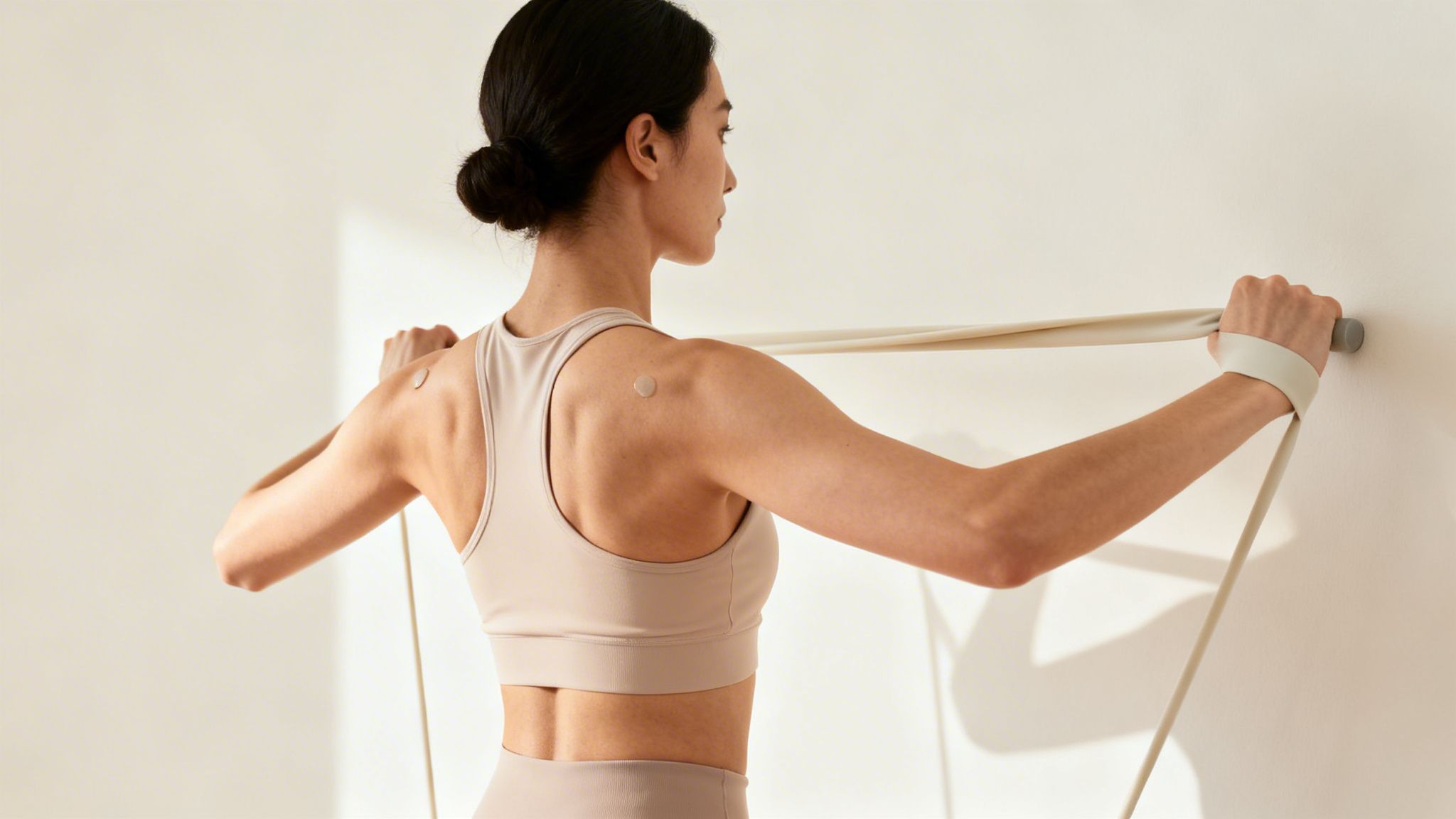
By focusing on the muscles that control the shoulder blade, like the serratus anterior and the lower/mid trapezius, you restore proper shoulder mechanics. This allows for smooth, pain-free movement whether you're pressing a barbell overhead in the gym, performing a kipping pull-up in CrossFit, or simply reaching for something on a high shelf.
How to Implement Scapular Work
Effective scapular training involves both mobility (the ability to move through a full range of motion) and stability (the ability to control that motion). Start with low-load activation drills to re-establish the mind-muscle connection before adding resistance.
Practical Examples:
- Warm-up Integration: Before your next upper body workout, perform 2 sets of 10-15 reps of Serratus Anterior Wall Slides. This wakes up the key stabilizer that helps your scapula glide correctly.
- Accessory Work: Add Prone Y-T-W's to the end of your training session. Focus on squeezing your shoulder blades together and down without shrugging your shoulders toward your ears. This builds endurance in your mid and lower traps.
- Core Integration: During a plank, practice Scapular Push-ups. Without bending your elbows, pinch your shoulder blades together and then push them apart. This teaches you to separate arm movement from scapular movement, a critical skill for any pressing exercise.
Clinician's Note: Many athletes with shoulder pain exhibit "scapular dyskinesis," an observable alteration in the normal position and motion of the scapula. This isn't just a symptom; it's a key part of the root cause. Correcting this pattern is fundamental to resolving pain and preventing re-injury.
Who Benefits Most?
This approach is crucial for anyone whose activities involve overhead movement. This includes weightlifters dealing with shoulder pinches during snatches, office workers with "tech neck," and swimmers looking to improve their stroke mechanics. If you've tried generic stretches without finding a long-term solution, addressing your scapular control could be the missing piece.
If you live in Marlton, Mount Laurel, Cherry Hill, or the surrounding South Jersey area and are tired of shoulder and neck pain holding you back, it's time to diagnose and address the root cause. Schedule a Free Discovery Visit with our team to get a clear diagnosis and a plan that puts you back in control.
2. Upper Crossed Syndrome Correction Protocol
Imagine your posture as a tug-of-war. In Upper Crossed Syndrome, a common pattern seen in desk workers and athletes alike, the chest (pectorals) and upper neck muscles are overly tight, constantly pulling forward. Meanwhile, the muscles in the back of your shoulders (lower trapezius) and the front of your neck (deep neck flexors) are weak and lengthened, losing the battle. This imbalance creates a "crossed" pattern of dysfunction, leading to forward head posture, rounded shoulders, and chronic neck and shoulder pain. Correcting this is one of the most effective strategies for finding lasting relief.
This protocol isn't about just one exercise. It's a two-pronged attack: systematically stretching the tight, overactive muscles while simultaneously strengthening the weak, inhibited ones. This restores muscular balance around the shoulder girdle and cervical spine, fixing the root cause of the pain instead of just chasing the symptoms. By correcting this pattern, you can eliminate the constant strain that leads to everything from tension headaches to shoulder impingement during a workout.
How to Implement the Correction Protocol
A successful approach requires consistency with both stretching and strengthening. The goal is to re-educate your body to hold a more neutral, efficient posture automatically. This involves targeted drills and conscious postural adjustments throughout your day.
Practical Examples:
- Daily Stretching Routine: Dedicate a few minutes each day to release tight areas. Perform a Doorway Pectoral Stretch for 30-60 seconds on each side to open up your chest. Follow this with a gentle Upper Trapezius Stretch, holding for 30 seconds to release tension in the side of your neck.
- Strengthening Program: Incorporate strengthening exercises 4-5 days a week. Add Chin Tucks to your warm-up to activate the deep neck flexors. During your workout, include exercises like Band Pull-Aparts or Prone Y-Raises to target your weak rhomboids and lower traps.
- Postural Reminders: Set an alarm on your phone for every hour. When it goes off, take 15 seconds to check your posture: pull your shoulders back and down, tuck your chin slightly, and sit or stand tall. This builds the endurance needed to maintain good posture without thinking about it.
Clinician's Note: Upper Crossed Syndrome is a direct result of sustained postures and repetitive movements. Simply stretching or getting a massage provides only temporary relief because it doesn't address the underlying weakness. Strengthening the inhibited muscles (like the serratus anterior and deep neck flexors) is what creates a permanent change in your resting posture and resolves the pain for good.
Who Benefits Most?
This protocol is a game-changer for office workers who spend hours hunched over a computer and are dealing with that nagging pain between their shoulder blades. It's also critical for athletes, such as a tennis player whose forward shoulder posture is causing a painful "hitch" in their serve, or a weightlifter who can't press overhead without their neck aching. You can learn more about how we address these nagging, chronic issues that keep you from being active.
If you live in Marlton, Mount Laurel, Cherry Hill, Moorestown, or the surrounding South Jersey area and are ready to stop chasing symptoms and finally fix the cause of your neck and shoulder pain, we can help. Schedule a Free Discovery Visit with our team to get a precise diagnosis and a plan that restores balance to your body.
3. Thoracic Spine Mobility and Extension Exercises
Imagine your spine as a chain. If one link in the middle, the thoracic spine (your mid-back), becomes stiff and locked, the links above (your neck) and next to it (your shoulders) are forced to move excessively to pick up the slack. This compensation is a primary driver of chronic neck and shoulder pain. A rigid mid-back prevents your shoulders from gliding properly and forces your neck into strained positions, especially during overhead movements like a push press. That's why restoring thoracic mobility is a cornerstone of any effective plan for the best exercises for neck and shoulder pain.

By unlocking your thoracic spine's ability to extend (arch backward) and rotate, you allow the entire upper body kinetic chain to function as designed. This takes the emergency brake off your shoulders and gives your neck a break from constant overwork, enabling smoother, stronger, and pain-free movement whether you're performing a lift, playing a sport, or simply sitting at your desk.
How to Implement Thoracic Spine Work
A successful approach progresses from passive mobility to active control. Start by using tools like a foam roller to gently encourage extension, then move to active stretches and, finally, integrated movements that build stability through the newfound range of motion.
Practical Examples:
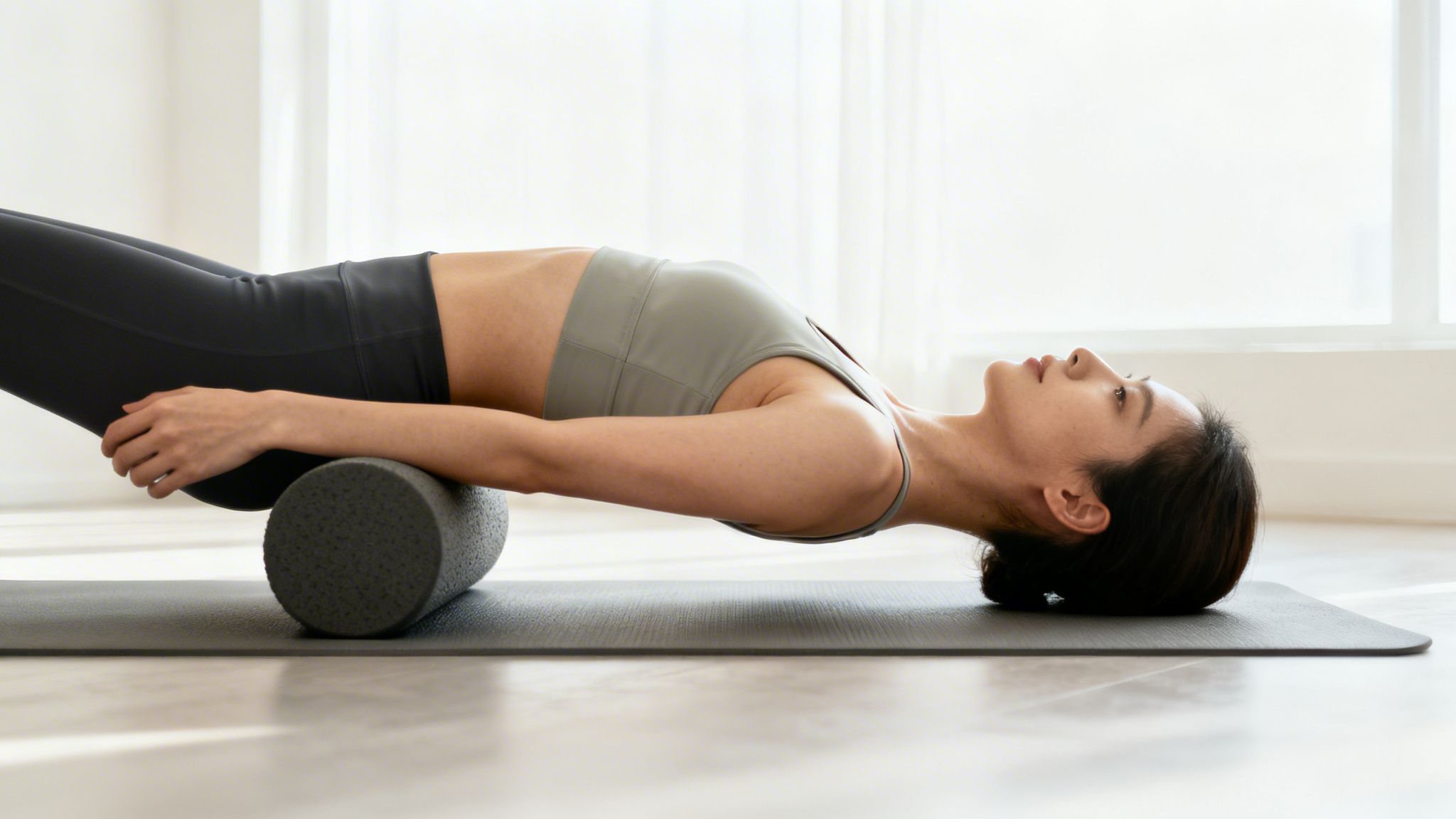
- Daily Mobilization: Begin or end your day with Thoracic Extension over a Foam Roller. Spend 2-3 minutes slowly working the roller up and down your mid-back, pausing to gently extend over it. Avoid rolling on your low back or neck.
- Pre-Workout Activation: Before training, incorporate Open Book Stretches and Cat-Cow variations into your warm-up. For the Cat-Cow, focus specifically on arching and rounding through your mid-back, not just your lumbar spine. For a more advanced warm-up, a complete dynamic stretching routine can prepare the entire body for movement.
- Strength Integration: Add the Bird-Dog with Thoracic Rotation into your core work. As you extend the opposite arm and leg, pause at the top and rotate your chest open toward the side of your raised arm. This teaches your body to control rotation and stabilize the core simultaneously.
Clinician's Note: We often see athletes who have lost throwing velocity or powerlifters who can't comfortably get under a barbell. The problem is rarely just the shoulder. More often than not, a "stuck" thoracic spine is the hidden culprit, blocking the necessary range of motion for these powerful actions. Unlocking it is a crucial step for long-term results.
Who Benefits Most?
This is non-negotiable for "desk athletes" and anyone who spends hours hunched over a computer or phone. It’s also a game-changer for rotational athletes (golfers, baseball players) and anyone performing overhead lifts like snatches or overhead presses. If your neck and shoulders always feel tight no matter how much you stretch them, the problem likely lies lower down in your thoracic spine.
If you live in Marlton, Mount Laurel, Cherry Hill, or the surrounding South Jersey area and are ready to stop chasing symptoms and fix the root cause of your pain, let's talk. Schedule a Free Discovery Visit with our team to get a clear diagnosis and a plan that restores your movement and gets you back to the activities you love.
4. Rotator Cuff Strengthening with Progressive Loading
The rotator cuff is a group of four small muscles that wrap around your shoulder joint, acting like a dynamic "cuff" to keep the head of your arm bone centered in its socket. When these muscles are weak or imbalanced, the larger muscles like your deltoids and pecs can overpower the joint, leading to instability, impingement, and chronic pain. Strengthening these stabilizers with progressive loading is fundamental for building a resilient shoulder that can handle the demands of weightlifting, sports, and life.

The key is "progressive loading." This principle means you must gradually increase the demand on the muscles over time to stimulate adaptation and build strength. For the rotator cuff, this doesn't mean grabbing the heaviest dumbbell; it means starting light, mastering the movement pattern, and then methodically increasing the challenge. This movement-based rehab approach builds true functional capacity for long-term results.
How to Implement Rotator Cuff Work
Effective rotator cuff training prioritizes perfect form and muscular endurance over heavy weight. The goal is to isolate these small muscles without compensation from larger muscle groups, like the upper traps. High-repetition sets with light resistance are often most effective.
Practical Examples:
- Daily Activation: Before activity or even during a break at your desk, perform 2-3 sets of 15-20 reps of Banded External Rotations. Keep your elbow pinned to your side and focus on rotating from the shoulder, not pulling with your arm.
- Post-Workout Finisher: At the end of your upper body day, add Side-Lying External Rotations with a very light dumbbell (1-5 lbs). This position helps minimize the involvement of the deltoid, allowing for better isolation of the rotator cuff.
- Integrated Strength: Incorporate Prone I-Y-T's on an incline bench. This exercise targets the rotator cuff and the critical scapular stabilizers simultaneously, building a more coordinated and robust shoulder complex.
Clinician's Note: A common mistake is going too heavy, too soon. This recruits larger, global muscles and defeats the purpose of the exercise. If you feel your neck or upper traps taking over, or if you have to use momentum to complete the rep, the weight is too heavy. Drop the ego and focus on quality contraction for long-term results.
Who Benefits Most?
This is non-negotiable for any overhead athlete, including CrossFitters, swimmers, baseball pitchers, and tennis players. It's also vital for weightlifters who want to protect their shoulders during bench presses and overhead lifts. Anyone experiencing that nagging, deep shoulder ache that won't go away can benefit from a systematic rotator cuff program, as it addresses a common source of joint instability.
If you're in Marlton, Mount Laurel, Cherry Hill, or the surrounding South Jersey area and are tired of guessing which exercises will finally fix your shoulder, we can help. Schedule a Free Discovery Visit with our team to get a precise plan that builds real strength and eliminates pain for good.
5. Myofascial Release and Trigger Point Therapy
Imagine your muscles are like ropes made of countless individual fibers. Over time, due to repetitive stress, poor posture, or injury, knots and adhesions can form in these ropes. These "trigger points" are hyper-irritable spots within a taut band of muscle, and they can refer pain to other areas, including your neck and shoulders. Myofascial release directly targets these restrictions, offering a powerful way to reduce pain and improve movement quality.
Unlike generic stretching, trigger point therapy provides a focused, deep pressure to break up these specific knots. This process improves blood flow, reduces tissue tension, and allows overworked muscles to finally relax. For an athlete struggling with a tight pec that pulls the shoulder forward during a bench press or an office worker with a persistent knot in their upper trap, this targeted approach can provide immediate relief and facilitate better movement, but it is not a long-term solution on its own.
How to Implement Myofascial Release
Effective self-myofascial release requires the right tools (like a lacrosse ball or foam roller) and the right technique. The goal is to apply sustained, tolerable pressure to a tender spot until you feel a release. This should be followed by corrective movement to restore normal function to the tissue.
Practical Examples:
- Pre-Workout Mobilization: Before overhead pressing, spend 60-90 seconds on each side performing a Pectoralis Minor Release. Lie face down and place a lacrosse ball between your chest and the floor, just below your collarbone. Hunt for a tender spot and then gently raise and lower your arm to work through the restriction.
- Post-Workout or Daily Maintenance: Use a lacrosse ball against a wall to perform an Upper Trapezius Trigger Point Release. Place the ball between the wall and the area where your neck meets your shoulder. Lean into it with a pressure of 5-7 out of 10 and gently nod your head or turn it side to side.
- Cool-Down Routine: After a workout, address the Levator Scapulae, a common culprit in neck stiffness. Place the ball on the upper-inside corner of your shoulder blade and lean against a wall, applying pressure while slowly turning your head away from that shoulder.
Clinician's Note: While self-release is useful, it provides temporary relief. To achieve long-term results, it must be paired with corrective exercises that address the root cause of why the trigger points formed in the first place. This is where getting a proper diagnosis and a movement-based rehab plan is critical.
Who Benefits Most?
Anyone dealing with muscle tightness, stiffness, and localized knots will benefit. This is especially true for weightlifters whose tight lats and pecs contribute to shoulder impingement and CrossFit athletes with trigger points from high-rep movements. If you feel like you have a "rock" in your shoulder that massage only temporarily helps, direct trigger point work combined with strengthening is your solution.
If you live in Marlton, Mount Laurel, Cherry Hill, or the surrounding South Jersey area and are ready to break the cycle of chronic muscle tension, let's find and eliminate the source. Schedule a Free Discovery Visit with our team for a hands-on assessment and a plan to get you moving freely again.
6. Postural Restoration and Movement Re-education
While specific exercises are excellent for building strength and control, their benefits are quickly undone if you return to faulty movement patterns for the other 23 hours of the day. Postural restoration is about changing your default settings. It’s about retraining your brain and body to find and maintain better alignment not just in the gym, but while you sit at your desk, drive your car, or stand in line at the grocery store.
Think of it this way: performing 30 minutes of corrective exercise is great, but it can’t compete with eight hours of slouched “tech neck” posture. Movement re-education takes the stability and strength you build from exercises and integrates it into daily life. This is what creates long-term results and makes the relief from neck and shoulder pain last. It addresses the root cause by fixing the very habits that created the problem.
How to Implement Postural and Movement Re-education
This process involves becoming conscious of your habits and then systematically replacing poor ones with better, more efficient mechanics. The goal is to make good posture and movement feel automatic.
Practical Examples:
- Ergonomic Audit: Adjust your workspace to promote a neutral spine. This means setting your monitor at eye level so your head isn't tilted down, and positioning your chair so your hips are slightly above your knees.
- Movement Pattern Practice: Dedicate a few minutes each day to practicing a fundamental movement correctly. For example, practice a hip hinge (like a deadlift) with a PVC pipe on your back to learn how to lift an object off the floor without straining your neck and upper back.
- Daily Posture Checks: Set an hourly reminder on your phone or watch. When it goes off, take 30 seconds to reset: sit tall, gently pull your shoulder blades back and down, and tuck your chin slightly as if holding a tennis ball.
Clinician's Note: Lasting change comes from consistency, not intensity. The most effective approach is to make small, sustainable changes to your daily environment and habits. Trying to fix everything at once is overwhelming. Pick one habit—like your desk setup—and master it before adding another.
Who Benefits Most?
This is a non-negotiable for anyone with chronic, recurring neck and shoulder pain, especially office workers and long-distance commuters. Athletes also see immense benefits, as correcting posture between sets or during rest periods can improve performance and reduce injury risk during training. If you feel like your pain always comes back no matter what, poor daily movement habits are almost certainly the culprit.
If you are tired of the cycle of pain and relief and are ready for a real solution, it's time to look beyond temporary fixes. For residents of Marlton, Mount Laurel, Cherry Hill, Moorestown, Haddonfield, and the wider South Jersey area, our team can help you identify and correct the postural habits sabotaging your progress. Schedule a Free Discovery Visit with us to create a plan for permanent relief and get back to living actively.
7. Functional Movement Integration and Sport-Specific Progressions
Isolated exercises are only the first step. True, lasting relief from neck and shoulder pain comes from bridging the gap between strengthening a muscle in a controlled setting and using it seamlessly in real life. Functional movement integration is the process of taking your newfound stability and applying it to the complex, multi-joint patterns you use every day, whether that's in your sport, at the gym, or at work.
This approach recognizes that your body doesn't operate in isolation. A baseball pitcher doesn't just use their rotator cuff; they use their legs, core, and thoracic spine in a coordinated sequence to throw a ball. Functional integration re-teaches your body how to perform these specific tasks efficiently and safely, leading to long-term results.
How to Implement Functional Progressions
The key is a systematic, goal-oriented approach. You start with the foundational strength and control you've built and gradually increase the complexity, load, and specificity of the movements until they mirror your target activity. This ensures your body adapts safely.
Practical Examples:
- For the CrossFit Athlete: After establishing solid scapular control with prone Y-T-W's, progress to Loaded Carries like farmer's walks. This challenges shoulder stability while integrating the core and hips. From there, move to performing overhead movements like push presses, but under controlled fatigue at the end of a workout to build resilience.
- For the Weightlifter: Integrate thoracic mobility gains into your lifts. After mastering mobility drills, perform Overhead Squats with a PVC pipe, focusing on maintaining a stable overhead position. Progress to an empty barbell, then slowly add weight. This layers shoulder stability onto the specific demands of weightlifting.
- For the Desk Worker: Progress from basic chin tucks and posture correction to functional endurance. Practice holding good posture while performing simulated work tasks, like reaching overhead to a high shelf or holding a light weight out in front as if carrying a laptop. This prepares the muscles for the sustained demands of the workday.
Clinician's Note: One of the most common reasons for re-injury is returning to a high-level activity too soon. An athlete might feel strong in the clinic but hasn't prepared their tissues for the chaotic, fatigue-based demands of a real game or intense workout. Progressing through functional movements under increasing stress is non-negotiable for a successful return to sport and long-term results.
Who Benefits Most?
This final step is critical for anyone whose goal is to get back to a specific high-demand activity without pain. This includes the tennis player needing to serve without a shoulder pinch, the weightlifter aiming for a new PR in the snatch, and even the parent who just wants to lift their child without a flare-up. If you've done rehab before but found the pain returned as soon as you went back to your life, you likely skipped this crucial integration phase.
If you are in Marlton, Mount Laurel, Cherry Hill, or anywhere in South Jersey and want to ensure your recovery translates to real-world performance, it's time for a plan that sees you to the finish line. Schedule a Free Discovery Visit with our team to build a complete roadmap from pain to peak performance.
8. Integrated Core and Cervical Stabilization
Treating neck pain by only focusing on the neck is like trying to fix a leaky roof by only patching one shingle, ignoring a cracked foundation. True, lasting stability in the neck doesn't come from isolated movements; it comes from its connection to the rest of the body. Your neck is the top of a kinetic chain. If the core is weak or the shoulder blades are unstable, the small muscles of your neck are forced to pick up the slack, leading to chronic strain, stiffness, and pain.
This method combines direct training of the deep cervical flexors (the "core" of your neck) with core strengthening and scapular control. By teaching the neck, shoulders, and core to work together as a single, coordinated unit, you build a resilient system that can handle the demands of a heavy deadlift, a long day at a desk, or an intense training session without breaking down. This root-cause approach creates long-term results.
How to Implement an Integrated Approach
The key is to layer exercises, starting with basic activation and progressing to complex, multi-joint movements. You are retraining your body to use the right muscles at the right time, creating a support system for your neck from the ground up.
Practical Examples:
- Foundation Building: Begin by pairing a Supine Chin Tuck with a Dead Bug. As you hold the chin tuck to activate the deep neck flexors, perform the dead bug to challenge your core stability. This teaches your brain to co-contract the neck and core stabilizers simultaneously.
- Adding Scapular Control: Progress to a quadruped (hands and knees) position. Perform an Isometric Neck Hold against band resistance while doing Bird-Dog repetitions. This forces you to maintain a neutral neck and stable shoulders while your core fights against rotation.
- Full-Body Integration: Incorporate neck and scapular alignment into your main lifts. During a Sled Push, focus on keeping your head in line with your spine and your shoulder blades packed down and back. This turns a conditioning tool into a powerful corrective exercise for posture and one of the best exercises for neck and shoulder pain.
Clinician's Note: Many athletes who fail to find relief with isolated neck stretches have an underlying stability issue elsewhere. We often see lifters whose chronic neck pain disappears once we teach them how to properly brace their core and set their lats during a squat. The neck pain wasn't the problem; it was the symptom of poor full-body mechanics. Getting a proper diagnosis is key.
Who Benefits Most?
This integrated method is essential for anyone with recurring neck pain that hasn't responded to conventional treatments. It's especially critical for athletes in sports like CrossFit, wrestling, or football where neck strength is directly tied to performance and safety. It's also the answer for office workers who find their neck and shoulder pain always comes back, because isolated stretches can't fix a weak core or poor postural endurance.
If you live in Marlton, Mount Laurel, Cherry Hill, Moorestown, Haddonfield, Medford, or the surrounding South Jersey area and are tired of solutions that only last a few hours, it's time to address the system, not just the symptom. Schedule a Free Discovery Visit with our team to see how an integrated, movement-based rehab approach can provide the long-term relief you’ve been looking for.
Neck & Shoulder Pain: 8 Exercise Approaches Compared
| Approach | Implementation complexity | Resource requirements | Expected outcomes | Ideal use cases | Key advantages |
|---|---|---|---|---|---|
| Scapular Stabilization and Mobility Work | Moderate — requires learning scapular mechanics and progression | Low — resistance bands, light weights, mirror/video feedback helpful | Improved scapular control, reduced shoulder pain, better overhead mechanics | Overhead athletes, desk workers, post-shoulder rehab | Resolves source of shoulder dysfunction; improves posture and performance |
| Upper Crossed Syndrome Correction Protocol | Moderate — needs assessment and consistent lifestyle changes | Low — stretching/strengthening tools, ergonomic adjustments | Improved posture, reduced neck/shoulder pain, fewer compensations | Desk workers, active adults with forward head/rounded shoulders | Addresses global postural imbalance with broad functional benefits |
| Thoracic Spine Mobility and Extension Exercises | Low–Moderate — technique-sensitive but straightforward progressions | Low — foam roller, band; may require manual therapy for severe restrictions | Increased thoracic extension/rotation, less cervical/shoulder compensation | Desk workers, overhead athletes, people with limited thoracic mobility | Often provides rapid relief and improves rotation and breathing mechanics |
| Rotator Cuff Strengthening with Progressive Loading | Moderate–High — requires precise activation and progressive loading | Low–Moderate — bands, light dumbbells, cables; professional guidance advised | Greater rotator cuff strength/endurance, injury prevention, improved stability | Overhead athletes, people with instability, post-injury rehab | Prevents re-injury and improves throwing/overhead performance when done correctly |
| Myofascial Release and Trigger Point Therapy | Low–Moderate — technique learning important to avoid harm | Low — foam rollers, lacrosse/massage balls; occasional professional therapy | Immediate reduction in tissue tension and improved ROM; temporary unless combined with corrective exercise | Active individuals with tightness, recovery-focused athletes, desk workers | Provides fast symptom relief and enhances effectiveness of other interventions |
| Postural Restoration and Movement Re-education | High — requires behavior change, education, and habit retraining | Low–Moderate — ergonomic changes, professional coaching, regular practice | Long-term posture/movement improvement and reduced recurrence of pain | Chronic pain sufferers, desk workers, anyone needing lasting change | Produces lasting results by changing movement habits and self-management |
| Functional Movement Integration and Sport-Specific Progressions | High — skilled programming and phased progressions required | Moderate–High — equipment, training space, clinician/coaching oversight | Return-to-sport readiness, measurable performance gains, reduced re-injury risk | Competitive/recreational athletes returning from injury or seeking performance gains | Ensures functional carryover and objective readiness for sport demands |
| Integrated Core and Cervical Stabilization | High — multidisciplinary, individualized, and closely supervised | High — professional oversight, chiropractic input, strength equipment | Comprehensive long-term pain resolution, improved performance, reduced recurrence | Athletes and active adults with persistent or recurrent neck/shoulder pain | Whole-kinetic-chain approach yielding faster, sustained results beyond isolated care |
Stop Guessing and Start Solving Your Pain in South Jersey
You've just navigated a detailed guide to the best exercises for neck and shoulder pain, moving far beyond generic stretches and into a movement-based rehab philosophy that delivers long-term results. We've explored everything from scapular stabilization and rotator cuff strengthening to the critical role of thoracic mobility and integrated core work. The common thread is clear: true recovery isn't about chasing symptoms; it's about getting an accurate diagnosis and correcting the underlying movement dysfunctions that cause them.
Simply performing these exercises in isolation, however, is like having all the right ingredients but no recipe. Real progress comes from understanding why you're doing a specific exercise, how it fits into your unique movement system, and when to progress it. This article gives you the "what," but a personalized plan from an expert provides the "how" and "why" that lead to permanent results.
From Information to Action: Your Next Steps
Putting this knowledge into practice is the most important step. Your journey out of pain starts by recognizing that your body operates as an interconnected system. The exercises and concepts covered, from correcting Upper Crossed Syndrome to integrating functional movements, all point to one central truth: a problem in your neck or shoulder is rarely just a neck or shoulder problem.
Key Insight: Your pain is a signal that something in your movement system is breaking down. The goal isn't to silence the signal with temporary fixes, but to diagnose and repair the breakdown at its source for long-term results.
Think about the weightlifter who constantly gets neck pain while doing overhead presses. The issue might not be a weak neck, but poor thoracic extension that forces the shoulders and cervical spine into a compromised position. Or consider the office worker whose chronic shoulder ache is actually driven by a weak core, creating a cascade of postural compensation up the chain. This is why a targeted, systematic approach based on a proper diagnosis is essential.
Why a Personalized Plan is Non-Negotiable
Attempting to self-diagnose and build a program from a list of exercises can be frustrating and even risky. You might focus on strengthening your rotator cuff when the real issue is scapular immobility, or you might stretch your neck when the root cause is a stiff upper back. This is the cycle of guessing that keeps so many active people in pain.
A professional diagnosis cuts through that noise. It identifies your specific movement faults and builds a precise roadmap for correction. This is where a professional, movement-based rehab approach comes into play. It’s a method that combines expert manual therapy with targeted, one-on-one strength and conditioning to not only eliminate your pain but rebuild your body to be more resilient than it was before the injury. It’s about creating a system that can handle the demands of your sport, your workouts, and your life without breaking down.
For those in South Jersey, this expert guidance is within reach. If you live or work in areas like Marlton, Mount Laurel, Cherry Hill, Moorestown, Haddonfield, or Medford, you don't have to keep struggling with the same recurring pain. You don’t have to modify every workout or give up the activities you love. It’s time to stop guessing and get a clear, actionable plan that delivers real, lasting results. Your body has an incredible capacity to heal and adapt when given the right stimulus. Let’s create that stimulus together.
Tired of the endless cycle of neck and shoulder pain holding you back? If you're an active adult in Marlton, Mount Laurel, Cherry Hill, Moorestown, Haddonfield, Medford, or the surrounding South Jersey area, it's time to get a real diagnosis and a plan for long-term results. Schedule your Free Discovery Visit to see if our movement-based approach to rehab is the right fit for you.