
Active recovery physical therapy is a movement-based approach designed for one purpose: to get you out of pain and build a body that’s more resilient than before. Unlike sitting on the couch and waiting for a miracle, this method uses intelligent, targeted, low-intensity exercise to address the root cause of your injury. It’s about creating long-term results, not just temporary relief.
Why Resting Your Injury Might Be Holding You Back

Being sidelined by an injury is a special kind of hell for anyone who loves to move. You’ve probably followed the old-school advice to ‘just rest it,’ hoping that nagging shoulder or cranky knee would finally heal. But every time you try to get back to your training, the pain flares up, sending you right back to square one.
This frustrating cycle happens because traditional rest doesn't fix the real problem. It’s a pause button, not a solution.
Imagine a CrossFit athlete who’s tried everything for their shoulder impingement—ice, rest, and weeks away from the bench press. The pain quiets down, sure, but it roars back the second they unrack a barbell. This happens because the root cause, like poor shoulder stability or faulty movement patterns learned during overhead lifts, was never actually addressed.
Moving Beyond Temporary Fixes
Passive treatments might offer a moment of relief, but they don’t build a body that can withstand your workouts. Real recovery comes from teaching your body how to move correctly and building strength where it matters. This is the heart of active recovery physical therapy.
Our philosophy is simple: intelligent, purposeful movement is the most powerful tool for healing. The goal isn't just to stop the pain; it's to find the root cause, fix it, and build a stronger, more durable body that resists future injury.
This isn't some fringe idea; it's a massive shift in how we approach rehab. The demand for effective physical therapy is exploding—the global market was valued at USD 26.31 billion in 2023 and is only getting bigger. That growth is fueled by people like you who are tired of passive treatments and want active, performance-focused care that gets real results. Explore more about the proven efficacy of rehabilitation services.
So, what’s the real difference between the active approach we use and the passive rest you’ve been told to try? Let’s break it down.
Active Recovery vs Passive Rest A Quick Comparison
This table cuts through the noise and shows you exactly how our movement-based approach stacks up against the old "rest and wait" method.
| Attribute | Active Recovery Physical Therapy | Passive Rest & Modalities |
|---|---|---|
| Approach | Uses targeted, low-intensity movement to stimulate healing and correct movement patterns. | Involves complete rest, ice, heat, or treatments where you are a passive recipient. |
| Primary Goal | To identify and fix the root cause of the injury, building long-term resilience. | To reduce immediate pain and inflammation, providing temporary symptom relief. |
| Outcome | Creates a stronger, more efficient body, reducing the risk of reinjury. | Often leads to a cycle of recurring pain once activity is resumed. |
As you can see, one method prepares you for the demands of your sport, while the other just puts a flimsy bandage on a wound.
If you are an active adult in Marlton, Mount Laurel, Cherry Hill, Moorestown, Haddonfield, Medford, or the surrounding South Jersey area and you're done with temporary fixes, it’s time for a strategy that delivers long-term results. Schedule your Free Discovery Visit at Valhalla Performance today and find out how we can get you back to what you love, stronger than before.
Your Body Isn't Broken, It Just Needs the Right Instructions
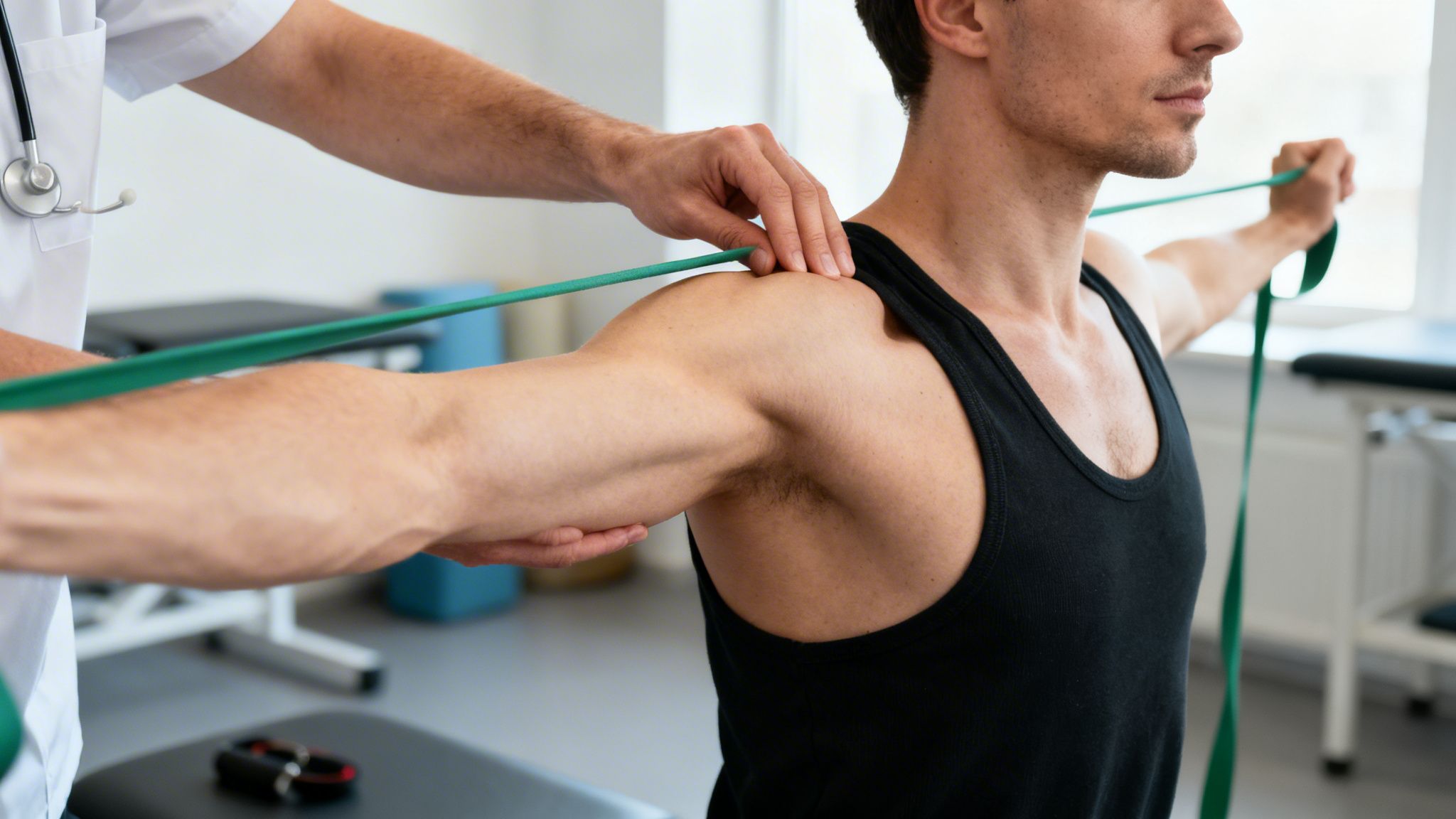
When you get injured, your first instinct—and the generic advice you’ve heard for years—is to shut everything down. Stop moving. Wrap it. Ice it. Basically, treat the painful area like it’s made of glass.
But that’s like trying to fix a traffic jam by closing the highway. You’re not helping; you’re just stopping the supply trucks from getting where they need to go.
Active recovery is the exact opposite. It’s the expert crew that shows up, redirects the flow, and gets things moving again. We use smart, low-intensity movement to jumpstart your body’s own repair system in a way that sitting on your couch simply can’t.
The magic isn't in some secret exercise. It's in the physiological process we create—on purpose.
Getting the Good Stuff In and the Bad Stuff Out
Think of your blood as the most efficient delivery service on the planet. When tissue gets damaged, it’s screaming for resources to rebuild. The right kind of movement acts like a pump, driving a fresh supply of blood directly to the injured area.
This isn’t just a trickle. It’s a strategic flood of everything your body needs to get the job done.
- Oxygen: The main fuel for cellular repair. More blood flow means more oxygen, and more oxygen means your cells can work faster.
- Nutrients: Blood delivers the proteins, vitamins, and minerals needed to reconstruct muscle, tendons, and ligaments.
- Waste Removal: That same surge of blood flow also acts as a cleanup crew, flushing out inflammatory byproducts and metabolic waste that cause pain and swelling.
This is the entire foundation of active recovery physical therapy. We’re not just chasing pain; we’re creating the perfect internal environment for your body to fix itself from the inside out.
Rewiring Your Brain to Stop Moving Poorly
Pain does more than just hurt. It rewires your brain to move poorly.
When you’re injured, your nervous system creates "protective" patterns to avoid pain. The problem is, these patterns are often sloppy and inefficient.
Think about it: your shoulder hurts when you press overhead, so you start hiking your trap and arching your back to get the weight up. You completed the lift, but you just reinforced a dysfunctional habit that’s begging for another injury.
Active recovery attacks this problem head-on. By performing precise, controlled movements, you’re re-educating your brain. You’re teaching it, rep by rep, that it’s safe to move properly again.
This is just as critical as healing the tissue itself. We’re erasing the bad software that led to the injury in the first place and rebuilding your movement from the ground up, making you a more resilient athlete. Integrating these concepts into your warm-ups is a game-changer; our guide to building a dynamic stretching routine can show you how.
If you’re an active adult in the South Jersey area—Marlton, Mount Laurel, Cherry Hill, Moorestown, Haddonfield, or Medford—and you're sick of quick fixes that don't last, let's talk. It's time to fix the real problem. Schedule your Free Discovery Visit and let's build you back stronger than before.
Is Your Physical Therapy a Permanent Fix or a Temporary Patch?
How can you tell if your physical therapy is setting you up for long-term success or just slapping a temporary patch on a deeper problem? The answer is the difference between getting back to your sport for good and finding yourself right back in a clinic six months from now with the same issue.
The line between a permanent fix and a temporary patch usually comes down to one thing: is your therapist just treating the symptom—your barking knee—or are they digging deeper to find the root cause, like weak hips or poor foot mechanics?
The PT Mill vs. Root-Cause Diagnosis
Many traditional PT clinics are high-volume operations. You get a few minutes with a therapist before you're handed off to an aide and hooked up to a machine. This approach leans heavily on passive, feel-good treatments that rarely fix the underlying issue.
- Heat packs and ice: They feel nice, but all they do is temporarily alter blood flow and nerve signals. They do nothing to fix the mechanical problem causing the pain.
- Unattended e-stim: Electrical stimulation has its place, but being tethered to a machine doesn't teach your body how to stop the faulty movement pattern that got you hurt.
- Generic exercise handouts: A one-size-fits-all sheet of exercises is a guess, not a diagnosis. It doesn’t account for your specific body, injury history, or performance goals.
This model is built for efficiency, not long-term results. It’s the definition of a temporary patch. A movement-first approach, on the other hand, starts with a comprehensive, one-on-one deep dive to find the root cause. This is the bedrock of active recovery physical therapy.
Evaluating Your Physical Therapy Plan
Are you getting a genuine, long-term solution or just a short break from the pain? This checklist will help you tell the difference.
| Checklist Item | Long-Term Solution (Active) | Temporary Fix (Passive) |
|---|---|---|
| Focus of Treatment | Addresses the root cause (e.g., hip mobility causing knee pain). | Focuses solely on the site of pain (e.g., just treating the knee). |
| Therapist Time | Spends the entire session one-on-one, coaching and correcting your movement. | Divides time between multiple patients; you spend time alone or with an aide. |
| Core Methods | Emphasizes hands-on treatment and progressive exercises to build resilience. | Relies on passive modalities like heat, ice, and unattended e-stim. |
| The Plan | Your exercise plan is highly personalized and evolves as you get stronger. | You receive a generic handout of exercises that rarely changes. |
While general PT boasts high patient satisfaction—with 79% of patients reporting significant pain reduction—those numbers don't always tell the whole story for driven athletes and active adults. For people who have tried typical PT and are still stuck, the gap between success rates of 68% to 72% in some outcomes and a full return to performance is a chasm. This is where a personalized, movement-based approach proves its worth by targeting the root cause to build true, lasting resilience. Discover more insights on what makes physical therapy effective.
If your current plan checks all the boxes in the "Temporary Fix" column, it’s time to demand more. For those in Marlton, Mount Laurel, Cherry Hill, Moorestown, Haddonfield, Medford, and South Jersey, you don’t have to settle for temporary relief.
Schedule your Free Discovery Visit at Valhalla Performance today. Let’s find the real source of your pain and build a permanent solution, so you can get back to being an athlete.
Active Recovery Plans for Lifters, Runners, and Athletes

Theory is great, but getting back under the barbell is better. The real value of active recovery physical therapy is how it solves the frustrating injuries that sideline people who love to train. "Just take it easy" isn't a solution when your entire week revolves around your next big lift or long run.
Instead of resting and hoping for the best, let's look at how we use targeted movement to fix common problems for weightlifters, runners, and CrossFit athletes. These aren't random exercises. They are strategic interventions designed to correct the mechanical failures that caused the pain in the first place.
The Weightlifter’s Impinged Shoulder
You know the feeling: that sharp, pinching pain at the front of your shoulder every time you bench press or try to snatch overhead. It’s a classic sign of impingement. Old-school advice tells you to stop pressing, but that does nothing to fix why your shoulder is protesting.
Nine times out of ten, the real culprits are weak rotator cuff muscles and poor scapular control, turning your shoulder joint into a dysfunctional mess.
Our active recovery plan attacks this by rebuilding your shoulder’s support system.
- Band Pull-Aparts: This move is a powerhouse for activating the muscles in your upper back and rear delts. Strengthening them helps pull your shoulder blades into a better position, creating more space in the joint and stopping that "pinching" of the rotator cuff.
- Light Kettlebell Carries (Bottoms-Up): Holding a light kettlebell upside down is incredibly challenging. It forces your rotator cuff to work overtime to stabilize the weight. This isn't about lifting heavy; it's about re-teaching your shoulder how to be stable under load—fixing the very instability that caused the injury.
This approach addresses the root cause, so you can get back under the bar with a stronger, more bulletproof shoulder.
The Runner's Nagging Knee Pain
"Runner's knee"—that dull, annoying ache around your kneecap—can turn every mile into misery. Slapping ice on it is just a Band-Aid. In many cases, your knee isn't the villain; it’s the victim. The real issue is often hiding upstream in weak or dormant glute muscles.
When your glutes aren't firing properly, your running form breaks down, and all that stress gets dumped right onto your knee joint.
An active recovery plan for runner's knee often starts by ignoring the knee and focusing on the hips. By building stronger glutes, you give your leg the stability it needs, taking the pressure off the knee and allowing it to track correctly.
Here’s how we do it:
- Glute Bridges: This move isolates and fires up your gluteus maximus without stressing your knees. It’s step one in reminding your brain that these powerful muscles exist.
- Banded Lateral Walks: Slap a resistance band around your ankles and shuffle sideways. You’ll feel your gluteus medius—a key hip stabilizer—light up. A strong glute med is critical for preventing your knee from caving inward when you run, a primary driver of knee pain.
Post-CrossFit Lower Back Pain
Nothing kills the post-WOD high faster than debilitating lower back pain, especially after a heavy day of deadlifts or kettlebell swings. That pain is a giant red flag that your core bracing strategy failed and your lower back took a beating it wasn't built for.
Resting might make the pain fade, but it doesn't teach you how to protect your spine during your next workout. Active recovery is all about decompressing your back and re-patterning your core engagement. Getting athletes back to peak performance is a process, and understanding the steps in a return-to-sport physical therapy program provides a clear roadmap.
- Cat-Cow: More than just a simple yoga pose, this is a tool for gently moving the spine, reducing stiffness, and improving your awareness of your spinal position. It helps decompress the discs and calms down an overactive nervous system.
- Bird-Dog with Core Bracing: The bird-dog is phenomenal for teaching true core stability. The goal is to extend your opposite arm and leg while keeping your lower back perfectly still. This drills the exact bracing pattern you need to keep your spine safe when you're lifting heavy.
In every case, the active recovery plan does more than chase pain. It finds the weak link and forges it into a source of strength. You don't just recover—you come back stronger.
If you’re an active adult in Marlton, Mount Laurel, Cherry Hill, Moorestown, Haddonfield, Medford, or South Jersey, and you’re sick of injuries controlling your training, we can help. Schedule your Free Discovery Visit at Valhalla Performance and let’s build a plan to fix the real problem for good.
The Valhalla Performance Method to Injury Recovery
If you’re an active adult, you’ve likely experienced the frustration of traditional physical therapy. You know the drill: treated like a number in a packed clinic, shuffled between an aide, a cold pack, and a generic handout of exercises that do nothing to address the real issue.
This broken model rarely gets to the heart of the problem, leaving you trapped in a miserable cycle of pain, rest, and reinjury.
At Valhalla Performance, we threw that model out. Our entire approach to active recovery physical therapy is built on one idea: you deserve a partner in your recovery, not just a passive provider. We don’t just treat your pain—we empower you with the knowledge of how your body is supposed to work so you can take back control for good.
Beyond the Symptom: A Root-Cause Diagnosis
Our process starts with a deep-dive, one-on-one assessment with a doctor of chiropractic who is also a strength and conditioning specialist. We block out this time to listen to your story, understand your goals, and—most importantly—analyze how you move.
We aren't just looking at the spot that hurts. We’re running a full-body diagnostic to find the real source of your pain. That nagging knee pain you get when you squat? It might have nothing to do with your knee. It could be coming from stiff ankles or inactive glutes that are forcing your knee into a compromised position.
Traditional therapy often just treats the screaming knee. We focus on fixing the ankle and glutes, because we know that until you correct the root cause, the pain will always come back. This is the difference between a temporary patch and a permanent solution.
An Integrated System for Lasting Results
Once we pinpoint the underlying problem, we build a progressive, goal-oriented plan that blends two powerful disciplines: precise chiropractic care and personalized strength and conditioning. This isn’t about getting a quick adjustment and being sent on your way. It’s about creating a complete environment for long-term recovery.
This integrated approach means we can:
- Restore Proper Joint Mechanics: We use targeted chiropractic adjustments to improve mobility in stiff joints that are causing movement compensations and pain elsewhere.
- Re-educate Movement Patterns: We guide you through specific exercises designed to overwrite faulty patterns your body learned to avoid pain.
- Build Foundational Strength: We progressively load your movements to build real-world strength and resilience, turning your weaknesses into strengths.
This unique combination gets you out of pain faster and builds a more durable body that can handle the demands of your sport and your life. You can learn more about how we develop these strategies by exploring our custom treatment plans that maximize recovery.
The evidence backs this up. A recent study on athletic recovery found that 63.89% of athletes successfully returned to their sport after following a structured rehab plan. Even better, the re-injury rate was a low 8.80%. This proves a proper plan doesn't just get you back in the game—it keeps you there. Learn more about the study on structured rehabilitation outcomes.
Our method is designed to end the frustrating cycle of setbacks. We are your partners in this, committed to giving you the tools and knowledge to not only recover but to come back stronger than ever.
If you are an active adult in Marlton, Mount Laurel, Cherry Hill, Moorestown, Haddonfield, Medford, or the greater South Jersey area who is ready for a real solution, it's time to experience the difference. Schedule your Free Discovery Visit at Valhalla Performance today and let's start building the plan to get you back to what you love—for good.
Take Control of Your Recovery and Get Back in the Game
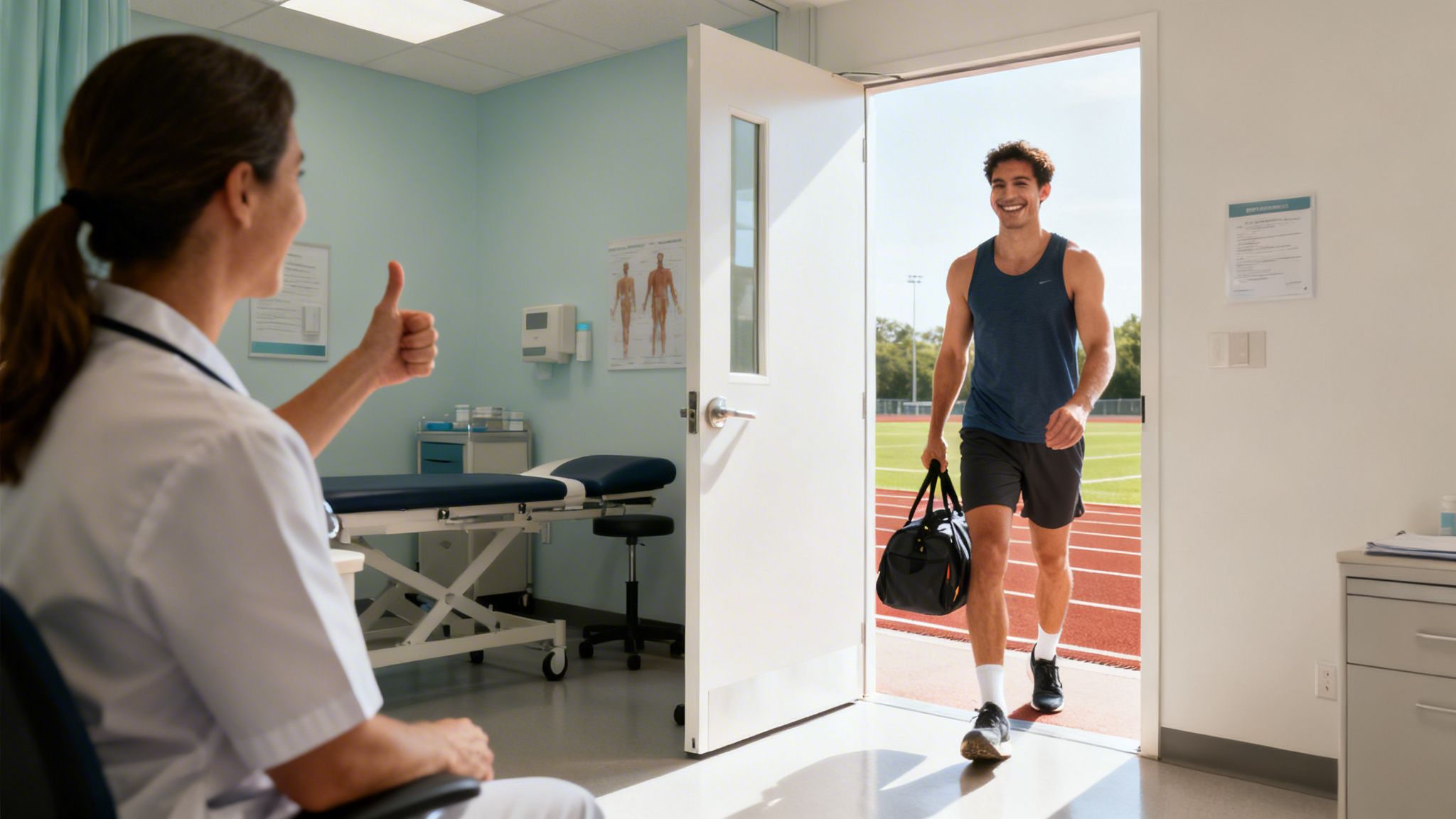
It’s time to break the cycle of getting hurt, resting, feeling a little better, and then re-injuring the same thing. If you take one thing away today, let it be this: real, lasting recovery is an active process. It’s something you do, not something that’s done to you.
For too long, motivated athletes and active adults have been sold the lie of passive rest. You rest, and months later, you’re right back where you started. That’s not a plan; it’s a holding pattern.
You don't have to settle for a temporary fix. There’s a better way—one that hunts down the root cause of your pain and builds a body that's more resilient than before. This is the entire foundation of our active recovery physical therapy philosophy. We don’t patch holes. We rebuild the fortress.
Your Path to a Permanent Fix
If you're an active adult in Marlton, Mount Laurel, Cherry Hill, Moorestown, Haddonfield, Medford, or anywhere in South Jersey, your next move is simple. Stop tolerating pain that’s keeping you out of the gym, off the field, or away from the sport you live for.
We’re here to offer a different kind of care—one where you are an active participant, not a passive patient. Stop accepting temporary relief and start building a permanent solution.
Your comeback story starts with a conversation. Schedule your Free Discovery Visit with us at our Mt. Laurel clinic. This is a no-pressure opportunity for us to figure out what’s really going on, show you the root of the problem, and determine if our movement-first approach is the right fit to get you back to 100%.
You Asked, We Answered: Active Recovery FAQs
If you’ve tried physical therapy before and left frustrated, you’re probably skeptical. We get it. You're tired of the runaround and just want to get back to your life without pain. Here are the straight answers to the questions we hear most from active adults who are ready for a real solution.
How Is This Different from the PT I Already Tried?
Most physical therapy clinics are high-volume. You get a few minutes with a therapist before being handed off to an aide or left alone with a machine. Sound familiar?
That’s not how we operate. Our active recovery physical therapy is the opposite. Every session is one-on-one, with our full attention on you. We dig deep to find the real reason you’re in pain. We combine hands-on chiropractic work with targeted strength training to fix the root cause, not just chase symptoms. The goal isn't just to stop the pain now—it's to build a body that's bulletproof against future injuries.
Should I Be Doing This If I’m in a Lot of Pain?
Great question. "Active recovery" never means pushing through sharp pain. It means using the right kind of gentle, controlled movement to tell your body it’s safe to start healing.
For someone in serious pain, active recovery might be as simple as a pain-free range-of-motion drill or a gentle muscle contraction. These movements calm your nervous system and reduce inflammation, often working better than just sitting on the couch. Our first job is to find a movement you can do without pain, and we build from there.
How Do I Fit This into My Training Schedule?
We don't give you another grueling workout to dread. We design your active recovery plan to support your actual training, not sabotage it. Think of it as a tool, not another chore.
Here’s how it fits in:
- On Rest Days: Use it to speed up healing and reduce muscle soreness.
- As a Warm-Up: Perform specific drills to prime your body for the workout ahead.
- As a Cool-Down: Use it to kickstart the recovery process immediately after you train.
We’ll show you exactly when and how to perform these movements so they directly fuel your performance.
I’ve Had This Pain for Years. Can This Still Help Me?
Absolutely. In fact, active recovery is a game-changer for chronic pain. When you've been hurting for years, your body has likely created dysfunctional movement patterns to "work around" the problem. You've trained your body to be good at moving badly.
This is where active recovery shines. We systematically unwind those bad habits. By re-teaching your body how to move correctly and strengthening the weak links you didn't even know you had, we can finally break the cycle that’s kept you in pain for years. It’s not a quick fix—it’s the real fix.
If you're an active adult in Marlton, Mount Laurel, Cherry Hill, Moorestown, Haddonfield, Medford, or anywhere in South Jersey who is fed up with being sidelined, it’s time for a different approach. Stop guessing and start fixing the real problem. Schedule your Free Discovery Visit with Valhalla Performance today by visiting https://thevalhallaperformance.com and let’s build the plan that gets you back in the game for good.